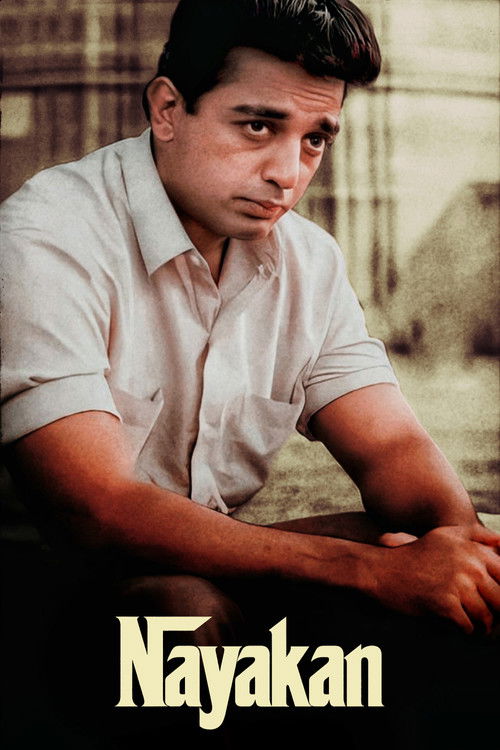
Nayakan
1987 · Mani Ratnam
For when you want a big, serious crime saga to sink into for an evening — the rise-and-reckoning kind, with family at its heart. A commitment, and worth it.
What it's about
A boy from a southern Indian village watches his father murdered, kills a corrupt policeman, and flees to Bombay's slums — where he grows into Velu Naicker, the protector-don of the city's Tamil migrant underclass. He dispenses the rough justice the state won't provide, beloved by the people he shields, even as the violence that made him starts collecting its price from his own family.
The experience
An epic that earns the word: decades of one life compressed into a film that swings from tenderness to sudden brutality, always circling the question of what a good man's power costs. It's absorbing, mournful, and builds real tragic weight.
Performances
Kamal Haasan plays Velu across roughly five decades of a single life, aging from hot-blooded young man to weathered patriarch with astonishing physical and emotional detail — it's one of the celebrated performances of Indian cinema.
The craft
Mani Ratnam brought a new photographic language to Tamil cinema here: burnished low light, lived-in slum textures, and a restraint that makes the eruptions of violence land harder. The period reconstruction of Bombay's Tamil quarter is remarkable, and it rewards a big screen.
Why it matters
A watershed for Tamil cinema and one of the defining Indian films of the 1980s — it reset what a mainstream Indian crime drama could look and feel like, and cemented both Ratnam's and Haasan's legends.
Snapshot
Nayakan ("The Hero," or more precisely "The Leader") is a Tamil-language crime epic that follows Velu Naicker from a childhood act of vengeance in a southern village to his reign as the protector-don of Bombay's Tamil migrant underclass. Directed by Mani Ratnam and anchored by Kamal Haasan in a performance spanning roughly five decades of a single life, the film reframed the gangster saga as a study of moral cost: a man who administers a rough justice the state will not, and who cannot escape the corruption that power breeds in his own house. It is widely regarded as a watershed in Tamil cinema — a film that fused a new photographic language, a restrained realism of milieu, and a genuinely tragic architecture — and it remains, by broad critical consensus, one of the defining Indian films of the 1980s.
Industry & production
Nayakan was made within the commercial Tamil film industry ("Kollywood," centered in Chennai/Madras), then a high-output popular cinema organized around star vehicles, song-and-dance interludes, and family-melodrama conventions. Mani Ratnam, still relatively early in his directing career, used the project to push that industrial form toward something closer to an auteur-driven prestige picture without abandoning its mass address. The film was produced by G. Venkateswaran under the Muktha Films banner; the standard account places it as a mainstream commercial production rather than an art-house or parallel-cinema venture, which makes its formal ambition notable — it smuggled a sober, tragic register into a popular vehicle built around one of Tamil cinema's biggest stars.
Casting Kamal Haasan, already a major draw, was central to the film's viability and to its ambition: the role demanded an actor willing to age across the runtime and to play a protagonist who is neither hero nor villain in the conventional sense. The screenplay was by Mani Ratnam; the Tamil dialogues are generally credited to the writer Balakumaran, whose spare, weighty lines contributed to the film's texture. Beyond these well-established credits, granular production detail — budget, shooting schedule, exact box-office receipts — is not something the reliable public record documents precisely, and I will not invent figures. What is secure is the film's outsized reputational return: it became a reference point far beyond its immediate commercial life.
Technology
Nayakan was shot and finished on 35mm photochemical film, the standard professional format of its moment, with an optical (analog) sound track and physical editing on a flatbed. Its technological significance lies less in novel equipment than in how conventional tools were deployed. Cinematographer P.C. Sreeram is associated with a then-emerging approach in Tamil cinema that leaned on available-light aesthetics, heavy use of bounce and diffused lighting, deep shadow, and practical or motivated sources rather than the flat, evenly keyed illumination typical of much popular Indian cinema of the period. The film's images — smoke, rain, low-wattage interiors of Dharavi, backlit silhouettes — read as an argument that the existing photochemical toolkit could yield a grittier, more sculpted look. In that sense its "technology" story is really a technique-and-craft story: the same cameras and stock everyone had, used with markedly different lighting discipline.
Technique
Cinematography
P.C. Sreeram's work on Nayakan is routinely cited as one of the most influential achievements in Indian cinematography, and the National Film Award it received (see below) reflects that standing. The visual signature is chiaroscuro: faces half-buried in shadow, single-source key light, silhouettes against doorways and rain, and a willingness to let large areas of the frame fall to black. This is a deliberate rhyme with the moral world of the story — a man operating in the gray between crime and protection — and it broke sharply from the brightly lit conventions around it. Sreeram also favors expressive staging within the frame and atmospheric density (rain, smoke, the crowded geometry of the slum) rather than decorative prettiness. The look is often, and reasonably, connected to the shadowed visual grammar of American gangster and noir cinema, adapted to a Bombay slum register.
Editing
The film was cut by the editing team of B. Lenin and V.T. Vijayan, longtime collaborators of Ratnam's in this era. The editing supports a decades-spanning chronicle: it must compress a life while preserving the emotional weight of its turning points — the father's murder, the killing of the policeman, the flight to Bombay, the deaths that accumulate around Velu, the final reckoning with his family. The cutting is generally in service of the drama's tragic momentum rather than flashy montage, and it manages the film's central formal challenge — repeated ellipses across years — so that the audience registers both the passage of time and the recurrence of the same cycle of violence.
Mise-en-scène / staging
Art direction by Thota Tharani (also a National Award recipient for the film) is fundamental to its authority. The evocation of a Bombay migrant slum — its lanes, thresholds, shrines, and cramped interiors — grounds the melodrama in a believable social world. The staging repeatedly frames Velu within his community: he is shot amid the people he protects, so that his authority reads as embedded rather than abstract. Interiors are dressed for texture and shadow rather than gloss, reinforcing the photographic strategy. The overall effect is a lived-in materiality unusual for a star vehicle of the period.
Sound
Ilaiyaraaja composed the score and songs, and his contribution is one of the film's load-bearing elements. The soundtrack — including songs such as "Thenpandi Cheemayile" and "Nee Oru Kadhal Sangeetham" — is remembered as among his finest, integrating lyrical melody with the film's melancholy. Ilaiyaraaja's underscoring works against sentimentality: rather than inflating scenes, the music often deepens their sense of loss. The songs are woven into the narrative fabric in ways that comment on Velu's world and interior life rather than functioning purely as detachable spectacle.
Performance
Kamal Haasan's Velu Naicker is the film's core and the reason it holds its tragic charge. He plays the character from young manhood into old age, and the transformation — carried by makeup, posture, voice, and a progressive dimming of vitality — is frequently named among the great performances of Indian cinema; it won him the National Film Award for Best Actor. Crucially, Haasan resists heroic grandstanding: Velu is watchful, weary, and increasingly haunted, a man whose power cannot buy him immunity from grief. The supporting performances populate the world convincingly, but the film is structurally a single-protagonist tragedy, and its emotional success rests on Haasan's calibration of authority and erosion.
Narrative & dramatic mode
The dramatic mode is tragedy in an epic frame — the rise-and-fall arc familiar from the gangster genre, but tuned toward moral irony rather than triumph. The originating wound is generational: a boy watches his father killed, kills the policeman responsible, and flees. In Bombay he is taken in and grows into a figure who dispenses protection and retribution to a community the law ignores; his criminality is inseparable from his role as guardian. The film's engine is the collision between this self-justifying benevolence and its human toll — the loved ones lost to the violence he lives by, and the moral judgment finally rendered from within his own family. The recurring question the film poses (memorably compressed into the child's query about whether Velu is a good man or a bad man) is never resolved into a comfortable answer; the drama holds the ambivalence rather than dissolving it. The structure is episodic and decades-long, but organized around a clear tragic logic: the founding act of vengeance seeds a cycle that returns, transformed, to claim him.
Genre & cycle
Nayakan belongs to the gangster / crime-saga genre, specifically the "rise of the don" cycle, and it participates in a broader Indian tradition of underworld and vigilante-protector narratives that flourished across the 1970s–80s. It sits alongside — and helped elevate — a strain of Indian crime cinema that took the mob boss as a tragic, quasi-mythic figure rather than a mere antagonist. Its relationship to the Hollywood gangster epic, and to The Godfather in particular, places it in dialogue with an international genre lineage while localizing that template to the specific social reality of Tamil migrants in Bombay. Within Tamil cinema it stands as a benchmark for the "serious" crime film, distinct from lighter masala fare.
Authorship & method
The film is a signal work of Mani Ratnam's authorship, exhibiting traits that recur across his career: a preference for morally complex protagonists, an interest in the individual caught inside larger social and political forces, and a commitment to elevated craft — image, sound, and performance treated as expressive systems rather than decoration. Ratnam's method here is collaborative in the strongest sense, and the film is inseparable from its key partners. P.C. Sreeram's cinematography supplied the shadowed visual identity; Ilaiyaraaja's score gave it emotional and cultural resonance; the editing team of B. Lenin and V.T. Vijayan structured its decades-long sweep; Thota Tharani's art direction built its credible world; and Balakumaran's dialogues shaped its verbal weight. Kamal Haasan's performance is itself a form of co-authorship, given how much of the film's meaning is carried in his aging of the character. The generative premise — a gangster modeled in part on the real Bombay figure Varadarajan Mudaliar, filtered through the tragic template of the crime epic — is the seed from which these collaborators built.
Movement / national cinema
Nayakan is a product of mainstream Tamil (South Indian) cinema, not of the parallel/art-cinema movement, yet it functions as part of a broader modernization of Indian popular film in the 1980s in which certain commercial directors absorbed art-cinema seriousness — social realism, moral ambiguity, sophisticated craft — into star-driven formats. Within Tamil cinema specifically, the film (together with Ratnam's surrounding work and Sreeram's photography) is often positioned as inaugurating a more visually and dramatically ambitious idiom. It is thus a national-cinema landmark on two axes: as a defining Tamil film and as one of the Indian films of its decade that traveled furthest in reputation.
Era / period
Made in 1987, Nayakan belongs to a late-1980s moment in Indian cinema poised between the melodramatic and vigilante modes of the 1970s–80s and the slicker, more globally aware filmmaking of the 1990s that Ratnam himself would help lead. Its narrative reaches back across earlier decades of post-Independence urban migration, using the figure of the Tamil in Bombay to register the social dislocations of that longer period. As an artifact, it captures a threshold: photochemical craft at a high point, popular form stretched toward tragic seriousness, just before the industrial and stylistic shifts of the following decade.
Themes
The film's governing theme is the ambiguity of justice outside the law — the way a community abandoned by the state produces its own protector-avenger, and the way that role is inseparable from crime. Around this cluster: the inheritance of violence across generations (the son who becomes what the killing of his father made him; the family that must in turn judge him); fatherhood and its failures, both literal and symbolic, as Velu becomes a "father" to Dharavi while losing his own children to the life he leads; migration, displacement, and belonging among the Tamil poor of Bombay; and the loneliness of power, which cannot shield its holder from grief. Underlying all of it is the film's refusal to certify its protagonist as either hero or monster — the moral question is held open as the true subject.
Reception, canon & influence
Nayakan was received as a major achievement and has only grown in stature. Its craft was recognized at the national level, with National Film Awards for Kamal Haasan (Best Actor), P.C. Sreeram (Best Cinematography), and Thota Tharani (Best Art Direction) — a distribution of honors that itself signals how completely the film's power rests on its combined craft. It was selected as India's official submission for the Academy Award for Best Foreign Language Film for its year, an indicator of its standing as a national flagship (it did not receive a nomination). Its enduring canonical marker is its inclusion in TIME magazine's "All-Time 100 Movies," where critic Richard Corliss named it among the finest films — a rare distinction for a Tamil-language work and a key reason for its international visibility.
On the backward axis of influence, the film is openly indebted to the Hollywood gangster epic and specifically to Francis Ford Coppola's The Godfather, whose rise-of-the-don architecture, family-and-crime intertwining, and shadowed visual mood it adapts. Ratnam has acknowledged this lineage while grounding the story in the biography of the real Bombay underworld figure Varadarajan Mudaliar and in the specific texture of Tamil migrant life — so the film is best understood as a localization and moral re-tuning of an international template rather than a copy.
On the forward axis, its legacy is broad. It was remade in Hindi as Dayavan (1988), directed by and starring Feroz Khan, extending its story to the North Indian market, and it circulated in dubbed/other-language versions that widened its reach. More diffusely, its photographic style — Sreeram's chiaroscuro and available-light discipline — is frequently credited with reshaping the look of subsequent Tamil cinema, and the film became a template for the "serious" crime saga in South Indian filmmaking. It also consolidated the Mani Ratnam–Ilaiyaraaja–Sreeram creative axis as a marker of prestige. For Kamal Haasan it stands among his career-defining roles, repeatedly cited in surveys of the greatest performances in Indian cinema. In sum, Nayakan functions as a hinge: it drew a global genre inward, remade it in a specifically Tamil moral and social key, and pushed the surrounding industry toward higher craft — its influence legible both in direct remakes and in the elevated standard it set for the films that followed.
A Deleuzian reading
A man stands in a doorway with rain behind him, and half his face has gone to black.
The full Deleuzian reading of Nayakan →
Reception
A critical and commercial triumph on release in 1987, it steadily climbed from Tamil-cinema landmark to global canon — capped when Time magazine put it on its All-Time 100 Movies list in 2005, making it a first-stop Indian film for world cinephiles.
How Nayakan was received, from release to now →
How to watch Nayakan: what to notice on a first viewing
- Watch half of Velu's face stay in shadow. Sreeram lights him with a single source and lets the rest of the frame fall to black, again and again, rather than keying him flat and fully lit like a typical star. The lighting tells you upfront that you will never see the whole of this man.
- Watch where Velu stands relative to the crowd around him. Ratnam keeps shooting him inside the lanes and doorways of the neighborhood he protects, among the people rather than above them on a pedestal. His authority reads as something the neighborhood grew, not a status he simply holds.
- Listen for music that deepens loss instead of swelling it. Ilaiyaraaja's songs and underscoring work against sentimentality, staying restrained in scenes where a Hollywood score would push harder for tears. The music trusts the story's sadness instead of trying to amplify it for you.
- Watch how Velu's posture changes as the decades pass. Haasan ages the character through voice, makeup, and above all a slow dimming of vitality in how he carries himself, rather than through obvious markers of time passing. You can read the years directly off his spine instead of being told a date.
- Notice how often someone asks if Velu is good. The film keeps returning to the same unresolved question about him from different characters, at different points in his life, without ever supplying a clean answer. The question stays open on purpose instead of being resolved into a verdict.
The whole guide to watching Nayakan, with the keys for a rewatch →
Influences: the films it descends from and the films it influenced
- The Godfather (1972) — Supplies the rise-of-the-don architecture and Gordon Willis's top-lit, deliberately underexposed chiaroscuro that Sreeram localizes — faces sinking into shadow at moments of moral compromise.
- The Godfather Part II (1974) — Models the immigrant-origin crime saga tracked across decades and the actor's slow physical aging into patriarchal stillness that Kamal Haasan echoes as co-authorship of the role.
- Once Upon a Time in America (1984) — Prefigures the elegiac, decades-spanning gangster memory built through large elliptical time jumps rather than continuous plot — the ellipsis/time-compression editing B. Lenin and V.T. Vijayan deploy.
- Deewaar (1975) — Establishes the Indian template of a dockside working-class man radicalized into a smuggler-don modeled on a real Bombay underworld figure, dramatizing justice-outside-the-law as tragic inheritance.
- Mother India (1957) — Bequeaths the tragic-epic moral frame in which a parent must destroy their own child to uphold a code — the structural engine of Nayakan's climactic reckoning.
- The Battle of Algiers (1966) — Pioneers the available-light, newsreel-grained, community-embedded framing of a poor quarter as a living milieu — the documentary discipline behind Sreeram's slum realism.
- Raging Bull (1980) — Sets the benchmark of an actor treating physical aging and bodily decline as the film's central expressive system — the performance method Kamal Haasan adapts across the character's decades.
- Pather Panchali (1955) — Establishes the Indian neorealist grammar of natural-light interiors and poverty rendered as textured, lived space rather than backdrop — the realist lineage Sreeram's photography inherits.
- Dayavan (1988) — Direct Hindi remake that transposes Nayakan's shot architecture and don-rise structure to the North Indian market, extending the same script and staging beats.
- Thalapathi (1991) — Ratnam's own reprise of the elevated crime epic — a Karna-myth don saga treating image, Ilaiyaraaja score, and morally-caught protagonist as the same integrated authorship system.
- Satya (1998) — Extends Nayakan's grounding of the gangster in credible migrant-city texture and available-light realism, replacing melodrama with the embedded-milieu observation Nayakan pioneered.
- Sarkar (2005) — Explicitly reworks the Godfather-through-an-Indian-don template that Nayakan first localized, inheriting its shadowed patriarch iconography and justice-outside-the-law authority.
- Vada Chennai (2018) — Carries forward the decades-spanning Tamil gangster epic built on North-Madras community realism and episodic time-compression, the serious crime-saga standard Nayakan set.
- Aaranya Kaandam (2011) — Descends from Nayakan's proof that Tamil cinema could sustain a craft-forward, chiaroscuro-lit crime film, pushing its noir photography toward stylized neo-noir.
- Kaala (2018) — Directly echoes the Tamil-migrant don embedded in a Bombay slum, using community-embedded framing of Dharavi as a collective protagonist in the way Nayakan framed its settlement.
- Gangs of Wasseypur (2012) — Scales up the multi-decade Indian gangster-dynasty saga with elliptical generational leaps and inheritance-of-violence structure that Nayakan established as viable in Indian idiom.
- Soorarai Pottru (2020) — The Tamil social-hero-against-the-system whose dignity-of-the-little-man moral center Kongara absorbed through her Ratnam-orbit training and rebuilt as Maara's class grievance.
- Pudhupettai (2006) — Established the Tamil slum-to-don epic with PC Sreeram's low-key chiaroscuro underworld imagery, the exact chiaroscuro grammar Pudhupettai inherits while inverting Nayakan's mournful dignity into moral ugliness.
- Vikram Vedha (2017) — Established the sympathetic Tamil don as a moral-gray protagonist adapted from the Godfather template, the anti-hero register Vijay Sethupathi's Vedha directly extends.
- Hey Ram (2000) — Kamal Haasan's earlier decades-spanning prosthetic-aging performance set to an Ilaiyaraaja score, establishing the star-vehicle-as-serious-art collaboration Hey Ram inherits wholesale.
- Kireedam (1989) — Contemporaneous Indian popular-tragedy structure: a sympathetic man's slide into violence traced with tragic irony so the audience mourns rather than condemns him.
Similar films
- Vada Chennai (2018) — influence & lineage · same viewing thread
- Aaranya Kaandam (2011) — influence & lineage · same viewing thread
- Thalapathi (1991) — influence & lineage
- Satya (1998) — influence & lineage
- Mahanadhi (1994) — same viewing thread
- Pudhupettai (2006) — same viewing thread
- Asuran (2019) — same viewing thread
- Vikram Vedha (2017) — same viewing thread
All the films related to Nayakan →
Watch it with: curated runs of related films
- Blood Feuds and Broken Men — A run of Indian films about ordinary men swallowed by violence, vendetta, and moral compromise — watch these together when you want fate, murky righteousness, and gunpowder sharing the same frame.