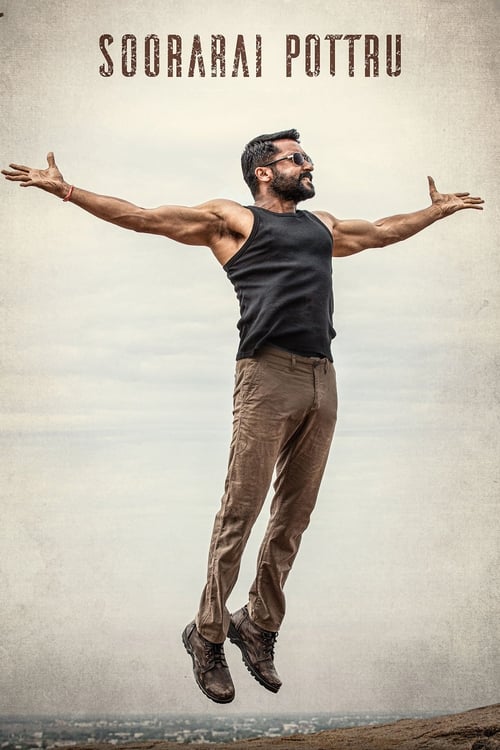
Soorarai Pottru
2020 · Sudha Kongara Prasad
For when you need an inspiration hit — the kind of film you reach for when your own ambitions feel heavy and you want proof that stubbornness can move mountains. Feel-good, but with real fire in it.
What it's about
Maara, an ex-military man from rural Tamil Nadu, sets out on a seemingly impossible mission: to start a low-cost airline so ordinary people can afford to fly. Inspired by the true story of Air Deccan founder G. R. Gopinath, the film follows him against entrenched aviation gatekeepers, hostile financiers, and an industry built to keep the common man on the ground.
The experience
A rousing, big-hearted underdog drama that runs on righteous anger and sheer momentum — every setback stings and every small victory feels like a festival. It's emotional filmmaking with the throttle open, and it makes you want to stand up and cheer.
Performances
Suriya gives a career-defining performance as Maara, all coiled fury and wounded pride, a turn honored at India's National Film Awards.
The craft
Sudha Kongara grounds a star vehicle in lived class detail — the village, the money troubles, the marriage of equals at its center — so the triumphs land as earned rather than manufactured. The flying sequences and driving score reward a big screen and loud speakers.
Why it matters
One of the first major Tamil star vehicles to skip theaters entirely for streaming during the pandemic, it vindicated the gamble by sweeping India's National Film Awards, including Best Feature Film, and spawned a Hindi remake.
Snapshot
Soorarai Pottru ("Praise the Brave," a phrase drawn from Tamil Sangam-era martial poetry) is a Tamil-language drama built around the true story of Captain G. R. Gopinath, the ex-army officer turned entrepreneur who founded the low-cost carrier Air Deccan and, in doing so, broke open Indian aviation to the ordinary traveler. Directed by Sudha Kongara and headlined by Suriya, who also co-produced through his 2D Entertainment banner, the film adapts Gopinath's memoir Simply Fly: A Deccan Odyssey. It premiered directly on Amazon Prime Video in November 2020 after the COVID-19 pandemic shuttered theaters — one of the first major Tamil star vehicles to bypass a theatrical release entirely. The gamble was vindicated critically and institutionally: at the 68th National Film Awards, Soorarai Pottru was named Best Feature Film, with further honors for Suriya (Best Actor, shared with Ajay Devgn), Aparna Balamurali (Best Actress), G. V. Prakash Kumar (Best Music Direction), and its screenplay. It stands as both a populist star vehicle and a rare Indian entrepreneurial biopic that keeps class grievance, not aspiration alone, at its center.
Industry & production
The film sits at the intersection of Tamil commercial cinema's star system and a newer, producer-driven prestige model. Suriya, one of the most bankable leads in Tamil cinema across the 2000s and 2010s, took the project as both actor and producer, lending it the muscle of a top-tier star vehicle while its subject matter — an underdog's fight against an entrenched aviation cartel — aligned with his on-screen persona of the aggrieved common man. Co-production came from Guneet Monga's Sikhya Entertainment, a banner associated with independent and internationally minded Indian cinema, signaling the film's ambition beyond the regional market.
Its distribution history is inseparable from the pandemic. With theaters closed through much of 2020, the producers sold the film to Amazon Prime Video for a direct-to-streaming premiere on 12 November 2020, and it was released with dubbed versions to widen reach. This made it a bellwether for the accelerating shift toward OTT platforms in Indian cinema — a star-driven, big-budget release that reached audiences at home rather than in cinemas. The film was later remade in Hindi by Kongara herself as Sarfira (2024), with Akshay Kumar in the lead, a fairly unusual instance of a director re-directing her own work across industries. Specific budget and revenue figures for the original are not reliably documented in a form I can cite with confidence, so I will not assert them.
Technology
The production is a conventional digital feature of its period, shot on modern digital cinema cameras and finished through a standard digital-intermediate pipeline; I have no verified record of the specific camera bodies or lenses to cite. Where the film's craft is genuinely notable on the technology axis is in its recreation of civil-aviation environments on a Tamil-cinema budget: airport interiors, aircraft cabins and cockpits, tarmac operations, and the machinery of a startup airline. These sequences lean on a combination of built sets, practical locations, and visual-effects augmentation for aircraft and scale, executed to be persuasive without the resources of a Hollywood aviation picture. The film's most consequential "technology," however, is thematic rather than production-side — it dramatizes a real technological-commercial disruption (the low-cost carrier model) and treats the airplane less as spectacle than as an emblem of access denied to the poor.
Technique
Cinematography
Niketh Bommireddy's photography favours an intimate, kinetic register over glossy composition. Much of the film is handled with mobile, close-in camerawork that stays pressed to Suriya's face during confrontation and humiliation, so that the drama reads as bodily and immediate rather than iconographic. The palette shifts with milieu — earthy, warm tones in the Madurai-rooted family and small-business scenes, cooler and more clinical light in the corporate and airport spaces that Maara is fighting to enter. Crowd and confrontation sequences are staged with a documentary looseness that suits the populist material, while the aviation set-pieces are photographed to convey aspiration and scale at the emotional peaks.
Editing
Sathish Suriya's cutting organizes a life-story that spans years without collapsing into montage-biopic tedium. The screenplay uses a framing device and non-linear returns rather than strict chronology, and the editing threads the timeline so that the emotional stakes — the family, the marriage, the recurring humiliations — accumulate across the runtime. The rhythm alternates between long emotional-dialogue holds and compressed, propulsive passages covering the mechanics of building an airline, keeping a fundamentally procedural story (financing, licenses, adversaries) dramatically buoyant.
Mise-en-scène / staging
The film's production design draws a hard visual line between two Indias: the working-class, agrarian and small-town world Maara comes from, and the marble-and-glass world of aviation capital he is trying to breach. That contrast is the film's central staging idea — costume, location, and décor consistently mark who belongs where, so that Maara's every entry into an elite space registers as trespass. The domestic scenes are dense with lived-in texture, particularly around Bommi's bakery-entrepreneur subplot, which grounds the marriage in shared ambition rather than decoration.
Sound
G. V. Prakash Kumar's contribution extends from song to score, and the soundscape is a major carrier of the film's emotion. The songs are integrated as expressive beats — aspiration, romance, grief — rather than detachable interludes, and the score drives the film's rousing crescendos. Sound design in the aviation and crowd sequences works to sell scale and immersion. The film's music direction was singled out at the National Film Awards, an unusually strong institutional endorsement of the score's role in the drama.
Performance
Suriya's Maara is a performance of controlled fury — a man perpetually one insult away from violence, whose rage is legible as class humiliation rather than mere hot-headedness. He plays the character across a wide age and status range, from hot-blooded youth to weathered founder, and the National Film Award for Best Actor reflects the consensus that this was among his finest turns. Aparna Balamurali, as Bommi, delivers the film's other award-winning performance: her character is written as a partner and businesswoman with her own ambitions and temper, and Balamurali refuses to soften her into a supportive appendage. Paresh Rawal, as the aviation magnate who embodies the industry's contempt for the common flyer, gives the antagonism a smooth, institutional coldness that suits the film's class politics.
Narrative & dramatic mode
The film operates in the mode of the inspirational biopic, but it is structured as a grievance narrative more than a success story. Its most important scene is an origin wound: Maara's inability to reach his dying father in time because air travel is priced beyond the reach of people like him. That injustice, not entrepreneurial appetite, becomes the engine of the plot — the dream of "making the common man fly" is framed as redress. Around this spine the screenplay (by Kongara with Shalini Ushadevi) builds a two-front drama: the external fight against a hostile industry, regulators, and financiers, and the internal, domestic front of a marriage between two strong-willed people. The film uses a non-linear structure and a framing device to open, then loops back through the chronology, allowing setbacks and reversals to land with cumulative weight. Its dramatic mode is unapologetically emotional and confrontational, punctuated by rousing set-pieces, in the tradition of Tamil mass cinema — but the "mass" hero beats are motivated by social wrong rather than pure spectacle.
Genre & cycle
Soorarai Pottru belongs to the underdog/entrepreneur biopic, a genre that gained momentum across Indian cinema in the 2010s as filmmakers increasingly mined real lives of reformers, athletes, and business disruptors. Within that cycle it is distinctive for keeping its politics populist rather than aspirational-capitalist: where many startup narratives celebrate wealth creation, this one frames business as a weapon against a rigged class order. It also sits squarely inside the Tamil "mass hero with a cause" tradition, in which a star channels collective resentment against elites — a lineage that runs deep in Tamil cinema's social-message filmmaking. The blend of that regional populism with the globally legible biopic form is the film's genre signature.
Authorship & method
Sudha Kongara is a director whose career bridges Tamil and Hindi cinema and who trained in the orbit of Mani Ratnam's productions. Her breakthrough as a director came with the boxing drama Irudhi Suttru (2016), simultaneously made in Hindi as Saala Khadoos, which established her interest in stubborn underdogs, combustible mentor/partner dynamics, and sports-or-struggle structures — all of which recur here. Her method with Soorarai Pottru was one of loose adaptation: she took Gopinath's memoir Simply Fly as a foundation and fictionalized freely, changing names and reshaping events into a dramatized composite, so the film should be read as inspired-by rather than documentary.
Her key collaborators form a coherent authorial unit. Cinematographer Niketh Bommireddy supplies the intimate, mobile visual grammar; editor Sathish Suriya shapes the non-linear time-scheme; and composer G. V. Prakash Kumar — himself a prominent Tamil music director and actor — provides songs and score that were judged the year's best at the national level. The screenplay credit shared between Kongara and Shalini Ushadevi underscores a co-writing method, and Suriya's role as star-producer means the film also carries the imprint of an actor shaping a vehicle to his established screen politics.
Movement / national cinema
The film is a product of Tamil (Kollywood) cinema, one of the largest and most self-consciously political of India's regional film industries. Tamil cinema has a long history of fusing star charisma with social messaging — from Dravidian-movement-era message pictures to contemporary caste- and class-conscious commercial films — and Soorarai Pottru extends that tradition into the entrepreneurial biopic. At the same time, its Sikhya co-production, its pan-Indian dubbed releases, and its Hindi remake position it within a broader movement of the late 2010s and early 2020s in which regional Indian cinema increasingly aimed at and reached national and diasporic audiences, aided by streaming platforms that dissolved the old theatrical boundaries between language markets.
Era / period
The film is a document of a very specific industrial moment: the pandemic pivot to streaming. As a marquee star vehicle released directly on Amazon Prime Video in late 2020, it belongs to the small cohort of high-profile Indian films that abandoned theatrical release during COVID-19 and, in doing so, helped normalize OTT premieres for big-budget regional cinema. Its subject is also period-bound in a second sense — it looks back to the deregulation-era liberalization of Indian civil aviation in the early 2000s, when low-cost carriers transformed who could fly, and reads that history through a contemporary lens of inequality and access.
Themes
The dominant theme is class and access: the airplane stands for everything the poor are structurally kept from, and the plot is a sustained argument that ordinary people are owed a share of the modern world's mobility. Dignity is the emotional currency — Maara's humiliations, and his refusal to accept them, drive nearly every major scene. A second, unusually well-developed theme is partnership: the marriage of Maara and Bommi is written as a union of two entrepreneurs, and the film insists on Bommi's parallel ambition rather than subordinating her to her husband's dream. Grief and family duty supply the origin wound and recur as motivation. Underpinning all of it is a critique of entrenched capital — the incumbent airline magnate embodies an industry that treats exclusion as natural — set against a vision of business reimagined as social justice.
Reception, canon & influence
Critically, the film was widely praised on release, with particular acclaim for Suriya's and Aparna Balamurali's performances, Kongara's direction, and G. V. Prakash Kumar's music; its emotional force and its unusually pointed class politics were recurring notes in that reception. The decisive canonization came institutionally at the 68th National Film Awards, where it took Best Feature Film alongside acting honors for both leads, Best Music Direction, and a screenplay award — a sweep that placed it firmly among the most celebrated Indian films of its year. (Precise citation of every individual award category and any international festival selections should be checked against the official record; I am confident of the major wins named here but will not embellish the full list from memory.)
Looking backward, the film's influences are twofold: the real history of Air Deccan and Gopinath's memoir on the content side, and, on the craft side, the underdog-drama template Kongara had already honed in Irudhi Suttru, itself part of a longer Indian lineage of sports-and-struggle inspirational cinema and of Tamil cinema's social-hero tradition. Looking forward, its most concrete legacy is the 2024 Hindi remake Sarfira, directed again by Kongara with Akshay Kumar — a rare author-driven cross-industry recreation. More broadly, its critical and awards success reinforced two trends of its moment: the viability of the regional-language entrepreneurial biopic aimed at a national audience, and the legitimacy of the direct-to-streaming premiere for major star vehicles. Its lasting reputation rests on having proven that a populist, star-fronted commercial film could carry a genuinely oppositional class politics and be honored as the year's best.
Reception
Denied a theatrical run by COVID, it went straight to Amazon Prime in Diwali 2020 — then swept five National Awards including Best Feature Film, turning a lockdown OTT release into an instant modern Tamil classic and the proof-of-concept that a streaming-only film could be event cinema.
How Soorarai Pottru was received, from release to now →
How to watch Soorarai Pottru: what to notice on a first viewing
- Watch the camera stay pressed to Maara's face when he's insulted. Bommireddy holds close on Suriya during confrontation and humiliation scenes, so the drama reads as something happening in the body, not just the plot. His anger looks like something earned by history, not just written on the page.
- Notice the light turn cold once Maara enters corporate spaces. The film shoots the Madurai family world in earthy, warm tones and switches to clinical, cooler light in the airport and boardroom scenes he's trying to break into. You can feel which world belongs to him and which one doesn't, before anyone says it.
- Notice how costume marks who belongs in each room. Marble-and-glass aviation offices are staged against working-class, small-town textures, and clothing and decor consistently signal who's a trespasser in which space. Every time Maara walks into an elite room, the film has already told you he doesn't belong there.
- Listen for songs arriving inside scenes of ambition or grief. G. V. Prakash Kumar's songs are woven into the story's emotional beats rather than dropped in as separate musical interludes. The music carries feeling the dialogue doesn't stop to spell out.
- Watch Bommi argue business, not just support Maara's dream. Aparna Balamurali plays Bommi with her own temper and her own bakery ambitions, refusing scenes that would reduce her to a purely supportive spouse. The marriage reads as two entrepreneurs, not one dreamer and one helper.
The whole guide to watching Soorarai Pottru, with the keys for a rewatch →
Influences: the films it descends from and the films it influenced
- Irudhi Suttru (2016) — Kongara's own template: the combustible mentor/partner two-hander and the sports-struggle escalation structure — training-as-procedure building to a public contest — ported wholesale into Soorarai Pottru.
- Guru (2007) — The establishment-defying entrepreneur epic that legitimized the star-fronted business biopic in Tamil cinema, telling a rise-against-the-gatekeepers arc through integrated songs rather than montage alone.
- Nayakan (1987) — The Tamil social-hero-against-the-system whose dignity-of-the-little-man moral center Kongara absorbed through her Ratnam-orbit training and rebuilt as Maara's class grievance.
- Slumdog Millionaire (2008) — A present-tense interrogation/grievance frame that unlocks a life in non-linear flashback, staged against a two-Indias class divide — the exact narrative scaffolding of Soorarai Pottru's opening.
- Swades (2004) — The reformist hero confronting entrenched rural inequity, with songs woven directly into a systems-change arc rather than deployed as spectacle interludes.
- Rocky (1976) — The foundational inspirational-underdog rhythm — setback, drilled preparation, buoyant forward motion — that Kongara's 'procedural buoyancy' editing directly descends from.
- The Aviator (2004) — The obsessive aviation-founder biopic: period airline recreation and a protagonist whose fixation collides head-on with an entrenched industry cartel.
- Sarfira (2024) — An author-driven cross-industry recreation: Kongara reshooting essentially her own screenplay in Hindi with a new star, a rare same-director remake preserving the grievance-structure and partnership beats.
- Jai Bhim (2021) — A Suriya star-producer vehicle carrying pointed oppositional class/caste politics into a direct-to-OTT premiere — extending Soorarai Pottru's proof that a populist star film can be genuinely adversarial to the system.
- The Founder (2016) — An entrepreneur biopic built on the mechanics of systems-building and the ugly economics of scaling a populist, mass-access product against incumbents.
- Steve Jobs (2015) — A non-linear founder portrait organized around a series of high-friction confrontations rather than chronological milestones, prioritizing combustible relationships over timeline.
- Kaaka Muttai (2015) — Two-Indias contrast staging in which the poor are visually and physically locked out of an aspirational consumer object — the same class-and-access framing as Maara's fare-for-the-common-man crusade.
- Sarpatta Parambarai (2021) — A Tamil underdog-fighter procedural whose training-and-bout momentum and class-politics undertow parallel Kongara's method, arriving via the same OTT-premiere moment.
- Karnan (2021) — A Tamil populist film that makes denial-of-access (a village with no bus stop) the literal narrative engine, driving dignity-and-class grievance the way Soorarai Pottru drives affordable flight.
- Rocketry: The Nambi Effect (2022) — An Indian aerospace real-figure biopic staging one obsessive technologist against an institutional establishment, with detailed technical/period recreation of flight hardware.
- Ford v Ferrari (2019) — An underdog engineering-and-machines drama pitting hands-on builders against corporate gatekeeping, using the physical craft of the vehicle as the emotional stakes.
Similar films
- Sarpatta Parambarai (2021) — influence & lineage
- Jai Bhim (2021) — influence & lineage
- Nayakan (1987) — influence & lineage
- RRR (2022) — shared sensibility
- Vaaranam Aayiram (2008) — shared sensibility
- Iruvar (1997) — shared sensibility
- Aadukalam (2011) — shared sensibility
- Velaiyilla Pattathari (2014) — shared sensibility