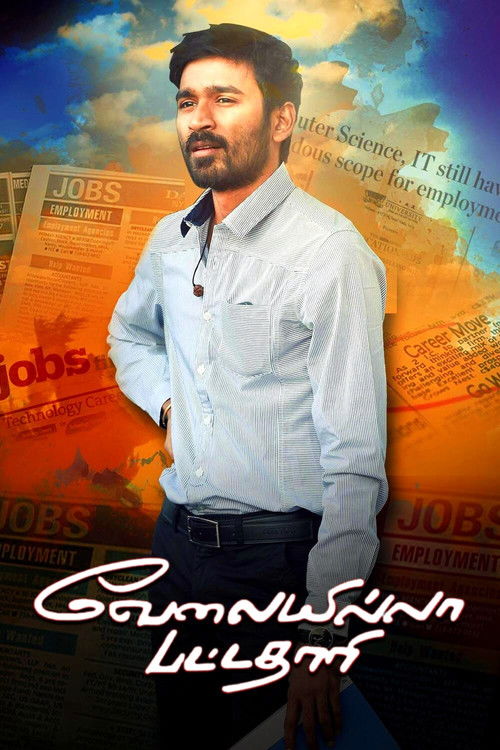
Velaiyilla Pattathari
2014 · R. Velraj
For when you need a pick-me-up — the movie equivalent of someone telling you your setbacks don't define you. Great for a feel-good night, especially if you've ever slogged through a job hunt.
What it's about
Raghuvaran is a civil engineering graduate who has been unemployed for years, enduring rejection letters, a disappointed father, and the small daily humiliations of being the family's 'failure.' When he finally lands the job he's dreamed of, a wealthy, ruthless corporate rival sets out to crush him — and the underdog decides to fight back with the only capital he has: stubbornness, skill, and self-respect.
The experience
A crowd-pleaser through and through — it moves from wry, relatable comedy about jobless life at home to fist-pumping underdog defiance, with songs and mass-hero moments built to be cheered. Warm-hearted even when it swings big.
Performances
Dhanush carries it with easy, self-deprecating charm — he wrote the story and dialogue himself, and he plays educated unemployment with an authenticity that made Raghuvaran a folk hero for a generation of Tamil graduates before shifting credibly into swagger.
The craft
Directed by R. Velraj, a working cinematographer making his debut, the film keeps its underdog fable grounded in recognizable middle-class textures — the household scenes are its secret weapon. The soundtrack is a huge part of the package, with anthems that became rallying cries well beyond the film.
Why it matters
A major commercial hit that consolidated Dhanush's stardom, spoke directly to Tamil Nadu's educated-unemployed youth, and spawned a sequel; its title acronym 'VIP' entered everyday slang.
Snapshot
Velaiyilla Pattathari — the title translates roughly as "the unemployed graduate," and the film is universally known by its acronym VIP — is a 2014 Tamil-language drama-comedy directed by R. Velraj and headlined by Dhanush, who also wrote its story, screenplay, and dialogue. It follows Raghuvaran, an idealistic civil-engineering graduate who has been jobless for years and lives under the disappointed gaze of a middle-class father, until a hard-won job pits him against a wealthy, unscrupulous corporate rival. The film sits squarely inside a durable Tamil-cinema tradition: the underdog "common man" narrative in which economic humiliation is transmuted into moral victory. Released to broad popular success, it consolidated Dhanush's stardom, marked the directorial debut of a working cinematographer, and — unusually for a mid-budget genre film — generated a sequel three years later, evidence that its central figure resonated as a franchise-worthy persona rather than a one-off role.
Industry & production
VIP was produced principally through Dhanush's own banner, Wunderbar Films, in partnership with the veteran producer-distributor Kalaipuli S. Thanu (Company/V Creations). This structure is itself significant: by the mid-2010s Dhanush was not merely a leading man but a producer shaping his own vehicles, and VIP exemplifies the star-as-author model that came to define his career. Building the film around a screenplay he wrote himself gave Dhanush unusual control over the persona presented on screen — the sincere, wiry, verbally quick working-class hero — and let the project function as a deliberate reinforcement of his brand.
The film belongs to the commercially confident Tamil (Kollywood) industry of the early-to-mid 2010s, a period in which mid-budget star vehicles with strong music and mass-appeal sentiment routinely outperformed more expensive spectacles. VIP was positioned as a broad-audience release and performed strongly at the box office; precise grosses vary across trade sources and I will not assert a specific figure, but its commercial success is well established and is confirmed by the studio's decision to greenlight a sequel. That sequel, VIP 2 / Velaiilla Pattadhari 2 (2017), directed by Soundarya Rajinikanth and again starring Dhanush, extends the character rather than the plot, which retroactively frames the original as a franchise origin.
Technology
VIP is a conventional digital-era production of its moment, and the record on its precise camera and finishing pipeline is thin enough that I will not name specific equipment I cannot verify. By 2014 mainstream Tamil features were shooting digitally and finishing with a digital intermediate as standard practice, and nothing about the film's look suggests a departure from that norm. What is technologically notable is not the capture format but the distribution and promotional ecosystem the film exploited: Anirudh Ravichander's soundtrack circulated aggressively through digital audio platforms and YouTube ahead of and around release, a music-first marketing pattern that had become central to Tamil commercial cinema. The film's cultural footprint was as much a function of streamed songs and shareable clips as of theatrical exhibition.
Technique
Cinematography
Velraj came to directing from a substantial career as a cinematographer, and the film's visual grammar reflects a shooter's instincts even where the credited director of photography is a separate hand — I am not certain of the DOP credit and will not guess. The imagery favors clean, legible framing keyed to the emotional register of scenes: warm, close, domestic interiors for the family passages; harder, cooler compositions for the corporate and confrontation material. The visual strategy is functional rather than ostentatious, subordinating style to the readability of feeling and status. Class difference is often carried spatially — cramped, textured middle-class rooms against the polished emptiness of wealth.
Editing
The film is cut to the rhythms of mainstream Tamil commercial construction: dialogue-driven dramatic scenes give way to song sequences and comedy interludes, and the pacing accommodates the "mass" beats — the hero's turns, the confrontation set-pieces — that the form demands. I cannot reliably confirm the credited editor and will not invent one. The editing's chief task is tonal management, shepherding the film across its registers (sentiment, comedy, romance, confrontation) without letting any one mode collapse the others, a balancing act at which the film is generally judged to succeed.
Mise-en-scène / staging
Production design and staging do heavy thematic work. The Raghuvaran household — the exhausted father, the supportive mother, the sibling dynamics — is dressed and blocked to communicate the specific texture of educated-but-broke middle-class life: the respectability, the pressure, the daily small humiliations of unemployment. Against this, the antagonist's world of contracts, offices, and conspicuous wealth is staged as sleek and affectless. The contrast is the film's argument made visible.
Sound
Anirudh Ravichander's contribution — both songs and background score — is arguably the film's most consequential technical element, driving its emotional peaks and its marketing alike. The score amplifies the sentimental family material and lends the hero's assertive turns their propulsive charge. Because I cannot verify individual song titles with confidence, I will not list them, but the soundtrack's popularity is well documented and was integral to the film's reach.
Performance
Performance is the film's engine. Dhanush plays Raghuvaran as an everyman whose dignity survives his circumstances — quick-tongued, tender in the family scenes, coiled in confrontation — and the role is finely calibrated to his established strengths. The supporting ensemble is structured around him: a paternal/fraternal figure supplying the film's emotional gravity (Samuthirakani), a romantic lead (Amala Paul), comic relief (the actor Vivek in a supporting capacity), and an antagonist whose smoothness sets off the hero's rawness. The performances are pitched to the broad register of Tamil popular cinema, but the family scenes in particular were widely praised for their sincerity.
Narrative & dramatic mode
The dramatic mode is melodrama in the precise, non-pejorative sense: a moral universe in which social and emotional stakes are externalized and legible, and in which virtue is tested and ultimately vindicated. The narrative arc is the classic rise of the humiliated: years of joblessness and paternal disappointment establish the hero's low ebb; a job provides the turn; the rivalry with a powerful adversary supplies escalating conflict; and the resolution restores both economic standing and familial pride. Comedy and romance are woven through as tonal relief and audience-pleasing texture, but the spine is the father-son relationship and the theme of earned self-respect. The screenplay's structure is conventional, and its power lies not in formal surprise but in the conviction with which it inhabits a familiar shape.
Genre & cycle
VIP is a hybrid — drama, comedy, and action braided together in the standard configuration of Tamil commercial cinema — but its governing genre is the underdog social drama. It belongs to a long Kollywood cycle of "common man" films in which a marginalized or economically precarious hero confronts an entrenched power. Within Dhanush's own filmography it extends a recognizable line of working-class, streetwise protagonists. Its specific hook — the educated unemployed, the graduate whose degree has bought him nothing — gives it a sharper contemporary edge than the generic label suggests, tapping directly into anxieties about credential inflation and joblessness among young Indians.
Authorship & method
The film's authorship is genuinely dual. R. Velraj, in his directorial debut, brings a cinematographer's attention to visual legibility and tonal control, and his experience on the technical crews of prior films shows in the assured handling of the commercial form. But the animating authorial voice is Dhanush's: as writer and star he shapes the protagonist, the family drama, and the film's moral temperature, making VIP a star-authored vehicle as much as a director's picture. The most consequential collaborator beyond the two of them is composer Anirudh Ravichander, whose music defines the film's emotional and commercial identity. I am not able to confirm the cinematographer and editor credits with certainty and have deliberately refrained from naming them rather than risk error; readers should treat those specific crew attributions as gaps in this account.
Movement / national cinema
VIP is a product of Tamil cinema, one of the most robust and self-sufficient of India's regional film industries, and it should be read within that industry's own logics rather than as a satellite of Hindi-language Bollywood. It reflects the mid-2010s Kollywood mainstream: star-and-music-driven, commercially assured, rooted in Tamil social types and speech, and confident in its address to a mass regional audience. The film's engagement with class, family duty, and the dignity of labor draws on deep currents in Tamil popular narrative, and its hero's verbal wit and populist charge are idioms specific to that tradition.
Era / period
The film is emphatically of its early-2010s moment. Its central premise — a graduate rendered surplus by an economy that produces degrees faster than jobs — speaks to a widely felt Indian anxiety of the period about youth unemployment and the gap between educational aspiration and economic reality. That topicality is a large part of why the film landed: it dramatized a recognizable predicament rather than an abstract one. Technologically and industrially it also marks the era in which the star-producer model and digital, music-forward marketing had become dominant in Tamil commercial filmmaking.
Themes
The film's core theme is the dignity of the middle class under economic pressure — the insistence that worth is not conferred by employment or wealth but by character and effort. Around this cluster several others: the father-son relationship, in which paternal disappointment and eventual pride form the emotional through-line; class antagonism, staged as the confrontation between an honest have-not and an arrogant have; and the specific modern grievance of the educated unemployed, whose credentials have failed to deliver the mobility they promised. Masculine self-respect, family loyalty, and the moral superiority of earned over inherited status complete the thematic field. These themes are not developed with irony or ambivalence; the film asserts them with sincerity, which is both its limitation as art and the source of its popular force.
Reception, canon & influence
Critically and commercially, VIP was received as a satisfying, well-crafted crowd-pleaser, with particular praise for Dhanush's performance and the family-drama material, and for Anirudh's music; I am summarizing the broad consensus rather than citing specific reviews, and will not fabricate quotations or ratings.
Influences on the film (backward): VIP draws on the long Tamil and broader Indian tradition of the underdog social melodrama — the poor-but-principled hero versus entrenched power — and on the specific everyman lineage of Dhanush's own earlier working-class roles. Its father-son sentiment and class-conflict structure are staples of Tamil popular cinema that the film inherits and refreshes with a contemporary unemployment theme. The protagonist's name, Raghuvaran, is widely understood as an homage to the late Tamil actor of that name, situating the film within an explicit lineage of remembrance.
Legacy / what it shaped (forward): The film's clearest legacy is the sequel it spawned, VIP 2 (2017), which treated Raghuvaran as a continuing persona and confirmed the original's status as a franchise seed — a relatively rare outcome for a mid-budget social drama. It further cemented Dhanush's everyman brand and validated the star-as-writer-producer model he was building. For director Velraj it served as a successful launch from cinematography into direction. Beyond these concrete outcomes, claims about wider influence on the Tamil "unemployment drama" cycle are difficult to substantiate precisely, and I flag that as an area where the historical record is genuinely thin rather than assert a lineage I cannot verify.
Reception
A straight-up blockbuster on release — Dhanush's 25th film landed as an instant crowd-pleaser — and its stock has only risen since, helped by a sequel (VIP 2, 2017) that most fans agree fell far short and made the original look even better.
How Velaiyilla Pattathari was received, from release to now →
How to watch Velaiyilla Pattathari: what to notice on a first viewing
- Notice the texture of Raghuvaran's cramped family rooms. The household is dressed and lit warm and close, full of the small clutter of educated but broke middle class life. The space itself carries the daily humiliation of years of unemployment before a word is spoken.
- Watch how empty and polished the rival's office looks by comparison. Wealth is staged as sleek, cool, and affectless against the textured warmth of the family home. Class difference is built into the rooms themselves, not just the dialogue.
- Watch Dhanush's face in scenes with his father. He plays Raghuvaran as quick tongued and coiled in confrontation but visibly softens the instant the family scenes begin. The performance keeps the character's dignity legible even while his circumstances stay low.
- Listen for when a song arrives at a low point in the story. Anirudh Ravichander's score and songs swell at the film's emotional turns, amplifying both the family sentiment and Raghuvaran's assertive moments. The music is doing as much work as the writing to carry the audience through the hero's rise.
- Watch whether a scene is shot warm or cool. Domestic and family passages are framed close and warm, while corporate and confrontation scenes turn harder and cooler. The camera keys its temperature to status and feeling rather than to any single visual style.
The whole guide to watching Velaiyilla Pattathari, with the keys for a rewatch →
Influences: the films it descends from and the films it influenced
- Varumayin Niram Sivappu (1980) — The definitive Tamil portrait of the degree-holding jobless graduate humiliated by the market — VIP's engineer-without-work premise and its dignity-under-rejection scenes descend directly from Balachander's dramaturgy of educated unemployment.
- Nizhalgal (1980) — Bharathiraja's naturalist ensemble of qualified-but-idle youths grinding through the city set the template of despairing educated-unemployed realism that VIP restages, softened, for the 2010s middle class.
- Samsaram Adhu Minsaram (1986) — Visu's middle-class domestic melodrama, built on the father as moral anchor amid economic pressure, supplies the sentimental family-drama register and father-son emotional temperature at VIP's core.
- Mullum Malarum (1978) — Established the grounded Tamil working-class everyman hero whose short-tempered dignity powers a realist social drama — the proletarian protagonist mold Raghuvaran extends.
- Deewaar (1975) — The Salim-Javed script architecture of the humiliated working-class hero morally squared against entrenched wealth is the pan-Indian melodrama chassis VIP's rise-of-the-humiliated arc inherits.
- Polladhavan (2007) — Crystallized Dhanush's grounded urban working-class everyman persona — the ordinary young man defined by a modest possession — the exact performance brand VIP is engineered to monetize.
- Aadukalam (2011) — Dhanush's National Award-winning lived-in, class-inflected naturalism under Vetrimaaran is the performance register VIP borrows and sands down into a crowd-pleaser.
- Padikkadhavan (2009) — An earlier Dhanush masala-underdog vehicle fusing broad comedy, family sentiment and a rise-against-the-arrogant-rich arc — the commercial hybrid template VIP tightens and updates.
- Thevar Magan (1992) — Anchors the Tamil melodrama of the son measured against the father's moral legacy, the father-as-conscience dynamic VIP reworks into its tender teacher-father / jobless-son bond.
- Maari (2015) — Dhanush doubling down post-VIP on the star-authored mass everyman vehicle with an Anirudh partnership, extending the persona-as-franchise model VIP validated.
- Velaiilla Pattadhari 2 (2017) — The direct sequel that carried Raghuvaran forward as a continuing persona — confirming VIP as a rare mid-budget franchise seed and re-running its class-antagonist structure against a corporate rival.
- Velaikkaran (2017) — A later Tamil worker-dignity-versus-corrupt-corporation social drama with an Anirudh score, riding the same employment-and-class-antagonism current VIP surfed (a cycle whose wider causal link is admittedly thin).
- 3 (2012) — Launched Anirudh Ravichander and the 'Kolaveri Di' music-first viral model — dropping a single online ahead of release — the exact marketing engine VIP's rollout replicates with the same star-driver.
- Ethir Neechal (2013) — The immediately preceding Dhanush-produced underdog comedy-drama with an Anirudh score, sharing VIP's precise template of a humiliated nobody propelled upward by chart-topping songs.
- Raanjhanaa (2013) — Exports Dhanush's working-class-everyman brand into Hindi cinema the year before VIP, proving the star-authored underdog persona as a portable, bankable commodity.
- Madras (2014) — The parallel early-2010s Kollywood strand of grounded neighborhood dramas mapping class geography through space and set design, sharing VIP's naturalist class-contrast staging.
Similar films
- Aadukalam (2011) — influence & lineage
- Ghilli (2004) — shared sensibility
- 12th Fail (2023) — shared sensibility
- Iruvar (1997) — shared sensibility
- Asuran (2019) — shared sensibility
- Vada Chennai (2018) — shared sensibility
- Pudhupettai (2006) — shared sensibility
- Nadodikkattu (1987) — shared sensibility