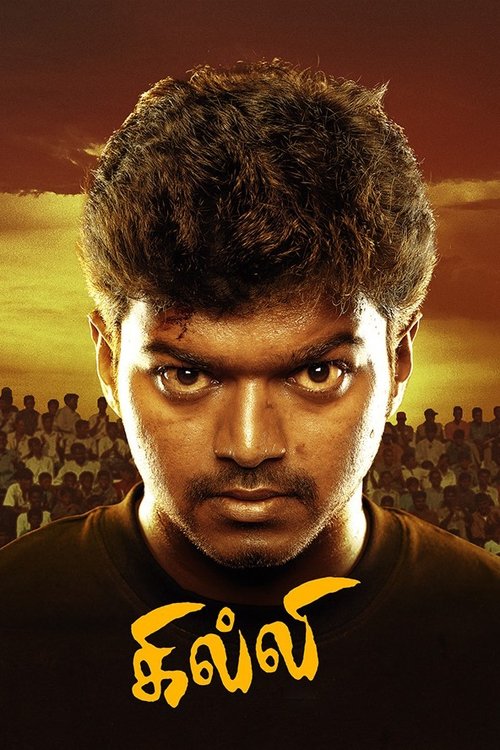
Ghilli
2004 · Dharani
For when you want a full-throttle popcorn night — zero homework, maximum adrenaline and cheer-out-loud hero moments. Comfort food, served hot.
What it's about
Velu, a college kabaddi player from Chennai, unwittingly helps a young woman flee her village — where Muthu Pandi, a violent local strongman, has decided to marry her by force and is eliminating anyone who stands in the way, starting with her own brothers. What follows is a chase that barrels between Madurai muscle and city streets, with a kabaddi tournament waiting at the end of it.
The experience
Pure momentum — a crowd-pleaser that sprints from fight to comedy to song and back without catching its breath. It's loud, swaggering, and genuinely fun, the kind of film built to make a packed theater roar.
Performances
Vijay is at his early-2000s peak here — quick-footed, funny, and effortlessly likeable, the star turn that sealed his mass-hero status. Prakash Raj's villain is a genuine menace, which is what makes the whole machine work.
The craft
Dharani directs the masala template with unusual discipline: the sport, the romance, the comedy, and the villain track all feed one propulsive chase structure instead of fighting each other. The action and the kabaddi sequences are staged for maximum crowd energy — this one plays best loud.
Why it matters
A defining blockbuster of 2000s Tamil cinema that cemented Vijay's rise to superstardom and became the gold standard for how to remake a hit (it adapts the Telugu blockbuster Okkadu) with total conviction.
Snapshot
Ghilli is a Tamil-language action-masala film directed by Dharani, released in 2004 and built around the then-rising star Vijay in the role of Velu, a college kabaddi player who impulsively rescues a young woman from a violent Madurai faction leader determined to marry her by force. It is, first and importantly, a remake: the film adapts Gunasekhar's Telugu blockbuster Okkadu (2003), which starred Mahesh Babu. This lineage is not incidental — it is central to understanding the film's construction, its confidence, and its place in the early-2000s South Indian remake economy. Within Tamil cinema, Ghilli functioned as a consolidating event rather than a formal innovation: it fused sport, romance, comedy, and honor-killing melodrama into a single propulsive vehicle and, in doing so, helped cement Vijay's transition into a top-tier "mass hero." The film became one of the defining commercial successes of its year and has retained an unusually durable afterlife in popular memory, culminating in a widely attended theatrical re-release two decades on.
Industry & production
Ghilli belongs squarely to the commercial mainstream of Kollywood (the Chennai-based Tamil film industry) at a moment when cross-industry remakes were a dominant and lucrative strategy. Telugu, Tamil, Kannada, and Hindi producers routinely purchased proven scripts from one another, betting that a story already de-risked at one box office could be re-engineered for a neighboring market with its own stars and idiom. Ghilli is a textbook instance: Okkadu had been a major Telugu hit in 2003, and the Tamil version arrived quickly to capitalize on that momentum with Vijay carrying the lead. The production was mounted by the veteran producer A. M. Rathnam, a figure associated with large-canvas commercial films of the period, and Dharani — himself an established maker of populist entertainers — was entrusted with translating the property for Tamil audiences.
The casting reflects the star architecture of the era. Vijay, by 2004, was ascending rapidly toward the front rank of Tamil leading men, and Ghilli is frequently cited as one of the films that fixed his "mass" persona. Trisha Krishnan played the heroine, Dhanalakshmi, in a role that contributed to her own rise as a leading actress of the decade. The antagonist, the faction leader Muthupandi, was played by Prakash Raj, one of South Indian cinema's most prolific and respected character actors, whose casting as the villain lent the confrontation genuine dramatic weight rather than cartoonishness. The comedy track leaned on the ensemble conventions of the period, with Vadivelu among the comic performers whose set-pieces became part of the film's popular fabric. I should note that precise contractual and budgetary details of the production are not part of the reliably documented public record, and I will not manufacture figures for them.
Technology
Ghilli was produced and exhibited on 35mm photochemical film, the standard for Tamil theatrical features in 2004, well before the industry's digital-capture and digital-projection transitions later in the decade. Its technological character is therefore conventional for its moment: analog origination, optical/lab-based finishing, and the large-format, high-volume single-screen and early-multiplex exhibition culture of mid-2000s South India. The film's most technology-adjacent ambition lies not in cameras or effects but in scale of staging — crowd sequences, the kabaddi matches, chases, and fight choreography — all achieved primarily through practical means (extras, stunt coordination, location shooting) rather than digital augmentation. Any account claiming specific post-production or effects tools for this title would be speculative; the honest position is that Ghilli is a practically-executed commercial film of the late-celluloid era, and its "technology" is essentially craft and logistics.
Technique
Cinematography
The film's visual approach is the muscular, saturated, movement-forward style typical of early-2000s Tamil commercial cinema: bright exteriors for the Madurai and rural sequences, glossier and more stylized coverage for the songs, and kinetic camerawork for action and sport. The kabaddi matches are the clearest test of the cinematography's job — conveying speed, physical contact, and the geometry of a raid legibly enough that a mass audience with no assumed knowledge of the sport can feel the momentum. Wide establishing coverage alternates with tighter, faster cutting during raids to build tension. I do not have a reliably confirmed cinematographer credit to attribute here with confidence, so rather than guess I will simply say the record on the specific director of photography is thin in the sources available to me; the style, however, is unmistakably that of the period's high-key, high-energy commercial house look.
Editing
Editing serves the masala imperative of tonal switching. Ghilli moves briskly between registers — romance, broad comedy, dance number, and violent confrontation — and the cutting is what makes those transitions feel like features rather than seams. Action sequences and the kabaddi raids depend on rhythmic, impact-driven assembly, while the comedy tracks are given room to breathe in longer, performance-led beats. As with the cinematography credit, I will not assert a specific editor's name I cannot verify; the technique itself is legible as the efficient, momentum-preserving cutting expected of a commercial entertainer of this scale.
Mise-en-scène / staging
The film's staging draws a sharp spatial and moral contrast between two worlds: the faction-ridden rural/small-town milieu of Madurai, coded through honor, patriarchal violence, and open-air confrontation, and the more anonymous urban space of Chennai, where the heroine can potentially disappear and remake her life. This geography is dramaturgically load-bearing — the plot is a flight from one space to another, and the mise-en-scène marks that passage. Crowd choreography is a recurring feature: kabaddi arenas, festival and public settings, and the massed confrontations of the faction plot all stage the hero against a backdrop of many bodies, a standard visual grammar for establishing "mass" heroism.
Sound
The soundtrack, composed by Vidyasagar, is one of Ghilli's most consequential elements and a major driver of its popularity. The song "Appadi Podu" in particular became a genuine cultural phenomenon, an up-tempo dance number whose hook entered common circulation well beyond the film itself and remained a fixture at celebrations and events for years. Vidyasagar's score across the film balances the romantic melodies expected of the love track with the percussive, energetic idiom demanded by the action and the sport. Beyond music, the sound design of the kabaddi sequences — the physical grunt-and-contact texture of the raids — is integral to selling the sport as cinema. Vidyasagar's contribution is the element of the film's craft that can be attributed with the most confidence and that most clearly shaped its reception.
Performance
Performance is where Ghilli most visibly does its star-building work. Vijay's Velu combines easy comic charm, romantic lightness, and explosive physicality, and the film is calibrated to let him toggle between those modes — a template that would recur across his subsequent career. Trisha plays Dhanalakshmi as a young woman whose fear is real and whose agency (the decision to flee) initiates the plot, giving the romance a stake beyond convention. Prakash Raj's Muthupandi is the performance that keeps the film from tipping into weightlessness: he plays obsession and menace with a controlled seriousness that makes the threat credible. The comedy performers, Vadivelu foremost among them, supply the tonal counterweight, and their set-pieces are among the most-quoted parts of the film in popular memory.
Narrative & dramatic mode
The dramatic mode is masala — the South Indian commercial synthesis that deliberately integrates multiple genres into one continuous experience rather than treating them as separable. Structurally, the narrative is a rescue-and-flight thriller wrapped around a romance and studded with comedy and song. The inciting engine is coercion: Muthupandi's determination to marry Dhanalakshmi by eliminating opposition, and her consequent decision to escape. Velu's entanglement begins almost by accident and hardens into commitment, converting a chance encounter into a moral obligation and, eventually, a romance. The film sustains tension through a pursuit structure — the villain's reach extending toward the fleeing pair — while periodically releasing it through comedy and musical numbers. This alternation of tension and release is not a flaw of unity but the intended aesthetic of the form: the pleasure is precisely in the modulation.
Genre & cycle
Ghilli sits at the intersection of the action-romance and the sports film, with the sport (kabaddi) doing double duty as both character definition and set-piece spectacle. Kabaddi is significant here because it is an indigenous, physically intimate contact sport rather than an imported one, which roots the hero's athleticism in a recognizably local idiom. Within the broader cycle of early-2000s Tamil "mass" entertainers, Ghilli is a strong exemplar of the hero-vehicle built to consolidate a rising star's box-office identity. It also belongs to the specific cycle of cross-industry remakes that defined South Indian commercial cinema in this period, where a single high-concept property migrated across languages. The faction-violence backdrop — honor, marriage by force, rural power — connects it to a durable strand of Tamil and Telugu cinema preoccupied with patriarchal coercion and the woman who tries to escape it.
Authorship & method
Directorially, Ghilli is the work of Dharani operating in adaptation mode: the film's authorship is a negotiation between the source material of Okkadu and the demands of Tamil star cinema and a Tamil audience. Dharani's method here is that of the skilled commercial translator — preserving the property's proven high-concept engine while re-tuning comedy, music, star business, and local texture for Kollywood. Among the collaborators, the most confidently attributable and arguably most impactful is composer Vidyasagar, whose songs (especially "Appadi Podu") became inseparable from the film's identity and success. The producer A. M. Rathnam provided the industrial muscle behind a large-canvas release. On the specific cinematography and editing credits I have flagged above, the reliable record available to me is thin, and I decline to attach names I cannot verify; the responsible statement is that these craft functions were executed to the polished commercial standard the film clearly achieves, but the individual attributions should be confirmed against primary credits rather than asserted here.
Movement / national cinema
The film is a product of Tamil commercial cinema (Kollywood) within the larger ecosystem of South Indian cinema, and it is best understood through the regional remake culture that bound Tamil, Telugu, Kannada, and Hindi industries together in the 2000s. This was not an art-cinema or new-wave context but the populist mainstream — an industry organized around star vehicles, song-and-dance integration, family-audience appeal, and festival-window theatrical releases. Ghilli's national-cinema significance is partly as a case study in how a story circulates across India's linguistic film markets, each re-authoring it around a local star and local comic and musical idioms.
Era / period
Ghilli is a mid-2000s film, situated near the end of the celluloid era and at a formative point in the careers it advanced. For Vijay, 2004 sits within the run of films that elevated him toward the front rank of Tamil stardom; for Trisha, the same period established her as a leading heroine. The film's period character — 35mm production, single-screen-dominant exhibition, the remake economy at its height, and a soundtrack culture in which a single song could become a mass event — is very much of its moment. It predates the digital, streaming, and pan-Indian-theatrical shifts that would reshape South Indian cinema in the following decade.
Themes
Beneath the entertainment machinery, Ghilli engages recurring themes of South Indian popular cinema: coercion versus consent in marriage, a woman's flight from patriarchal violence, and the transformation of a carefree young man into a protector through moral obligation. The kabaddi frame carries a thematic charge of its own — physical courage, the willingness to enter hostile territory and get out (the essence of a kabaddi raid), which rhymes with the plot's own structure of incursion and escape. The rural-to-urban movement encodes a theme of anonymity and reinvention: the city as a space where a threatened woman might vanish and start again. These themes are handled in the register of mass entertainment rather than social realism, but they give the film a spine that its lighter elements hang on.
Reception, canon & influence
Ghilli was received as a major commercial success and is broadly remembered as one of the standout Tamil box-office performers of its year and a landmark in Vijay's ascent; I will not attach specific gross figures, as I cannot verify exact numbers, but its status as a large hit is well established in popular and industry memory. Its most enduring cultural residue is musical — "Appadi Podu" long outlived the film's theatrical run as a party and celebration staple.
Looking backward, the film's principal influence is unambiguous and acknowledged: it is a remake of Okkadu (2003), and its narrative architecture, central conceit, and dramatic engine derive directly from that Telugu source. It also draws on longer traditions of faction-violence melodrama and the masala star vehicle.
Looking forward, Ghilli occupies a notable node in the cross-industry life of a single story: the Okkadu property was remade across multiple Indian film industries (including a later Hindi version), and Ghilli stands as the definitive Tamil instantiation within that family. Within Kollywood, the film became a reference point for Vijay's "mass" persona and a perennial in the nostalgia canon — a status confirmed by its well-attended twentieth-anniversary theatrical re-release in 2024, which drew renewed audiences and underscored how firmly the film had lodged in Tamil popular memory. Its legacy, then, is less about formal innovation than about durability: a remake that so thoroughly out-lived and localized its source that it became, for Tamil audiences, the canonical version of the story.
Reception
A monster hit on release — widely cited as the first Tamil film to cross ₹50 crore — and its legend has only grown: the 2024 20th-anniversary re-release packed theaters and broke Indian re-release records.
How Ghilli was received, from release to now →
Influences: the films it descends from and the films it influenced
- Okkadu (2003) — Direct source: Ghilli reproduces its scene-by-scene architecture — a kabaddi champion impulsively shields a girl fleeing a faction leader's forced marriage, then harbors her in his family home for a domestic-siege middle act.
- Narasimha Naidu (2001) — Crystallizes the Telugu faction-patriarch villain and honor-marriage coercion plot that supplies Ghilli's antagonist type (Prakash Raj's Muthupandi) and its coercion-vs-consent dramatic engine.
- Amar Akbar Anthony (1977) — Codifies the masala tonal-switching grammar Ghilli runs on — abrupt, unapologetic modulation between broad comedy, romance, action and song within a single sequence.
- Sholay (1975) — Template for rural faction/dacoit melodrama built around a theatrical villain terrorizing a community, staged across wide crowd tableaux that Ghilli echoes in its rural set-pieces.
- Enga Veettu Pillai (1965) — MGR-era root of the Tamil 'mass hero' vehicle — fan-servicing hero entry, dual/wronged-champion posture, and fight-and-song elevation that Vijay's persona in Ghilli directly inherits.
- Baasha (1995) — Standardizes the modern Kollywood mass-hero introduction and elevation grammar (slow-motion entry, punch-dialogue reveal) that Dharani stages around Vijay.
- Dhill (2001) — Dharani's debut action-masala establishing his own method — a hot-headed physical hero, stunt-driven set pieces and comedic interludes — the template later scaled up in Ghilli.
- Pokkiri (2007) — Extends the Vijay mass-hero-remake formula in Ghilli's wake — a Tamil remake of a Telugu hit — cementing the cross-industry star-vehicle pipeline Ghilli helped normalize.
- Thuppakki (2012) — Advances the Vijay mass-hero vehicle a decade on while retaining the interleaved comedy/action/song masala structure and interval-block elevation Ghilli typified.
- Mersal (2017) — Carries the Vijay mass-hero grammar and crowd-choreographed song spectacle forward, working openly in the fan-servicing entry-and-elevation tradition Ghilli represents.
- Dhool (2003) — Dharani's immediately-prior Vijay masala refining his rural-innocent-in-the-city hero, comedy-action interleave, and Vidyasagar scoring collaboration that Ghilli reprises.
- Ghajini (2005) — Contemporaneous large-canvas Tamil star vehicle that likewise became a cross-industry remake template (Hindi, 2008), sharing Ghilli's masala-scale ambition and its single-story-across-industries model.
- Pokiri (2006) — Telugu mass hit whose multi-industry remake life (Tamil Pokkiri, Hindi Wanted) parallels the Okkadu family, extending the cross-industry remake-culture Ghilli exemplifies.
- Tevar (2015) — The Hindi instantiation of the same Okkadu property — kabaddi-hero-shields-woman-from-faction-leader — a sibling node in the cross-industry remake family Ghilli anchors in Tamil.
Similar films
- Sholay (1975) — influence & lineage
- Velaiyilla Pattathari (2014) — shared sensibility
- Kaithi (2019) — shared sensibility
- Vikram (2022) — shared sensibility
- Kill (2024) — shared sensibility
- Lubber Pandhu (2024) — shared sensibility
- Pudhupettai (2006) — shared sensibility
- Aavesham (2024) — shared sensibility