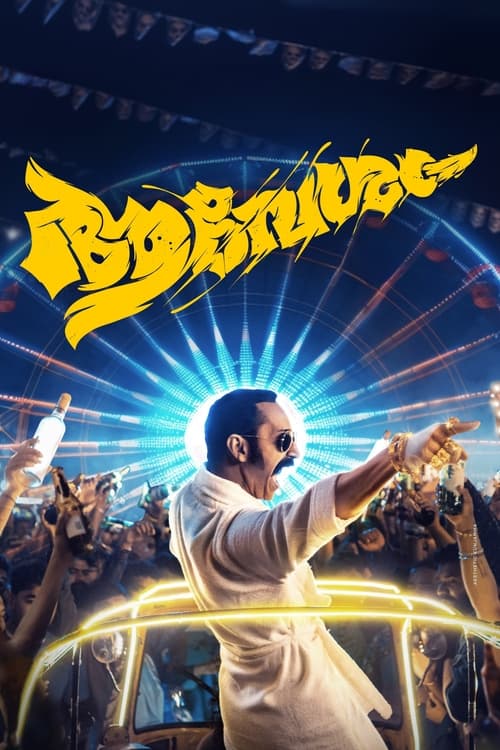
Aavesham
2024 · Jithu Madhavan
For a rowdy night when you want pure energy — big laughs, bigger action, a character you'll be quoting after. Crowd-pleaser first, but it sneaks in feeling; great with friends and good speakers.
What it's about
Three Malayali freshmen arrive in Bangalore for engineering college, get humiliated by their hostel seniors, and go hunting for a local tough guy to back them up. They find Ranga — a flamboyant, gold-draped gangster who adopts them with terrifying enthusiasm — and quickly learn that having a don for a best friend is a much bigger problem than the bullies ever were.
The experience
Loud, funny, and gleefully unhinged — a party of a movie that keeps escalating, with an undercurrent of something sadder about loneliness and the need to be admired. It's the rare mass entertainer where the swagger is also the joke and the wound at the same time.
Performances
Fahadh Faasil's Ranga is a one-man spectacle — bald, gold-chained, oscillating between menace, neediness, and comic delight, often within a single scene. It's a movie-star turn that's also a genuinely strange, layered character study.
The craft
Jithu Madhavan runs the 'mass' action formula through a comic filter, staging hero-worship set pieces that celebrate and puncture gangster swagger simultaneously, driven by a relentless, thumping soundtrack. The energy level alone rewards a loud room.
Why it matters
One of the defining Malayalam blockbusters of 2024, it helped cement the industry's signature move of the moment: the crowd-pleasing mass entertainer executed with real wit and character depth.
Snapshot
Aavesham ("Passion" or "Rage/Impulse") is a Malayalam-language comedy-action film released in April 2024, the second feature by writer-director Jithu Madhavan after his 2023 horror-comedy debut Romancham. Its premise is deceptively slight: three Malayali teenagers who have migrated to Bangalore for engineering college, humiliated by hostel seniors, go looking for muscle to settle the score and instead attach themselves to Ranga, a flamboyant, gold-draped local gangster played by Fahadh Faasil. What begins as a transactional revenge errand curdles into something stranger — a study of dependency, surrogate fatherhood, and the intoxication of proximity to power. The film became one of the defining Malayalam commercial successes of 2024 and cemented a particular register for the industry: the "mass" entertainer executed with the craft sensibility of the region's post-2010 art cinema. Fahadh Faasil's Ranga — a coiled, unpredictable, oddly tender grotesque — is widely regarded as one of his signature comic-menacing creations.
Industry & production
Aavesham sits at the confluence of two of the most important production banners in contemporary Malayalam cinema. It was produced under Fahadh Faasil and Friends (FFF), the outfit associated with Fahadh Faasil and Nazriya Nazim, in collaboration with Anwar Rasheed Entertainment — Anwar Rasheed being both a director (Ustad Hotel, Trance) and a key producer of the industry's more adventurous commercial fare. This pairing is significant: it channels prestige-industry capital and taste toward a broad-audience star vehicle, exactly the hybrid the film embodies.
The picture was positioned as a festival-window blockbuster, released around Eid in April 2024, a slot Malayalam distributors treat as prime for wide family and youth turnout. It performed extremely strongly at the box office and is routinely cited among the top-grossing Malayalam films of its year; I am declining to attach specific revenue figures here because the publicly circulated numbers vary by source and trade reporting in the region is inconsistent, and I would rather not launder an estimate into a fact. What is uncontested is that it was a decisive commercial hit, strong enough that a follow-up/expansion of the property was subsequently announced. The film's reach was amplified by a pre-release and post-release music campaign — the track "Illuminati" in particular became a viral phenomenon across streaming and social platforms, functioning as marketing as much as soundtrack.
Technology
Aavesham is a contemporary digital production and should be understood within the standard high-end Malayalam workflow of the mid-2020s: digital capture, an extensive color-grading pipeline, and a theatrical sound mix built for large-format exhibition. I do not have reliable public documentation of the exact camera bodies or lenses used, so I will not name a specific system; what the image demonstrably prioritizes is the flexibility of digital sensors under mixed, saturated artificial light — neon, bar signage, sodium street lamps — pushed hard in the grade toward candied, high-chroma color. The film's look is inseparable from post-production: the palette is authored, not merely captured. On the audio side, the release was engineered for immersive theatrical playback (multichannel/Atmos-class presentation is now typical for a tentpole Malayalam release of this scale), and the soundtrack's low-end and brass-forward mix is clearly designed to be felt in a room. Technologically the film is unremarkable in its tools and remarkable in its deployment of them — it is a case study in how commodity digital cinema technology, in disciplined hands, produces a strongly stylized surface.
Technique
Cinematography
Cinematography is by Sameer Thahir, one of the most important image-makers of the Malayalam New Generation and himself a director (Chaappa Kurishu, Neelakasham Pachakadal Chuvanna Bhoomi). His work here is deliberately maximalist. Bangalore is rendered as a nocturnal, neon-slicked playground — a heightened, almost comic-book urbanism that externalizes the students' intoxication with Ranga's world. Thahir leans on wide framings that let Fahadh Faasil's physical performance breathe across the full width of the image, on low and canted angles that inflate Ranga into a figure of mock-mythic stature, and on kinetic camera movement during the film's set pieces. Color is a primary storytelling instrument: the seductive, saturated glow of Ranga's milieu is played against the drabber, fluorescent institutional spaces of the college, so that the visual grammar itself dramatizes the pull of the gangster's life over ordinary striver ambition.
Editing
The cut is by Vivek Harshan, a leading Malayalam editor. His work is central to the film's comic engine — much of the humor is timing-based, built on holds, sudden accelerations, and the rhythm of reaction. The editing modulates confidently between registers: loose, hangout-style scenes that let performances stretch out, and tightly compressed action and montage passages synced to the score. The film's tonal control — its ability to slide from farce to menace to sentiment without whiplash — is as much an achievement of the edit as of the writing.
Mise-en-scène / staging
The production design foregrounds Ranga as a maximalist object: gold chains, loud shirts, a lair and an entourage that read as a boy's fantasy of gangster life made literal. This is intentional. The film stages Ranga's world as an aestheticized temptation, all texture and swagger, precisely because the students (and the audience) are meant to find it magnetic before they find it dangerous. Staging repeatedly uses the entourage as a chorus around the star, and the college as a colorless counter-space. The Bangalore setting — Malayalis abroad within India — is used to keep the young protagonists slightly unmoored, which makes their attachment to a charismatic elder countryman legible.
Sound
The sonic identity is dominated by Sushin Shyam's score and songs (treated more fully under Authorship). Beyond the music, the film uses sound design for comic punctuation and for the swelling, brass-heavy "elevation" cues that accompany Ranga's entrances and reversals — a knowing deployment of the "mass hero" audio vocabulary, tuned so that it is simultaneously rousing and slightly absurd. The mix is aggressive and front-footed, matching the visual maximalism.
Performance
The film is, finally, a performance vehicle. Fahadh Faasil builds Ranga out of contradictions — infantile and paternal, generous and violent, ridiculous and frightening — and sustains that instability across the runtime so that the audience never fully settles into whether to laugh at him, fear him, or love him. It is a big, external, physically inventive turn that nonetheless keeps a flicker of loneliness underneath. The three young leads (played by, among others, Mithun Jai Sankar, Roshan Shanavas, and the performer known as Hipzster) function largely as an audience-surrogate ensemble, their relative naturalism grounding Fahadh's flamboyance. Among the supporting players, Sajin Gopu is frequently singled out as a standout within Ranga's entourage. I'm keeping character-name attributions light here to avoid overstating details I can't verify precisely.
Narrative & dramatic mode
Structurally the film runs a bait-and-switch on its own logline. The revenge-against-bullies premise is a doorway, quickly subordinated to the real subject: the relationship between the boys and Ranga. The dramatic mode is comic throughout, but it is comedy braided with a genuine coming-of-age arc and, underneath that, a cautionary one — the students get what they asked for (protection, belonging, potency by association) and discover the cost of it. The screenplay favors an episodic, hangout rhythm over tight three-act mechanics; scenes exist to deepen the central bond and to give Fahadh room, rather than to advance a tight plot clock. This looseness is a feature — it mirrors the seductive drift of the boys into Ranga's orbit — though it also means the film's momentum is carried more by character and set piece than by suspense. The emotional turn in the later stretches, toward something wounded and paternal, is what lifts the film above pure caper.
Genre & cycle
Aavesham is a gangster-comedy, and it belongs to a recognizable contemporary Malayalam cycle: the commercial "mass" entertainer refracted through the sensibility and craft standards of the New Generation art film. It is in dialogue with the broader Indian tradition of the eccentric-gangster comedy while remaining specifically Malayalam in its humor and texture. It also participates in a Fahadh Faasil sub-cycle — films built around his capacity to make a volatile, larger-than-life character both threatening and comic (a lineage that runs through his gallery of unstable men). And it is a college/youth movie, drawing on the campus-and-friendship register that Malayalam cinema has long cultivated. The film's distinctiveness is in how self-aware it is about "mass" grammar: it deploys hero-elevation tropes with evident affection and evident irony at once.
Authorship & method
Jithu Madhavan is the film's authorial center, credited with its story and direction. His two features to date — Romancham (2023) and Aavesham (2024) — establish a consistent method: genre premises (haunted house, gangster revenge) used as scaffolding for ensemble comedy, with tone that pivots on a dime and a strong instinct for how young men talk and behave together. His signature is tonal control and comic timing rather than formal experimentation. (Precise writing credits beyond his story-and-direction role — dialogue and any co-writers — I'd rather not specify from memory, as I can't verify the full writing team with confidence.)
His key collaborators form a murderer's row of Malayalam talent. Cinematographer Sameer Thahir brings a director's eye and a maximalist color sensibility. Composer Sushin Shyam — among the most influential Malayalam music directors of his generation (Kumbalangi Nights, Minnal Murali, Bramayugam) — supplies both the propulsive score and the film's breakout song "Illuminati," whose viral life became part of the film's cultural footprint. Editor Vivek Harshan shapes the comic and tonal rhythm. And Fahadh Faasil, beyond starring, is a producing force via FFF, making the film an expression of an actor-producer's taste as much as a director's. The production is best understood as a collective of established New Generation artisans applying prestige craft to an unabashedly popular form.
Movement / national cinema
The film is a product of the Malayalam "New Generation" / New Wave that reshaped the industry from roughly 2010 onward — a movement characterized by naturalistic performance, location-rooted texture, genre literacy, and a willingness to fuse arthouse craft with commercial appetite. By the 2020s this movement had matured into a distinctive commercial-critical convergence, in which small-industry economics and auteur-adjacent craft produced films that traveled well beyond Kerala. Aavesham is an exemplary late-cycle artifact of that convergence: it is unmistakably a crowd-pleaser, yet every department bears the fingerprints of the movement's craft culture. It also reflects Malayalam cinema's growing pan-Indian reach in the streaming era, and its diegetic setting among Malayalis in Bangalore gently thematizes the industry's own outward migration.
Era / period
Set and made in the present day, Aavesham is a mid-2020s film in both content and sensibility. It reflects a specific moment: the post-Minnal Murali, post-pandemic Malayalam industry, confident about mounting stylish genre entertainers for a national audience, with music built to live natively on streaming and short-video platforms. Its youth milieu — engineering college, hostels, inter-state migration for education — is contemporary and recognizable, and its meme-ready star turn and viral song are artifacts of the 2024 attention economy. It is very much a film of its exact year.
Themes
The film's richest theme is surrogate fatherhood and belonging: displaced boys, far from home, attach themselves to a dangerous elder who offers the protection and recognition they crave, and the movie is honest about how much that need can override judgment. Related is the seduction of power and violence — the aesthetic pleasures of Ranga's world are staged as genuinely alluring, so the film implicates the viewer in the boys' temptation before it counts the cost. It is also a study of performed masculinity: Ranga is masculinity as spectacle and armor, and the humor and pathos both flow from the gap between the swagger and the loneliness beneath it. Underneath the comedy runs a coming-of-age current about the difference between wanting to be feared and learning who to trust, and a quieter thread about migration and class — small-town Malayali strivers navigating a big, indifferent city.
Reception, canon & influence
Aavesham was received as a major popular success and a high point for Fahadh Faasil's comic-villain register; critical response broadly praised his performance, Sushin Shyam's music, and the film's craft and entertainment value, with the more measured notices flagging its loose, episodic structure and its length. The song "Illuminati" achieved an outsized cultural life of its own, becoming one of the year's inescapable Malayalam music phenomena.
Backward — influences on the film: it draws on the Indian eccentric-gangster comedy tradition and on the "mass hero" grammar of star-elevation cinema, filtered through the naturalism and craft standards of the Malayalam New Generation; within Fahadh Faasil's own filmography it extends his gallery of volatile, magnetic men. Jithu Madhavan's method here also clearly continues the ensemble-comedy instincts of his debut Romancham.
Forward — what it shaped: as one of 2024's signature Malayalam hits, it reinforced the industry's confidence in the craft-forward "mass" entertainer as a nationally exportable form, and it strengthened the Ranga-type — the lovable-dangerous comic gangster — as a marquee mode for Fahadh Faasil and for the industry. The property's success was strong enough to prompt talk of continuation/expansion, which itself signals the character's franchise potential. Because the film is recent, its longer-term canonical standing and its concrete influence on subsequent filmmakers are still settling, and any claim about its lasting legacy should be held provisionally; what is already clear is that, in the moment, it functioned as both a commercial benchmark and a showcase for how far Malayalam cinema's craft-meets-crowd formula could travel.
Reception
No flop-to-classic arc needed — it exploded on release (Vishu 2024) as one of Malayalam cinema's biggest hits of the year, and has since settled into 'exhibit A' status whenever anyone argues that 2024 belonged to Malayalam cinema.
How Aavesham was received, from release to now →
Influences: the films it descends from and the films it influenced
- Romancham (2023) — Jithu Madhavan's debut established his method Aavesham reuses wholesale: a genre premise (haunted house / gangster revenge) used purely as scaffolding for a young-men ensemble comedy, with tone that pivots on a dime between dread/menace and banter.
- Kumbalangi Nights (2019) — Sushin Shyam's mood-driven scoring and Fahadh Faasil's Shammy — the smiling, self-mythologizing, volatile-magnetic man — directly seed the Ranga register and the score's propulsive elevation cues.
- Angamaly Diaries (2017) — Model for staging a gang of young men as a kinetic, saturated hangout where the entourage functions as a chorus and gang violence is choreographed as communal ritual rather than plot mechanics.
- Thondimuthalum Driksakshiyum (2017) — Anchors the New Generation naturalist-performance standard — underplayed, behaviorally exact acting — that grounds Fahadh and the ensemble beneath Aavesham's maximalist surface.
- In Harihar Nagar (1990) — Foundational Malayalam male-friend-group ensemble-comedy grammar: a tight quartet of youths, cross-talk timing, and episodic misadventure that Aavesham's college-boy trio inherits.
- Kammatipaadam (2016) — Supplies the naturalist urban-gangster milieu — the underclass fixer, the bar-and-lodge underworld texture — that Aavesham stylizes into neon-lit comic register.
- Minnal Murali (2021) — Demonstrated Sushin Shyam building propulsive, crowd-pleasing elevation music for an unabashedly mass form, the template for Aavesham's star-lift cues and the 'Illuminati' set-piece.
- Vikram (2022) — Codifies contemporary mass-hero star-elevation cutting — slow-build entrance, sound-design punch on the reveal — that Aavesham deploys (and gently parodies) for Ranga's introduction.
- Pushpa: The Rise (2021) — Low-canted-angle hero framing paired with a signature thumping motif on every swagger beat — the exact mass-grammar vocabulary Aavesham borrows for its comic gangster.
- Lock, Stock and Two Smoking Barrels (1998) — Progenitor of the eccentric-gangster comedy where a chorus of hangers-on and comic-timed, tonally whiplashing editing turn criminal milieu into farce.
- Pulp Fiction (1994) — Template for the episodic-hangout structure and tonal modulation — long comic digressions abruptly punctured by violence — that shapes Aavesham's loose, sketch-like build.
- Jailer (2023) — Parallel articulation of the gangster-comedy mass mode: a marquee star mixing genuine menace with deadpan humor, violence played for crowd-pleasing wit rather than gravity.
- Manjummel Boys (2024) — Same-year Malayalam hit built on the identical engine: a male-friend-group ensemble whose collective banter and loyalty is the true subject, genre incident secondary.
- Premalu (2024) — Shares the episodic-hangout comedy DNA and naturalist rendering of how young people actually talk, part of 2024's Malayalam wave of vibe-over-plot crowd-pleasers.
- Bramayugam (2024) — Fellow 2024 craft-forward showcase scored by Sushin Shyam, evidencing the same New-Generation-artisans-applied-to-genre-spectacle production logic.
- Turbo (2024) — Contemporary Malayalam star-vehicle mass entertainer, extending the same industry bet Aavesham reinforced: prestige craft harnessed to unapologetic hero-elevation spectacle.
Similar films
- Manjummel Boys (2024) — influence & lineage · same viewing thread
- Vikram (2022) — influence & lineage · same viewing thread
- Kumbalangi Nights (2019) — influence & lineage
- RRR (2022) — same viewing thread
- Superboys of Malegaon (2025) — same viewing thread
- Jigarthanda DoubleX (2023) — same viewing thread
- Maheshinte Prathikaaram (2016) — shared sensibility
- Jigarthanda (2014) — shared sensibility
All the films related to Aavesham →
Watch it with: curated runs of related films
- First Day, First Show — A run of maximalist, movie-drunk crowd cinema best taken loud and communal — spectacle, folk myth, gangster swagger, and lads-on-a-trip mayhem that all believe in the front row.