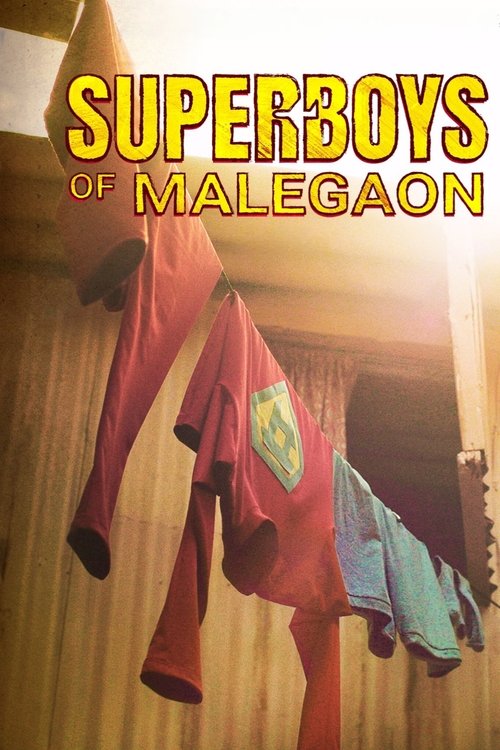
Superboys of Malegaon
2025 · Reema Kagti
For when you want to feel good about people and remember why you love movies — warm enough for a family watch, with enough substance that it doesn't evaporate. Expect to laugh and then, late on, to well up.
What it's about
In Malegaon, a hard-grinding power-loom town in Maharashtra, the movies are the only escape — so video-parlour operator Nasir Shaikh decides to stop showing films and start making them. With a ragtag crew of friends, weavers, and a local writer, he shoots no-budget parody remakes of Bollywood hits, by Malegaon and for Malegaon. The film follows the crew across years of scrappy triumphs, fallings-out, and the question of what all this moviemaking is really for.
The experience
Funny, big-hearted, and sneakily moving — the DIY filmmaking scenes are pure joy, and then the story deepens into something about friendship, credit, and mortality that catches you off guard. It's a crowd-pleaser with a real ache under it.
Performances
Adarsh Gourav anchors the film as Nasir with charm that never tips into hero worship — you see the stubbornness and vanity alongside the dream — and the ensemble around him gives the crew the lived-in texture of real, imperfect friendship.
The craft
Reema Kagti directs Varun Grover's screenplay with obvious affection for low-budget ingenuity — bullock-cart camera dollies, homemade effects — while keeping the town's textures of looms, dust, and video parlors vivid and specific. The film-within-a-film gags are staged with real comic precision.
Why it matters
Premiering at Toronto before its Indian release, it brought the true story of Malegaon's homegrown film industry to a global audience and stands as one of mainstream Hindi cinema's warmest tributes to its own grassroots.
Snapshot
Superboys of Malegaon is a fictionalized biographical comedy-drama about Nasir Shaikh, a video-parlour operator and self-taught filmmaker from Malegaon — a power-loom town in the Nashik district of Maharashtra — who, in the late 1990s and 2000s, mobilized a circle of friends to shoot no-budget parody remakes of Bollywood hits for local audiences. Directed by Reema Kagti from a screenplay by Varun Grover, and produced under the Tiger Baby / Excel banners associated with Zoya Akhtar and Farhan Akhtar in partnership with Amazon MGM Studios, the film premiered on the international festival circuit in late 2024 (including a berth at the Toronto International Film Festival) before a theatrical release in India in early 2025 and subsequent streaming on Amazon Prime Video. It stars Adarsh Gourav as Nasir, with Vineet Kumar Singh, Shashank Arora, and an ensemble playing the ragtag troupe. The film is a dramatization of a story already documented on screen — Faiza Ahmad Khan's 2008 documentary Supermen of Malegaon — and it belongs to the durable subgenre of movies about the making of movies, filtered here through the specific texture of small-town, working-class, largely Muslim India. Its animating idea is that cinema is not only what emanates from Mumbai's industry but something a community can seize and make for itself.
Industry & production
The film sits inside one of contemporary Hindi cinema's most identifiable production cultures: the Akhtar–Kagti axis. Reema Kagti, Zoya Akhtar, and Farhan Akhtar have functioned as a long-running creative and commercial unit through Excel Entertainment and, more recently, Tiger Baby Films, the company Kagti and Zoya Akhtar co-founded and through which they produced streaming work such as Made in Heaven and Dahaad. Superboys of Malegaon extends that partnership into feature form with the backing of Amazon MGM Studios, reflecting the broader mid-2020s pattern in which global streaming platforms co-financed mid-budget, prestige-leaning Indian features aimed at both theatrical windows and library value. That financing model matters to the film's identity: a story about the poorest, most improvised end of filmmaking was itself produced within a well-capitalized, festival-oriented apparatus — a tension the film is aware of.
The material carries a notable rights-and-lineage history. The Malegaon phenomenon entered wider consciousness through Faiza Ahmad Khan's documentary, and any dramatization inherits that prior act of documentation as both source and shadow. The production's core proposition — an ensemble of comparatively under-marquee actors rather than top-tier stars — aligns commercial strategy with subject matter, since the film is precisely about people without industry access.
Technology
The narrative is, at root, a chronicle of filmmaking technology at its most improvised. The real Malegaon films were shot on consumer and prosumer video — camcorders, VHS and later digital handycams — and exhibited in makeshift local venues, a workflow born of necessity in a town without production infrastructure. The film's dramatic engine repeatedly turns on hardware limitations: what a single borrowed camera, a bedsheet, a hand-cranked rig, or a green-adjacent backdrop can and cannot do. The famous flying-Superman effects of the source story were achieved through physical ingenuity rather than optical budget, and that ethos of "solve it in the room" is the film's technological throughline.
The 2025 production itself was made with contemporary professional digital tooling, and one of its central craft tasks was the recreation of period consumer-video textures — the softer resolution, interlacing artifacts, and color of camcorder footage — to distinguish the "films within the film" from the polished frame around them. I don't have a verified record of the specific capture format or camera package used, so I won't assign one; the salient point is the deliberate contrast the production stages between its own image and the degraded, affectionate reconstruction of Nasir's homemade cinema.
Technique
Cinematography
The photography — the credited director of photography is Swapnil S. Sonawane — carries two registers. The first is an observational, period-evocative rendering of Malegaon: its looms, lanes, rooftops, and video parlors, shot to feel lived-in rather than picturesque, with a palette that leans warm and dust-toned to convey heat and labor. The second register is the pastiche mode, in which the crew's own crude productions are recreated with the visual grammar of low-end video: flatter light, cruder framing, visible seams. The interplay lets the camera editorialize gently — the "real" world photographed with care, the dreamed-of movies photographed with loving imperfection.
Editing
Structurally the film follows a workshop-to-premiere arc common to making-of stories, and its cutting has to manage a large ensemble, a compressed timeline, and the tonal switchbacks between comedy and pathos. The editing's decisive challenge is juxtaposition: intercutting the chaos of a shoot with the finished, ramshackle result to mine both laughs and tenderness. I do not have a reliably verified editor credit to attribute here, so I will refrain from naming one rather than guess; the film's rhythm, however, is clearly built around setpiece "productions" that function as internal climaxes.
Mise-en-scène / staging
Production design does heavy narrative work. The recreation of turn-of-the-millennium Malegaon — signage, costume, the physical clutter of a video shop, the improvised film sets within the town — establishes both place and period and dramatizes scarcity as an aesthetic. The staging repeatedly foregrounds the gap between ambition and means: a modest set dressed to stand in for a Bollywood spectacle, bodies and props arranged to fake effects the budget cannot buy. That visible resourcefulness is not incidental; it is the film's argument made physical.
Sound
Sound design contrasts the ambient life of a loom town — machinery, crowds, call-and-response of a community — with the tinny, over-driven audio of amateur exhibition. Music underlines the emotional beats of aspiration and setback. I don't have a confirmed composer or music-director credit that I can state with confidence, so I won't attribute the score; where the record on my end is thin, it is thin, and I'd rather flag that than invent a name.
Performance
Performance is the film's greatest asset and its thematic center. Adarsh Gourav — following his international breakout in The White Tiger — anchors the film as Nasir, playing him as a dreamer whose stubborn optimism is both engine and liability. The ensemble is written and played as a genuine collective rather than a star vehicle: Vineet Kumar Singh and Shashank Arora among the troupe give the film its texture of friendship, rivalry, and shared risk. The acting register modulates carefully between broad comedy (the amateur actors "acting" badly within their films) and grounded drama (the same people offscreen), and the film's affection depends on the cast selling both.
Narrative & dramatic mode
The film operates in the biographical/making-of mode, organized around the collaborative production of art under constraint. Its dramatic spine is the classic "let's put on a show" structure — assembling a team, overcoming shortfalls of money and skill, arriving at a premiere — inflected with the bittersweetness of a true story whose real-world coda includes hardship. The mode is fundamentally comic-humanist: obstacles generate humor, and humor is the community's method of survival. Underneath, the drama is about authorship and dignity — whether people the industry ignores can be authors of their own images — and it earns its pathos by treating amateurism not as a punchline but as a form of courage.
Genre & cycle
Superboys of Malegaon belongs to the international cycle of films about outsider and amateur filmmaking — a lineage that includes Tim Burton's Ed Wood, Michel Gondry's Be Kind Rewind (whose homemade "Sweded" remakes are a close cousin of the Malegaon parodies), Tom DiCillo's Living in Oblivion, and, in the register of cinema-love, Cinema Paradiso. Within Indian cinema it joins a smaller strand of self-reflexive films about the movies and their meaning to ordinary audiences. As a "based on a true story" prestige comedy-drama with festival ambitions, it also sits in the mid-2020s cycle of Hindi films seeking critical and international validation through streamer co-financing rather than mass-market star spectacle.
Authorship & method
Reema Kagti's directorial filmography — from the ensemble comedy Honeymoon Travels Pvt. Ltd. through the noir-inflected Talaash and the period sports drama Gold, plus her showrunning work on prestige series — reveals a filmmaker comfortable across register and adept with ensembles and period reconstruction, both central to this project. Her long collaboration with the Akhtars gives the film an institutional confidence that plays against its scrappy subject.
The screenplay is by Varun Grover, one of the more distinctive voices in contemporary Hindi film writing: co-writer of Masaan, an acclaimed lyricist (notably on Gangs of Wasseypur), a stand-up satirist, and the writer-director of All India Rank. Grover's sensibility — small-town specificity, class awareness, and comedy that carries a political undertow — is a natural fit for Malegaon, and much of the film's tonal balance can be traced to that pairing of Kagti's assured direction with Grover's wry, humane script. Cinematographer Swapnil S. Sonawane is the other key credited collaborator identifiable with confidence. For the editor and the composer, I do not have verified attributions I can responsibly state, and I flag that gap rather than fill it.
Movement / national cinema
The film is a product of Hindi-language Indian cinema, but its deeper affiliation is with regional and vernacular filmmaking cultures that exist outside the Mumbai industry's center of gravity. Malegaon's homemade cinema is a grassroots, hyper-local media practice — closer to folk performance and community exhibition than to studio production — and the film honors that as a distinct tradition. It also participates in the "new" streaming-era Hindi cinema, in which platforms enabled subject matter and casting choices that the theatrical star system had marginalized. The result is a film that is nationally Bollywood-adjacent in production yet insistently decentered in sympathy, arguing for a map of Indian cinema that includes its peripheries.
Era / period
The story is a period piece set largely around the turn of the millennium and the 2000s, when consumer video made DIY filmmaking newly possible for people without capital — a specific technological window between celluloid's expense and the smartphone's ubiquity. The film's careful reconstruction of that moment is both nostalgic and analytical: it captures a brief era in which the means of image-making had democratized just enough for a loom town to make its own movies. The framing 2025 production, released into a streaming-saturated present, implicitly measures how far distribution has since changed even as it looks back on that hinge point.
Themes
The governing themes are the democratization of art and the dignity of the amateur: the conviction that filmmaking belongs to everyone, not only to those with access. Community and collaboration run throughout — the "superboys" are a collective, and the film treats friendship and shared labor as the real special effect. Cinema-as-escape is explicit in the source material's premise (a mill town seeking relief from drudgery), and the film examines both the consolations and the costs of that dream. Class and place recur: the specificity of a working-class, largely Muslim town rarely centered in mainstream Hindi cinema is itself a thematic statement. And, self-reflexively, the film meditates on authorship — on who gets to be called a filmmaker — and on the bittersweetness of pursuing art when the world offers little reward for it.
Reception, canon & influence
The film arrived with a strong critical reputation coming out of its festival run, where the pairing of Kagti and Grover and Gourav's lead performance were focal points of praise, and it was positioned as one of the more warmly received Hindi releases of its cycle. I don't have verified box-office figures or specific published quotations to cite, and I won't manufacture them; my characterization of its reception is therefore general rather than numeric.
Its influences run backward to two sources at once: the real events and figures of Malegaon, and the prior screen treatment of them in Faiza Ahmad Khan's documentary Supermen of Malegaon, which established the subject in film culture and against which the fiction inevitably converses. More broadly it draws on the international making-of and amateur-cinema tradition (Be Kind Rewind, Ed Wood, Cinema Paradiso) and on the socially attentive strand of contemporary Hindi writing associated with Grover.
Looking forward, its most likely legacy is twofold. As a high-profile dramatization, it renews attention to the Malegaon story and to the broader phenomenon of grassroots, vernacular filmmaking in India, potentially encouraging further work centered on cinema's peripheries. And as a product of streamer-backed, ensemble-led prestige filmmaking, it stands as a data point in the mid-2020s argument that Hindi cinema's future could accommodate stories about ordinary people made without traditional star power. Any claim about durable canonical status would be premature this close to release; what can be said is that the film consciously positions itself as a tribute to, and an extension of, a real tradition of people making movies against the odds — and that this self-awareness is the source of both its charm and its stakes.
Reception
It premiered at TIFF 2024 to warm reviews, then barely made a ripple at the Indian box office in early 2025 — before word of mouth and streaming turned it into one of the year's most beloved Hindi films, the classic 'nobody saw it in theaters, everybody vouches for it now' trajectory.
How Superboys of Malegaon was received, from release to now →
How to watch Superboys of Malegaon: what to notice on a first viewing
- Watch how the film's look shifts between Malegaon and its movies. Real Malegaon is shot warm and lived-in, while the crew's own amateur productions are recreated in flatter light and cruder framing, visible seams and all. The camera treats the town with more care than the fake spectacle it dreams up, on purpose.
- Notice how a small set gets dressed to fake a big effect. Bodies and props are arranged to stand in for a Bollywood-scale spectacle the budget cannot afford, dramatizing scarcity itself as the film's visual style. You can see exactly how much ambition is being stretched over how little money.
- Watch how Adarsh Gourav plays Nasir's stubborn optimism. Gourav plays Nasir as a dreamer whose confidence is both what drives the group forward and what keeps getting them into trouble. His optimism is the engine of the whole enterprise and its biggest risk at once.
- Listen for the tinny, overdriven sound of the amateur screenings. The film contrasts the rich ambient noise of a working loom town against the cheap, blown-out audio of the group's own homemade exhibitions. The gap between the two sounds tells you exactly how much they are making with almost nothing.
The whole guide to watching Superboys of Malegaon, with the keys for a rewatch →
Influences: the films it descends from and the films it influenced
- Supermen of Malegaon (2012) — The direct documentary source, whose actual footage of a Superman flying on a bicycle rig against a hand-rigged green cloth supplies the practical-effects vocabulary and the ethnographic gaze the fiction reconstructs shot for shot.
- Ed Wood (1994) — Establishes the affectionate-biopic register that treats a technically inept filmmaker's boundless conviction as heroic rather than mockable — the tonal contract of dignifying the amateur that Kagti and Grover adopt wholesale.
- Be Kind Rewind (2008) — Codifies 'sweding' — remaking canonical blockbusters with cardboard, string and in-camera trickery — as an aesthetic where the visible seams of the handmade become the point, the exact scarcity-as-craft logic behind Malegaon's parody remakes.
- American Movie (1999) — Its patient documentary attention to a broke small-town director scrounging cast, crew and cash models the film's insistence that the labor and logistics of no-budget production are themselves the drama.
- Day for Night (1973) — The template for the ensemble film-about-a-film-crew, braiding on-set mishaps, romantic entanglements and the collective machinery of production into a comedy of collaboration that Superboys reproduces at village scale.
- Cinema Paradiso (1988) — Supplies the nostalgic small-town cinephilia frame — cinema as communal ritual for people at the economic margins — and the sentimental-memory structure that valorizes exhibition and love-of-movies over industry glamour.
- Bowfinger (1999) — The guerrilla-production farce whose gags are built from working around what you cannot afford — stealing shots, improvising effects — giving Superboys its comic engine of ingenuity-under-constraint.
- Singin' in the Rain (1952) — The foundational put-on-a-show backstage comedy about a production team improvising past a technological limitation, whose beat-by-beat 'the shoot is falling apart, let's rescue it' structure recurs in the Malegaon set-pieces.
- Living in Oblivion (1995) — Turns the indignities of the low-budget shoot — dead lights, blown takes, ego clashes — into escalating farce, the micro-catastrophe-per-scene rhythm Superboys mines for its on-set comedy.
- Gully Boy (2019) — From Kagti's own Tiger Baby/Akhtar stable, it shares the democratization-of-art thesis — a vernacular artist rising from the margins with borrowed tools — and the streamer-era, star-power-light ensemble realism.
- The Disaster Artist (2017) — A parallel dramatization of amateurs making a beloved 'bad' movie, using the same strategy of restaging a real production's most infamous scenes so the audience savors both the ineptitude and the sincerity behind it.
- Masaan (2015) — Grover's screenwriting signature — small-town Hindi-belt specificity, class awareness and humane comedy carrying a political undertow — is the same authorial hand shaping Superboys' tonal balance.
- All India Rank (2023) — Grover's own writer-director feature demonstrates the period-precise, wry, class-conscious turn-of-millennium milieu-building he brings as screenwriter here.
- Gangs of Wasseypur (2012) — Grover's lyric-writing collaboration established the film-literate, pop-cinema-referencing vernacular idiom of the Hindi hinterland that Superboys' Bollywood-parody culture directly extends.
- The White Tiger (2021) — Adarsh Gourav's breakout lead performance there — an underclass striver whose interiority carries a star-free film — is the same actor's method Kagti banks the ensemble on.
- Talaash: The Answer Lies Within (2012) — Kagti's own control of period-and-place reconstruction and ensemble mood-management, developed here, is the directorial toolkit she redeploys for Malegaon's turn-of-millennium texture.
Similar films
- Gully Boy (2019) — influence & lineage
- Masaan (2015) — influence & lineage
- Manjummel Boys (2024) — same viewing thread
- Aavesham (2024) — same viewing thread
- RRR (2022) — same viewing thread
- Jigarthanda DoubleX (2023) — same viewing thread
- C/o Kancharapalem (2018) — shared sensibility
- Bangalore Days (2014) — shared sensibility
All the films related to Superboys of Malegaon →
Watch it with: curated runs of related films
- First Day, First Show — A run of maximalist, movie-drunk crowd cinema best taken loud and communal — spectacle, folk myth, gangster swagger, and lads-on-a-trip mayhem that all believe in the front row.