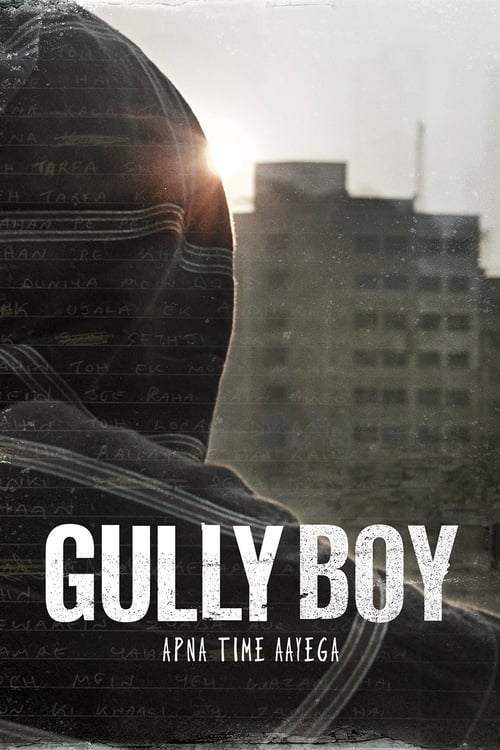
Gully Boy
2019 · Zoya Akhtar
For when you need the good kind of underdog rush — a film to leave you charged up and humming the tracks. Comfort viewing with real substance under it.
What it's about
Murad is a chauffeur's son from Dharavi, one of Mumbai's largest slums, writing rhymes in private about a life he's expected to accept quietly. When he meets a local rapper called MC Sher, the city's underground hip-hop scene cracks open for him — and over one year, he tries to turn private grievance into public voice, against the pull of his family, his class, and a fierce, jealous girlfriend who's loved him since childhood.
The experience
Warm, propulsive, and openly inspirational without feeling cheap — the battle-rap and recording scenes crackle, and the film keeps its street-level texture even as it builds toward the underdog payoff you're rooting for. It'll make you want to write something.
Performances
Ranveer Singh strips away his usual flamboyance to play Murad hushed and watchful, doing his own rapping. Alia Bhatt is a livewire as Safeena — funny, volatile, unforgettable in limited screen time — and Siddhant Chaturvedi's MC Sher was an instant star-making debut.
The craft
Zoya Akhtar shoots Dharavi with respect and specificity rather than pity, and builds the film on the real Mumbai gully-rap scene — the soundtrack, assembled from a small army of Indian hip-hop artists, is a document of the movement as much as a score. The music sounds terrific on good speakers, and 'Apna Time Aayega' became an anthem far beyond the film.
Why it matters
It swept the Filmfare Awards, was India's official Oscar submission, and pushed Indian street hip-hop from subculture into the mainstream almost overnight.
Snapshot
Gully Boy is a Hindi-language musical drama about Murad Ahmed (Ranveer Singh), a Muslim chauffeur's son from Dharavi who discovers rap and, over the course of a year, converts private grievance into public voice. Written by Zoya Akhtar and Reema Kagti, with dialogue by Vijay Maurya, it was produced by Excel Entertainment (Farhan Akhtar and Ritesh Sidhwani) and Akhtar and Kagti's Tiger Baby Films. It premiered at the 69th Berlin International Film Festival in February 2019, days before its Indian theatrical release on 14 February, and became one of the year's major commercial and critical successes in Hindi cinema. It was selected as India's official submission for the Academy Award for Best International Feature Film at the 92nd Academy Awards, though it did not advance to the shortlist, and it swept the 65th Filmfare Awards, winning Best Film, Best Director, Best Actor (Singh), Best Actress (Alia Bhatt), and both supporting acting prizes (Siddhant Chaturvedi, Amruta Subhash).
Its significance is double. Formally, it is the most fully realized attempt yet to reconcile the Hindi film musical — historically built on non-diegetic playback and lip-synced fantasy — with a mode in which every song is something a character actually performs, in a real place, for real stakes. Culturally, it took a genuinely subcultural formation, Mumbai's street-rap scene of the mid-2010s, and delivered it to a mass audience with its personnel largely intact rather than replaced by industry professionals.
Industry & production
The film sits at the intersection of two industrial facts. The first is Excel Entertainment, founded in 1999 by Farhan Akhtar and Ritesh Sidhwani, one of the defining production houses of the multiplex era and a company with a specific history in music-driven realism (Rock On!!, 2008). The second is Tiger Baby, the company Akhtar and Kagti set up to control their own development, which by 2019 was also producing the Amazon series Made in Heaven. Gully Boy is thus a mid-to-large-budget star vehicle financed and marketed with full commercial machinery, but developed inside a writer-director partnership with unusual autonomy.
The project's origin is well documented in outline: Akhtar encountered the music of Divine (Vivian Fernandes) and Naezy (Naved Shaikh) — whose 2015 collaboration "Mere Gully Mein" and Naezy's earlier "Aafat!" had circulated widely on YouTube — and built a fictional composite from their trajectories rather than optioning either life story as biography. Murad is not Naezy, though he borrows his diffidence and his lyric-notebook interiority; MC Sher is not Divine, though he borrows his role as the scene's connector and elder. The film accordingly relocates its protagonist to Dharavi, the dense, economically productive settlement in central Mumbai that functions in global media shorthand as the Indian slum — a compression that buys legibility at the cost of specificity, since the real scene was dispersed across Kurla, Andheri, Malad and beyond.
The most consequential production decision was to bring the scene's artists inside the film rather than around it. Ankur Tewari served as music supervisor over a soundtrack assembled from a large collective of Indian rappers and producers — Divine, Naezy, Dub Sharma, Spitfire, Kaam Bhaari, MC Altaf, MC TodFod of Swadesi, and others — with several of them writing the verses that Ranveer Singh performs. The album is, in effect, a compilation of the scene, credited as such. Nas was reported at the time of release to have come aboard as an executive producer in connection with the film's international rollout; his Mass Appeal imprint launched an Indian joint venture the same year. Casting followed the same logic of controlled discovery: Siddhant Chaturvedi was near-unknown outside Excel's own web series Inside Edge, and much of the supporting ensemble came from theater and regional cinema (Amruta Subhash, Vijay Raaz, Vijay Varma).
Technology
The film is unusually legible as a document of a specific technological moment. The Mumbai street-rap scene it depicts was made possible by three overlapping conditions: cheap smartphones with usable cameras and audio input; free or near-free production software, so a verse could be written, recorded and mixed without booking studio time; and YouTube as a distribution channel that required no label, no gatekeeper and no physical product. Naezy's breakout was, by his own well-circulated account, shot on a handheld consumer device in his neighborhood — a fact the film dramatizes almost literally in the sequence where Murad's first video is made with borrowed equipment and no permission.
Sitting underneath this is the collapse in Indian mobile data prices following Reliance Jio's launch in September 2016, which within two years moved tens of millions of users onto high-volume mobile video. The film's plot — an unknown becomes locally famous through a link rather than a record deal — is only coherent inside that infrastructure. Gully Boy is, in this sense, a film about disintermediation that arrives via the most intermediated apparatus in Indian culture.
On the production side, the film was shot digitally on location in extremely dense environments, which constrains equipment to compact packages, fast lenses and available or minimally augmented light. The published record on exact camera and format specifications is thin, and I will not guess at it. What is observable is the consequence: a look built from small rigs moving inside real lanes rather than sets.
Technique
Cinematography
Jay Oza's photography does two distinct things and keeps them separate. In Dharavi, the camera is close, mobile and often handheld, working in corridors that are barely shoulder-width; the frame is loaded with foreground obstruction — grilles, laundry, wiring, doorways, shoulders — so that Murad is repeatedly seen through something. In the wealthy city, the camera stiffens: glass, mirrors and car interiors become the recurring apparatus. The sequences in which Murad drives an affluent family and is looked past rather than at are the film's cleanest visual thesis, staged through the rearview mirror and the closed window, an interface that permits sight but not contact.
Light follows the same logic — practical, sodium-toned and mixed in the settlement; clean, even and cold in the spaces of money. The film resists prettifying Dharavi into texture-porn, though it does not entirely escape the picturesque, and several critics said so.
Editing
Nitin Baid's cutting alternates two rhythms. Dramatic scenes are given long, patient handling with few cuts, letting performances breathe; the musical sequences then release into rhythmic montage cut to the beat, but almost always anchored to a performing body in a real location rather than to an abstract fantasy space. The film's most-discussed passage — the "Azadi" sequence, built around Dub Sharma's track sampling protest chants — is the exception that proves the rule: it is the one moment where the editing detaches into pure political montage.
Mise-en-scène / staging
Production design and location work build the film's central spatial argument: distance. Murad's home is a single room whose every dramatic beat is over-heard; the film stages the father's second marriage, the mother's humiliation and Murad's frustration inside a volume too small to permit privacy. Against this, the film sets rooftops and terraces — the settlement's only unclaimed space, and the place where writing and performing happen. The vertical geography is consistent enough to be read as a system: interiors compress, roofs release. Costume works similarly, with Murad's wardrobe shifting from anonymous, borrowed and slightly ill-fitting to chosen.
Sound
The sound design carries the film's subjectivity more than the camera does. Dharavi is rendered as continuous, layered ambience — machinery, television, argument, traffic — which the film periodically cuts away when Murad puts on headphones, dropping the world out and leaving the track. This is a simple device, used sparingly and to real effect: it makes interiority audible in a film about a character who cannot speak. The transition from written verse to recorded vocal to amplified performance is tracked with care, each stage sounding different.
Musically, Ranveer Singh performs the vocals on several of the film's key tracks himself, including "Apna Time Aayega," "Doori" and "Asli Hip Hop," and appears alongside Divine and Naezy on the reworked "Mere Gully Mein." The background score is credited to Karsh Kale with the Salvage Audio Collective. The songs remain playback in the technical sense, but they are diegetic in the dramatic sense, and the film is careful never to let a character sing something they could not be singing.
Performance
Ranveer Singh, whose star persona had been built on maximalism (Ram-Leela, Bajirao Mastani, Padmaavat), performs almost the whole film in recession — shoulders in, eyes down, voice low — so that the rap sequences function as detonations of withheld energy. It is a genuinely disciplined piece of star casting-against-type.
Alia Bhatt's Safeena is the film's sharpest creation and its most destabilizing: a medical student under strict family control who is also possessive, jealous and physically violent, refusing both the demure-Muslim-girl template and the supportive-girlfriend function the plot would ordinarily assign her. Siddhant Chaturvedi's MC Sher supplies warmth and mentorship without condescension. Vijay Raaz, Amruta Subhash and Vijay Varma give the family and neighborhood material a weight the script alone does not guarantee — Subhash in particular, whose Razia carries the film's clearest account of what patriarchy costs the generation above Murad's.
Narrative & dramatic mode
Structurally the film is a straightforward Bildungsroman with a competition climax: discovery, mentorship, first performance, viral break, family rupture, betrayal-adjacent crisis, final battle. It is the 8 Mile architecture, and the film does not pretend otherwise.
What it does differently is the treatment of song. Mainstream Hindi cinema's musical grammar is non-diegetic: songs externalize feeling, suspend time and are lip-synced in spaces the narrative does not otherwise contain. Gully Boy systematically converts this to performance realism — Murad raps because rapping is his occupation and his argument — while retaining the emotional function the tradition assigns to song. The film therefore gets to have both: the mass-audience release of a musical number and the causal integrity of a naturalist drama. That reconciliation is its principal formal achievement, and it is why the film reads as "realist" to audiences despite a plot of considerable romantic convenience.
Its dramatic weakness is the corollary. The class critique is stated with force in the first two acts — the "Doori" sequence, the driver's-seat humiliations — and then partly resolved by individual talent, which is a solution the film's own diagnosis has already ruled out for everyone who is not the protagonist.
Genre & cycle
The film belongs simultaneously to three cycles. First, the global hip-hop rise narrative — 8 Mile (2002) as the immediate template, with Straight Outta Compton (2015) in the background. Second, the Bombay underclass film, which in Hindi cinema runs from Salaam Bombay! (1988) and Dharavi (1991) through the Ram Gopal Varma and Anurag Kashyap crime cycles to Slumdog Millionaire (2008), the Anglo-Indian production against which Western reviewers inevitably measured it. Third, the "New Bollywood" musician film — Rock On!! (2008) and Rockstar (2011) — which had already begun moving songs into diegesis.
Underneath all three is an older domestic lineage: the angry young man of the 1970s, forged in Salim–Javed's screenplays for Zanjeer (1973) and Deewaar (1975), in which a slum-born, dispossessed hero confronts a rigged city. Gully Boy substitutes the microphone for the crowbar, but the grievance is inherited — a genealogy sharpened by the fact that Javed Akhtar is the director's father.
Authorship & method
Zoya Akhtar's filmography — Luck by Chance (2009), Zindagi Na Milegi Dobara (2011), Dil Dhadakne Do (2015) — is consistently about access: who is permitted inside a system, and what the permitted must pay. Luck by Chance dissected the film industry's gatekeeping; Dil Dhadakne Do anatomized the family as a corporation. Gully Boy is the same subject viewed from outside the gate. Her method is ensemble-driven, dialogue-forward and long-developed, and her partnership with Reema Kagti — co-writer, co-founder of Tiger Baby, and a director in her own right — is central rather than ancillary.
The key collaborators: Kagti on script; Vijay Maurya on dialogue, whose Bambaiya Hindi-Urdu street register does much of the work of authenticity that the visuals cannot; Jay Oza on camera; Nitin Baid, who had cut Masaan (2015), on edit; Ankur Tewari supervising a soundtrack whose actual authorship is distributed across the scene, with Spitfire, Divine, Naezy, Dub Sharma and Kaam Bhaari among those writing verses. The precise division of lyric-writing labor, and the terms on which the real artists' lives and material were licensed, are not comprehensively documented in the public record; accounts have varied, and I will not adjudicate them here.
The unavoidable authorship question is positional. A film about structural exclusion was made by a director from Hindi cinema's most established creative dynasty, produced by her brother's company. Akhtar has been publicly forthright about that privilege, and the film partly metabolizes it through Sky (Kalki Koechlin), the affluent art student who joins the "Azadi" action and can leave when it stops being fun. Whether that self-awareness constitutes an answer or a hedge was a live critical dispute.
Movement / national cinema
Gully Boy is a signature work of the post-2000s Hindi "middle cinema" turn — the multiplex-era convergence in which realist location shooting, non-star supporting casts and vernacular dialogue were absorbed into big-budget star vehicles rather than confined to a parallel sector. It shares that terrain with Kashyap, Dibakar Banerjee, Vikramaditya Motwane and Anurag Basu, but Akhtar's version is more commercially integrated than most: the film is fully a Bollywood product, with a chart soundtrack and a top-tier star, that nonetheless imports its aesthetic and much of its personnel from outside the industry.
It also participates in a global 2010s pattern of hip-hop's vernacular localization — Francophone banlieue rap, Brazilian funk and drill, K-hip-hop, Nigerian and South African scenes — where an American form is not imitated but re-grounded in local language, grievance and place. The film is explicit about this: Murad's early anxiety is precisely whether an Indian can claim the form at all, and the answer the film gives is that he can only claim it in his own tongue and his own lane.
Era / period
Released February 2019, three months before India's general election, the film arrived at a moment of intensifying majoritarian politics. Its protagonist is a working-class Muslim, and the film's insistence on that identity as ordinary rather than exceptional — a family, a job, a girlfriend, an ambition — is a quiet political act in its context, made without polemic. The "Azadi" sequence, drawing on a chant with a long history in Indian protest (feminist adaptations associated with Kamla Bhasin, later the student mobilizations at JNU in 2016), pushed further, and its presence in a mainstream release drew comment at the time. By late 2019, versions of that chant were audible in the nationwide protests against the Citizenship Amendment Act, giving the film's soundtrack an afterlife its makers could not have scheduled.
Themes
Distance. Doori — distance — is the film's organizing word and its best song. Not poverty as spectacle but proximity without access: the driver who sits three feet from wealth, the settlement that abuts the towers, the ocean of city visible from a roof you cannot leave.
Voice as the scarce resource. Murad's problem is not that he has nothing to say; it is that no channel exists for saying it. The film treats articulation as a material good, unequally distributed.
Inherited submission. The father's insistence that Murad accept his station, and the second marriage that humiliates the mother, present patriarchy and class fatalism as the same transmission mechanism. Murad's rebellion is against both simultaneously, which is why the domestic plot and the music plot resolve together.
Authenticity and its policing. Who owns the form; whether Sky's participation is solidarity or tourism; whether Murad's success removes his standing to speak for the gully. The film raises all three and settles none, which is either honesty or evasion depending on the reader.
Women's constrained ambition. Safeena's storyline is not a subplot but a parallel: she wants to be a surgeon and is permitted less than Murad at every stage, and her rage is the film's most convincing emotion.
Reception, canon & influence
Critical reception in India was strong, with particular praise for the performances, the soundtrack and the film's refusal to condescend to its milieu; international reviews were largely positive, often framing it through 8 Mile and Slumdog Millionaire comparisons that the film's Indian defenders found reductive. The dissenting line was consistent and worth recording: that the class analysis is sharper than the class politics, that the meritocratic ending softens what the first hour establishes, that a dynastic production about exclusion carries an irony it acknowledges but cannot dissolve, and that Dharavi is rendered with more visual charm than a genuinely hostile place would allow. The Oscar submission and non-shortlisting generated its own domestic debate about which Indian films are legible to Academy voters.
Backward influences. 8 Mile as structural template. The Salim–Javed angry young man as emotional inheritance. Salaam Bombay!, Dharavi and the Bombay realist tradition for milieu. Rock On!! and Rockstar for the diegetic-music grammar within Hindi cinema. And most directly, the primary sources themselves: Divine's "Yeh Mera Bombay" and "Mere Gully Mein," Naezy's "Aafat!" — songs and videos that are not merely the film's inspiration but, reworked, part of its text.
Forward legacy. The clearest effect was industrial. Indian hip-hop moved from subculture to a signed, charting, festival-booked business within roughly two years: major-label and imprint activity around the scene expanded sharply in 2019, including Mass Appeal's Indian venture with Divine; Ranveer Singh launched the independent label IncInk with artists drawn from the film's orbit; and MTV Hustle, a rap-focused competition series, launched in India in 2019 and became a durable pipeline. "Apna Time Aayega" passed into general Indian usage as a phrase, detached from the film — the surest sign of cultural absorption.
Within cinema, the film normalized the fully diegetic Hindi musical and demonstrated that a star vehicle could be built on non-industry musical talent without dilution. It launched Siddhant Chaturvedi and consolidated Akhtar's standing as a commercial director with authorial credibility. Its more ambiguous legacy is aesthetic: the "gully" look — graffiti, terraces, crew iconography — was rapidly absorbed into Indian advertising and music video, which is both the proof of its reach and the mechanism by which a subculture's visual language gets converted into a style anyone can rent.
Reception
A hit and critical darling on release — Berlinale premiere, festival buzz, and a sweep of a record 13 Filmfare Awards — its afterglow dimmed a little when India's Oscar bid went nowhere, but it has settled comfortably as the definitive Indian hip-hop movie and a gateway Bollywood pick for international viewers.
How Gully Boy was received, from release to now →
How to watch Gully Boy: what to notice on a first viewing
- Watch Murad framed through grilles, laundry, and doorways in Dharavi. Jay Oza shoots the settlement close and handheld with the frame loaded by foreground obstruction, so Murad is repeatedly seen through something rather than in open space. The camera keeps something between you and him, the same way the city does.
- Notice how often glass or mirrors separate Murad from wealth. When Murad drives an affluent family, the camera works through the rearview mirror and the closed car window, an interface that lets him be seen without ever being addressed. He is visible to these people and still completely unreachable to them.
- Listen for the world drop out when Murad puts on headphones. Dharavi's continuous layered noise, machinery, television, argument, traffic, cuts away completely the moment Murad puts on his headphones, leaving only the track. This is the one moment the film lets you hear exactly what he hears inside.
- Notice how much happens on rooftops instead of indoors. Murad's home is a single room where every family conflict is overheard, while rooftops and terraces, the settlement's only unclaimed space, are where writing and performing actually happen. Indoors compresses him. The roof is the only place he gets room to work.
- Watch Ranveer Singh keep his shoulders in and eyes down. Singh plays almost the entire film in physical recession, quiet and withheld, so that each rap sequence detonates as a release of energy he keeps hidden elsewhere. The performance is built around what he does not show you until the mic is on.
The whole guide to watching Gully Boy, with the keys for a rewatch →
Influences: the films it descends from and the films it influenced
- Deewaar (1975) — Salim–Javed's construction of class injury as a performed rhetorical set-piece — the badge number, the refusal to pick up thrown money — gives Gully Boy the device of grievance delivered as speech rather than plot, with Murad's verses occupying the exact slot Vijay's confrontation monologues held.
- Salaam Bombay! (1988) — Nair's method of working real street children into real Bombay locations with a long lens shooting through live crowd traffic is the direct precedent for Jay Oza's obstructed-foreground framing, where laundry, bodies and doorways cross the lens instead of being cleared from it.
- Dharavi (1992) — Establishes the chawl single-room as a staging unit — family conflict blocked against a doorway with the camera pinned into a corner and no room to reframe — which is precisely how Gully Boy shoots Murad's father, the second wife and the shared floor space.
- Wild Style (1983) — The founding docu-fiction bargain of hip-hop cinema: actual writers and MCs playing versions of themselves and performing their own material, which is the same contract by which Divine's and Naezy's tracks and personas are reworked into Gully Boy's text rather than merely cited as inspiration.
- 8 Mile (2002) — Supplies the battle-rap ladder as three-act spine, including the opening choke and the closing verse that pre-empts the opponent by naming the protagonist's own humiliations first — a structural template Gully Boy reproduces beat for beat while relocating the shame from trailer park to servant's quarters.
- La Haine (1995) — Codifies vertical geography as class geography — the rooftop as the only unsurveilled ground, with descent into the estate meaning re-entry into policing — the same ascent/descent axis Gully Boy uses for its terrace cyphers versus its Dharavi lanes.
- Rock On!! (2008) — Normalized in Hindi cinema that lead actors appear as the band, with songs originating in on-screen rehearsal rooms instead of playback convention — the grammar Gully Boy inherits and pushes to a fully diegetic endpoint where no song exists outside a character's authorship.
- Rockstar (2011) — Rahman and Ali build each song as a two-state object — private origin, then public stage return — and cut between the two; Gully Boy applies that same double-staging to every track, from notebook and headphone playback to the final arena performance.
- Gangs of Wasseypur (2012) — Sneha Khanwalkar's field-recorded score sourced from non-industry regional singers proved a Hindi soundtrack could carry distributed, located authorship; Gully Boy extends that model into a star vehicle with verses written across Divine, Naezy, Spitfire, Dub Sharma and Kaam Bhaari.
- Luck by Chance (2009) — Akhtar's own audition grammar — the outsider held in a sustained medium shot while insiders decide off-screen whether he may speak — is reused verbatim in Gully Boy's label, studio and casting-gate scenes, making the framing itself the film's argument about access.
- Masaan (2015) — Editor Nitin Baid's practice of ending a scene on a held, unresolved reaction and bridging the cut with sung verse carries straight into Gully Boy, where his cut-to-the-beat montages let a song's downbeat, not a line of dialogue, close the emotional beat.
- Slumdog Millionaire (2008) — Akhtar films a Dharavi rise-from-the-slum narrative shot in real slum density, substituting rap performance for the quiz show as the music-powered engine of escape.
- Jhund (2022) — Casts actual settlement youth opposite a legacy star and makes a literal boundary wall the film's controlling geography, extending Gully Boy's proof that non-professional talent from the milieu can carry a star vehicle without being smoothed into extras.
- The Archies (2023) — Akhtar builds a second fully diegetic musical, songs performed in-world by a cast of newcomers with no playback convention — the same refusal of the omniscient song slot she established in Gully Boy, now applied to period pastiche.
- Kho Gaye Hum Kahan (2023) — Tiger Baby's follow-through on Gully Boy's YouTube-upload device: the phone screen and feed become the narrative surface itself, with disintermediated self-publication driving plot rather than merely enabling a breakout.
- Superboys of Malegaon (2024) — Kagti transposes the Gully Boy premise into VHS-era filmmaking — amateurs building an art form with cheap consumer technology outside the industry gate, cast with unknowns — carrying over the same collaborator-authored script method she co-wrote with Akhtar.
- Patti Cake$ (2017) — Commits to actor-performed vocals recorded to camera rather than lip-sync, which is what permits battles and freestyles to be shot as continuous performance — the same production decision that lets Ranveer Singh's verses hold in long takes.
- Straight Outta Compton (2015) — Stages the writing and tracking of a verse as a real-time scene and turns the concert into political confrontation; Gully Boy's 'Azadi' does the same work by folding Dub Sharma's sampled protest chant into a montage of found political audio.
- Sairat (2016) — Puts unsanitized regional vernacular in the mouths of non-industry leads and treats the score as the film's argument rather than decoration — the register work Vijay Maurya's Bambaiya Hindi-Urdu dialogue performs for Gully Boy's claim to authenticity.
Similar films
- Salaam Bombay! (1988) — influence & lineage · same viewing thread
- Straight Outta Compton (2015) — influence & lineage
- Masaan (2015) — influence & lineage
- La Haine (1995) — influence & lineage · same viewing thread
- Slumdog Millionaire (2008) — same viewing thread
- Souleymane's Story (2024) — same viewing thread
- Dhurandhar (2025) — shared sensibility
- Udaan (2010) — shared sensibility
All the films related to Gully Boy →
Watch it with: curated runs of related films
- Cinema of the Dispossessed — A run of slum-and-favela dramas — Rio, Mexico City, Mumbai, the Paris banlieue — where children survive by their wits and the city itself is the antagonist.