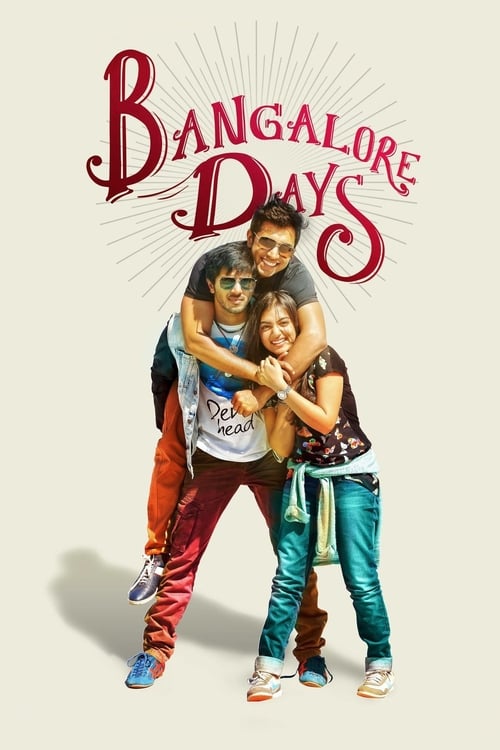
Bangalore Days
2014 · Anjali Menon
For a feel-good weekend watch with the whole couch — when you want to laugh, swoon, and get a little misty without anything cynical in the mix. Pure comfort, made with care.
What it's about
Three cousins from small-town Kerala land in Bangalore with very different agendas: one arrives through an arranged marriage, one is running from home, and one is drifting toward a life he hasn't chosen yet. The big city — with its traffic, bike races, offices, and strangers — starts rearranging all their certainties about love, family, and what they actually want.
The experience
Warm, funny, and generous — a big ensemble hangout movie that slides easily from broad comedy into real ache and back. It's nearly three hours and earns them; by the end these cousins feel like your own.
Performances
A murderers' row of the Malayalam new generation — Dulquer Salmaan, Nivin Pauly, Nazriya Nazim, and Parvathy — with Fahadh Faasil's near-silent turn as a withdrawn husband as the film's still, magnetic center.
The craft
Anjali Menon's tonal control is the signature: she orchestrates half a dozen storylines and moods without ever letting the film curdle into melodrama or fall apart into sketches. It's mainstream entertainment built on naturalistic, character-first foundations — bombast-free and all the more affecting for it.
Why it matters
A landmark of Malayalam cinema's 2010s resurgence and one of its biggest hits ever — proof that the industry's new naturalistic sensibility could also be a massive popular success, from one of the few women directing at this scale in India.
Three cousins from small-town Kerala converge on Bangalore — one chasing an arranged marriage, one chasing escape, one chasing nothing in particular — and the big city rearranges all their certainties. Anjali Menon's ensemble film became a landmark of Malayalam cinema's 2010s resurgence, proof that the industry's new sensibility — naturalistic, character-first, allergic to bombast — could also be a massive popular success; it stood for years among the highest-grossing Malayalam films ever made. Menon, one of the few women directing at this scale in Indian cinema, orchestrates a murderers' row of the Malayalam new generation: Dulquer Salmaan, Nivin Pauly, Nazriya Nazim, Parvathy, and Fahadh Faasil, whose near-silent turn as a withdrawn husband is the film's still center. The craft signature is tonal control — Menon slides from broad comedy into divorce, disability, and thwarted motherhood without a gear-grind, treating the multiplex family entertainer as a vessel for real feeling. For many viewers outside India, this was the gateway drug to Malayalam cinema, the film passed hand to hand with the instruction: start here.
Reception
An instant blockbuster in 2014 — one of Malayalam cinema's biggest hits at the time — it never needed a reappraisal; a decade on it has simply hardened into the definitive modern Malayalam comfort-classic and the default gateway film for newcomers to the industry.
How Bangalore Days was received, from release to now →
Influences: the films it descends from and the films it influenced
- Manjadikuru (2008) — Menon's own debut feature already builds a large ancestral-home ensemble whose overlapping vignettes are held together by soft-toned editing and child's-eye naturalism — the multi-character choreography and warm-nostalgic register she scales up for the three-cousins structure of Bangalore Days.
- Ustad Hotel (2012) — Menon wrote this screenplay, refining her signature grandparent-as-emotional-anchor device and the arc of a rootless young urbanite reconciled to family through a mentor — the same script architecture of generational reconciliation she directs in Bangalore Days.
- Sandesham (1991) — The template of the Malayalam family entertainer that laces broad domestic comedy with sharp social observation and lets a full household of characters breathe — the tonal-control model of comedy-into-pathos that Menon inherits for the family-entertainer register.
- Thoovanathumbikal (1987) — Padmarajan's unhurried, behaviorally observed romance established Malayalam cinema's naturalist grammar of restraint — minimal underscoring, actors playing subtext over dialogue — the performance idiom of minimalist restraint Menon's ensemble works in.
- Namukku Parkkan Munthiri Thoppukal (1986) — Bharathan's lyrical rural-to-urban romantic melodrama fused location naturalism with emotional lushness, a middle-cinema balance of poetry and realism that underwrites Bangalore Days' rural-nostalgia-versus-city-migration texture.
- Dil Chahta Hai (2001) — Akhtar's foundational modern-Indian friendship ensemble — three young leads whose diverging love lives are cross-cut and resolved through group loyalty — is the pan-Indian structural blueprint Menon adapts into a cousins-in-the-city trio.
- Premam (2015) — Extends the youth-ensemble naturalism into a generational-friendship saga, doubling down on unforced performances, ambient location realism and the tonal drift between comedy and heartbreak that Bangalore Days popularized for the same audience.
- Charlie (2015) — Reunites Dulquer Salmaan in a whimsical, warmly lit ensemble travelogue whose picaresque interlocking-lives structure and buoyant tonal control build directly on Bangalore Days' feel-good New Generation template.
- Maheshinte Prathikaram (2016) — Pushes New Generation naturalism further into slice-of-life realism — small-town ensemble, minimalist non-performative acting, comedy mined from everyday behavior — the restraint-and-tonal-control lineage Bangalore Days helped mainstream.
- Koode (2018) — Menon's own later feature revisits the migrant-returns-to-family structure and sibling-bond emotional core with the same naturalist ensemble direction and delicate comedy-to-grief tonal modulation she refined on Bangalore Days.
- Kumbalangi Nights (2019) — Carries the ensemble-family naturalism to its apex — a household of brothers observed with location realism, restrained performance and comedy braided into serious emotion — extending the craft Bangalore Days brought to popular success.
- Traffic (2011) — The film that ignited the Malayalam New Generation movement, its hyperlink multi-strand ensemble braided by momentum-driven editing established the crisp, interlocking-lives narrative mode Bangalore Days shares.
- Salt N' Pepper (2011) — A New Generation dramedy that modernized the family entertainer with urban young professionals, understated performances and a light comedic-to-tender tonal glide — the same contemporary-realist register and demographic Menon targets.
- 22 Female Kottayam (2012) — Part of the same New Generation wave, it foregrounded a young woman's agency and interiority with naturalist performance and city settings — a sibling in reimagining Malayalam gender roles inside restrained realism, echoed in Menon's Divya/Sarah arcs.
- Neelakasham Pachakadal Chuvanna Bhoomi (2013) — A New Generation road film built on location-shot naturalism and youthful restlessness, sharing Bangalore Days' movement-era aesthetic of real spaces, natural light and young protagonists navigating migration and freedom.
- Om Shanti Oshana (2014) — Released the same year, it delivers a female-POV coming-of-age dramedy with the identical New Generation blend of gentle comedy, naturalist small-town texture and Nivin Pauly's affable everyman restraint.
Similar films
- Premam (2015) — influence & lineage
- Kumbalangi Nights (2019) — influence & lineage
- C/o Kancharapalem (2018) — shared sensibility
- Meiyazhagan (2024) — shared sensibility
- Manjummel Boys (2024) — shared sensibility
- Lost Ladies (2024) — shared sensibility
- Aavesham (2024) — shared sensibility
- Nadodikkattu (1987) — shared sensibility