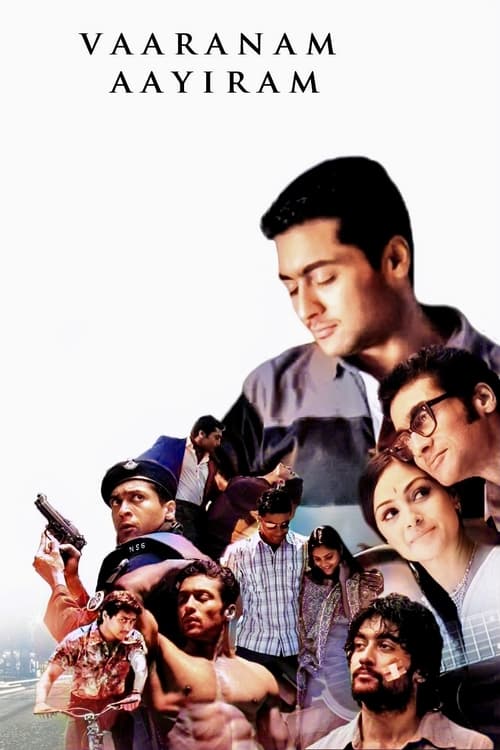
Vaaranam Aayiram
2008 · Gautham Vasudev Menon
For when you want a big emotional saga to surrender to — ideally with tissues nearby. This is the film for missing your parents, or calling your father afterward.
What it's about
When his father dies, a young Tamil man looks back across both their lives — telling the story of the man who raised him alongside his own coming of age through first love, devastating loss, addiction, and a test of courage far from home. It's a son's eulogy stretched into an epic, with one actor playing both father and son across the decades.
The experience
Sweeping and openly sentimental in the best sense — it wants you to feel everything, and mostly you do. The film moves through whole lifetimes, so it plays like a flood of memory: romantic highs, gutting lows, and music carrying you between them.
Performances
Suriya's dual role as father and son is the whole show: two distinct men, two body languages, aging across decades, in what's widely considered career-best work.
The craft
Gautham Vasudev Menon directs with glossy, romantic sweep, and Harris Jayaraj's songs became inescapable — this is a film where the soundtrack does real emotional lifting and rewards good speakers. The double-role construction lets a single face carry an entire generational argument about inheritance and grief.
Why it matters
It won the National Film Award for Best Feature Film in Tamil and stands as a benchmark of prestige mainstream Tamil cinema — proof a star vehicle could double as a deeply personal memory piece.
Snapshot
Vaaranam Aayiram ("A Thousand Elephants") is a Tamil-language memory film in which a son narrates his late father's life, and his own, across the span between two funerals. Directed by Gautham Vasudev Menon at the height of his commercial and authorial standing, it stars Suriya in a dual role as the father, Krishnan, and the son, Surya — a performance widely regarded as among the finest of his career, built on physical transformation and generational contrast. The film braids romance, bereavement, addiction, and a military rescue into a single emotional arc anchored by the father-son bond. It won the National Film Award for Best Feature Film in Tamil, cementing its standing as a prestige work within mainstream Tamil cinema rather than a purely commercial star vehicle. The title derives from a verse in Andal's Nachiyar Thirumozhi, in which the poet-saint dreams of a wedding procession with a thousand elephants — a devotional image of longed-for union that Menon repurposes as a secular meditation on love, marriage, and the passage of a life.
Industry & production
The film was produced by Aascar Film Pvt. Ltd., the banner of V. Ravichandran, a company associated with large-canvas Tamil productions of the period. It arrived at a moment when Tamil cinema's leading directors were increasingly pursuing "personal" epics under mainstream budgets, and Menon — coming off the police procedurals Kaakha Kaakha (2003) and Vettaiyaadu Vilaiyaadu (2006) — used Vaaranam Aayiram to pivot toward autobiographical melodrama. The production was notable for its scale of geography: substantial portions were shot outside India, aligning with the era's taste for foreign locales in upscale Tamil films. Suriya, then one of the industry's most bankable stars, committed to a demanding dual assignment that required distinct body types and ages for father and son, making the production as much a showcase of actor-craft as of directorial vision. The exact budget and box-office figures are not something I can state with confidence, so I will not assign numbers; what is secure is the film's positioning as a high-profile, prestige-seeking release that paid off critically through its National Award recognition.
Technology
Released in 2008, before the wholesale shift to digital acquisition in Tamil cinema, the film was in all likelihood photographed on 35mm — consistent with the industry norm of the moment — though I would flag that as inference from period practice rather than a documented specification. The more conspicuous "technology" of the film is prosthetic and physical: Suriya's embodiment of two generations relied on aging makeup, hairstyling, and a pronounced change in physique between the lean, contemporary son and the fuller, older father. The romance and travel sequences leaned on then-current conventions of glossy location cinematography and post-production color, while the climactic action set-piece required staging and effects work of a scale beyond Menon's earlier, more grounded thrillers. This is not a film remembered for technological innovation per se; its ambitions were emotional and performative, and its technical resources were marshalled toward transformation and travel rather than spectacle for its own sake.
Technique
Cinematography
The photography favors a warm, romantic register that suits a film organized around remembrance. The cinematography is credited to R. Rathnavelu (Ratnavelu), and the visual approach matches the era's polished, saturated look for Tamil romance — soft light for the courtship passages, expansive framing for the foreign-location sequences, and a more subdued palette for grief and the funereal frame. Because the film moves between decades and continents, the camera is asked to differentiate periods and moods, lending the father's earlier chapters a nostalgic tonality distinct from the son's contemporary story. Where I am uncertain about specific unit or second-unit credits, I will not speculate.
Editing
The film's structure is fundamentally an editorial achievement: it opens near an ending — the father's death — and reconstructs two lifetimes through flashback and voiceover. The cutting must sustain a long, discursive runtime while keeping the emotional throughline legible, moving fluidly between the frame narrative (the son accompanying the body) and the embedded memories. Song sequences function as compressed emotional chapters, and the editing has to modulate between the leisurely rhythm of romance and the urgency of the later action and rescue material. The film is long by design, and part of its critical conversation concerns whether its episodic breadth is a virtue of scope or a test of pacing.
Mise-en-scène / staging
Menon's staging is domestic and intimate at its core. The father's household — his marriage, his principles, his relationship with his sons — is rendered through everyday spaces and gestures, and the film repeatedly returns to the home as the emotional ground from which the son's wider adventures depart. Against this domestic anchor, the film sets contrasting environments: American college-town romance, urban tragedy, and finally a militarized wilderness. The staging deliberately widens the aperture as the son's life expands, so that the movement from living room to battlefield tracks the arc from inheritance to self-definition.
Sound
Harris Jayaraj's score and songs are inseparable from the film's texture; music is not decoration here but a primary vehicle of feeling, with the montage-song serving as the film's characteristic emotional unit. The sound design must also carry the tonal shifts — the hush of mourning, the ambience of romance, the concussive register of the climactic action. Voiceover narration is a load-bearing element of the soundtrack, since the entire film is framed as the son's spoken remembrance. Specific mixing and design credits I will not invent.
Performance
The film lives on Suriya. As the father, he plays warmth, integrity, and settled maturity; as the son, he traverses infatuation, heartbreak, dissolution, and hardened resolve. The dual role is not a gimmick of split-screen novelty but a thesis — that a son carries his father forward — and the performance is calibrated so that the two men rhyme without collapsing into each other. The supporting performances frame this center: Simran as the mother/wife Malini lends the father's chapters their tenderness, and the son's romance is carried by Sameera Reddy as Meghna, whose loss triggers the film's darkest turn. The ensemble is in service of a star performance that most critics singled out as the film's crowning element.
Narrative & dramatic mode
The dramatic mode is elegiac melodrama structured as retrospective narration. The framing device — a son transporting his father's body and, in the telling, resurrecting the man's whole life — gives the film license to be episodic, sweeping across courtship, marriage, childhood, first love, catastrophe, addiction, recovery, and military service. This is a "life-story" architecture, closer to the biographical novel than the tightly plotted thriller Menon had previously favored. The romance passages adopt the conventions of the modern Tamil love story; the bereavement and addiction passages tip into tragedy; the climax shifts into action-adventure as the son becomes a soldier and undertakes a rescue. The connective tissue is thematic rather than causal: each chapter tests whether the son can live up to, or be redeemed by, the example of the father. The tragic hinge — the death of Meghna, tied to the 2006 Mumbai commuter-train bombings — is what pivots the film from romance to grief and, ultimately, toward the son's reconstitution of himself in his father's image of strength.
Genre & cycle
The film sits at the confluence of several genres: the family melodrama, the romance, and, in its final movement, the military action film. Within Tamil cinema it belongs to the mid-2000s cycle of upscale, urban, emotionally earnest star vehicles that sought both mass appeal and critical legitimacy. It also participates in the enduring Indian tradition of the father-tribute film — works that foreground filial devotion and generational continuity as their central value. Menon's particular inflection is a cosmopolitan, English-fluent, middle-class milieu, distinguishing his romances from more rural or working-class registers. The late genre-swerve into commando action is characteristic of Tamil cinema's comfort with tonal breadth within a single feature, where a film may be simultaneously a love story, a grief drama, and an action picture.
Authorship & method
Vaaranam Aayiram is Menon's most personal film, understood as a tribute to his own father and thus as autobiographical in impulse if not in literal detail. Menon's authorial signatures are all present: first-person voiceover; articulate, semi-Anglicized dialogue; romance built through montage and music; a cosmopolitan urban sensibility; and a recurring interest in men defined by codes of duty. His method here fuses the personal essay-film impulse with mainstream star spectacle.
The key collaborators reinforce that authorship. Composer Harris Jayaraj, Menon's frequent partner, supplies a song score integral to the film's popularity and emotional design. The cinematography (credited to R. Rathnavelu) delivers the romantic, period-differentiated look the memory structure requires. The editing sustains a long, non-linear architecture; Menon's films of this period were associated with editor Anthony, and the cutting reflects the director's preference for narration-led flow. Menon himself is the writer, which is essential to reading the film as authorial: the screenplay's autobiographical framing and voiceover structure are the director's own, not an adaptation. Where I cannot verify a precise crew credit, I have left it unattributed rather than guess.
Movement / national cinema
The film is a product of Kollywood — the Tamil-language film industry centered in Chennai — during a confident, outward-looking phase in the 2000s. It reflects that industry's growing engagement with diasporic and international settings, its high production polish, and its ambition to win national recognition alongside regional box-office success. It is not part of an avant-garde or parallel-cinema movement; rather, it exemplifies mainstream Tamil cinema's capacity to absorb personal, prestige-oriented storytelling into a commercial star framework. Its National Award situates it within the officially sanctioned canon of Indian regional cinema while its songs and star kept it firmly in the popular mainstream.
Era / period
The film is thoroughly of its late-2000s moment. Its contemporary chapters engage a globalized, post-liberalization Indian middle class comfortable with study and romance abroad, and its tragic pivot is explicitly tethered to the traumas of the mid-2000s, invoking the 2006 Mumbai train bombings as the event that shatters the son's world. The military-rescue climax speaks to a period preoccupation with terrorism and national security in popular Indian storytelling. At the same time, the father's chapters reach back across earlier decades, so the film functions partly as a generational time-capsule, contrasting an older India of settled domestic virtue with a younger, more mobile and more exposed one.
Themes
The governing theme is inheritance — what a son receives from a father, and how a life becomes a form of continuation. Around this cluster love in several registers (young infatuation, enduring marriage), grief and its capacity to destroy or to forge, and redemption through discipline and duty. The film argues that character is transmitted: the father's integrity becomes the template by which the son, after collapse, rebuilds himself. Devotion is central — filial devotion above all, but also romantic devotion and, faintly through the title's Andal reference, a devotional idiom of longing and union transposed into human relationships. Masculinity is examined not as dominance but as tenderness plus resolve, embodied in a father who is gentle and principled and a son who must learn to be both. Loss and memory frame everything: the entire narrative is an act of mourning that insists remembrance is itself a form of love.
Reception, canon & influence
Critically, the film was received as an ambitious, emotionally resonant work and a career-defining showcase for Suriya, whose dual performance drew particular praise; its National Film Award for Best Feature Film in Tamil is the clearest institutional marker of that esteem. Discussion of the film also tends to note its length and episodic sprawl as the natural cost of its life-story ambitions — a point on which admiration and reservation coexist. I would flag that granular reception detail (specific reviews, exact commercial figures) is not something I can reproduce reliably here, so I confine myself to the well-established consensus of critical regard.
Looking backward, the film's influences are the traditions it synthesizes: the Indian father-tribute melodrama, the modern Tamil urban romance that Menon himself had helped shape, and the broad, life-spanning biographical mode common to South Asian popular cinema, all inflected by the director's autobiographical impulse and cosmopolitan sensibility. Looking forward, its legacy rests most on consolidating Menon's authorial brand — voiceover-driven, music-saturated, emotionally sincere romance-dramas about dutiful men — and on furnishing Suriya with one of his signature performances, a reference point in subsequent assessments of his range. Its Harris Jayaraj songs entered the enduring popular repertoire and remain among the most recognizable elements of the film's afterlife. Within Tamil cinema it stands as a durable example of how a mainstream star vehicle can also be a personal, award-honored work — a template of prestige melodrama that later filmmakers and audiences continued to measure the form against.
Reception
A hit in 2008 with somewhat mixed reviews — critics loved Suriya but called the film episodic and indulgent — it has since been nostalgically canonized by a generation of Tamil-cinema fans as Gautham Menon's most personal work, the one people rewatch on Father's Day.
How Vaaranam Aayiram was received, from release to now →
Influences: the films it descends from and the films it influenced
- Nayakan (1987) — Establishes the Tamil template Vaaranam extends — tracking one man's whole life across decades in discrete chapters, with the lead physically aged from youth to old age as the structural spine.
- Alaipayuthey (2000) — Its intercutting of a montage-built courtship against a present-day frame is the nonlinear-flashback romance grammar Menon inherits and rebuilds as memory triggered by the father's death.
- Roja (1992) — The A.R. Rahman method of using the song as a self-contained emotional narrative unit rather than an interlude is exactly the song-as-chapter design Harris Jayaraj's score for Menon descends from.
- Indian (1996) — Tamil precedent for a single star playing father and son with old-age prosthetics, the dual-role-plus-aging-makeup device Suriya deploys as Krishnan and Surya.
- Forrest Gump (1994) — Its retrospective first-person voiceover threading a man's episodic life through public historical events is the narration-led life-story architecture Vaaranam adopts (down to war and cross-continental settings).
- The Godfather Part II (1974) — Model for a parallel father-and-son generational structure in which the two lives, played across time, are cross-cut and mutually illuminated rather than told sequentially.
- Apur Sansar (1959) — The humanist episodic-life mode — a life narrated through selected chapters of love, marriage, loss and fatherhood — that underwrites the film's biographical sprawl.
- Minnale (2001) — Menon's own debut fixes his authorial signatures — confessional first-person voiceover, semi-Anglicized urban dialogue, romance carried by music montage — that Vaaranam scales up to a life story.
- Kaakha Kaakha (2003) — Consolidates Menon's recurring protagonist type — the dutiful man defined by a code — and the tonal-swerve method of shattering romantic idyll with sudden violence that Vaaranam reuses.
- Vinnaithaandi Varuvaayaa (2010) — Directly extends the voiceover-driven, music-saturated urban romance brand, again narrating a courtship in retrospect through a montage-and-song structure.
- Neethaane En Ponvasantham (2012) — Pushes the episodic-life-story device further by charting a single relationship across distinct age-stages, each demarcated like the chapters of Vaaranam's memory structure.
- Achcham Yenbadhu Madamaiyada (2016) — Late-Menon reiteration of the road-and-voiceover romance with a Rahman song-score functioning as continuous narrative connective tissue, the mature form of his song-as-chapter method.
- 96 (2018) — Builds an entire Tamil romance as a memory framing device — a present-day reunion unlocking period-differentiated flashback — the grief-and-memory retrospective architecture Vaaranam popularized.
- Ye Maaya Chesave (2010) — Menon's bilingual companion piece applies the same first-person-narrated, period-flashback romance method to a Telugu register and diasporic aspiration.
- OK Kanmani (2015) — Contemporary cosmopolitan romance built on the same integration of narration, song montage and modern-urban sensibility that Menon and Ratnam had been trading back and forth.
- 24 (2016) — A Suriya vehicle that again splits the star into multiple roles differentiated by physical transformation, extending the dual-role-as-showcase logic Vaaranam pioneered for him.
Similar films
- 96 (2018) — influence & lineage
- Nayakan (1987) — influence & lineage
- Asuran (2019) — shared sensibility
- Kannathil Muthamittal (2002) — shared sensibility
- Iruvar (1997) — shared sensibility
- Thanmathra (2005) — shared sensibility
- Thalapathi (1991) — shared sensibility
- Premam (2015) — shared sensibility