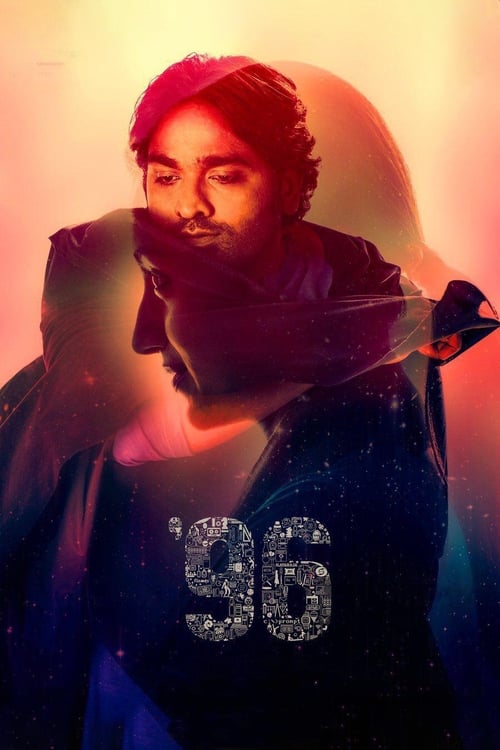
96
2018 · C. Prem Kumar
For a late night when you want to ache a little — first love, the road not taken, the person you never got over. Bring tissues; this is a good-cry film that treats heartbreak with dignity.
What it's about
Ram, a wandering travel photographer, drifts back to his hometown of Thanjavur, walks into his old school, and is flooded by memories of 1994 and the classmate he silently loved. A batch reunion brings him face to face with Janu — now married and living abroad — and most of the film unfolds over a single night as the two of them retrace what they were to each other, what went unsaid, and what remains.
The experience
Tender, unhurried, and quietly devastating — a film of long conversations, loaded silences, and songs that carry twenty years of feeling. It never raises its voice, which is exactly why it hits so hard.
Performances
Vijay Sethupathi plays Ram's shyness and stalled longing with disarming softness, and Trisha Krishnan gives Janu a grace and directness that anchors the whole night; together they make restraint feel electric.
The craft
Writer-director C. Prem Kumar, in his debut, strips the big-gesture romance down to two people talking through one night, cutting between the 1990s and the present so each era deepens the other. The music is doing serious emotional work here — this is a film to watch with good sound and no distractions.
Why it matters
Embraced as a landmark of restraint in Tamil commercial cinema, it became a modern touchstone for the unresolved-first-love story and a career-defining film for everyone involved.
Snapshot
96 is a Tamil-language romantic drama that turns a school reunion into a nocturnal reckoning with a love that was never spoken and can never be resumed. Ram (Vijay Sethupathi), an itinerant travel and nature photographer, drifts back to his hometown of Thanjavur, wanders into his old school at night, and — moved by the ghosts of the mid-1990s — helps organize a reunion of his batch. There he meets Janaki, "Janu" (Trisha Krishnan), the girl he loved and lost, now married and settled in Singapore. The bulk of the film unfolds across a single night in which the two, chaperoned by the awkward tenderness of middle age, retrace what happened, why it ended, and what remains. Directed and written by C. Prem Kumar in his feature debut, the film was widely embraced as a landmark of restraint in a commercial cinema often given to spectacle, and it revived Trisha's career while confirming Sethupathi's range. Its reputation rests on three pillars: a screenplay that trusts silence, two lead performances of unusual delicacy, and a score by Govind Vasantha that became inseparable from the film's afterlife.
Industry & production
96 was produced by S. Nandagopal for Madras Enterprises, a comparatively modest independent production by the standards of star-driven Tamil (Kollywood) cinema of the late 2010s. Its economics were closer to a mid-budget passion project than a mass-market vehicle: a contained story, largely nighttime and interior settings, a small principal cast, and a first-time director. Vijay Sethupathi, by 2018 one of Tamil cinema's most bankable character-leads precisely because he worked against conventional hero iconography, lent the project commercial viability; Trisha, a major star of the 2000s, returned in a role that reframed her as a dramatic actor rather than a glamour lead. Released in October 2018, the film performed well beyond its scale — commonly described as a sleeper success that held screens on word of mouth and repeat viewing. Precise budget and gross figures are not something I can verify with confidence, so I will not cite numbers. Its commercial durability was significant enough to prompt an official remake pipeline (see below), which is itself a market signal that the property was seen as reproducible across the South Indian industries.
Technology
On the specific camera and post-production toolchain used for 96, the public record is thin, and I will not invent equipment credits. What can be stated is contextual: by 2018 Tamil features were shot almost entirely on digital cinema cameras and finished through a digital intermediate, and 96 is visibly a product of that regime — its control of low-light interiors, the clean rendering of the long night, and the graded separation between the warm past and the cooler present all depend on digital capture and a color-managed grade. The film's aesthetic ambition is not technological novelty but technological restraint: available-light naturalism rather than heavy VFX or stylization. Sound was finished for standard theatrical multichannel exhibition, which matters because the film leans on quiet — room tone, the hum of a parked car, a song heard through a phone — where the absence of noise is doing dramatic work.
Technique
Cinematography
Cinematography is credited to Mahendiran Jayaraju and N. Shanmuga Sundaram, working under a director who is himself a trained cinematographer — and that lineage is legible in every frame. The film builds a deliberate two-register visual grammar. The 1990s flashbacks are warm, softly saturated, sunlit — memory as amber. The present-day night is cooler, lower-key, lit as if by streetlamp and dashboard: intimate, slightly melancholy, unglamorous. The camera favors patience over coverage — held two-shots, quiet reframings, faces allowed to change in real time rather than being cut around. Compositions frequently place the two leads within a single frame separated by small distances (a car's front seats, a table, a doorway), so that the physical geometry of the shot carries the film's central ache: proximity without permission to touch. The restraint is pointed in an industry where romance is often signaled through montage and song picturization; here the visual style withholds, and the withholding is the meaning.
Editing
The editing (R. Govindaraj) is organized around the film's boldest structural choice: a near-real-time single night braided with flashbacks to school. The cut has to sustain long conversational stretches without the crutch of incident — no melodramatic reversals, few plot mechanics — and it does so by trusting duration. Scenes are allowed to breathe past the point where a conventional edit would move on, which is precisely what lets the audience feel the accumulation of unsaid things. The intercutting between eras is motivated by association and memory rather than by exposition, so the past arrives the way it does in life: triggered by a place, a song, a face. The rhythm is slow but not inert; its tension comes from anticipation of contact that keeps being deferred.
Mise-en-scène / staging
The staging is chamber-drama intimate. Much of the film is a two-hander confined to a car, a house, a studio, the school grounds — spaces that concentrate the actors and eliminate distraction. Props and place carry heavy symbolic freight without being underlined: the school as a vessel of the past, the photographer's images as a life spent looking rather than living, the domestic interiors of the present as evidence of the separate lives that intervened. Blocking repeatedly dramatizes the tension between wanting to close distance and being unable to, and the director stages hesitation — a hand that doesn't reach, a sentence that doesn't finish — as the film's primary event.
Sound
Sound design and score are arguably the film's signature achievement. Govind Vasantha's music is not ornamental; it is structural, functioning almost as a third character in the long night. Songs are woven into the drama with unusual care — a piece of music can be the reason two people sit in a car a little longer, or the safe channel through which feeling that cannot be spoken gets expressed. The film also uses silence and ambient room tone deliberately, so that music, when it enters, lands with force. The most celebrated instance is the diegetic weight given to song: Janu singing becomes a moment of exposed intimacy, and the score's recurring themes act as emotional memory, tying present to past.
Performance
The performances are the reason the film's minimalism reads as fullness rather than emptiness. Vijay Sethupathi plays Ram as a soft-spoken, self-contained man whose stillness conceals a lifetime of arrested feeling; his choice to underplay — to let small facial shifts carry scenes — is central to the film's tone. Trisha's Janu is the film's revelation for many viewers: composed, warm, quietly devastated, negotiating loyalty and longing without a single overwrought beat. The chemistry is built on restraint rather than heat. The younger counterparts — Aadithya Bhaskar as the teenage Ram and Gouri G. Kishan as the teenage Janu — are essential rather than decorative; their fresh, unforced work in the flashbacks establishes the innocence the adult scenes mourn, and Kishan in particular drew notice for a debut of striking naturalness.
Narrative & dramatic mode
The dramatic mode is intimate realism verging on the elegiac — a two-hander memory play. Its structure is a nested time scheme: a present-tense night that obeys something close to real-time continuity, threaded with chronological flashbacks to adolescence. Crucially, the film is built around non-consummation. It refuses the reunion-romance genre's implicit promise that the lovers will finally unite; instead its engine is the productive tension between everything the characters feel and everything their circumstances (marriage, elapsed time, decency) forbid. Conflict is internal and ethical rather than external and plotted — there is no villain, no contrivance keeping them apart beyond life itself. This places the film closer to the tradition of the "brief encounter" — two people granted a single suspended interval to say what was never said — than to conventional Kollywood romance, and its emotional payoff is catharsis-through-restraint rather than resolution.
Genre & cycle
96 belongs to a strain of nostalgic, realist Tamil romance that gained prominence in the 2010s — films that traded high-gloss courtship for texture, memory, and everyday feeling. It is legibly in dialogue with the Mani Ratnam lineage of naturalistic urban romance (Mona/Alaipayuthey, Minnale), and it makes that inheritance explicit: the film's use of a "Vaseegara"-associated melody deliberately evokes Minnale (2001) and the emotional vocabulary of that earlier moment, a knowing citation that positions 96 as both continuation and reflection. Within the broader "school/college reunion" and "first-love-revisited" cycle common across Indian cinemas, 96 distinguishes itself by refusing wish-fulfillment. It is a romance defined by what does not happen.
Authorship & method
The film is decisively an authorial debut. C. Prem Kumar wrote and directed it, and its unity of tone — patient, sincere, unshowy — reflects a single controlling sensibility. His background as a cinematographer is not incidental; the film's confidence in visual storytelling, its willingness to let images and duration carry emotion rather than dialogue, is the mark of someone who thinks in shots. His key collaborators are unusually central to the result. Govind Vasantha, as composer, is effectively a co-author of the film's emotional architecture; his score and songs — including widely beloved tracks associated with the film such as "Kaathalae Kaathalae" and "Life of Ram" — became cultural artifacts in their own right, and his work on the film was honored at the national level (Govind Vasantha received the National Film Award for Best Music Direction for 96). Playback singers, notably Chinmayi and Pradeep Kumar, are strongly identified with the film's sound. The cinematographers (Mahendiran Jayaraju and N. Shanmuga Sundaram) executed the two-register visual scheme, and editor R. Govindaraj realized the demanding present/past braid. The method throughout is subtractive: strip incident, trust performance, let music and silence do what plot usually does.
Movement / national cinema
96 is a product of Tamil cinema (Kollywood), the Chennai-based industry that is one of the largest and most distinct of the South Indian film cultures. It sits within a late-2010s current of "content-driven" South Indian filmmaking in which mid-budget, character-first films — often built around actors like Vijay Sethupathi who deliberately declined the conventional mass-hero mold — found major audiences without the apparatus of spectacle. The film's success across state and language lines (through its remake and its music) also reflects the increasing pan-South circulation of Tamil and Telugu properties in this period. It is not the product of a formal "movement" with a manifesto, but it is representative of a real shift in the industry's appetite toward intimate realism.
Era / period
The film operates across two periods and is acutely conscious of both. Its emotional heart lies in the mid-1990s — a pre-digital, pre-mobile adolescence rendered with careful nostalgia, where distance was truly distance and a lost contact could be lost for decades. That specificity is not merely decorative; the entire premise depends on a world in which two people could be separated so completely that a reunion 22 years later is genuinely a reunion with the unknown. The present is the connected, diasporic 2010s — Janu lives abroad, lives are documented and photographed, and yet the technologies of connection cannot undo the separation that the analog past made permanent. The film's power comes partly from this friction: it is a story about memory made for, and about, an era that no longer forgets in the same way.
Reception, canon & influence
Critically, 96 was received as a standout of its year — praised for its restraint, its writing, the maturity of its performances, and especially its music, with Trisha's return singled out as a career-redefining turn and Sethupathi's underplaying held up as a model of leading-man vulnerability. It accumulated significant industry recognition in the Tamil awards circuit and, at the national level, its music was honored (Govind Vasantha's National Film Award). Beyond juries, it earned the more durable currency of repeat viewing and a soundtrack that outlived the theatrical run.
Influences on the film (backward): 96 draws on the naturalistic-romance tradition associated with Mani Ratnam and the early-2000s Tamil romance moment, explicitly nodding to Minnale through its music; more broadly it stands in the international lineage of the single-night, unconsummated-encounter romance, where the drama is a suspended interval rather than a courtship toward union.
Legacy / what it shaped (forward): The film's most concrete legacy is its official remake — the Telugu Jaanu (2020), directed by Prem Kumar himself, with Sharwanand and Samantha in the lead roles — which transplanted the story to another industry and confirmed the property's reach. Its music became a lasting reference point in Tamil film scoring and popular listening. And within Kollywood it stands as a frequently cited example that a mid-budget, spectacle-free, emotionally restrained romance can achieve both critical esteem and broad popular love — an argument, by demonstration, for the commercial viability of intimacy. Where the historical record on its precise production and financial details remains thin, its cultural imprint — through performance, through song, and through remake — is unambiguous.
Reception
A modest-sized sleeper in October 2018 that word-of-mouth turned into a phenomenon — and it's only grown since, now routinely ranked among the great Tamil romances and a gateway film that non-Tamil audiences discover through streaming and Letterboxd.
How 96 was received, from release to now →
Influences: the films it descends from and the films it influenced
- Brief Encounter (1945) — Established the template 96 inherits: a middle-aged, unconsummated railway-station romance whose entire drama is suppressed longing and renunciation rather than a courtship toward union, carried by voiceover memory and a single recurring musical motif.
- Before Sunrise (1995) — Pioneered the two-hander built on duration-over-incident — long unbroken walk-and-talk takes let one suspended encounter fill a whole film, the model 96 uses for its all-night reunion.
- Before Sunset (2004) — Supplied the exact structural template: former lovers meeting years later for one brief window, the reunion freighted with the unlived life between them and staged as a single continuous interval.
- In the Mood for Love (2000) — Perfected proximity-without-touch staging and a repeating theme (Yumeji's Theme) functioning as a third character to voice desire the characters never speak — 96's central formal debt for score and blocking.
- Alaipayuthey (2000) — Modeled the nonlinear flashback braid weaving a romance across two time frames, plus the composer-as-co-author method (Rahman's songs as emotional architecture) that 96 reproduces with Govind Vasantha.
- Mouna Ragam (1986) — Founded the Tamil naturalistic-romance strain built on silence, room tone, and underplayed restraint — its very title ('silent symphony') anticipates 96's trust in the unspoken.
- Minnale (2001) — 96 explicitly nods to it musically; it codified the nostalgic, song-drenched urban Tamil romance whose wall-to-wall soundtrack does the emotional lifting that dialogue usually would.
- Vinnaithaandi Varuvaayaa (2010) — Built an unrequited, naturalistic Tamil romance where available-light realism and a saturating score, not plot events, carry longing — a direct precedent for 96's subtractive method.
- Autograph (2004) — Structured a man revisiting his past loves as a memory-braid of school and college flashbacks, the nostalgic-return architecture 96 refines into a single reunion night.
- The Bridges of Madison County (1995) — Framed a brief mature encounter as a suspended, retrospectively narrated memory that ends in renunciation over union — the emotional grammar of restraint 96 adopts for adults.
- Premam (2015) — Extended the nostalgic-realist romance across decades with naturalistic performance and period-coded, song-forward palettes — parallel South Indian content-cinema craft to 96's analog-vs-digital scheme.
- Vaaranam Aayiram (2008) — Builds an entire Tamil romance as a memory framing device — a present-day reunion unlocking period-differentiated flashback — the grief-and-memory retrospective architecture Vaaranam popularized.
- Jaanu (2020) — Prem Kumar's own Telugu self-remake, recreating the two-register analog/digital color scheme and Govind Vasantha's score beat-for-beat to transplant the property intact.
- Sita Ramam (2022) — Extends 96's nostalgic, analog-era romance of suspended reunion and non-consummation across time, using a warm period two-register look and a score-led emotional structure.
- Lost in Translation (2003) — A brief encounter defined by proximity without touch, ambient sound and mood over incident, resolving in deliberate non-consummation — the same tonal register 96 works in.
- OK Kanmani (2015) — A modern, dialogue-light Tamil chamber romance of naturalistic restraint with the Rahman score foregrounded — the same 'intimacy is commercially viable' argument 96 makes.
- C/o Kancharapalem (2018) — Contemporary Telugu content-cinema using available-light naturalism, non-professional underplayed performance, and a braided multi-timeline romance — 96's exact-year twin in method.
- Meiyazhagan (2024) — Prem Kumar's own precursor: a single overnight reunion staged as a two-hander of unspoken longing, where memory is excavated through conversation and a Govind Vasantha score functions as the second voice — the exact grammar Meiyazhagan reuses.
Similar films
- C/o Kancharapalem (2018) — influence & lineage · same viewing thread
- Premam (2015) — influence & lineage
- Meiyazhagan (2024) — shared sensibility
- Main Vaapas Aaunga (2026) — shared sensibility
- Vaaranam Aayiram (2008) — shared sensibility
- Vikram Vedha (2017) — shared sensibility
- Maheshinte Prathikaaram (2016) — shared sensibility
- Pariyerum Perumal (2018) — shared sensibility
Watch it with: curated runs of related films
- The Ache of Almost — Watch these together for the way each circles a love that time, distance, or duty keeps just out of reach — long looks, feelings left unsent, and the life that gets lived instead.