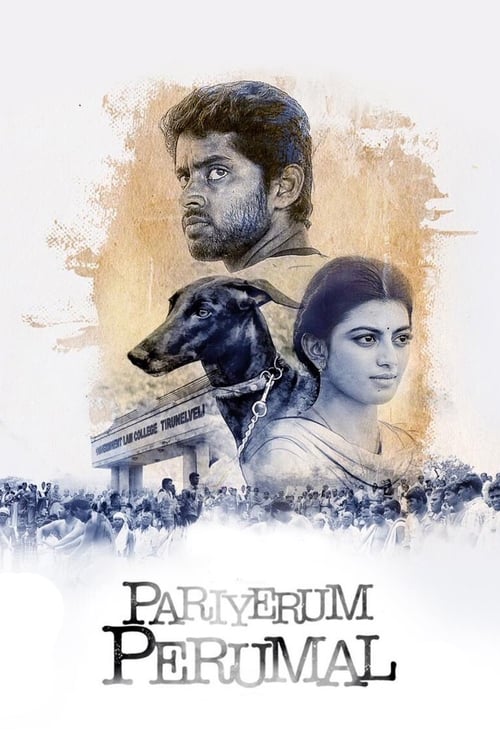
Pariyerum Perumal
2018 · Mari Selvaraj
For when you want a film with real moral weight — one that makes you furious for the right reasons and gives you someone to root for with your whole chest. This is a challenge, not a comfort watch, but it pays you back.
What it's about
Pariyan, a young man from a Dalit family, enrolls in law school with his beloved dog and a dream of standing tall in a world built to keep him low. He strikes up a friendship with Jothi, a warm, guileless classmate from a dominant caste — and the men in her family decide that friendship itself is a provocation. What looks like a college romance becomes a fight for bare dignity, as humiliation and intimidation close in from every side.
The experience
It starts gentle and gets harder to watch by the reel — tender scenes of first friendship laced with a constant low hum of threat. The anger is slow-building and earned; certain images land like a punch and stay with you. It's moving without ever being soft.
Performances
Kathir plays Pariyan with remarkable containment — you watch a young man swallow humiliation after humiliation and hold his dignity in his eyes and posture rather than his words. It's a performance of restraint that makes the eventual cracks devastating.
The craft
Mari Selvaraj's debut announces a filmmaker with a complete visual language: recurring images of dogs, water, and the colors blue and black carry the film's meaning as much as its dialogue. Santhosh Narayanan's score moves between folk lament and driving anthem, and the songs are woven into the storytelling rather than pasted on. It's vivid, rural, sun-scorched filmmaking that rewards attention to what's in the frame.
Why it matters
A landmark of the new wave of anti-caste Tamil cinema, it proved a first-time director could take caste violence head-on and find both critical acclaim and a wide audience, launching Mari Selvaraj as a major voice.
Snapshot
Pariyerum Perumal — released internationally as Pariyerum Perumal: The Great Hero Rides a Horse — is the debut feature of Tamil director Mari Selvaraj, produced under Pa. Ranjith's Neelam Productions. On its surface a college romance between Pariyan, a Dalit first-year law student, and Jothi, a classmate from a dominant caste, the film uses that thwarted friendship as an X-ray of caste violence in the southern districts of Tamil Nadu. It is less a story of love realized than of love foreclosed: the drama tracks not whether the couple will unite but whether Pariyan will survive, and on what terms he can claim dignity in a society engineered to deny it. Anchored by Kathir's watchful, contained lead performance and Santhosh Narayanan's plaintive score, the film became one of the defining works of the Ambedkarite "new wave" that reshaped Tamil cinema in the late 2010s, and it announced Selvaraj as a major authorial voice.
Industry & production
The film was produced by Pa. Ranjith through Neelam Productions, the banner Ranjith founded to platform anti-caste and Dalit-centered cinema and to mentor filmmakers from marginalized backgrounds. This production context is inseparable from the film's meaning: Neelam is an activist-aligned enterprise as much as a commercial one, and Pariyerum Perumal functioned as a proof of concept that a hard-edged caste narrative, shot on modest means with a first-time director and a lead actor without star wattage, could reach a wide Tamil audience. Selvaraj had worked as an assistant to Ranjith before his debut, and the film reflects that lineage of mentorship. It was made on a comparatively lean budget typical of the parallel-minded Tamil productions of the period rather than the star vehicles that dominated the box office. I would not assert specific budget or gross figures, as reliable and consistent numbers are not something I can verify here. What is well established is that the film was a critical success and performed strongly enough relative to its scale to be treated as a landmark, cementing Neelam's model and enabling Selvaraj's subsequent, larger productions.
Technology
Pariyerum Perumal is a digitally originated film in the mainstream of late-2010s Indian production practice, shot on digital cinema cameras and finished through a standard digital-intermediate pipeline. There is no showy technological signature here; the film's tools are conventional and its innovations lie in deployment rather than in hardware. That restraint is itself a choice. Where contemporaneous Tamil star vehicles leaned on high-gloss color grading and heavy visual-effects augmentation, this film keeps its digital image close to the textures of the rural Tirunelveli locations — dust, harsh sun, the flat light of interiors — using the flexibility of digital capture to work in real, unglamorous spaces rather than to manufacture spectacle. The most "technological" gesture is arguably the sound design and the recording of Santhosh Narayanan's score, discussed below, rather than anything in the image chain.
Technique
Cinematography
The cinematography, by Sridhar, is built on a tension between naturalism and iconography. Much of the film observes its rural and small-town settings with a documentary plainness — handheld or unfussy framings, natural light, real locations in and around the Tirunelveli region. But at charged moments the film shifts register into deliberate, almost mythic composition: low angles that monumentalize Pariyan, symmetrical framings, and a recurring, insistent use of the color blue — the Ambedkarite color, also the signature of the Neelam banner — threaded through costume, sky, and set. The camera repeatedly returns to Pariyan's face in tight, held close-ups, refusing to look away from his effort to keep his composure under humiliation. The film also stages violence and menace at the edges of the frame and in the middle distance, so that threat feels ambient rather than announced.
Editing
The editing favors held duration over cutting rhythm. Scenes of humiliation and confrontation are allowed to run long enough to become uncomfortable, denying the audience the relief of a quick cut away from Pariyan's degradation. The film intercuts a stylized, recurring figure — an assassin-like man in a white shirt who appears at intervals — against the realist narrative, using cross-cutting to keep dread alive even in quiet passages. The structure is patient and accretive rather than propulsive: the film builds meaning by repetition and return (to the dog, to the railway line, to gestures of contempt) rather than by conventional escalation. I am not able to confirm the editor's credit with confidence, and I will not guess at a name.
Mise-en-scène / staging
Selvaraj's staging is saturated with symbol without tipping into abstraction. The opening establishes Pariyan's beloved black dog, Karuppi — the name itself evoking blackness and, by extension, caste-coded stigma — and the animal's death sets the film's key of loss and injustice before a word of the central romance is spoken. Space is organized around segregation: who may enter which room, who sits and who stands, who drinks from which vessel. The recurring man in white is staged as an almost supernatural embodiment of caste violence, moving through the film's world like an omen. Water, trains, and thresholds recur as staging motifs, and the film's images are legible as an argument even with the sound off.
Sound
Santhosh Narayanan's contribution operates on two levels: a score of lament and dignity, and songs that carry the film's politics directly. The film's signature piece, associated with the dead dog Karuppi, is an elegy that fuses folk idiom with a modern arrangement, and its lyrics — written by Selvaraj himself, whose background is in poetry — turn a pet's death into a threnody for the oppressed. The sound design elsewhere is spare and realist, using ambient rural sound and pointed silences; the contrast between that quiet and the swell of the songs is one of the film's most affecting devices. The final scene famously locates its meaning almost entirely in sound and image rather than speech.
Performance
Kathir's Pariyan is a study in suppressed feeling: the performance is defined by stillness, by a jaw held tight and eyes that register every slight while the body refuses to give the oppressor the reaction he wants. It is a portrait of dignity as endurance. Anandhi, as Jothi, plays a character who is in some ways oblivious to the danger her friendship poses to Pariyan, and the performance registers that gap in awareness without villainizing her. The supporting cast is used pointedly: Yogi Babu, a comic star, appears in an unusually grave register, and the actors playing the men of Jothi's family embody an everyday, unremarkable cruelty that is more chilling than melodrama would be. The father figure and the film's older men are performed with a naturalism that grounds the story's argument in recognizable social types.
Narrative & dramatic mode
The film's dramatic mode is realist tragedy inflected with mythic symbolism. It borrows the outward shape of the college romance — the meeting, the friendship, the family's objection — but systematically subverts it: the obstacle is not misunderstanding or fate but structural caste power, and the resolution offers no union. Instead the film moves toward a confrontation over dignity itself. The narrative withholds catharsis; its climactic scene stages a tense, quiet reckoning between Pariyan and Jothi's father over cups of tea, in which the difference between black tea and milk tea becomes a wordless index of whether coexistence on equal terms is even imaginable. The mode is one of controlled anger channeled through observation, and the film's power comes from its refusal to soften the social reality into a feel-good arc.
Genre & cycle
Formally the film is marketed as romance and drama, but it belongs most meaningfully to the cycle of Tamil anti-caste cinema — sometimes called Dalit cinema or the Ambedkarite new wave — that crystallized in the 2010s. Within that cycle it sits alongside Pa. Ranjith's own films (Attakathi, Madras, Kabali, Kaala) and the broader realist turn associated with directors like Vetrimaaran. The film both uses and critiques the conventions of the mainstream Tamil romance: it invokes the genre's expectations precisely in order to expose how caste renders them impossible for its protagonist. It also participates in a longer tradition of socially conscious Tamil melodrama while stripping away the reconciliatory endings that tradition often supplied.
Authorship & method
Pariyerum Perumal is a deeply authored debut, drawing heavily on Mari Selvaraj's own biography and his roots in the Tirunelveli countryside; Selvaraj is also a published poet, and the film's dense symbolism and lyrical writing reflect that background. He wrote as well as directed, and the film's images function as a personal iconography he would carry into later work. His key collaborators are central to its identity: Santhosh Narayanan (composer), whose score and songs give the film its emotional and political voice; Sridhar (cinematographer), whose blend of realism and iconographic framing defines its look; and producer-mentor Pa. Ranjith, whose Neelam Productions provided both the means and the ideological frame. The film emerges from a collaborative, movement-aligned method rather than a solitary-auteur one — a workshop of like-minded artists building a cinema of caste assertion — even as its authorial stamp is unmistakably Selvaraj's. On the editing credit I will not assert a name I cannot verify.
Movement / national cinema
The film is a product of Tamil cinema (Kollywood) and, more specifically, of the anti-caste, Ambedkarite current within it that gained force in the 2010s. That movement is inseparable from Tamil Nadu's longer Dravidian and self-respect political traditions, but it marks a distinct sharpening: rather than gesturing at social uplift in general terms, these films name caste directly, center Dalit protagonists and Dalit filmmakers, and mobilize a visual vocabulary — the color blue, images of Ambedkar and Buddhist iconography, folk musical forms — as explicit political signature. Pariyerum Perumal is among the movement's purest statements, and its success helped legitimize this current commercially as well as critically within the national conversation about Indian cinema and caste.
Era / period
Set and made in the contemporary moment of its release, the film captures late-2010s rural and small-town Tamil Nadu: the law college as a site of aspiration and exclusion, the persistence of untouchability practices in daily life, and the collision between a younger generation's hopes and entrenched social hierarchy. It arrived during a period of intensified public reckoning with caste violence in India, and it reads as of its moment — engaged with the lived present rather than nostalgic or historical. Within Tamil film history it belongs to the post-2010 wave in which digital production, independent-minded banners, and socially assertive storytelling reshaped what mainstream Tamil cinema could address.
Themes
Caste is the film's central and organizing theme — not as background but as the very structure of its world. From that spine radiate its other concerns: dignity and the refusal to be humiliated; the impossibility of "innocent" friendship or romance across caste lines under conditions of structural power; the way violence is normalized and made ambient rather than exceptional; and the question of whether coexistence between oppressor and oppressed is possible without the oppressed erasing themselves. The dog Karuppi encodes the theme of the devalued life, the being whose death goes unmourned by the powerful. Education appears as both a promise of mobility and a stage on which caste is re-inscribed. The recurring man in white embodies caste as a persistent, almost fated menace. And the closing tea scene distills the film's ultimate thematic question — equality — into a single, unresolved domestic gesture.
Reception, canon & influence
Pariyerum Perumal was received with strong critical acclaim as one of the most important Tamil films of its year and a landmark in Indian cinema's engagement with caste; it drew particular praise for Kathir's performance, Selvaraj's assured direction, Santhosh Narayanan's music, and its refusal of easy resolution. It has since been widely canonized in discussions of Dalit and anti-caste cinema. It also gathered honors on the awards circuit — I can confirm that it was widely recognized and awarded, though I would rather not misattribute specific award names and categories than risk stating them incorrectly.
Looking backward, the film's influences are legible: Pa. Ranjith's earlier caste-conscious films provided the immediate template and the production ecosystem; the Dravidian self-respect tradition and Ambedkarite iconography supplied its political vocabulary; and the broader realist turn in Tamil cinema gave it license to work in unglamorous registers. Selvaraj's own poetry and rural biography are the deepest well.
Looking forward, the film's legacy is substantial. It established Mari Selvaraj as an auteur and set the template — animal symbolism, rural southern-district settings, folk-scored elegy, caste confronted head-on — that he developed across his subsequent films (notably Karnan and later works). It reinforced the viability of Neelam Productions' model and of anti-caste storytelling as commercially and critically serious cinema, encouraging a wider field of Tamil filmmakers to foreground caste explicitly. Within a few years of its release it was already being treated as a reference point and a canonical text for the movement it helped define.
A Deleuzian reading
A black dog, and then no dog.
The full Deleuzian reading of Pariyerum Perumal →
Reception
No flop-to-classic arc needed — it was acclaimed on arrival in 2018 as a word-of-mouth hit with no stars, and its stature has only climbed since as Mari Selvaraj (Karnan, Maamannan, Vaazhai) became one of Tamil cinema's defining directors, making his debut look like a movement's founding document.
How Pariyerum Perumal was received, from release to now →
Influences: the films it descends from and the films it influenced
- Sujata (1959) — Ancestor of the tea-scene-equality gesture: builds its caste melodrama on the shared-cup/shared-blood motif in which an inter-dining act of touch becomes the film's whole moral argument about untouchability and dignity.
- Ankur (1974) — Parallel-cinema template of location-shot, non-glamorous rural realism that ends on a child hurling a stone at the feudal landlord's house — the same silent act-of-protest coda Selvaraj inherits through his realist-tragedy register.
- Paruthiveeran (2007) — Established the Tamil rural realist-tragedy where a naturalist dialect romance is subverted into brutal caste-honor violence in its final reel, the subverted-romance structure Pariyerum reworks.
- Subramaniapuram (2010) — Set the Madurai-realist grammar of non-star casting, sun-bleached documentary naturalism and doomed rural romance ending in betrayal, licensing the unglamorous southern-district register Selvaraj works in.
- Madras (2014) — Direct template from the mentor's Neelam ecosystem: spatializes caste conflict onto a single contested object (the wall/mural), the symbolic-segregation staging Selvaraj adapts.
- Fandry (2014) — The closest craft ancestor: uses a black animal (the pig) as a caste-symbol and a Dalit boy's doomed love for an upper-caste girl, climaxing in a hurled stone at the camera — the animal-motif-plus-subverted-romance blueprint behind Karuppi.
- Virumaandi (2004) — Sustains the tradition of the caste-feud social-issue film that refuses easy resolution, treating rural violence as systemic rather than as a personal grudge to be settled.
- Aadukalam (2011) — Grounded, location-rooted caste realism with a morally unresolved ending, extending the prestige-realist mode Aadukalam's National-Award sweep helped legitimize.
- Mahanadhi (1994) — Uses a narrowing frame of social entrapment and mounting dread to dramatize a decent man crushed by institutional caste cruelty — the social-problem-film descent updated.
- Karnan (2021) — Direct authorial descendant: develops the personal iconography of animal symbolism (donkey, horse, headless deity), monumentalizing low-angle mythic framing of the Dalit hero, and Santhosh Narayanan's folk-elegy score.
- Sarpatta Parambarai (2021) — Descendant of the Neelam model, carrying Ambedkarite/Dalit assertion into a period sports-drama register with the same movement-aligned production method.
- Jai Bhim (2021) — Descendant that pushes explicit anti-caste storytelling into mainstream courtroom form, naming Ambedkar directly and centering custodial atrocity against an oppressed community — viability Pariyerum helped prove.
- Writer (2021) — Descendant applying Pariyerum's naturalist realism and institutional-caste critique to police custody and Dalit dignity, with held close-ups and realist silence over melodrama.
- Maamannan (2023) — Descendant developing suppressed-stillness performance (Vadivelu's coiled restraint) and the recurring boar/pig animal-motif into electoral-politics caste confrontation.
- Vaazhai (2024) — Descendant returning to the autobiographical Tirunelveli-countryside well, naturalist child performance and folk-elegy scoring that Pariyerum first drew from Selvaraj's own biography.
- Lubber Pandhu (2024) — Set the post-2010 caste-realist grammar of addressing caste humiliation 'without preaching' — sunlit rural available-light texture and behavioral detail carrying the politics — the exact register critics praised in Pachamuthu's debut.
- Court (2014) — Sibling in observational method: static, held long takes and realist silence documenting caste oppression through a Dalit folk balladeer, the naturalist-documentary duration Pariyerum shares.
- Sairat (2016) — Sibling that lures the audience into mainstream inter-caste romance grammar, then detonates it with sudden honor-killing realism — the exact bait-and-subvert romance strategy Pariyerum deploys.
- Kaala (2018) — Same-year sibling from the same movement: monumentalizing low-angle framing of the oppressed hero and Ambedkarite blue-black color coding as assertion iconography.
- Asuran (2019) — Sibling extending rural caste-revenge realist-tragedy with naturalist dialect and held close-ups of suppressed rage, part of the same post-2018 caste-forward Tamil wave.
- Chithha (2023) — Uses silence and long-held reaction shots to let injustice register on the face, making stillness the primary instrument of emphasis in 2010s Tamil social cinema.
- Meiyazhagan (2024) — Renders caste as an atmosphere of everyday humiliation and withheld belonging rather than plotted conflict — the 'caste of feeling' Meiyazhagan handles as social undertow beneath its warmth.
- Homebound (2025) — Selvaraj's Dalit-authored Tamil cinema stages caste through proxemics — the Dalit protagonist kept at literal physical distance — and restrained observation instead of the courtroom-melodrama register.
- Peranbu (2019) — Part of the same late-2010s Tamil turn to unsentimental social realism about the marginalized, using restrained diegetic sound and observational staging in place of the industry's melodramatic conventions.
- Viduthalai: Part I (2023) — A contemporaneous Tamil caste-realism work sharing the bottom-up POV of the dispossessed and refusal of moral consolation, extending the same movement Viduthalai belongs to.
Similar films
- Sarpatta Parambarai (2021) — influence & lineage
- Asuran (2019) — influence & lineage
- Jai Bhim (2021) — influence & lineage
- Aadukalam (2011) — shared sensibility
- Viduthalai: Part I (2023) — shared sensibility
- Iruvar (1997) — shared sensibility
- Pudhupettai (2006) — shared sensibility
- Maheshinte Prathikaaram (2016) — shared sensibility