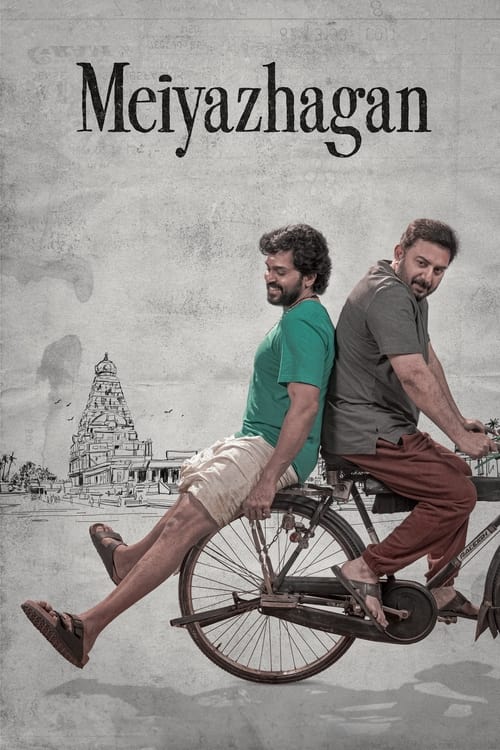
Meiyazhagan
2024 · C. Prem Kumar
For when you need a good cry of the healing kind — homesickness, forgiveness, the ache of a place you can't go back to. Slow-cinema comfort food; give it patience and it pays you back double.
What it's about
Twenty-two years after his family lost their home and left Thanjavur, a guarded man returns for a cousin's wedding he'd rather skip. At the celebration he's joyfully claimed by an effusive stranger who insists they know each other — and whose name he's too embarrassed to ask. What follows is one long night of food, bicycle rides, old grievances, and small kindnesses that slowly reopens everything he left behind.
The experience
Unhurried, warm, and quietly devastating — mostly two men talking, yet it accumulates the force of an epic about belonging. It sneaks up on you: you're smiling for an hour before you realize there's a lump in your throat.
Performances
Arvind Swamy plays the guarded returnee with beautifully controlled reserve, while Karthi, in a career-best turn, makes the nameless host's relentless warmth so specific and generous that the film's whole emotional argument rests on him — and holds.
The craft
C. Prem Kumar writes reunion the way few filmmakers can — long, unforced conversations that carry decades of history — and shoots the Cauvery delta countryside with unhurried devotion, all green fields, night air, and lamplight. The lilting score does a lot of quiet lifting; this is a film that rewards surrendering to its pace.
Why it matters
Widely embraced as confirmation that Prem Kumar's tender reunion mode, announced with '96, is a genuine directorial signature — and it handed Karthi the most acclaimed performance of his career.
C. Prem Kumar announced himself with '96, Tamil cinema's tenderest reunion film, and this follow-up deepens the mode: a man returns to Thanjavur, the hometown his family lost twenty-two years earlier, for a wedding he'd rather skip — and is claimed, joyfully and relentlessly, by a stranger who insists they know each other. Arul cannot place him, and the film wrings an entire moral education from that lapse. Arvind Swamy plays the guarded returnee; Karthi, in a career-best turn, plays the effusive host whose name Arul is too embarrassed to ask. What follows is mostly conversation — a night of food, bicycle rides, old grievances, and small kindnesses — yet it accumulates the force of an epic about belonging, caste of feeling, and what a hometown owes the people it exiled. Prem Kumar shoots the Cauvery delta with unhurried devotion, letting Govind Vasantha's score swell only when earned. Tamil cinema has a long tradition of the village-return melodrama; this one strips it to two men talking, and trusts that to be enough. It is.
Reception
It opened quietly in September 2024 but word-of-mouth did the heavy lifting, and its Netflix arrival turned it into one of the most talked-about Tamil films of the year — now a fixture on best-of-2024 lists.
How Meiyazhagan was received, from release to now →
Influences: the films it descends from and the films it influenced
- Before Sunrise (1995) — Builds an entire feature from one overnight encounter between two people walking and talking, making the drifting conversation itself the plot rather than incident — the walk-and-talk template Meiyazhagan localizes to a village.
- My Dinner with Andre (1981) — Proves a film can run on two people talking as its sole dramatic engine, with a listener slowly thawing before a torrent of another man's memory — the pure dialogue two-hander form.
- Anbe Sivam (2003) — The mismatched-pair journey where a garrulous, open-hearted humanist gradually dismantles a guarded, name-forgetting companion — the same warm-stranger-thaws-the-closed-man dynamic between Karthi and Arvind Swamy.
- Autograph (2004) — Structures homecoming as a sentimental Tamil memory-journey — returning to a native place reactivates buried relationships and unfinished feeling, the melodrama-of-remembrance mode Meiyazhagan inherits.
- 16 Vayathinile (1977) — Broke studio convention by shooting on real village locations and treating rural Tamil landscape as a devotional subject — the founding gesture behind Meiyazhagan's cinematography/landscape-devotion.
- Mullum Malarum (1978) — Spare, image-led rural drama that trusts silence and naturalistic village texture over expository dialogue — the restrained, unhurried aesthetic that underwrites the seed's pacing.
- 96 (2018) — Prem Kumar's own precursor: a single overnight reunion staged as a two-hander of unspoken longing, where memory is excavated through conversation and a Govind Vasantha score functions as the second voice — the exact grammar Meiyazhagan reuses.
- Paruthiveeran (2007) — Established Karthi's rustic naturalist register — raw rural dialect, unglamorous physicality — the performance vocabulary he refines into his 'career-best' village everyman here.
- Merku Thodarchi Malai (2018) — Western Ghats landscape devotion and unhurried rural realism, letting labor and terrain dictate rhythm — a parallel commitment to place-as-character over plot momentum.
- C/o Kancharapalem (2018) — Hyperlocal small-town naturalism built from near-documentary texture and non-professional faces, dignifying ordinary lives — the same anti-melodramatic tenderness toward provincial community.
- Pariyerum Perumal (2018) — Renders caste as an atmosphere of everyday humiliation and withheld belonging rather than plotted conflict — the 'caste of feeling' Meiyazhagan handles as social undertow beneath its warmth.
- The Trip (2010) — A two-hander in which loose, semi-improvised conversation and a passing landscape carry the whole film, the pair's banter masking loneliness — the digressive talk-driven structure.
- Thavamai Thavamirundhu (2005) — Village-return family melodrama that mines memory, guilt and belonging from a native household — a kindred use of homecoming to reopen the emotional ledger of the past.
- Sudani from Nigeria (2018) — Small-village communal hospitality extended to a stranger, its warmth and gentle humor carried by unforced domestic detail — the ethic of a community absorbing an outsider over a few days.
- Sethum Aayiram Pon (2020) — Homecoming to a native village triggers reckoning with roots, folk custom and belonging, filmed with landscape reverence and unhurried observation — the return-to-origins pilgrimage in the same key.
Similar films
- 96 (2018) — influence & lineage
- C/o Kancharapalem (2018) — influence & lineage
- Anbe Sivam (2003) — influence & lineage
- Pariyerum Perumal (2018) — influence & lineage
- Kishkindha Kaandam (2024) — same viewing thread
- Main Vaapas Aaunga (2026) — same viewing thread
- Lost Ladies (2024) — same viewing thread
- Kadaisi Vivasayi (2022) — same viewing thread
All the films related to Meiyazhagan →
Watch it with: curated runs of related films
- Small Towns, Long Memory — Watch these together for how patiently they sit with a place and its people — a last farmer, a slipping memory, a homecoming after twenty-two years — each measuring belonging in soil, kin, and time.