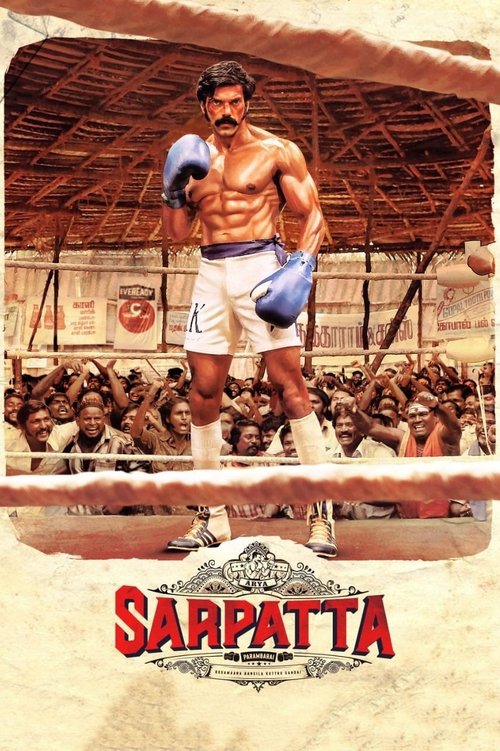
Sarpatta Parambarai
2021 · Pa. Ranjith
When you're craving a rousing underdog sports drama with real substance under the sweat — something to cheer at that also gives you a world and a politics to think about after.
What it's about
In the clan-boxing world of 1970s North Madras, whole neighborhoods stake their pride on bare-knuckle lineages, and the storied Sarpatta clan is losing its grip. Kabilan, a dockyard laborer who worships the sport from the crowd, gets his chance to put on the gloves when his clan is challenged to a do-or-die bout — against his mother's fierce opposition and amid political currents, rivalries, and temptations that threaten to eat him before any opponent does. It's an underdog boxing story where the ring belongs to an entire community.
The experience
A big, muscular crowd-pleaser that earns its roars — the fights are visceral and superbly staged, but it's the texture of the world and the weight of community pride that keep the pulse up. It swings from triumph to self-destruction and back, and the highs genuinely soar.
Performances
Arya transformed physically for Kabilan and grounds every rise and fall, while Pasupathy is the film's soul as the veteran coach Rangan — a performance of granite dignity that many count among the year's best in Tamil cinema.
The craft
Pa. Ranjith recreates 1970s North Madras in loving, immersive detail — hairstyles, posters, harbor light, ring-side crowds — and stages the bouts with distinct personalities and escalating stakes rather than interchangeable punching. The propulsive soundtrack and period production design make it a feast on a big screen with the volume up.
Why it matters
A streaming-era Tamil release that became a phenomenon anyway, celebrated for weaving anti-caste, working-class politics into a mainstream sports epic and for cementing Pa. Ranjith as one of Indian cinema's most vital political filmmakers.
Snapshot
Sarpatta Parambarai is a Tamil-language period sports drama set in the working-class clan-boxing subculture of North Madras during the mid-1970s, culminating around the political rupture of the Emergency (1975–77). Directed by Pa. Ranjith and released directly to Amazon Prime Video in July 2021, it follows Kabilan (Arya), a dockyard labourer and devoted fan of the Sarpatta clan, who is drawn from spectator to fighter under his mentor Rangan Vaathiyar (Pasupathy) and must carry his parambarai — lineage, dynasty, inherited tradition — into a do-or-die bout against a rival clan's champion. The film fuses the archetypal underdog boxing narrative with Ranjith's signature anti-caste, working-class political consciousness, rendering the ring as an arena where community pride, patronage, addiction, and self-worth are all contested. It has been widely received as one of the strongest entries in the modern Tamil sports-film canon and a high point of the streaming-era Tamil cinema that flourished during the pandemic.
Industry & production
The film is a product of the Tamil (Kollywood) industry operating within a specific moment: theatrical exhibition across India was disrupted by the COVID-19 pandemic, and OTT platforms became a primary release channel for mid-to-large budget films. Sarpatta Parambarai premiered on Amazon Prime Video on 22 July 2021, bypassing theaters. This distribution route shaped both its reach — an immediate pan-Indian and diaspora audience via streaming — and, arguably, its form, which is expansive, ensemble-driven, and roughly two-and-a-half hours long, closer to a novelistic serial than a tightly commercial theatrical package.
Ranjith produced through his own banner, Neelam Productions, alongside K9 Studios, with the film credited to producers including Shanmugam Dhakshinamurthy. Neelam is significant beyond financing: it is the institutional expression of Ranjith's project to build Dalit and anti-caste representation into mainstream Tamil filmmaking, and it has also served as a platform for the Casteless Collective music movement he co-founded. Concrete, verified budget and viewership figures for the film are not something I can state reliably; streaming platforms rarely disclose audited numbers, and I will not invent them. What can be said with confidence is that the project mobilized a large ensemble cast and extensive period recreation of 1970s Madras, indicating a substantial production undertaking by Tamil independent-prestige standards.
Technology
Sarpatta Parambarai was shot digitally, consistent with standard practice in Tamil cinema of the period, and finished for high-resolution streaming delivery. Its most notable technological work is not novel capture hardware but the marshalling of production design, digital color grading, and, where needed, visual-effects set extension to reconstruct a vanished 1970s North Madras — its tenements, shipyards, arrack shops, and open-air boxing arenas. The boxing sequences themselves depend heavily on choreography and camera-and-cut technique rather than digital augmentation; the "technology" that matters most is the invisible craft of staging convincing physical combat and grading the image toward a warm, period-evocative palette. I do not have verified details of the specific camera systems or lenses used and will not speculate on model names.
Technique
Cinematography
Cinematography is credited to Murali G. The visual scheme leans into a saturated, sunlit-and-sodium warmth that evokes both period and place: the amber of arrack bars, the grime-and-glow of the docks, the dust of the arena. The camera treats the boxing ring as a theatrical space, using ropes, crowd, and lantern-light to frame fighters within a charged social field rather than isolating them in clinical sports coverage. Crowd geography is a recurring concern — the film repeatedly situates the boxer inside a mass of partisan spectators, so that individual combat reads as collective stake. In the fight scenes, coverage alternates between wide master shots that preserve spatial legibility (who is where in the ring, how the crowd surges) and tighter, impact-oriented angles, keeping the boxing readable rather than incoherent — a discipline not all sports films maintain.
Editing
Editing is credited to Selva RK. The cut carries a long, layered narrative — multiple clans, a mentor's arc, a marriage, a descent into alcoholism, and the political backdrop of the Emergency — and must modulate between the propulsion of the bouts and the slower social texture between them. The boxing matches are the editorial showpieces: rounds are built with escalating rhythm, the cutting tightening as fatigue and desperation mount. Elsewhere the editing allows scenes to breathe, favouring the accumulation of milieu and relationship over relentless pace, which is what gives the film its epic, lived-in quality rather than a lean genre efficiency.
Mise-en-scène / staging
Period reconstruction is central. Costume, set dressing, signage, hairstyles, and the design of the boxing arenas all work to place the film precisely in 1970s North Madras — a specifically Tamil, working-class, and substantially Dalit and subaltern milieu that mainstream Tamil cinema has historically marginalized or exoticized. Ranjith's staging foregrounds this world's dignity and internal complexity: patronage networks, clan rivalries, drink, and the political machinery of the Emergency are woven into the physical environment. The ring is staged as a communal theater; domestic and street spaces are dense with the emblems of a specific class culture, including the recurrent Ambedkarite and anti-caste iconography that is a hallmark of Ranjith's mise-en-scène across his filmography.
Sound
The soundscape combines the diegetic roar of the boxing crowd — a crucial element in selling the stakes of each bout — with Santhosh Narayanan's score and songs. The music blends contemporary Tamil idioms with folk and percussive textures rooted in the milieu, and the film's use of song is integrated into its social world rather than functioning purely as commercial interludes. The sound design of the fights (the thud of blows, the surge and hush of the crowd) is a load-bearing part of their impact.
Performance
Performance is one of the film's most praised dimensions. Arya, in the lead role of Kabilan, undertook a visible physical transformation and carries an arc from eager fan to champion to self-destruction and redemption; the role is generally regarded as a career-best turn for him. Pasupathy as Rangan Vaathiyar anchors the film with a weighty, dignified mentor performance, embodying the wounded pride and moral authority of the clan tradition. The large supporting ensemble — including John Kokken as the rival fighter Vembuli, Dushara Vijayan as Kabilan's wife Mariamma, John Vijay, and others — fills out a densely populated social world, and several supporting turns were singled out in reviews. The collective effect is ensemble realism: the film feels populated by a community rather than a hero and his foils.
Narrative & dramatic mode
The dramatic mode is the underdog sports epic crossed with social realism and community chronicle. On its most legible level the film follows the classic rise–fall–redemption structure of the boxing genre: the raw talent discovered, the mentor's faith, the triumphant ascent, the fall through hubris and addiction, and the climactic return. But Ranjith embeds this individual arc within a collective and political frame. Kabilan's boxing is never only his own; it is the honor of the Sarpatta clan, the pride of a marginalized community, and — as the Emergency descends — an act inflected by state repression and political maneuvering. The dramatic engine is therefore doubled: personal redemption and communal vindication run in parallel, and the film's emotional payoffs land on both registers. The mother's disapproval and the "dangerous politics" of the synopsis are not mere obstacles but the moral and historical pressures that give the sport its weight.
Genre & cycle
Sarpatta Parambarai sits at the intersection of the boxing film, the period drama, and the socially conscious "New Tamil Cinema" of the 2010s–2020s. Within the boxing genre it is in obvious conversation with the global lineage of Raging Bull, the Rocky cycle, and their many descendants, as well as Indian boxing dramas. Within Tamil and Indian sports cinema it belongs to a cycle of films that use sport as a vehicle for caste, class, region, and identity politics. Ranjith's distinctive move is to root the genre in a hyper-specific local subculture — the clan-based amateur boxing of 1970s North Madras — rather than a generic or aspirational-national frame, giving the familiar genre beats an unfamiliar cultural texture.
Authorship & method
The film is centrally an auteur work of Pa. Ranjith, whose body of work — Attakathi (2012), Madras (2014), Kabali (2016), Kaala (2018), and Sarpatta Parambarai — constitutes one of the most sustained anti-caste, Ambedkarite projects in contemporary Indian cinema. Ranjith's method is to take popular genre frameworks (the gangster film, the star vehicle, the sports film) and reorient them around Dalit and working-class subjectivity, embedding political iconography, assertive community pride, and critique of caste hierarchy into commercial forms. His extra-filmic activity — Neelam Productions, the Neelam publishing and cultural work, and the Casteless Collective — is continuous with this authorship.
The film's realization depends on key collaborators. Cinematographer Murali G shapes its warm period image; composer Santhosh Narayanan, a frequent Ranjith collaborator, provides a score and songs integrated into the milieu; editor Selva RK structures the sprawling narrative and the escalating bouts. The screenplay is credited to Ranjith with collaborators (writing is credited alongside Ranjith, drawing on research into the real clan-boxing culture of North Madras). This ecosystem of recurring collaborators is itself part of Ranjith's authorial signature.
Movement / national cinema
The film is a flagship of what is often called the "new wave" of Tamil cinema — a movement, roughly from the early 2010s, of directors foregrounding rural and urban subaltern experience, regional specificity, and caste politics against the grain of star-centric commercial convention. Ranjith is one of its defining figures, and Sarpatta Parambarai exemplifies the movement's fusion of genre entertainment with pointed social critique. Within Indian national cinema more broadly, it belongs to a broader turn toward regionally rooted, politically explicit storytelling and to the streaming-era expansion of pan-Indian audiences for Tamil-language work.
Era / period
The film is set primarily in the mid-1970s, and the Emergency declared by Indira Gandhi (1975–77) is not incidental background but part of the film's political weather, bearing on the fates of its characters. This historical setting lets Ranjith explore a specific moment in the life of North Madras's working-class and marginalized communities. In terms of its own era of production, the film is a 2021 work marked by the pandemic-driven ascendancy of OTT release and by the maturation of Tamil new-wave cinema into confident, large-canvas period filmmaking.
Themes
The governing theme is parambarai itself — lineage, inheritance, and belonging — and what it means to carry a tradition that is at once a source of pride and a burden. Around it cluster: caste and class dignity, and the assertion of subaltern self-worth against a hierarchical society; patronage and its corruptions, as political and clan patrons shape and endanger the fighters they sponsor; masculinity and its self-destruction, dramatized through Kabilan's descent into alcoholism and the film's frank treatment of addiction; the relationship of the individual to the collective, since victory and shame are always communal; and the intrusion of state power and party politics into ordinary lives, crystallized by the Emergency. Anti-caste politics and Ambedkarite consciousness, explicit across Ranjith's work, run through the film's iconography and worldview.
Reception, canon & influence
Critically, Sarpatta Parambarai was met with strong acclaim on release, widely praised for Ranjith's world-building, Arya's transformative lead performance, Pasupathy's supporting work, the period recreation of 1970s North Madras, and the visceral staging of its boxing. Reviewers frequently placed it among the best Tamil films of its year and among the stronger sports dramas in Indian cinema; it is often cited as evidence of the creative payoff of the streaming shift for Tamil cinema. (I am summarizing the general critical consensus rather than citing specific outlet verdicts, which I cannot reproduce verbatim here without risk of error.)
Looking backward, the film draws on the global boxing-film tradition — the mentor-and-fighter dynamic, the rise-fall-redemption arc familiar from the Rocky and Raging Bull lineages — and on the real social history of North Madras's clan-boxing culture, which Ranjith researched and dramatized. It is continuous with his own prior films in its anti-caste framing and its rooting of genre in a specific subaltern milieu.
Looking forward, the film consolidated Ranjith's standing as a leading auteur of Tamil new-wave cinema and strengthened the case for regionally specific, politically engaged period genre filmmaking on streaming platforms. It contributed to a broader momentum for Tamil sports and social dramas that treat marginalized communities as protagonists rather than backdrop, and it reinforced the viability of the OTT-first release for ambitious mid-budget Tamil cinema. Given its relative recency, its longer-term influence is still crystallizing; but within a few years of release it was already frequently invoked as a benchmark for the modern Tamil sports epic. Reports of a possible sequel have circulated, but I cannot confirm production status with certainty, and I note that here rather than assert it.
Reception
Dropped straight to Amazon Prime in July 2021 when COVID kept it out of theaters, it was acclaimed on arrival and has only grown — now routinely called Pa. Ranjith's best film and a fixture on best-Tamil-films-of-the-decade lists, with fans still lamenting they never got to see it on a big screen.
How Sarpatta Parambarai was received, from release to now →
How to watch Sarpatta Parambarai: what to notice on a first viewing
- Notice how the crowd surrounds the ring during every fight. Murali G keeps cutting back to the partisan crowd pressed around the ropes, so a single punch reads as something the whole neighborhood is fighting for. A fighter is never actually fighting alone. His clan is always visibly in the frame with him.
- Track how much faster the cutting gets as a round wears on. Selva RK tightens the cutting rhythm as fatigue and desperation mount inside a bout, then lets scenes outside the ring breathe at a much slower pace. You feel a fighter tiring through the edit itself, not just through what his body is doing.
- Notice the amber, sodium-lit glow over the docks and bars. Murali G bathes the arrack bars, the docks, and the dusty arena in a warm, saturated period light that feels lived in rather than nostalgic. The color tells you this is a real, specific world before a single line of dialogue does.
- Listen for the crowd's roar rising and falling with each punch. The sound design tracks the surge and hush of the spectators alongside the thud of each blow, so the crowd's noise carries as much stake as the fight itself. You can gauge how a fight is going just by listening to the sound of the crowd around it.
- Notice the political posters and imagery on the walls behind them. Ranjith fills domestic and street spaces with the specific signage and iconography of a working-class, Dalit and subaltern Madras, dense detail that most Tamil films of the period never showed. The background of a scene is telling you which community and which politics this story actually belongs to.
The whole guide to watching Sarpatta Parambarai, with the keys for a rewatch →
Influences: the films it descends from and the films it influenced
- Raging Bull (1980) — The escalating in-ring passages descend directly from Scorsese and Thelma Schoonmaker's subjective punch-POV camera and percussive, tempo-shifting bout cutting, where the fight edit expresses the fighter's psychology rather than merely reporting the match.
- Rocky (1976) — Supplies the mentor-and-fighter melodrama and the working-class-underdog rise/fall/redemption arc — the coach who reads a raw brawler and the training-toward-a-title structure — that Ranjith reorients around Dalit subjectivity.
- Fat City (1972) — Model for the addiction-and-faded-masculinity strand: boxing rendered as down-and-out milieu realism, the fighter's self-destruction through drink and decline foregrounded over triumph, which Sarpatta channels into Kabilan's arc.
- Body and Soul (1947) — James Wong Howe's handheld, into-the-ring mobile camerawork (famously shot on roller skates) and the framing of the fight-fix as social corruption prefigure Sarpatta's kinetic ring coverage and its treatment of boxing as a rigged social arena.
- The Set-Up (1949) — Establishes the near-real-time single-bout structure and the ringside crowd as a braying chorus whose faces are cut into the fight — the diegetic crowd-roar geography Ranjith stages around the North Madras bouts.
- Gangs of Wasseypur (2012) — Template for the sprawling, novelistic multi-clan regional epic in which folk and pop songs are woven into the milieu rather than staged as interludes — the parambarai-vs-parambarai saga scale and Santhosh Narayanan's embedded score share this method.
- Madras (2014) — Ranjith's own prior blueprint: rooting a commercial genre in the concrete geography and wall-politics of a North Chennai subaltern neighborhood, with anti-caste assertion built into ensemble realism and the Santhosh Narayanan collaboration.
- Kaala (2018) — Immediately precedes Sarpatta in Ranjith's Ambedkarite project — embedding blue iconography, community-as-protagonist staging and caste critique inside a star-vehicle genre, a reorientation Sarpatta transposes onto the sports film.
- Pariyerum Perumal (2018) — Parallel Dalit-protagonist realism that centers caste humiliation and dignity within genre form, sharing Sarpatta's insistence on the marginalized community as subject rather than backdrop and its grounded performance register.
- Blue Star (2024) — Extends the template directly — a period-set Tamil sports drama (cricket) staging caste rivalry through team/club allegiance, inheriting Sarpatta's fusion of the sports-genre arc with anti-caste community politics and North Tamil Nadu milieu.
- Lubber Pandhu (2024) — Demonstrated the sport-as-arena-of-caste/clan-pride structure Lubber Pandhu runs on — a competitive discipline (boxing) becomes the theater where masculine ego and social hierarchy are fought out, complete with the veteran-versus-upstart rivalry.
- Mukkabaaz (2017) — The closest craft cousin: a boxing film that makes caste oppression its engine, staging the ring bout and the corrupt federation as the arena where caste power is fought — the same fusion of pugilism and anti-caste politics.
- Saala Khadoos / Irudhi Suttru (2016) — A Tamil-milieu boxing melodrama built on the abrasive coach-shapes-raw-fighter dynamic and Chennai working-class texture, sharing Sarpatta's training-arc grammar and physical-transformation performance demand.
- Karnan (2021) — Same Tamil-new-wave anti-caste moment and shared composer Santhosh Narayanan: myth-charged iconography, a collective-uprising structure and ensemble realism rooting political grievance in a specific subaltern community.
- Asuran (2019) — Shares the physical-transformation lead performance and the dramatization of caste violence as inherited, generational grievance, with a period/rural reconstruction anchoring the drama in a concrete social history.
- Sairat (2016) — Broader-movement sibling in vernacular anti-caste cinema: repurposes crowd-pleasing genre and folk-song energy to expose caste, using non-star ensemble realism to make the subaltern milieu the emotional center.
- Jai Bhim (2021) — Contemporaneous OTT-era Tamil anti-caste drama that, like Sarpatta, treats a marginalized community's lived injustice as primary narrative material and rides the same streaming-shift momentum for politically engaged mid-budget Tamil cinema.
- Vada Chennai (2018) — Sibling: mines the same North Madras working-class milieu as period social history, using rival clans (boxing here, gangs there) and real neighborhood texture as the engine of ensemble drama.
- Soorarai Pottru (2020) — A Tamil underdog-fighter procedural whose training-and-bout momentum and class-politics undertow parallel Kongara's method, arriving via the same OTT-premiere moment.
Similar films
- Pariyerum Perumal (2018) — influence & lineage
- Jai Bhim (2021) — influence & lineage
- Asuran (2019) — influence & lineage
- Lubber Pandhu (2024) — shared sensibility
- RRR (2022) — shared sensibility
- Jigarthanda DoubleX (2023) — shared sensibility
- Pudhupettai (2006) — shared sensibility
- Vada Chennai (2018) — shared sensibility