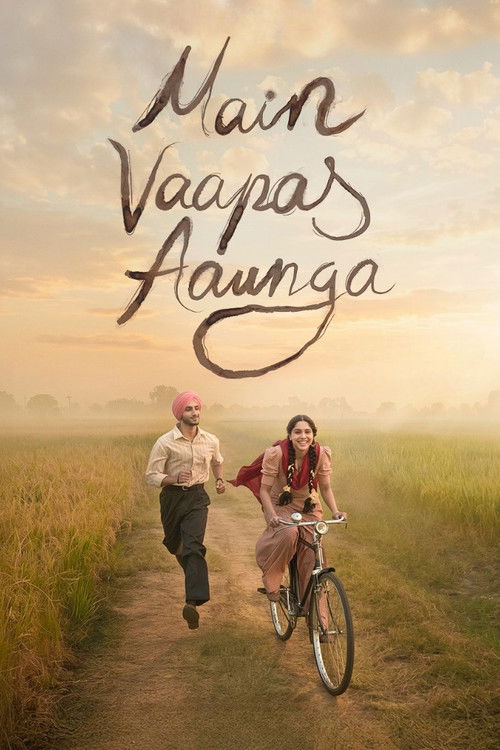
Main Vaapas Aaunga
2026 · Imtiaz Ali
When you want an epic romance to surrender an entire evening to and need a good cry — love, loss, and history on the largest canvas. Emotionally demanding but a comfort in the way great melodrama is.
What it's about
At 95, Ishar Singh Grewal — Sikh, dementia-stricken, dying — keeps murmuring about going back to a home in Sargodha his family has never heard of. His grandson Nirvair starts pulling the thread, and the film opens into 1947 Punjab: a college romance between a Sikh man and a Muslim woman, cut through by Partition, migration, and violence. Two timelines braid — a deathbed in present-day India and the love story the old man never told.
The experience
Sweeping and unhurried at 167 minutes, moving between tenderness and grief with songs woven through the storytelling. It's a film that wants to overwhelm you slowly — the ache builds across generations, and it earns its tears.
Performances
Naseeruddin Shah, one of Indian cinema's most respected actors, anchors the present-day frame as the dying Keenu, with Vedang Raina and Sharvari carrying the 1947 romance and Diljit Dosanjh — in his second film with the director — as the grandson piecing the story together.
The craft
Imtiaz Ali, the modern Hindi cinema romantic, co-wrote it with novelist Nayanika Mahtani, and the dual-timeline structure lets memory and music do the storytelling. Period-recreated Punjab, a big score, and full-blooded song sequences make this one for the largest screen and best sound you have.
Why it matters
It belongs to the ongoing reckoning of Indian popular cinema with Partition — the subcontinent's founding wound — told here as personal memory rather than history lesson, and it marks Ali returning to the grand romantic register that made his name.
Snapshot
Main Vaapas Aaunga — "I will come back" — is a 167-minute Hindi romantic drama, Imtiaz Ali's first feature since Amar Singh Chamkila (2024) and his second collaboration with Diljit Dosanjh. Released theatrically on 12 June 2026 and streaming on Netflix from 7 August, it braids two timelines: a dying, dementia-stricken Sikh nonagenarian in present-day India, and the 1947 Punjab of his youth, where a college romance with a Muslim woman was severed by Partition. Naseeruddin Shah plays Ishar Singh Grewal, called Keenu, the old man muttering about returning to his ancestral home in Sargodha; Vedang Raina plays him young, Sharvari plays Afsana Ahmedzai, and Dosanjh plays Nirvair, the grandson who reconstructs a story his family never heard. Written by Ali with the novelist Nayanika Mahtani, shot by Sylvester Fonseca, cut by Aarti Bajaj and scored by A. R. Rahman, it opened without much promotional noise and built a fifty-day theatrical run on word of mouth, closing at roughly ₹98 crore worldwide against a reported ₹70 crore budget. Because the film is only months old at the time of writing, its longer critical and industrial afterlife cannot yet be assessed; what follows distinguishes the documented record from the traditions it draws on.
Industry & production
The film was announced in June 2025 and shot between October and December 2025, entirely in Indian Punjab. That constraint is itself significant: an Indian production cannot film in Sargodha, so the Pakistani city at the story's centre — the place Keenu spends seventy-eight years promising to return to — had to be built out of Indian Punjab's surviving pre-Partition fabric. The film's geography is therefore a reconstruction in the literal sense, which is not incidental to a picture about the unreliability of remembered places.
Production was shared between Applause Entertainment (the Aditya Birla Group's content studio, led by Sameer Nair, better known for longform and streaming work than for theatrical features), Birla Studios, and Ali's own Window Seat Films, with Birla Studios distributing. Producers credited include Nair, Deepak Segal, Mohit Choudhary and Shibhasish Sarkar. The financing shape — a mid-budget period drama with two genuine draws (Shah's prestige, Dosanjh's global concert-scale celebrity) and no franchise scaffolding — is characteristic of where Hindi cinema's middle has migrated since the pandemic.
Release strategy tells its own story. Originally slated for April 2026 to land on Baisakhi, the Punjabi harvest festival, the film moved to 12 June. It opened at ₹1.28 crore domestic and just over ₹5 crore across its first weekend — a soft start for a film of this cost — then held, crossing fifty days in theatres by 31 July. The most visible marketing gesture came on 7 June, when Rahman performed live with cast members at the Attari–Wagah border ceremony near Amritsar: a promotional event staged at the exact line the film's plot cannot cross.
Technology
The technical record is thin in published sources; camera systems, finishing pipeline and prosthetic work have not been documented in detail. What Ali has described publicly is a philosophy rather than a toolkit. Memory, he has said, is cleaner than life — "you remember fewer things than what existed" — and the production pursued that subtraction through lensing, lighting, costume and camera technique in combination, chasing "a certain hue or tone that memory achieves." Costume research extended to which dyes were actually available in 1940s Punjab, and casting and styling worked from period photographs, "trying to create those faces that we see in old photographs in albums." The period, Ali has noted, surprised the research: educated Punjabis of the 1940s were "more westernised than today," listening to English records.
Two uses of technology inside the film are worth marking. The first is the smartphone: the final movement turns on a video call that carries Afsana's portrait across the border to a dying man — the border that armies, states and seventy-eight years could not open, opened by a handset. The second is the closing credits, which leave fiction entirely for documentary footage of contemporary refugees elsewhere in the world, an archival turn that reframes the preceding three hours as one case among many. Shah, who is in his late seventies, plays ninety-five; whether by makeup, prosthetics or performance alone, the specifics are not on record.
Technique
Cinematography
Sylvester Fonseca, who shot Amar Singh Chamkila for Ali, works here in two registers. The 1947 material is the film's "happy memory" — reviewers have singled out its magic-light montages, a warm, uncluttered, slightly over-clean image consistent with Ali's stated method of photographing recollection rather than the past. The present-tense material, a sickroom and a grandson's investigative journey, sits in a cooler, more literal idiom. The division is not merely decorative: it makes the image itself the diegetic property of a failing mind, so that the film's most beautiful passages are also its least trustworthy.
Editing
Aarti Bajaj has cut essentially Ali's entire filmography, and her work here has been described by Rahul Desai in The Hollywood Reporter India as "virtually a co-director" — "fusing timelines and feelings, motion and instinct" while keeping a fragmented structure legible to a general audience. The difficulty is specific: the film's organising consciousness has dementia, so the cutting must be associative enough to feel like a broken memory and ordered enough that a viewer can assemble a chronology the protagonist himself cannot. That tension between subjective disorder and narrative clarity is the film's central formal problem, and the cutting is where it is negotiated.
Mise-en-scène / staging
Staging divides along the same seam. The present is chamber-scaled — a bed, a family that has never asked the questions the grandson asks — while 1947 opens into colleges, streets, courtyards and, eventually, the crowd. The film's structural move is to let the crowd swallow the couple: as one reading has it, the protagonist's private anguish is "forced to merge and disappear in a collective grief of displacement." The riot sequences and the migration are staged less as spectacle than as the mechanism by which an intimate story is confiscated.
Sound
Rahman's involvement is the sixth of his collaborations with Ali, following Rockstar, Highway, Tamasha, Jab Harry Met Sejal and Amar Singh Chamkila, with Irshad Kamil again writing lyrics — a partnership running roughly fifteen years. The eight-track album, released 10 June 2026, includes "Kya Kamaal Hai," "Maskara," "Ishq Mastana," "Vo Nahin," "Dheere Dheere," "Tere Paas Main" and "Dariya," with vocals spread across Dosanjh, Raina, Mohit Chauhan, Shilpa Rao, Faheem Abdullah, Nilanjana Ghosh and others. Desai's characterisation is apt to Rahman's method: the score "makes music out of disparate pieces and displaced cultures," songs moving "through regions and genres like secular entities" — a soundtrack whose refusal to sit inside one tradition enacts the film's argument. The end-credits song, carrying the documentary refugee footage, has been singled out as the picture's most direct statement.
Performance
Shah's performance is the near-unanimous critical centre. Desai called it an "all-time performance" that "reframes the neurological war between lucidity and dementia as a chronological battle between masculinity and emotion"; Shubhra Gupta in The Indian Express called it "superbly-judged"; Saeed Naqvi in NDTV described a "masterclass." The role asks for two men in one body — the boy who loved and the cold father he became — with the dementia serving as the seam where the second is stripped back to reveal the first. Raina and Sharvari carry the 1947 romance; Dosanjh, cast against his own star wattage as a caregiver rather than a performer, anchors the present. Banita Sandhu's role as the grandson's girlfriend has drawn the sharpest dissent.
Narrative & dramatic mode
The film is a memory-frame melodrama with an investigative spine. Nirvair functions as detective and reader: he decodes his grandfather's delirium, travels toward the source, and delivers the answer. The answer is not a reunion but a confirmation — Afsana, married off to another man after Keenu's family fled, died waiting for the return his title promises. Keenu's own return, six years after 1947, arrives too late, and the failure hardens into seven decades of withheld feeling.
The dramatic mode is thus retrospective rather than suspenseful: the outcome is historically foreclosed, and the tension lies in whether the old man will be permitted to know it before he dies. Crucially, the film treats emotional numbness as a survival technology — Keenu becomes distant and cold because feeling was unaffordable — which converts a conventional romance into a study of inherited coldness. Kartik Bhardwaj in Cinema Express read the film as being about "the buried trauma of the refugees and how pain gives birth to patriarchy"; Nandini Ramnath in Scroll.in noted that it "boldly confronts severe psychological repression."
Genre & cycle
Main Vaapas Aaunga sits inside the Partition film, a cycle that has run since Chinnamul (1950) and Ritwik Ghatak's refugee trilogy, and within it belongs to the Punjabi, rather than Bengali, stream. Its closest generic relatives are the films built on the abducted or forcibly married woman — Pinjar (2003), from Amrita Pritam — and on the one who stayed behind: Khamosh Pani (2003), Earth (1998). Its treatment of post-Partition masculinity as damaged and damaging aligns it with Anup Singh's Qissa (2013) more than with anything in the mainstream.
Against the populist cross-border romance — Gadar: Ek Prem Katha (2001), Veer-Zaara (2004) — it deliberately lowers its voice, substituting an old man's hallucination for confrontation or rescue. It also belongs to the return-to-Pakistan film, the pilgrimage narrative that Bhaag Milkha Bhaag (2013) popularised, though here the pilgrimage is delegated to a grandson and the traveller never arrives.
Authorship & method
The film reads as a self-revision. Ali's signature has been the journey as self-discovery, the heartbroken protagonist whose interiority organises the world — Jab We Met, Rockstar, Tamasha. The dual-timeline architecture is his own, from Love Aaj Kal (2009); the elopement, the highway, the archival Punjab texture of Amar Singh Chamkila all recur. Desai's formulation of the shift is precise: in the earlier films "the world contains a love story," while here "the love story has to contend with the world" — an acknowledgment, he suggests, that Ali "cannot afford to create self-absorbed and designer-broken heroes."
The collaborators are largely the established unit: Bajaj editing, Rahman and Kamil on music, Fonseca photographing. The significant addition is Nayanika Mahtani as co-writer — a London-based novelist and screenwriter (Shakuntala Devi, 2020) whose award-winning YA novel Across the Line is itself a Partition narrative. Her presence is the clearest evidence of the research-led approach Ali describes, and the structural discipline of the dual chronology is unusual for him.
Movement / national cinema
The film is mainstream Hindi cinema carrying parallel-cinema inheritance in its lead. Shah's career — Shyam Benegal's Nishant and Manthan, Sparsh, Jaane Bhi Do Yaaro, Masoom — is the New Indian Cinema of the 1970s and 1980s, and he has also worked in Pakistani cinema, in Khuda Kay Liye (2007) and Zinda Bhaag (2013). Casting him as a man who cannot return imports that cross-border working life into the role.
Equally, this is Punjabi cinema by another route. Dosanjh's stardom is Punjabi-language and diasporic before it is Bollywood, and the film's constituency — Punjab, and the Sikh diaspora for whom 1947 is family history rather than syllabus — is visible in its ₹20.45 crore overseas gross, better than a fifth of the total.
Era / period
Two eras are in play. The depicted one is 1940s Punjab, which Ali's research renders more cosmopolitan and Anglophone than nostalgia usually allows. The producing one is mid-2020s India, where Partition memory has become politically charged terrain, where theatrical exhibition has narrowed toward spectacle, and where a fifty-day run for an unhyped drama is a genuinely countercyclical result. The fifty-seven-day gap to Netflix is standard for the period; the film's reputation has likely grown more on streaming than in cinemas.
Themes
The title is the film's thesis: a promise made in the belief that departure is temporary. Partition's specific cruelty, as the film construes it, is that millions left expecting to return — and the promise, unkept, becomes the organising wound of a life and of the generations after it. From this follow the film's other concerns: memory as both refuge and prison; dementia as a paradoxical liberation, dissolving the defences that made survival possible; patriarchy as sediment, cruelty passed down from men who were once boys in love; and the grandson as the one who can finally ask. The closing documentary footage extends all of this outward, refusing to let 1947 remain a national grievance rather than a recurring human condition.
Reception, canon & influence
Reception was broadly strong: 86% positive across fourteen critics aggregated by Rotten Tomatoes, average 6.70/10. Sukanya Verma (Rediff) gave four stars, writing that "at a time when the politics of hostility has engulfed the world," the film's "unwavering belief in love is a testament to cinema's uplifting gifts." Gupta (Indian Express, three stars) called it "an astounding take on Partition trauma"; Anuj Kumar (The Hindu) praised "an evocative exploration of memory, loss and longing"; Dhaval Roy (Times of India) and Naqvi (NDTV) each gave 3.5. Dissent was real. Ramnath (Scroll.in) admired the psychological candour but faulted a conventional depiction of Muslim aggressors in the riot scenes, and Vineeta Kumar (India Today) gave two stars, calling it Ali's weakest film: "the film reaches for grief and belonging, but its pacing and politics blunt the impact." The grandson's subplot and Sandhu's role recur as the most-cited weaknesses.
Backward, the influences are legible: the Partition literature of Manto, Amrita Pritam, Bhisham Sahni and Khushwant Singh that this cycle has drawn on since Garm Hava (1974) and Tamas (1988); the abducted-woman plot of Pinjar; the damaged post-Partition patriarch of Qissa; and Ali's own dual-timeline and Punjab-archival work. The reviewer at The Hollywood Reporter India also set it against Sardar Udham (2021), where historical atrocity so overwhelms the frame that private loss becomes a footnote — a trap this film avoids by keeping the private loss in the foreground and letting history take it away on screen.
Forward, it is too early to say anything honest. Three months after release, the film has no measurable legacy. What it has demonstrated is narrower and still worth recording: that a mid-budget, star-led period drama with no franchise support and little marketing could sustain fifty days in a 2026 Indian theatrical market, and that Naseeruddin Shah, in his late seventies, could still command the strongest consensus of any performance in a Hindi release that year. Whether Main Vaapas Aaunga is remembered as a late-career peak for its director, as a Shah showcase, or as a turn in the Partition cycle toward the psychology of the survivors rather than the spectacle of the event, is a question the record cannot yet answer.
Reception
Opened quietly in June 2026 to a modest first weekend, then pulled off the year's best word-of-mouth arc — collections grew week over week until it crossed 50 days in cinemas and turned a ₹70-crore budget into a ₹98-crore sleeper hit. It cemented the 'Imtiaz Ali is back' narrative that Amar Singh Chamkila started.
How Main Vaapas Aaunga was received, from release to now →
Influences: the films it descends from and the films it influenced
- Garm Hava (1974) — Established the chamber-vs-crowd grammar this film inherits wholesale — Partition rendered as a household contracting room by room around an aging patriarch's face, with the political rupture arriving as offscreen news, departing relatives and emptied courtyards rather than as staged massacre.
- Tamas (1988) — Nihalani's riot staging — long-lens handheld that keeps the mob an impersonal moving mass in which named characters are lost mid-shot rather than individuated as villains — is the template for the sequences where the crowd swallows the couple.
- Earth (1998) — The abduction climax staged as neighbours turning at the gate, plus the retrospective frame in which a survivor's older voice narrates a childhood witnessing, supplies both the foreclosed-outcome structure and the device of a later generation interrogating the survivor's account.
- Train to Pakistan (1998) — Khushwant Singh's structure of a village interior held in stillness until an arriving train delivers the atrocity gives the film its method of letting history enter a private space as a scheduled, unstoppable event rather than a dramatic reversal.
- Pinjar (2003) — The abducted-woman plot drawn from Amrita Pritam — a woman taken in the chaos, then unreachable across a new border, her recovery refused by the arithmetic of the state — is the narrative spine here, down to casting an actress against her established star image to strip the role of glamour.
- Khamosh Pani (2003) — Built numbness-as-survival into performance technique: a woman who has buried her abduction behind decades of ordinary routine, played in withheld affect so that the past registers as flatness rather than as flashback — the register Shah's patriarch works in.
- Qissa (2013) — The direct precedent for pain-births-patriarchy — a Punjabi father whose Partition dispossession reorganises his household into a coercive gender regime, with the wound never spoken and only legible in how he rules the family.
- Ijaazat (1987) — A chance encounter in a single waiting room opens a full dual-timeline memory frame, with songs carrying the emotional register the dialogue withholds and Naseeruddin Shah playing grief entirely by suppression — the chamber-plus-recollection architecture the film's framing scenes reproduce.
- Bombay (1995) — Ratnam's riot sequences — a couple physically engulfed by a burning crowd, cut against Rahman's score used as interior state rather than accompaniment — is the sound-and-staging model for letting communal violence take a private love story on screen.
- Dil Se.. (1998) — Rahman's songs placed across geographically distinct registers, each number relocating the film to a different regional landscape and idiom, plus an ending foreclosed from the first reel so the songs play as elegy — the songs-across-regions method used here.
- Love Aaj Kal (2009) — Ali's own invention of the two-era cross-cut, with Aarti Bajaj matching gesture and blocking across periods so a hand or a doorway in one decade completes a movement begun in the other — the dual-timeline architecture this film rebuilds with more structural discipline.
- Rockstar (2011) — Bajaj's associative memory cutting — an image from the past inserted at the length of a thought, without dissolve or transition cue, so recollection interrupts the present tense mid-scene — is the editing figure the film runs on.
- Sardar Udham (2021) — Works the same dual-timeline interrogation frame and cold-present/warm-past two-register grade, but lets its atrocity set piece consume the last act — the negative model this film answers by keeping the private loss in the foreground while history removes it.
- Bhaag Milkha Bhaag (2013) — Uses the Partition memory as a traumatic flash-cut that recurs at increasing length across the film, each return admitting one more frame of what the survivor will not narrate — the same withholding-by-increment the grandson's investigation forces open.
- Manto (2018) — Stages the Manto stories in the same frame grammar and grade as the biographical scenes so testimony and invention cannot be separated by style — the shared source literature handled as formal problem rather than illustration.
Similar films
- Sardar Udham (2021) — influence & lineage
- Meiyazhagan (2024) — same viewing thread
- Lost Ladies (2024) — same viewing thread
- Kishkindha Kaandam (2024) — same viewing thread
- Bajrangi Bhaijaan (2015) — shared sensibility
- 96 (2018) — shared sensibility
- Masaan (2015) — shared sensibility
- Dilwale Dulhania Le Jayenge (1995) — shared sensibility
All the films related to Main Vaapas Aaunga →
Watch it with: curated runs of related films
- Small Towns, Long Memory — Watch these together for how patiently they sit with a place and its people — a last farmer, a slipping memory, a homecoming after twenty-two years — each measuring belonging in soil, kin, and time.