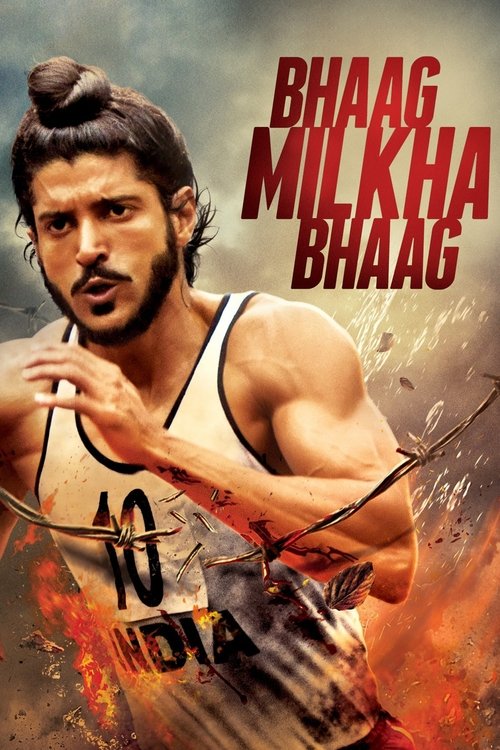
Bhaag Milkha Bhaag
2013 · Rakeysh Omprakash Mehra
For when you want an underdog story to cheer for — a film that makes you want to lace up your shoes and call your family. Comfort viewing at epic scale, with real historical weight underneath.
What it's about
The true story of Milkha Singh, the sprinter known as the Flying Sikh, who survived the massacre of his family during the 1947 Partition, drifted through refugee camps and petty crime, and found discipline in the Indian Army before running his way to the 1960 Rome Olympics. The film cuts between his rise as an athlete and the childhood trauma that fuels every race, framed around a fraught invitation to compete in Pakistan — the land he fled.
The experience
Big, emotional, and unashamedly rousing: training montages that make your pulse climb, flashbacks that land like body blows, songs that swell at exactly the moments you expect. It's long and it earns its tears the old-fashioned way — by making you love the man before it breaks your heart.
Performances
Farhan Akhtar's physical transformation into Milkha is the film's centerpiece — he trained until he moved like a competitive sprinter, and the conviction of the running sequences carries the whole picture.
The craft
Rakeysh Omprakash Mehra builds the film on intercutting: races in the present keep dissolving into Partition-era memory, so every sprint doubles as an act of outrunning the past. The track sequences are shot with real kinetic force, and the score and songs are engineered for a big screen and a full heart.
Why it matters
One of the defining Hindi biopics of its decade, it helped kick off Bollywood's wave of sports-hero films and turned Milkha Singh's story into national shorthand for resilience. Akhtar's transformation set a new bar for physical commitment in mainstream Indian cinema.
Snapshot
Bhaag Milkha Bhaag ("Run, Milkha, Run") is a Hindi-language biographical sports drama that dramatizes the life of the sprinter Milkha Singh — the "Flying Sikh" — from the trauma of his family's massacre during the 1947 Partition of the Indian subcontinent to his emergence as one of independent India's first internationally competitive track athletes. Directed by Rakeysh Omprakash Mehra and built around Farhan Akhtar's much-discussed physical transformation into the lead, the film threads two time frames together: a present-tense national narrative organized around Milkha's fraught journey to compete in Pakistan, and an extended set of flashbacks reconstructing his childhood, his years as a Partition refugee, his enlistment in the Indian Army, and his rise through athletics to the 1960 Rome Olympics. It is a long film — running well past the three-hour mark, a scale characteristic of mainstream Hindi cinema — that fuses the conventions of the training-and-triumph sports picture with a national-historical melodrama about displacement, wounded masculinity, and the psychic cost of Partition. On release it was both a commercial success and a critical talking point, and it stands as one of the defining Bollywood biopics of the 2010s.
Industry & production
The film was produced within the mainstream Hindi film industry (Bollywood) as a mid-to-large-budget star vehicle, developed by Mehra's own production banner in partnership with a major studio distributor; it carries the industrial signature of the post-2000s Bollywood biopic boom, in which studios increasingly financed prestige "true story" projects built around a transformed star performance. The most frequently cited detail of its provenance is that Milkha Singh himself granted the life rights for a nominal, symbolic sum — commonly reported as one rupee — on the condition of a share for a charitable trust; because this figure recurs across interviews and press coverage rather than in a single authoritative document, it should be treated as widely reported rather than independently verified here. The production drew on a long gestation in which Mehra and screenwriter Prasoon Joshi worked directly with the surviving Milkha Singh and his family to shape the account. Shooting spanned Indian and overseas locations to stage the athletics sequences and the international meets. Exact budget and box-office totals circulate in trade coverage but vary by source; rather than cite a specific number I cannot firmly anchor, it is safer to say the film performed strongly at the domestic box office and was regarded within the industry as a commercially successful prestige release.
Technology
The film was made and finished on the digital production and post-production pipeline standard for major Hindi cinema of the early 2010s, which had by then largely displaced photochemical origination. Its technological ambitions lie less in bleeding-edge capture than in the demands of the sports genre: staging and photographing running at speed convincingly, matching an actor's trained body to the kinetics of elite sprinting, and cutting foot-races for suspense. That places the film's real technical work in choreography, camera movement, and editorial rhythm rather than in visual effects spectacle; where period reconstruction is required — Partition-era Punjab, mid-century stadiums, the Rome Olympics milieu — it is achieved primarily through production design, costume, and location work supported by unobtrusive digital set-extension and grading rather than by foregrounded CGI. Detailed, verifiable specifics of the exact camera systems and finishing houses used are not something I can confirm without inventing them, so I will not attribute particular equipment.
Technique
Cinematography
The cinematography is credited to Binod Pradhan, a senior and highly regarded Hindi-cinema cinematographer whose earlier work (including for Vidhu Vinod Chopra and for Mehra on Rang De Basanti) established him as a stylist comfortable with both lyrical warmth and large-scale movement. In Bhaag Milkha Bhaag the camerawork modulates across the film's registers: the Partition and refugee passages tend toward earthy, dust-and-blood palettes and handheld immediacy; the athletic sequences favor tracking and lateral movement that keep pace with the runner, intercut with tighter framings of straining musculature, feet, and breath to convert running into drama. The song sequences open the frame to more saturated, composed imagery in the tradition of the Hindi film "picturization." Across these modes the lensing consistently privileges the body of the sprinter as landscape — sweat, scar, sinew — reinforcing the film's central conceit that Milkha's history is written on and run out through his body.
Editing
Editing is credited to P.S. Bharathi (Mehra's longtime creative partner). The editorial design is the film's most structurally significant technical choice: rather than a linear cradle-to-glory arc, the film continually cross-cuts between the present-tense frame narrative and layered flashbacks, so that Milkha's past is revealed as a series of returns — memories that intrude on and motivate his present. This associative, memory-driven cutting lets Partition trauma detonate inside otherwise triumphant sporting scenes, and it is the mechanism by which the film keeps a very long runtime dramatically taut. Within set-pieces, the race editing tightens to accelerate pulse and suspense. The editing on the film was recognized in Indian awards coverage; I'll note that it received significant editorial recognition without overstating a specific citation I cannot fully verify.
Mise-en-scène / staging
Mehra stages the film across three visual worlds that recur throughout: the golden-fielded, then blood-soaked Punjab of childhood and Partition; the disciplinary, camaraderie-driven space of the Army camp and the training ground; and the more polished arena of national and international competition. Production and costume design carry much of the period reconstruction — the refugee columns and camps, mid-century uniforms and stadium dressing, the textures of 1950s–60s India. Staging repeatedly uses the running track and the open road as metaphor: Milkha runs toward medals and away from memory in the same motion, and the mise-en-scène literalizes "flight" as both athletic and traumatic. Crowd staging in the competition and public-reception scenes situates his private struggle within a national one.
Sound
The score and songs are by the composing trio Shankar–Ehsaan–Loy, with lyrics by Prasoon Joshi, and music is central to the film's emotional architecture — an expected emphasis in mainstream Hindi cinema, where the song score is dramaturgy, not ornament. The title song and the motivational anthems function as montage engines for training and endurance, while the more plaintive numbers underscore loss, longing, and romance. Beyond the songs, the sound design leans on the corporeal grammar of the sports film — breath, footfall, heartbeat, the roar and hush of crowds — to place the audience inside the runner's exertion. The interplay of driving rhythmic tracks against near-silent, breath-forward race climaxes is a recurring sonic strategy.
Performance
The film is anchored by Farhan Akhtar as Milkha Singh, in a performance built as much on physical reconstruction as on interior work: Akhtar's widely reported athletic training and body transformation to approximate a sprinter's physique became part of the film's public identity and shifted expectations for commitment in Hindi biopic acting. The performance balances the extroverted charisma the sports-hero role demands against the withheld grief of a man shaped by massacre and displacement. The supporting ensemble includes Divya Dutta as Milkha's sister — a relationship that carries much of the film's emotional weight and the trauma of separation — with further roles from Pawan Malhotra as a mentor-coach figure, Yograj Singh, and Sonam Kapoor in a smaller romantic role. The acting register is broadly the heightened, emotionally legible mode of mainstream Hindi drama rather than restrained naturalism, calibrated to the melodramatic and inspirational aims of the material.
Narrative & dramatic mode
The dramatic mode is inspirational biographical melodrama fused with the sports-triumph template, but its distinguishing move is trauma-structured storytelling. The narrative is organized around a wound — the Partition massacre of Milkha's family and his father's dying exhortation to "run" — that the film returns to obsessively, so that athletic achievement is figured as both escape from and confrontation with history. The framing device (the pressure on Milkha to compete in Pakistan, the land of his loss) supplies present-tense stakes and gives the flashbacks their motivation and payoff. Emotionally the film works in large, direct strokes: grief, humiliation, discipline, love, and national pride are all foregrounded rather than implied. Its central irony — that the command to run is at once a father's plea to flee slaughter and the engine of a champion's stride — is the thematic knot the whole structure is built to tie.
Genre & cycle
Bhaag Milkha Bhaag sits at the intersection of two genres: the sports biopic and the Partition/nation film. As a sports film it deploys the familiar arc of adversity, training montage, rivalry, setback, and climactic race. As a national-historical drama it belongs to Hindi cinema's long engagement with Partition trauma and with narratives of nation-building. Crucially, it is a keystone of the 2010s Bollywood biopic cycle — a wave of fact-based films, many of them sports biopics (of cricketers, boxers, wrestlers, and other athletes), that dominated a significant share of prestige Hindi filmmaking in the decade. Within that cycle, Bhaag Milkha Bhaag is often positioned as an early, template-setting success that helped normalize the transformed-star athletic biopic as a bankable prestige form.
Authorship & method
The film is strongly authored by Rakeysh Omprakash Mehra, whose body of work — notably Rang De Basanti (2006) and Delhi-6 (2009) — repeatedly binds individual awakening to national reckoning; Bhaag Milkha Bhaag extends that signature by making a single body the site where the nation's founding trauma and its aspirational future collide. His method here foregrounds close collaboration with living sources (Milkha Singh and his family) and a preference for structuring national history through intimate, emotionally maximalist storytelling. His key collaborators recur across his filmography and shape the result decisively: writer–lyricist Prasoon Joshi, who supplies both screenplay and lyrics and thus unifies dialogue and song around the film's themes; cinematographer Binod Pradhan; the composer trio Shankar–Ehsaan–Loy; and editor P.S. Bharathi, whose memory-cutting realizes the film's temporal design. The Mehra–Joshi partnership in particular gives the film an unusual integration of narrative and musical authorship.
Movement / national cinema
The film is a product of mainstream Hindi cinema (Bollywood) and, more specifically, of a 2000s–2010s tendency toward socially and historically engaged mainstream filmmaking — films that retain the song-and-spectacle grammar of popular Hindi cinema while turning toward "real" national subjects (history, sport, biography, reform). It is not an art-house or parallel-cinema work; its ambitions are populist and its address is national. As a Partition narrative it participates in one of the enduring preoccupations of the subcontinent's cinemas, and its cross-border framing engages directly with the India–Pakistan relationship that Partition inaugurated. In that sense it functions as national cinema in the fullest way: a mass-audience film that narrates the nation to itself through the body of an exemplary citizen-athlete.
Era / period
Made and released in 2013, the film belongs to a confident, high-production-value moment in Hindi cinema, in which digital finishing, studio-backed prestige projects, and the star-transformation biopic were all ascendant. Diegetically, it reconstructs a mid-twentieth-century arc: the 1947 Partition and its refugee aftermath, 1950s India and the Army, and the international competition of the late 1950s and 1960 Rome Olympics. The film thus operates as a period piece about the first decades of Indian independence, viewed from and for a twenty-first-century audience — a retrospective on nation-building filtered through contemporary craft and stardom.
Themes
The dominant theme is the entanglement of personal trauma and national identity: Milkha's running is inseparable from Partition, and his victories are read as the young nation's own. Around this cluster: displacement and refugeehood; the transmutation of grief into discipline; masculinity forged through hardship, army life, and self-mastery; the burden and pride of representing a nation; and reconciliation, staged through the fraught return to Pakistani soil. The father's command to "run" operates as the film's master-metaphor, condensing flight, survival, ambition, and healing into a single act. Underpinning it all is a theme of memory as something that cannot be outrun and must instead be faced — the reason the narrative keeps circling back to the wound.
Reception, canon & influence
Critically and commercially, Bhaag Milkha Bhaag was among the more prominent Hindi films of 2013. Reviews and audience response singled out Farhan Akhtar's committed lead performance and the emotional force of the Partition material, while some criticism, as is common with the inspirational-biopic form, noted the film's length and its reliance on melodramatic and formulaic sports-genre beats. It featured in the year's major Indian awards conversation and received significant honors, including recognition as a top popular film at the National Film Awards; I flag that the precise slate of award wins is something I would rather characterize broadly than enumerate with false certainty.
Influences on the film (backward): it inherits the global sports-triumph template (adversity, training, climactic contest) and the Hollywood-derived athletic-transformation biopic, and it draws on Hindi cinema's own long traditions of Partition storytelling, song-driven emotional structure, and the socially engaged mainstream film — including Mehra's earlier fusion of the personal and the national in Rang De Basanti.
Legacy / what it shaped (forward): the film is frequently cited as a catalyst and template for the 2010s wave of Bollywood sports biopics and star-transformation "true story" films, helping to establish that a physically transformed lead and a fact-based national subject could be both prestige-bearing and commercially potent. It also cemented Farhan Akhtar's standing as a leading actor and reinforced Milkha Singh's iconic status in Indian popular memory, arguably becoming the dominant cultural image of "the Flying Sikh" for a generation of viewers. Its most durable influence, then, is generic and industrial: it is a reference point against which subsequent Indian athletic biopics have been measured.
Reception
A blockbuster and awards magnet in 2013 (National Film Award, Filmfare Best Film), it's now remembered as the film that kicked off Bollywood's sports-biopic gold rush — though later entries like Dangal have somewhat stolen its thunder, and modern rewatchers grumble about its three-hour-plus runtime.
How Bhaag Milkha Bhaag was received, from release to now →
Influences: the films it descends from and the films it influenced
- Rang De Basanti (2006) — Mehra's own editing grammar of intercutting a present-tense narrative with historical/national trauma so a personal awakening becomes national reckoning — the past/present collision structure BMB inherits wholesale, along with the Prasoon Joshi lyric-and-dialogue integration.
- Chariots of Fire (1981) — Codified the running-biopic as spiritual and national contest, staging races in lyrical slow-motion under anthemic score; BMB's race montages and nation-on-the-track framing descend directly from this treatment of the sprint as transcendence.
- Raging Bull (1980) — Built the sports biopic on radical bodily transformation of its star plus corporeal sound design — amplified breath, impact, and flesh — the model behind Farhan Akhtar's physique work and BMB's tactile audio of exertion.
- Rocky (1976) — Established the training-montage-to-climactic-contest architecture and the underdog-song build that BMB's arc structurally reproduces beat for beat.
- Garam Hawa (1973) — Foundational Partition-displacement cinema in which the wound of 1947 lodges inside a single family and body; BMB's Partition flashbacks work within this tradition of nationalizing trauma through the intimate.
- Tamas (1988) — Rendered Partition communal massacre as visceral remembered horror; BMB's night-of-slaughter memory imagery — the fleeing child, the murdered father — operates in the visual shadow of this depiction.
- Lagaan (2001) — Fused the sports-triumph climax with Bollywood song dramaturgy and national allegory, proving an athletic contest could carry mass-entertainment nationalism; BMB inherits its method of song-score functioning as narrative structure.
- Chak De! India (2007) — The immediate domestic template — sport as redemption for a protagonist scarred by Partition-era communal suspicion, marrying training-film mechanics to a national-wound backstory just before BMB refined it.
- Lagaan: Once Upon a Time in India (2001) — Rides the biographical sports-epic current Lagaan made viable, cross-cutting an athlete's ordeal into a nation-building emotional payoff.
- Mary Kom (2014) — Directly follows BMB's star-transformation-plus-true-national-athlete prestige formula, casting a marquee lead into a physically demanding real-sportsperson embodiment.
- Dangal (2016) — Extends the physically-transformed-lead sports biopic with climactic bout montage and anthemic song-score, the peak of the commercial-prestige true-story cycle BMB catalyzed.
- M.S. Dhoni: The Untold Story (2016) — Applies BMB's frame-and-flashback biopic structure and total star-embodiment to a cricketer, tracing the athlete's rise through cross-cut memory the way BMB traced Milkha's.
- Sultan (2016) — The male-star bodily-transformation sports-triumph film with a trauma backstory driving the comeback, cast squarely in BMB's melodramatic commercial-prestige mold.
- Gold (2018) — Explicitly fuses sport, Partition, and independence-era nation-building — binding athletic triumph to the 1947 rupture exactly as BMB welded Milkha's running to the Partition wound.
- Soorma (2018) — A trauma-to-triumph athlete biopic in which bodily catastrophe (paralysis) is the wound to be overcome, following BMB's melodramatic register of suffering-as-fuel.
- Toofaan (2021) — Mehra and Farhan Akhtar reprising the very transformation-biopic method they forged here — physique overhaul, corporeal training design, redemptive arc — now transposed to boxing.
- 83 (2021) — The fact-based national-sporting-triumph prestige film whose commercial and awards viability BMB helped establish, staging real athletic history as anthemic mass-entertainment nationalism.
- Slumdog Millionaire (2008) — The frame-and-flashback device in which present-tense pressure triggers cross-cut memories that reconstruct a life; BMB shares this architecture and its kinetic, memory-triggered cutting to reassemble a biography under duress.
- Paan Singh Tomar (2012) — Near-contemporary Indian real-athlete biopic told in nonlinear flashback, reframing a runner's life through the later trauma that derailed it — a parallel deployment of the athlete-remembered-in-fragments structure.
- Main Vaapas Aaunga (2026) — Uses the Partition memory as a traumatic flash-cut that recurs at increasing length across the film, each return admitting one more frame of what the survivor will not narrate — the same withholding-by-increment the grandson's investigation forces open.
Similar films
- Dangal (2016) — influence & lineage
- Slumdog Millionaire (2008) — influence & lineage
- Rang De Basanti (2006) — influence & lineage
- Lagaan: Once Upon a Time in India (2001) — shared sensibility
- Bajrangi Bhaijaan (2015) — shared sensibility
- Gully Boy (2019) — shared sensibility
- Kabhi Khushi Kabhie Gham (2001) — shared sensibility
- Dhurandhar (2025) — shared sensibility