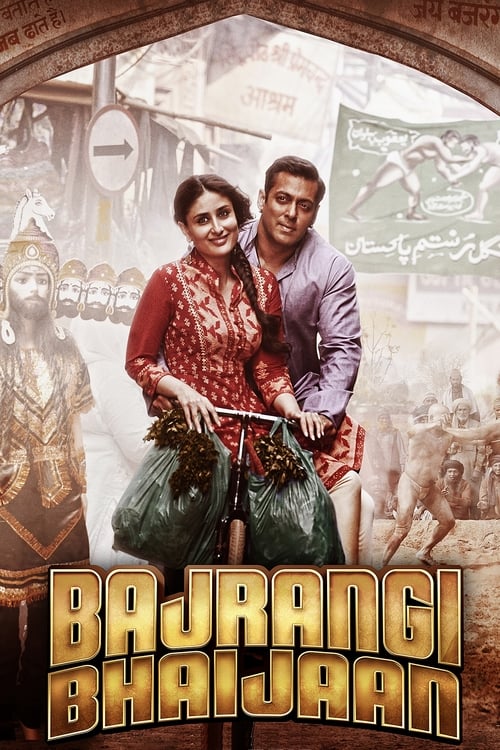
Bajrangi Bhaijaan
2015 · Kabir Khan
For when you need a good cry of the uplifting kind — a feel-good family film about kindness crossing borders. Comfort viewing with a conscience, great for watching with people of any age.
What it's about
A mute six-year-old Pakistani girl is separated from her mother on a train journey home from Delhi and left stranded in India with no way to say who she is or where she belongs. She's taken in by Pawan, a guileless, devout Hanuman worshipper who has vowed never to lie — and who decides, against all bureaucratic and geopolitical sense, to bring her back across the border to her family himself.
The experience
Warm, funny, and openly sentimental, built on the chemistry between a big man and a small silent girl; the comedy of Pawan's stubborn honesty keeps tipping into real tension as the journey gets riskier. It aims squarely for your heart and hits it — expect to well up.
Performances
Salman Khan trades his usual invincible-star persona for disarming gentleness, and it's one of his most affecting turns; six-year-old Harshaali Malhotra is remarkable, carrying half the film without a single word until its final moments.
The craft
Kabir Khan directs the fable with a light hand, letting the India–Pakistan crossing play as adventure rather than lecture, and shooting the mountain landscapes of Kashmir with real sweep. The songs are woven in gracefully, and the film's masterstroke is structural: building its emotional engine on a child who cannot speak, so every payoff has to be earned visually.
Why it matters
One of the biggest Hindi-film hits of its decade and a rare Indian blockbuster embraced enthusiastically on both sides of the India–Pakistan border — later a massive success in China too. It reset expectations of what a Salman Khan film could be.
Snapshot
Bajrangi Bhaijaan is the film in which mainstream Hindi cinema's biggest star agreed to be gentle. Released on Eid-ul-Fitr, 17 July 2015, it takes a premise of almost fable-like simplicity — a mute six-year-old Pakistani girl, separated from her mother on a train journey home from Delhi, is taken in by a guileless Hanuman devotee who resolves to walk her back across the border himself — and uses it to run a sustained argument about religious identity, national borders, and the moral insufficiency of both. Salman Khan plays Pawan Kumar Chaturvedi, called Bajrangi, a failed student and unembarrassed literalist whose vow never to lie becomes the film's engine of both comedy and crisis. Harshaali Malhotra, wordless throughout until the final seconds, plays Shahida, whom Pawan names Munni because he cannot ask her name.
The film was among the largest commercial successes in Hindi cinema's history, took the National Film Award for Best Popular Film Providing Wholesome Entertainment at the 63rd National Film Awards, and then had an improbable second life in 2018 as a major theatrical hit in China. It is now routinely cited — sometimes as achievement, sometimes as elegy — as the last big-budget Bollywood film to make reconciliation with Pakistan its central emotional proposition before the industry's nationalist turn.
Industry & production
The film sits at the intersection of two industrial logics. The first is the Eid star vehicle: since the late 2000s, Salman Khan had made the Eid weekend a proprietary release window, and Bajrangi Bhaijaan was engineered for it. The second is the star-as-producer model that reshaped Hindi cinema in the 2010s. Salman Khan Films co-produced with Rockline Venkatesh's Rockline Entertainment, with Eros International handling distribution — an arrangement that let the star's own company underwrite a film whose commercial risk was, on paper, considerable: a comedy-melodrama with a child at its center, a mostly Pakistan-set second half, and a hero who spends the film not fighting.
The screenplay originates with V. Vijayendra Prasad, whose story credit matters more than usual. Prasad was in the same year the writer of Baahubali: The Beginning, and his method — building modern popular narratives on load-bearing mythological armatures — is legible throughout. Kabir Khan and Parveez Shaikh are credited on screenplay alongside Prasad; Kausar Munir is credited with dialogue, which carries much of the film's comic register in Pawan's flat, unironic diction.
Production spanned Delhi, the Shekhawati region of Rajasthan (Mandawa's painted havelis stand in for small-town north India), and Kashmir, where the Sonamarg–Aru valley high country doubles for both sides of the Line of Control. No portion was shot in Pakistan; the "Pakistan" of the film is an Indian-shot construction, a fact that is itself part of the film's meaning — its Pakistan is an imagined, generous, essentially hospitable place, assembled on the Indian side of a line the film wants to dissolve.
Technology
Bajrangi Bhaijaan is a conventionally engineered A-list Hindi production of its moment: digital acquisition, a full digital intermediate, 2.39:1 anamorphic-format widescreen, 5.1/7.1 theatrical mixes, and visual effects used invisibly rather than spectacularly. The precise camera and lens package is not well documented in the public record, and it would be irresponsible to specify it; what is evident on screen is a large-format-adjacent digital image with substantial latitude in the snow exteriors, where the film repeatedly places dark figures against blown-out white without losing them.
The film's most consequential technological argument is diegetic rather than infrastructural. Its third act turns on a piece of consumer video: a television reporter's footage, uploaded and shared, becomes the mechanism by which two states are shamed into opening a gate. This is a genuinely 2010s plot engine — the film understands virality as a moral force, a mass sentiment that outruns bureaucratic procedure. Made fifteen years earlier, the same story would have required a benevolent official. Made here, it requires an upload.
A postscript belongs to distribution technology rather than production: the film's 2018 Chinese release, in a dubbed and subtitled version under a title translating roughly as Little Lolita's Monkey God Uncle, was part of the wave of Indian imports that followed Dangal. It demonstrated that the film's legibility survived translation almost intact, because so much of its meaning is carried in gesture.
Technique
Cinematography
Aseem Mishra, Kabir Khan's regular cinematographer across Kabul Express, New York, Ek Tha Tiger and later Tiger Zinda Hai, structures the film as a chromatic journey. The opening movement is saturated and warm: the ochre and vermilion of a Hanuman procession in Kurukshetra, the crowded brass-and-marigold of Delhi lanes, handheld and close, bodies pressing into frame. As Pawan and the child move north, the palette cools and empties — blue shadow on snow, gray rock, the frame widening until human figures are small and the composition becomes almost documentary in its patience.
Mishra builds a running visual grammar out of the height differential between Salman Khan and a six-year-old. Low angles from the child's eyeline make Pawan monumental; reverse high angles make her tiny and unreadable. The film keeps returning to a two-shot in which he must crouch, kneel, or lift her to share a frame — the physical labor of condescension made literal and tender.
Editing
Rameshwar S. Bhagat, another long-standing Kabir Khan collaborator, cuts a film of roughly two hours and forty minutes across a deliberately lopsided structure. The first act is leisurely, almost sitcom-paced: Pawan's backstory, the courtship of Rasika (Kareena Kapoor Khan), the comic business of a Brahmin household absorbing a child who eats chicken. The road film proper does not begin until well past the halfway mark, and the film accelerates only as its geography narrows. The song sequences are placed conventionally — celebration numbers front-loaded, the qawwali at a hinge point — but the editing consistently privileges reaction over incident: the cut that matters is almost always to the child's face registering something the adults have said.
Mise-en-scène / staging
The film is organized around thresholds. A mosque doorway Pawan cannot bring himself to cross. A temple he crosses without thinking. A smuggler's tunnel. A police station he insists on entering. A border gate that must, finally, open. Staging repeatedly places a character on one side of an aperture and the object of their obligation on the other, and the drama consists of the crossing.
Its second organizing system is the semiotics of religious identity. Because Shahida cannot speak, her identity must be inferred from behavior, and the film stages a sequence of small revelations: what she eats, which team she cheers, which building she walks into unhesitatingly. This is a formally elegant device and an ideologically pointed one — identity is shown to be a matter of learned ritual, entirely visible, entirely arbitrary, and entirely insufficient as grounds for exclusion. The production design supports it without underlining: tulsi plant and Hanuman idol on one side, dargah and prayer mat on the other, both photographed with the same affection.
Sound
Pritam's songs run the full commercial range, from the frankly promotional ("Selfie Le Le Re," "Aaj Ki Party") to the devotional. The qawwali "Bhar Do Jholi Meri," rendered by Adnan Sami, is the score's center of gravity and also its most contested element: the late Amjad Sabri, of the Sabri Brothers qawwal lineage long associated with the composition, publicly objected to its use, and the episode remains a live reference point in discussions of the film's borrowing across the border it romanticizes. Julius Packiam is credited with the background score, which is restrained by the standards of the form.
The most sophisticated sound decision is the negative one. Shahida's muteness is not treated as pathos-generating silence; the film gives her a full ambient life — breath, footsteps, laughter without voice — so that her final spoken word lands as an event in the sound design rather than a plot resolution.
Performance
Salman Khan's performance is the film's largest formal gamble. He plays Pawan with his physical vocabulary deliberately deflated: the swagger converted into a slightly stooped earnestness, the star's characteristic knowingness removed entirely. Pawan is a holy fool in the classical sense — his refusal to lie is not cleverness but incapacity — and the performance's discipline lies in never winking at the audience about it.
Harshaali Malhotra carries an enormous share of the film on reaction alone, and Kabir Khan's direction of her avoids the standard child-actor traps of precocity and mugging. Nawazuddin Siddiqui, entering late as the Pakistani television reporter Chand Nawab — a character named in acknowledgement of a real Karachi reporter whose repeatedly interrupted piece-to-camera became an early viral video — provides the film's only ironic consciousness, a cynic converted in real time. Om Puri, as the maulana who shelters them, supplies moral authority in a handful of scenes; his casting is intertextual, given a career spent crossing precisely these borders on screen.
Narrative & dramatic mode
The film is melodrama in the rigorous sense: a mode that renders moral states legible in the physical world, that trusts virtue to be visible, and that requires a mute innocent as its guarantor of sincerity. Its dramatic questions are not psychological but ethical, and they are posed as obstacles — a visa office, a checkpoint, a lie that would solve everything.
Beneath the melodrama is Vijayendra Prasad's mythological substructure. Pawan is a devotee of Bajrang Bali; his errand is to cross a hostile frontier, locate a captive female, and restore her to her family. This is Hanuman's Lanka episode from the Ramayana, transposed onto the Wagah border and stripped of its war. The recognition is not decorative — it explains why the film's hero can be entirely without cunning, why his strength is devotional rather than tactical, and why the climax must be a crowd rather than a fight.
Genre & cycle
Formally, the film belongs to the guardian-and-child road picture, a durable international form. Within Hindi cinema it belongs more precisely to the India–Pakistan reconciliation cycle: Henna (1991), Refugee (2000), Gadar: Ek Prem Katha (2001), Pinjar (2003), Veer-Zaara (2004), and, on the indie margin, Filmistaan (2012). What distinguishes Bajrangi Bhaijaan within that lineage is its removal of romance. Earlier entries route cross-border feeling through a couple, which allows the political to be contained as the personal. Here the bond is custodial and asexual, and the obligation therefore reads as ethical rather than erotic — harder to dismiss, and harder to resolve by marriage.
It is also, unambiguously, a masala Eid entertainer, and its achievement is holding both registers: it contains item-adjacent songs, broad domestic comedy, and a chase, while asking a mainstream Indian audience to spend an hour rooting for Pakistanis.
Authorship & method
Kabir Khan came to fiction from documentary — extensive work in Afghanistan and across the region, and a documentary on the Indian National Army made for television in the late 1990s. That formation explains a persistent tension in his commercial films: a reporter's interest in the texture of contested places, harnessed to star machinery. Kabul Express (2006) and New York (2009) are the documentary instincts foregrounded; Ek Tha Tiger (2012) is the star machinery foregrounded. Bajrangi Bhaijaan is the equilibrium.
The instructive comparison is internal and nearly simultaneous. Six weeks after Bajrangi Bhaijaan, Khan released Phantom (2015), a revenge thriller premised on extrajudicially killing the perpetrators of the Mumbai attacks. That the same director released both films in the same summer should complicate any reading of Bajrangi Bhaijaan as a settled ideological statement; it is better understood as one position a commercially disciplined filmmaker was able to occupy in 2015.
The collaborator group is stable and long-serving — Mishra on camera, Bhagat cutting, Pritam scoring — and the writing partnership with Vijayendra Prasad is the outlier that changes the result. Khan's own scripts tend toward the geopolitical thriller; Prasad supplies the folkloric spine that lets this one operate as parable.
Movement / national cinema
The film is a document of post-liberalisation Hindi cinema in its heartland phase. Where the 1990s and early 2000s located Bollywood's aspirational imagination in the diaspora, the 2010s turned inward and downward — to Uttar Pradesh, Haryana, Rajasthan, to characters who fail exams and work in shops. Pawan's Pratapgarh backstory, his father's shakha, his repeated failures, his Delhi lodging with a Brahmin family: all of this is the small-town register that came to dominate the decade.
It is equally a document of the industry's geographic expansion. Its Chinese theatrical run in 2018 belongs to the brief, remarkable period when Indian family melodrama found a mass audience in China, and it stands with Dangal and Secret Superstar as evidence that the form traveled on emotional rather than cultural specificity.
Era / period
2015 was an unusually consequential year in Indian cinema — Baahubali: The Beginning, Piku, Bajirao Mastani — and Bajrangi Bhaijaan is bound to its political moment as tightly as to its industrial one. Made in the year after a decisive change in Indian government, the film takes a protagonist explicitly coded within Hindu religious-nationalist milieu and moves him, without ever repudiating his faith, toward pluralism. Whether this constitutes accommodation or persuasion has been argued both ways with seriousness. What is not arguable is that the space for the argument narrowed afterward: within four years, the dominant mode of the Hindi border film was the one exemplified by Uri: The Surgical Strike (2019).
Themes
The film's governing theme is the gap between legal identity and moral obligation. Pawan's problem is never that he doubts what he owes the child; it is that no institution — embassy, police, border — has a procedure for it. His compulsive truthfulness, comic at first, becomes the film's most radical proposition: he cannot lie his way across the border, so the border must yield.
Secondary themes proliferate around this. Religious identity as performed rather than essential, made visible through the mute child's behavior. Caste, treated as comedy but never quite defused — Pawan's Brahmin fastidiousness is the residue the film cannot fully dissolve. Hospitality as sacred duty, embodied in the maulana. Media as an instrument of collective conscience. And childhood as a pre-political condition, which is both the film's emotional engine and its convenient limit: the child can be innocent of the conflict precisely because she cannot speak of it.
Reception, canon & influence
Indian critical reception was broadly warm, with the recurring reservations one would expect — length, sentimentality, a first act that delays the film's real business. The performance drew particular attention as a deliberate revision of a star persona. Commercially the film was extraordinary, becoming one of the highest-grossing Indian releases to that point; specific figures vary by source and accounting convention and are best consulted directly rather than asserted here. It performed strongly in Pakistan as well, which for a film of its subject was itself a result. The National Award for Best Popular Film Providing Wholesome Entertainment followed.
Looking backward, the film draws on the Ramayana's Hanuman episode as structure, on the Raj Kapoor tradition of the sanctified innocent as characterization, on the Partition-melodrama cycle for its emotional vocabulary, and on Kabir Khan's own documentary experience of the region for its refusal to caricature Pakistani civil society. Its qawwali sequence draws on a devotional performance tradition it did not fully credit.
Looking forward, its most immediate issue was Tubelight (2017), which reunited Khan and Khan on a near-identical template of holy fool, border, and war, and failed — suggesting that the earlier film's balance was harder to strike than it looked. A sequel scripted by Vijayendra Prasad has been publicly discussed for years without materializing. More diffusely, the film established the "star plays a naif" mode as a viable A-list option, and it helped open the Chinese market to Indian family melodrama.
Its most durable legacy, though, is retrospective and slightly melancholy. Bajrangi Bhaijaan is now most often invoked as a marker of what mainstream Hindi cinema was recently willing to imagine: a hit film, on the biggest release weekend of the year, in which the resolution is that both countries open the gate. Whether that reading is film history or nostalgia is a question the film's growing critical literature has not settled.
Reception
A monster hit and — rarer for a Salman Khan vehicle — a critical darling on release, it then got a whole second life in 2018 when China embraced it and turned it into one of the biggest Indian films ever released there.
How Bajrangi Bhaijaan was received, from release to now →
How to watch Bajrangi Bhaijaan: what to notice on a first viewing
- Watch the color cool as Pawan and the girl travel north. Aseem Mishra opens on saturated ochre and vermilion in Delhi, then lets the palette empty into blue shadow on snow and gray rock as the journey continues. The chromatic journey tracks distance from home more precisely than any dialogue does.
- Notice Pawan crouch or kneel to share a frame with her. Mishra builds a visual grammar from the height gap between Salman Khan and a six-year-old, using low angles to make him monumental and reverse angles to make her tiny. The physical labor of getting down to her level makes protection visible as an act, not a feeling.
- Count the doorways and gates the film makes someone cross. A mosque doorway, a temple, a smuggler's tunnel, a police station, a border gate: the story keeps placing a character on one side of an opening and their obligation on the other. Every threshold crossed is the plot's real unit of progress, more than any line of dialogue.
- Listen for how full the soundtrack is even though the girl never speaks. Her muteness gets a complete ambient life: breath, footsteps, laughter without voice, so silence never reads as absence. Building a whole sound world around her makes her presence, not her voice, the thing you register.
- Watch what she eats and which building she walks into without hesitating. Because she cannot speak, her identity is revealed only through small behavioral details, watched and interpreted by the people around her. Identity is shown as learned habit you can see, not a fact anyone has to announce.
The whole guide to watching Bajrangi Bhaijaan, with the keys for a rewatch →
Influences: the films it descends from and the films it influenced
- Sampoorna Ramayan (1961) — The Sundarakanda's three-beat emissary structure — cross into hostile territory, locate the abducted one, return with proof and without conquest — is transposed intact, with Hanuman's ocean leap becoming a crawl under a border fence and the burning of Lanka refused.
- Raja Harishchandra (1913) — Supplies the satya-vrat plot engine in which the hero advances by refusals rather than actions, each unspoken lie stripping him of a resource — Pawan's confession to the border guard and his rejection of the smuggler's tunnel are Harishchandra's escalation logic in a road-film chassis.
- Shree 420 (1955) — Establishes the sanctified-innocent performance grammar the star role revises: unfashionable body carriage, an open-mouthed reaction beat held a second past comfort, and moral legibility conveyed through the face rather than dialogue.
- Amar Akbar Anthony (1977) — Models the masala tonal weld — farce and devotional pathos inside a single scene — and the sequence in which a deity visibly answers a song, the template for the Hanuman-idol beats and for the lost-and-found reunion engine driving the last act.
- Barsaat Ki Raat (1960) — Fixes the filmi qawwali staging vocabulary reproduced by 'Bhar Do Jholi': performers seated in the round, harmonium-and-clap percussion built in call-and-response tiers, and cutaways to swaying rows of listeners that escalate the crowd rather than the soloist.
- Koshish (1972) — The precedent for ambient muteness — withdrawing the dialogue track so room tone, breath and traffic carry the scene, which forces the cut and the returned look to do the semantic work a line would otherwise do.
- Paper Moon (1973) — Codifies the height-differential two-shot: wide-angle deep focus keeping adult and child in one frame without cutting, so the child's low eyeline continually reframes and diminishes the guardian rather than being intercut with him.
- Central Station (1998) — The escort-a-child-to-a-parent road structure in which the guardian's moral conversion is measured only in reaction shots, and the palette cools as the landscape climbs away from the city — the warm-to-cool arc Aseem Mishra runs from Delhi to the Kashmir passes.
- Henna (1991) — The Kapoor-house prototype for staging Pakistani village hospitality without caricature and for filming the border as a river or ridge — a natural feature that kills — rather than as a checkpoint set.
- Veer-Zaara (2004) — Installs the Pakistani professional as the audience's moral proxy — the lawyer there, the TV reporter Chand Nawab here — and scales the reunion-at-the-gate climax as a mass event where the crowd's assent, not the protagonist's action, resolves the plot.
- Ramchand Pakistani (2008) — Stages the child's border crossing as an unremarked wander across an invisible line in open scrub, filmed in continuous wide shots with no signage or music cue — the exact spatial grammar of Munni's separation, inverted in direction.
- Kabul Express (2006) — The director's own documentary-derived method: handheld reportage texture in contested terrain and the enemy figure humanized through forced shared travel, which is the vehicle chassis Vijayendra Prasad's folkloric spine is later bolted onto.
- RRR (2022) — Prasad returns to the Hanuman-emissary template outright — Bheem enters an imperial capital unarmed and by stealth to recover an abducted child — reconfirming the writer's habit of hanging a modern political premise on a devotee-crosses-hostile-ground armature.
- Tubelight (2017) — Reassembles the identical parts — holy fool, border, war, child intermediary — with the reaction-privileged cutting no longer anchored to a mute foil, and its failure exposes how much of the earlier film's balance depended on the silent child withholding the emotional cue.
- Filmistaan (2012) — Runs the same cross-border captivity-into-warmth structure with the comic Indian innocent among Pakistani villagers, generating affection through shared pop-culture reference rather than plot concession — the low-budget rehearsal of the détente the bigger film sells at Eid scale.
- PK (2014) — Proves the A-list 'star plays a naif' mode months earlier by building comedy from a protagonist who reads religious semiotics literally and without code, the same device that lets a temple threshold, a skullcap or a namaz become a staging problem instead of a statement.
- Haider (2014) — The contemporary reference for snow-latitude Kashmir exposure — protecting high-key whites while letting shadows go cyan — so the landscape blanches the drama and the human figure reads as a dark speck against the pass.
- Baahubali: The Beginning (2015) — Vijayendra Prasad's writing method in its other 2015 application: a Puranic archetype used as load-bearing structure beneath a mass entertainer, with an oath the hero cannot break supplying the causal chain in place of psychology.
Similar films
- PK (2014) — influence & lineage
- Haider (2014) — influence & lineage
- Main Vaapas Aaunga (2026) — shared sensibility
- Dilwale Dulhania Le Jayenge (1995) — shared sensibility
- My Name Is Khan (2010) — shared sensibility
- Dangal (2016) — shared sensibility
- Om Shanti Om (2007) — shared sensibility
- Bhaag Milkha Bhaag (2013) — shared sensibility