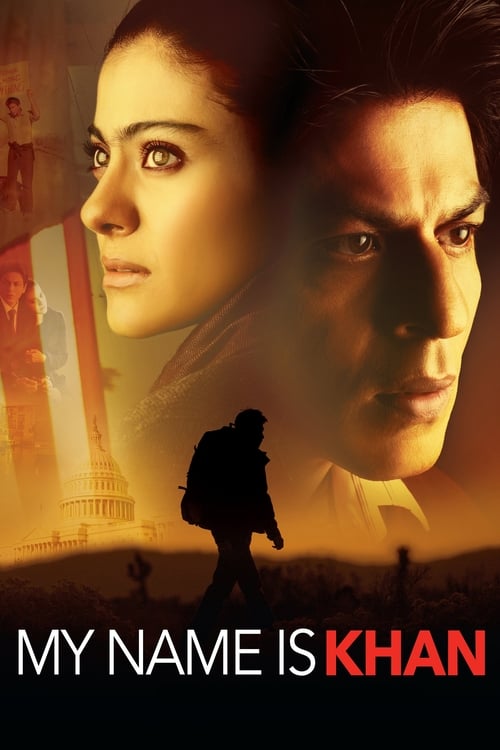
My Name Is Khan
2010 · Karan Johar
When you want a grand emotional epic and a proper cry — a film to surrender to rather than pick apart, best met with an open heart and a free evening.
What it's about
Rizwan Khan, a Muslim man from Mumbai with Asperger's syndrome, emigrates to San Francisco, where his literal-minded honesty wins him a life he never expected — a job, a Hindu wife named Mandira, a stepson, a neighborhood. Then September 11 happens, and the suspicion that falls on families like his shatters everything he's built. Refusing metaphor as always, Rizwan sets out across America with one plainly literal mission: to reach the President and say, "My name is Khan, and I am not a terrorist."
The experience
Big-hearted, earnest melodrama played at full volume — it wants to make you cry and mostly succeeds, sweeping from romance to grief to road-movie odyssey over nearly three hours. Subtle it is not; sincere it absolutely is.
Performances
Shah Rukh Khan works against every ounce of his movie-star charm, playing Rizwan with a controlled, contained physicality, and his reunion with Kajol — one of Hindi cinema's most beloved screen pairings — gives the marriage real warmth before the world intrudes.
The craft
Director Karan Johar turns the full apparatus of glossy Bollywood melodrama — soaring music, saturated emotion, epic runtime — toward the aftermath of 9/11, and the collision of that style with that subject is exactly what makes the film singular. It's crafted for the largest possible audience, and it plays like it.
Why it matters
The most conspicuous attempt by mainstream Bollywood to reckon with 9/11 and racial profiling in America, it became a global box-office event and a landmark of Hindi cinema addressing the Muslim experience for an international audience.
Snapshot
My Name Is Khan is the film in which Karan Johar — the Hindi cinema's most successful purveyor of glossy family melodrama — turned his signature apparatus toward the political. It stars Shah Rukh Khan as Rizwan Khan, an Indian Muslim on the autism spectrum (the film specifies Asperger's syndrome, per the diagnostic vocabulary current in 2010) who emigrates to San Francisco, marries a Hindu single mother named Mandira (Kajol), and, after the September 11 attacks destroy their family life, sets out across the United States to tell the President of the United States a single sentence: "My name is Khan, and I am not a terrorist."
The film's importance is less formal than positional. It is the most conspicuous attempt by mainstream Bollywood to metabolize 9/11 and its aftermath — the American security state, racialized suspicion, the collapse of the diasporic Indian's assumed safety — inside the machinery of the Hindi romantic melodrama. It reunited Shah Rukh Khan and Kajol, the most bankable screen couple of 1990s Hindi cinema, under the director who had made them a couple in Kuch Kuch Hota Hai (1998) and Kabhi Khushi Kabhie Gham... (2001). And it arrived attached to an off-screen controversy — Shiv Sena protests against Shah Rukh Khan's comments about Pakistani cricketers in the IPL — that made its release in India a matter of police protection and thus a national news event about the very question of Muslim belonging the film dramatized.
It is also, by broad critical consensus, a film of two halves: a first act of unusual tenderness and control, and a second act that expands into a road-movie parable of American goodness (the hurricane-stricken Georgia town of "Wilhelmina," the meeting with a presidential candidate) whose sentimental machinery many critics found unearned. The dossier that follows treats both.
Industry & production
My Name Is Khan was produced by Dharma Productions — the house founded by Yash Johar and run by his son Karan — in partnership with Red Chillies Entertainment, the company owned by Shah Rukh Khan and Gauri Khan. This pairing of the two most powerful producer-brands in Bombay's family-melodrama sector was itself the film's principal industrial fact: it guaranteed the budget, the stars, the international shooting schedule, and the promotional reach.
The film's distribution history is the more consequential story. It was acquired for worldwide distribution by Fox Star Studios, the Indian joint venture between 20th Century Fox and Star, in what was widely reported at the time as one of the largest deals yet struck for a Hindi film. This mattered structurally: it placed a Bollywood production inside a Hollywood major's distribution pipeline, with a release footprint across markets — the Gulf, the UK, North America, continental Europe — that Hindi cinema had previously reached through diaspora-specialist distributors. My Name Is Khan is a landmark in the corporatization of Bollywood distribution that ran through the 2000s, the period in which studio structures replaced the older financier-and-territory model.
Production was substantially American. Large portions were shot in and around San Francisco and Los Angeles, with additional US locations standing in for the film's fictional Georgia town. This was not new for Johar — Kabhi Alvida Naa Kehna (2006) was shot in New York — but here the American setting is diegetically load-bearing rather than aspirational backdrop: the film needs actual US streets, motels, highways, and detention architecture for its argument to land.
The release, on 12 February 2010, was disrupted in Maharashtra by Shiv Sena protests directed at Shah Rukh Khan personally, following his public remarks that Pakistani players should have been included in the Indian Premier League auction. Cinemas in Mumbai were vandalized and threatened; the state government deployed police to protect screenings. The episode is inseparable from the film's reception: a movie about a Muslim man asserting his right to belong was released under police guard because its Muslim star had said something conciliatory about Pakistan. Commentators across the Indian press noted the symmetry. The film went on to become one of the highest-grossing Hindi films in overseas markets to that date; precise figures vary substantially between sources and trade-reporting conventions, so specific numbers are best consulted directly rather than asserted here.
Technology
The film was shot on 35mm film and finished with a digital intermediate, the standard mainstream Hindi-cinema pipeline of the late 2000s. It sits at the tail end of the celluloid era for Bollywood's big-budget tier; within two or three years the same production houses would be shooting digitally.
Two technological registers matter to the film's texture. The first is the DI itself, which Ravi K. Chandran uses to enforce a strong and legible palette separation — the warm, saturated, honeyed San Francisco of the courtship and marriage against the desaturated, cooler, harder-contrast America of the post-9/11 sections. This is grading as dramaturgy, and it is applied with a heavier hand than Chandran's more naturalistic work elsewhere.
The second is diegetic: the film is unusually attentive to communications technology as an instrument of both connection and surveillance. Television news footage, cable coverage of the Iraq war and Hurricane-era relief, mobile phones, and — crucially — internet video and blog culture drive the plot. Rizwan's journey becomes a national story because an amateur video of him circulates online; the film's climax depends on the 2000s logic of virality and citizen media. Released in 2010, at the hinge between broadcast and networked publics, My Name Is Khan treats YouTube-era circulation as the mechanism by which a private grievance becomes public standing. That is a genuinely period-specific technological premise, and it dates the film in an instructive way.
Technique
Cinematography
Ravi K. Chandran, one of the most accomplished cinematographers working across Malayalam, Tamil, and Hindi cinema, shoots the film in a register that shifts decisively at its midpoint. The early San Francisco material is warm, shallow-focus, and full of soft window light — the Dharma house style, glamorous but here tuned down from the high-key gloss of Kabhi Khushi Kabhie Gham... toward something closer to domestic realism. Interiors are golden; the salon where Mandira works, the apartment they build, the school corridors are all rendered as an achieved, lived-in American middle-class life.
After 9/11 the camera changes posture. Handheld and shoulder-mounted work increases; the frame gets less composed, the light flatter and grayer, the palette drained toward blue-gray and institutional beige. The detention and interrogation sequences use hard sources, high contrast, and confining framings — Rizwan pressed into corners of the image, shot in ways that emphasize the physical smallness of a man in a large apparatus.
Chandran's most characteristic choice concerns point of view. Because Rizwan's autism is figured partly through sensory overload — the yellow of a particular color, the noise of a crowd, the intolerable pressure of physical touch — the cinematography periodically adopts a subjective register: selective focus that isolates a detail out of a busy field, sound-motivated close-ups on textures and objects, compositions that fragment rather than establish. This is a familiar cinematic grammar for representing neurodivergence, and the film applies it consistently rather than as isolated effect. Whether it constitutes insight or a picturesque version of difference is one of the film's live critical questions.
Editing
Deepa Bhatia's cutting is the film's most disciplined element. The structure is a frame narrative: Rizwan's journey in the present is intercut with an extended flashback covering his childhood in Borivali, his mother's teaching, his arrival in San Francisco, and the courtship and marriage. Bhatia manages a great many temporal levels — childhood, the San Francisco idyll, the post-9/11 rupture, the road journey — without losing legibility, and she uses the flashback architecture to withhold and then deliver the film's emotional detonations at chosen moments rather than chronologically.
Two editorial signatures stand out. The first is the use of association rather than chronology as a cutting logic: because Rizwan's memory is presented as detail-driven and involuntary, the film often cuts on an object, a color, or a phrase rather than on action or dialogue continuity. The second is the handling of the 9/11 sequence itself, which is compressed and largely elliptical — the attacks are registered through television, through reaction, through the sudden change in how strangers look at the family, rather than through spectacle. That restraint is a real decision and it works.
The second half is where the editing has to carry the most weight and where critics most often felt it strain: the road-movie structure is episodic by nature, and the Georgia hurricane sequence — a substantial detour in which Rizwan returns to a Black community that had earlier shown him kindness — extends the running time past three hours and shifts the film's register from intimate to allegorical.
Mise-en-scène / staging
Johar's staging works by contrast between two Americas. The first is the achieved diasporic domestic space: warm, cluttered with the objects of a blended Hindu-Muslim household, a house built by two people who have decided that their difference is not a problem. The film invests heavily in this environment precisely so that its destruction registers.
The second America is public and hostile: airport security architecture, holding cells, motels, highways, the anonymous surfaces of a country in which Rizwan is legible only as a category. Johar stages Rizwan repeatedly as a small figure in wide institutional frames — the visual argument being that the apparatus does not see individuals.
The film's signature staging gesture is the repeated verbal-physical formula of the title line, delivered in different spaces to different auditors, each time as an act of self-naming against classification. Johar stages these as direct address — Rizwan facing forward, the interlocutor and the camera aligned — which converts a plot device into ritual.
Sharmishta Roy's production design deserves note for the Borivali childhood sequences, which are rendered with more specificity of Muslim lower-middle-class Bombay life than Dharma Productions films usually attempt, and which supply the film's most persuasive claim to a milieu rather than a setting.
Sound
The score and songs are by Shankar–Ehsaan–Loy, with lyrics by Niranjan Iyengar and Javed Akhtar. The music departs from Dharma's usual model: there is essentially no conventional song-and-dance choreography, no item number, no lip-synced production number in the Kuch Kuch Hota Hai tradition. Songs are used as score — as montage accompaniment and emotional underline — which is one of the clearest signals that the film means to be received as serious rather than as entertainment-first.
Two musical choices are structurally important. "Sajda," a qawwali-inflected devotional number, and the recurring devotional register throughout, place Islamic musical form at the center of a mainstream Hindi film's emotional architecture at precisely the moment when Islam is the object of suspicion in the narrative. And the film's use of "We Shall Overcome" — the American civil-rights anthem, which has a long Indian afterlife in Hindi and Bengali translation ("Hum Honge Kamyab") — explicitly yokes the film's argument to the African American freedom struggle. The film's invocation of Martin Luther King Jr. and the Black church in its Georgia sequences makes this alignment its central rhetorical move.
Sound design is used aggressively to convey Rizwan's sensory processing: crowd noise rising into intolerability, isolated tones and textures, sudden drops to near-silence. The interrogation sequences use flat, close, reverberant room tone against the warm mixes of the domestic scenes.
Performance
Shah Rukh Khan's performance is the film's central object of debate. He constructs Rizwan out of a fixed vocabulary of physical signs — a forward-tilted posture, avoided eye contact, a rocking motion under stress, a flat and slightly halting delivery, hands held close. It is a highly technical, highly visible performance, and it belongs to a recognizable tradition of star performances of autism running back through Rain Man (1988). Its defenders point to its consistency and to the genuine tenderness Khan finds in Rizwan's literalism; its critics note that the film uses autism partly as a device for moral purity — Rizwan cannot lie, cannot dissemble, cannot hate — which makes the character an instrument of the argument rather than a person. Contemporary disability-studies criticism has been notably harder on the film than general film criticism was.
Kajol's Mandira is, on many accounts, the stronger performance and the film's actual dramatic engine. She plays a woman with appetite, humor, and ordinary ambition, and her collapse after the loss of her son is the film's least mediated emotional material. The reunion of Khan and Kajol carried enormous extra-textual charge for Indian audiences, and the film both exploits and inverts it: the couple whose romance defined 1990s Hindi cinema are here separated by a political catastrophe rather than by parental disapproval.
The supporting American cast, largely composed of non-star performers, is uneven — a common problem in Hindi productions shooting abroad, where American character actors are cast thinly and written flatter than the Indian roles.
Narrative & dramatic mode
The film's dramatic mode is melodrama in the full, non-pejorative sense: a mode organized around moral legibility, around the visible suffering of the innocent, around the demand that virtue be recognized. Peter Brooks's account of melodrama as a form that seeks to make the moral universe manifest is unusually apt here, because My Name Is Khan is literally about a man who travels across a continent to have a sentence about his moral status acknowledged by the highest available authority.
Structurally it combines three architectures. The frame-and-flashback design governs the first half and supplies the film's best writing. The picaresque road movie governs the second, with Rizwan moving through an America of episodic encounters — a motel, a Black church, a hurricane, a diner — in the tradition of the innocent traveler whose passage reveals a nation to itself. And underlying both is a quest structure of near-fable simplicity: a man, a sentence, a president.
Shibani Bathija's screenplay makes one crucial choice: the film's inciting catastrophe is not the September 11 attacks themselves but their consequence — the death of Mandira's son Sameer in a racist attack, and Mandira's subsequent rejection of Rizwan and of the name he gave the boy. The political violence is metabolized as a domestic wound. This is the film's method throughout: national trauma is rendered legible by being routed through the family. It is also the source of the most common critique — that the film resolves a political problem through a personal reconciliation and a symbolic audience with power, rather than through any structural reckoning.
The second half's turn toward parable — the town of Wilhelmina, the flood, the Black community rescued by a Muslim Indian, the national media, the presidential recognition — abandons realism deliberately. Read as social realism it is untenable. Read as a folk-tale of recognition, it is doing something more coherent, if still sentimental.
Genre & cycle
My Name Is Khan sits at the junction of several cycles.
Within Hindi cinema, it belongs to the diaspora film — the NRI-centered genre that Johar's own Kuch Kuch Hota Hai and Kabhi Khushi Kabhie Gham..., and Aditya Chopra's Dilwale Dulhania Le Jayenge (1995), had made the industry's most lucrative export. But it inverts that genre's premise. Where the classic NRI film treats the West as a place where Indian values are tested and reaffirmed, here the West becomes actively dangerous, and the question shifts from "can we remain Indian abroad?" to "will they let us live here at all?"
It also belongs to the post-9/11 Muslim-identity cycle in Hindi cinema, alongside films such as New York (2009), Kurbaan (2009, also a Dharma production), and later Vishwaroopam (2013). Read together, these constitute a genuine industrial response to the securitization of Muslim identity, and My Name Is Khan is the cycle's most commercially prominent and most sentimental entry.
Against Hindi cinema's older tradition of the "Muslim social" — the mid-century genre of Muslim-milieu melodramas such as Mere Mehboob (1963) and Pakeezah (1972) — the film represents a decisive shift: from the Muslim as a figure of refined courtly culture to the Muslim as a political subject under suspicion.
Finally, it participates in the global cycle of star vehicles about autism, and in the American road-movie tradition of the naïf crossing the country. The film knows both traditions and cites them.
Authorship & method
Karan Johar's authorship is usually described in terms of gloss, family sentiment, and the elevation of production design and star charisma over dramatic economy. My Name Is Khan is his attempt to apply that apparatus to political content, and the tension between apparatus and content is the film's defining creative fact. Johar does not abandon melodrama for realism; he insists that melodrama is adequate to the subject. Critics have divided almost entirely along the line of whether they accept that premise.
The key collaborators:
Shibani Bathija (screenplay) had written Fanaa (2006) and Johar's Kabhi Alvida Naa Kehna (2006). Her structural achievement here is the flashback architecture; the second half's episodic sprawl is the corresponding weakness. Niranjan Iyengar contributed dialogue and lyrics.
Ravi K. Chandran (cinematography) brought a pedigree from South Indian cinema and from films including Dil Chahta Hai (2001) and Black (2005) — the latter directed by Sanjay Leela Bhansali and also concerned with disability, which makes Chandran a pointed choice. His two-palette structure is the film's clearest formal argument.
Deepa Bhatia (editing) is notable as one of the most respected editors in Indian cinema and as a documentarian in her own right (Nero's Guests, 2009). Her documentary sensibility arguably accounts for the restraint of the 9/11 material.
Shankar–Ehsaan–Loy (music) had scored Kal Ho Naa Ho (2003) and much of Dharma's output; here they deliver their least song-driven, most score-driven work for the house.
Shah Rukh Khan functions as co-author, not only as star: as producer through Red Chillies and as the industry's most prominent Muslim public figure, whose own biography — the Muslim superstar of a Hindu-majority nation, repeatedly detained at American airports, as widely reported — supplies the film's extratextual authority. It is difficult to separate the film's meaning from the fact that it is Shah Rukh Khan saying the title line.
Movement / national cinema
The film belongs to mainstream Bombay commercial cinema in its corporatized, globalized phase — the period after roughly 2000 in which studio finance, multiplex exhibition, and international distribution reshaped what a Hindi blockbuster could be. It is not parallel cinema, not new-wave, not part of the independent Hindi cinema that emerged around Anurag Kashyap in the same years. It is precisely the commercial center of the industry, attempting a subject usually left to the margins.
Its national-cinema significance lies in the question of Indian secularism. India's constitutional secularism and its Hindu-majority politics are the unspoken ground of the film, even though the narrative is set almost entirely in the United States. The Hindu-Muslim marriage at the film's center, the childhood flashback in which Rizwan's mother teaches him that there are only good people and bad people rather than Hindus and Muslims, and the film's insistence on the ordinariness of Muslim life all address an Indian debate, displaced to American soil. Several critics have argued that displacement is the film's evasion: it is easier to indict American Islamophobia than Indian communalism, and the Shiv Sena protests around its release demonstrated the point involuntarily.
It also belongs to the transnational category of diaspora cinema — films made by and about migrant communities, addressed simultaneously to home and host audiences — where it sits alongside the work of Mira Nair and Gurinder Chadha, though from a far more commercial position.
Era / period
2010 places the film at a specific conjuncture. Nearly a decade after 9/11, the American security state had become an established fact rather than an emergency; the Iraq war was in its long decline; Barack Obama was in his second year as president. The film's optimism — its faith that recognition by American power is available to a Muslim who is sufficiently good — is legible as an Obama-era sentiment, and the film's unnamed presidential figure carries that association plainly.
In Indian terms, 2010 sits between the 2008 Mumbai attacks, which sharpened Hindu-Muslim tension considerably, and the political realignment later in the decade. The film's plea for Muslim ordinariness was made into a rising communal temperature, and its reception in India was shaped accordingly.
Industrially, 2010 is peak multiplex-era Bollywood: three-hour running times still standard, songs still expected, but content diversifying rapidly under multiplex economics. My Name Is Khan is a transitional artifact — a film that keeps the scale and running time of the old blockbuster while jettisoning most of its song apparatus.
Reception, canon & influence
Critical reception was substantial and sharply divided, and the division fell along a consistent line: near-universal praise for the first half, the performances (especially Kajol's), and the film's ambition; widespread criticism of the second half's descent into what many reviewers called sentimental implausibility, particularly the Georgia hurricane sequence and the presidential resolution. Indian critics were on the whole warmer than Western ones; several major American and British reviews found the film's treatment of America condescending or naïve, while acknowledging Khan's commitment. The film received numerous Indian awards, including Filmfare recognition for Khan and Kajol.
Disability-studies scholarship has produced the most pointed critique: that the film uses autism instrumentally, as a guarantor of innocence, and that Rizwan's neurodivergence functions less as a lived condition than as a narrative device conferring moral transparency. This literature has grown since 2010 and now constitutes a significant part of the film's academic reception.
Influences on the film (backward). Rain Man (1988) is the unavoidable precedent for the star-performance-of-autism, and the film does not disguise the debt. Forrest Gump (1994) is the more structurally important antecedent: the innocent whose journey across America intersects with national history and whose simplicity is treated as moral clarity — a template My Name Is Khan follows closely, including the cross-country walk and the encounter with a president. From within Hindi cinema, Sanjay Leela Bhansali's Black (2005) had recently established that a mainstream Hindi star vehicle about disability could be prestigious, and shares Chandran as cinematographer. Johar's own Kabhi Khushi Kabhie Gham... supplies the melodramatic grammar and the Khan-Kajol pairing. The American civil-rights tradition — King, the freedom songs, the Black church — is cited directly rather than merely alluded to.
Legacy (forward). The film's most durable influence is industrial. The Fox Star deal and the film's overseas performance helped establish that a Hindi film with a socially serious premise could carry a studio-scale international release, which contributed to the pattern of Hindi social-issue films with mainstream stars that followed through the 2010s. Its demonstration that a major Hindi film could largely dispense with lip-synced song numbers while retaining a Shankar–Ehsaan–Loy score contributed to a broader shift in how songs function in Hindi cinema.
Its title line entered common circulation in India and the diaspora as a shorthand for Muslim self-assertion against suspicion — a rare instance of a Bollywood line acquiring genuine political usage. It remains the reference point in discussions of how mainstream Hindi cinema has represented Muslim identity after 9/11, and is regularly taught in that context in film and South Asian studies curricula.
Its critical standing, however, has not risen. Where Dilwale Dulhania Le Jayenge or Kabhi Khushi Kabhie Gham... are now treated as canonical statements of their moment, My Name Is Khan occupies a more contested position: admired for what it attempted, and for its first ninety minutes; faulted for resolving the problem of Muslim belonging through a sentimental fable of American recognition. That combination — genuine political courage in the premise, evasion in the execution — is the settled critical verdict, and it is a fair one.
Reception
In 2010 it was a full-blown event — a record-smashing overseas opening, a Berlinale premiere, and a release week so charged that Mumbai theaters needed police protection. Today it's remembered less as a great film than as a fascinating cultural moment: a sincere, hugely ambitious swing whose melodrama and disability portrayal have divided viewers ever since.
How My Name Is Khan was received, from release to now →
How to watch My Name Is Khan: what to notice on a first viewing
- Notice how warm and golden the early San Francisco scenes look. Chandran shoots the pre-9/11 material in soft, golden, shallow-focus light, an achieved, glowing version of ordinary American life before anything changes. The film invests so heavily in this warmth precisely so its later loss will register.
- Notice Rizwan framed as a small figure in large institutional spaces. Johar repeatedly stages Rizwan as one small figure inside wide airport, security, and courtroom frames, dwarfed by architecture built for processing categories of people. The staging argues that the system he moves through does not see individuals, only classifications.
- Watch Rizwan's posture, eye contact, and rocking under stress. Shah Rukh Khan builds the character from a consistent set of physical signs, a forward-tilted stance, avoided eye contact, a rocking motion, hands held close, repeated throughout the film. The performance is built entirely from visible, external behavior rather than from any interior explanation you're given.
- Listen for the devotional qawwali number partway through the film. 'Sajda' places an explicitly Islamic musical form at the emotional center of the story, at the same moment the plot treats Islam as an object of public suspicion. The music makes a quiet counter-argument the dialogue never states outright.
- Notice a cut triggered by a color or an object, not an action. Bhatia often moves between past and present on a detail, a color, a phrase, rather than on dialogue or physical continuity, matching how the film frames Rizwan's own memory. The editing itself is built around the same detail-driven attention the story gives to how Rizwan experiences the world.
The whole guide to watching My Name Is Khan, with the keys for a rewatch →
Influences: the films it descends from and the films it influenced
- Rain Man (1988) — Hoffman and Levinson codified an externalized performance inventory for autism — flat affect, echolalia, aversion to touch, panic when routine breaks, savant recall — and Shah Rukh Khan reproduces that vocabulary almost beat for beat, including the public meltdown-in-transit set piece, inside a road structure lifted from the same film.
- Forrest Gump (1994) — Supplies the structural machine: a naïf's linear cross-country trek intercut with national history, where the innocent's literal-mindedness is cut as unwitting moral commentary and the arc terminates in an audience with a president — a template My Name Is Khan follows down to the walk and the handshake.
- Black (2005) — Shares cinematographer Ravi K. Chandran, whose low-key high-contrast lensing of disability — shallow focus racked onto hands and objects, faces lit off practicals — carries directly into Khan; it also proved a Hindi star vehicle about impairment could be positioned as prestige rather than pity.
- Kannathil Muthamittal (2002) — Chandran again: shoulder-level handheld tied to a single consciousness, with sound design foregrounded over dialogue so that a political atrocity is routed entirely through one person's sensorium — the direct technical parent of Rizwan's sensory-overload POV passages.
- Kabhi Khushi Kabhie Gham... (2001) — Johar's own melodramatic grammar transplanted wholesale — the maternal blessing staged as ritual, slow-motion recognition entrances, songs deployed as emotional punctuation rather than plot, and the Khan–Kajol register of comic sparring collapsing into weeping reconciliation.
- Kal Ho Naa Ho (2003) — The Johar-scripted New York diaspora film with a Shankar–Ehsaan–Loy score that established the Manhattan location grammar — bridge, brownstone stoop, neighborhood-as-chorus — which Khan repurposes for a Muslim family whose neighborhood turns hostile.
- Swades (2004) — Pioneered the de-starred Shah Rukh: no lip-synced numbers for the hero, songs demoted to underscore and montage, and a picaresque journey across landscape used as the engine of civic argument — the exact song-function shift Khan is credited with mainstreaming.
- Veer-Zaara (2004) — Establishes the frame-flashback confession — present-day custody or interrogation opening onto a life told in retrospect — and pairs it with a qawwali/devotional scoring register used to underwrite a Muslim character's dignity within star melodrama.
- Taare Zameen Par (2007) — Made neurodivergent interiority a cinematographic problem for mainstream Hindi cinema — warped focus, distorted sound mix, and associative animated inserts standing in for the protagonist's processing; Khan is its adult, star-fronted successor in technique as much as subject.
- Chak De! India (2007) — The prior de-glamorized Shah Rukh Muslim protagonist whose loyalty is publicly doubted, with the performance built from withheld reaction and averted eyes rather than charisma — the same rhetorical device of making an audience watch a star absorb suspicion without retaliating.
- Barfi! (2012) — Extends the post-Khan template of a bankable star performing neurodivergence: Priyanka Chopra's Jhilmil is assembled from the same externalized tic vocabulary, and Basu cuts to her sensory reactions as reaction-shot punchlines exactly as Johar cuts to Rizwan's.
- PK (2014) — Takes Khan's Gump-derived device — the literal-minded outsider who audits a society by obeying its stated rules exactly — and turns it on religious practice, using the same cross-country journey and the same comic-then-tearful escalation of the innocent's questions.
- Bajrangi Bhaijaan (2015) — Rebuilds the holy-fool road movie in which a star's incorruptible simplicity dissolves a geopolitical border, resolved by the same climactic mass-recognition scene where a watching crowd converts the protagonist's stigma into public vindication.
- Mulk (2018) — Descends from Khan's declarative self-defense — a Muslim family under collective suspicion arguing its belonging to camera — but swaps the sentimental fable of American recognition for a courtroom procedural, an explicit corrective to the resolution Khan was faulted for.
- New York (2009) — The immediate Hindi precedent for post-9/11 detention as melodrama, including the interrogation-flashback block and the elliptical handling of the attacks themselves through fragmentary news imagery rather than staged spectacle — the same evasion Khan formalizes.
- Kurbaan (2009) — Dharma's own companion post-9/11 film from months earlier: the identical house apparatus — glossy production design, star coupling, lush scoring — pointed at Muslim suspicion in America, making the gloss-versus-politics tension Khan inherits an in-house experiment.
- Khuda Kay Liye (2007) — Built its climax on a Muslim character arguing his faith directly to a Western institution in a sustained courtroom declaration — the rhetorical set piece Khan compresses into a repeated title line delivered as direct address.
- The Reluctant Fundamentalist (2012) — Structures post-9/11 Muslim suspicion as retrospective testimony delivered to an on-screen listener, the interview frame performing the same function as Khan's flashback frame: the accused controls the telling, so narration itself becomes the assertion of innocence.
Similar films
- Kabhi Khushi Kabhie Gham (2001) — influence & lineage
- Bajrangi Bhaijaan (2015) — influence & lineage
- Kal Ho Naa Ho (2003) — influence & lineage
- PK (2014) — influence & lineage
- Kannathil Muthamittal (2002) — influence & lineage
- Kuch Kuch Hota Hai (1998) — shared sensibility
- Dilwale Dulhania Le Jayenge (1995) — shared sensibility
- Like Stars on Earth (2007) — shared sensibility