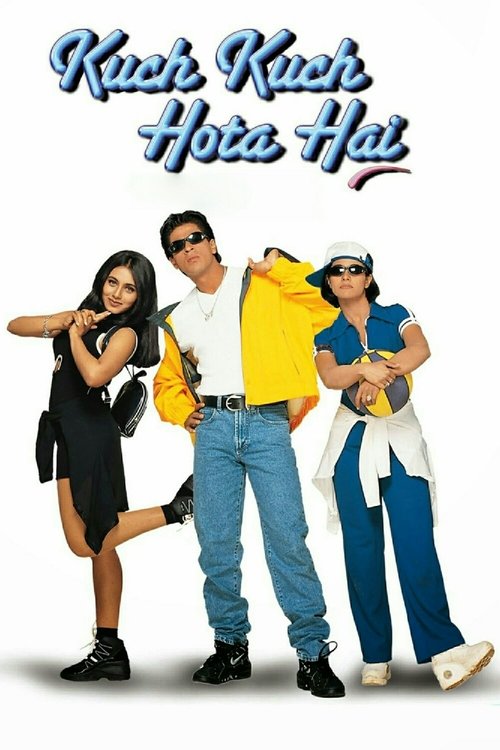
Kuch Kuch Hota Hai
1998 · Karan Johar
For a cozy night in when you want to fall in love — or fall back in love with the whole idea of Bollywood romance. Maximum comfort, zero challenge; ideal with friends who'll sing along.
What it's about
At a gloriously '90s Indian college, Rahul is best friends with tomboy Anjali — and blind to the fact that she loves him — while he chases the glamorous new arrival Tina. Years later, an eight-year-old girl, honoring her mother's last wish, schemes to reunite her widowed father with the college friend he never realized he loved, even though that friend is now engaged to someone else.
The experience
Bubbly, colorful, and shamelessly romantic — a candy-rush first half of college hijinks that deepens into a warm, teary second-chance love story. It's pure emotional comfort food, engineered to make you grin and then get something in your eye.
Performances
Shah Rukh Khan and Kajol's chemistry is the gold standard of Hindi screen romance, and Kajol in particular is wonderful — her tomboy Anjali, and the grown woman she becomes, give the film its whole beating heart.
The craft
Karan Johar directed this at twenty-six, and his debut fizzes with youthful energy: designer wardrobes, basketball courts, summer camps, and song sequences that became instant classics. The soundtrack was a phenomenon, and the film's blend of American teen-movie gloss with the joint-family weepie created a look and sound the industry copied for a decade.
Why it matters
The hinge film of post-liberalization Hindi cinema — it launched Karan Johar, defined the Dharma Productions house style, and swept the awards of its year. Its friendship bracelets, catchphrases, and songs are permanent pop-culture furniture in India.
Snapshot
Karan Johar's directorial debut, made at twenty-six for his father Yash Johar's Dharma Productions, is the hinge film of post-liberalization Hindi cinema: the point at which the family romance perfected by Sooraj Barjatya and Aditya Chopra was handed to a younger sensibility that had grown up on satellite television, designer labels and American teen movies, and that saw no contradiction between them and the joint-family weepie. Its plot is a machine of almost brazen simplicity. In a college idyll, Rahul (Shah Rukh Khan) loves the newly arrived Tina (Rani Mukerji) while failing to notice that his tomboy best friend Anjali (Kajol) loves him; Anjali leaves; Rahul marries Tina; Tina dies after childbirth, leaving eight letters for her daughter, also named Anjali, to be opened on successive birthdays. Eight years later the child (Sana Saeed), armed with her mother's posthumous instructions, engineers the reunion of her father with the woman he never recognized as his beloved — now engaged to another man (Salman Khan, in an extended cameo). The film became the highest-grossing Indian release of 1998, won the National Film Award for Best Popular Film Providing Wholesome Entertainment, and swept the major Filmfare categories including Best Film, Director, Actor, Actress and Supporting Actress. More consequentially, it established a house style — glossy, urban, star-forward, emotionally maximalist, obsessively costumed — that Dharma Productions has traded on for a quarter-century.
Industry & production
The film arrived at a genuine inflection point in the Bombay industry's institutional history. In 1998 the Government of India formally accorded filmmaking "industry status," opening the door to bank finance and insurance and beginning the slow displacement of the private, opaque and frequently criminal capital that had underwritten Hindi film production through the 1980s and 1990s. That underworld shadow was not abstract in these years — the 1997 murder of music magnate Gulshan Kumar and, shortly after, the prosecution of financier Bharat Shah made the industry's funding structures front-page material. Kuch Kuch Hota Hai belongs to the last cohort of major Hindi films produced substantially under the old dispensation while addressing itself to the corporatized, multiplex-and-overseas market that was about to arrive.
Dharma Productions, founded by Yash Johar in 1976, was at a low ebb. Its 1998 release Duplicate, directed by Mahesh Bhatt, had failed, and the company's survival was not assured. Karan Johar had served his apprenticeship on Aditya Chopra's Dilwale Dulhania Le Jayenge (1995) as assistant director and costume collaborator, and appeared briefly on screen in it; his debut was in that sense an inside job, made with the Yash Raj playbook in hand and with Shah Rukh Khan — by 1998 the industry's dominant romantic star — as its guarantor. Kajol and Khan had already been paired in Baazigar (1993), Karan Arjun (1995) and DDLJ; casting them again was less a creative choice than the deployment of an established public intimacy.
The economics deserve emphasis. The film's soundtrack, composed by Jatin–Lalit, was among the best-selling Hindi film albums of the decade, and music rights had by then become a primary pre-production financing instrument rather than an ancillary. Its overseas performance in the United Kingdom, North America and the Gulf helped consolidate the "overseas territory" as a distinct, high-margin revenue stream — the commercial argument that would within a few years reshape what Hindi films looked like and whom they were about.
Technology
Kuch Kuch Hota Hai was shot on 35mm color negative and finished photochemically; digital intermediate grading would not enter Indian mainstream production for roughly another five to seven years, so the film's celebrated high-chroma look was achieved on set — through lighting, filtration, art direction and costume — and in the timing bay, not in software. This matters for how one reads its images: the saturated primaries are physical facts of production design and exposure, not post-hoc corrections.
The film is entirely post-synchronised. Dialogue was dubbed in studio after the fact and songs were pre-recorded with playback singers and lip-synced on set — the standard Bombay method, which Lagaan (2001) is conventionally credited with beginning to displace in favour of location sync sound. The consequence is an audio track with no ambient continuity, in which voices sit forward and slightly detached from their spaces, and in which the shift into song involves no acoustic rupture at all, because the whole soundtrack is already a constructed object.
The specific theatrical sound format of the original release is not something the accessible record documents cleanly, and it would be irresponsible to assert one; what is clear is that the late 1990s saw rapid adoption of DTS and Dolby Digital across Indian first-run exhibition, and that a flagship Dharma production's mix and its song sequences were engineered for that upgrading exhibition environment.
Technique
Cinematography
The choice of Santosh Sivan as director of photography is the most interesting technical decision in the film and the least discussed. Sivan was in 1998 the most artistically serious cinematographer working in Indian cinema — the eye behind Mani Ratnam's Roja, Bombay and Iruvar, and the director of The Terrorist, released the same year, a film of austere natural light and almost documentary intimacy. Hired onto a candy-coloured Bombay romance, he supplied not restraint but an unusually disciplined maximalism.
The college sequences are built on color blocking: primaries pushed hard, backlight used as a continuous haze that separates figures from the set and gives the campus its dreamed, unlocatable quality. Sivan favours wide lenses in the ensemble comedy, keeping the frame busy and the depth aggressive, then switches to long-lens close-ups — particularly on Kajol — for the emotional beats, where the background dissolves into unreadable color. The eight-year jump is marked chromatically as much as narratively: the camp section cools and softens, admitting whites, pastels and greens where the college had been red, yellow and blue. Song picturisation uses fluid crane and Steadicam movement in a way that treats the number as a spatial excursion rather than a series of poses.
Editing
Sanjay Sankla, who would go on to cut Kabhi Khushi Kabhie Gham and other Dharma productions, structures the film around a legible two-part architecture with the letters as its hinge. The flashback is not fragmented or interleaved; it is delivered as a single sustained block, so that the audience acquires the past whole and then watches the present catch up to it. This is the engine of the film's dramatic irony: we know what Rahul does not, for over an hour of screen time.
Within scenes, the cutting is punctual and gesture-driven — a hard cut on a turn of the head, a look, a physical beat — and the comedy is edited to reaction rather than to action. The song sequences are cut at a markedly higher density than the dialogue scenes, functioning as self-contained rhythmic set pieces. The eight-year ellipsis itself is executed with minimal apology, a confidence characteristic of a mode that expects the audience to accept large narrative jumps as a condition of the form.
Mise-en-scène / staging
Sharmishta Roy's art direction builds a college that exists nowhere: a fantasy campus with chapel, quad, corridors and basketball court, unmoored from any recognizable Indian city, functionally a stage for youth as a genre rather than youth as a sociology. The summer camp of the second half performs a comparable operation on Indian pluralism, staging a morning-prayer scene of deliberate ecumenical warmth.
Manish Malhotra's costume design is not decoration but the film's primary semiotic system, and it is here that the picture is most legible and most vulnerable. Anjali in the college section wears tracksuits, caps and logo-bearing American sportswear; Tina arrives in short skirts and, decisively, in a chiffon sari for the song that wins Rahul. Anjali's later transformation — the sari, the long hair, the softened silhouette — is staged as revelation, the moment the film has been withholding. Clothing carries the argument about femininity that the dialogue never has to make.
Sound
Jatin–Lalit's score, with lyrics by Sameer, sits at the confluence of filmi orchestration and Western pop production — synth pads, programd drums and electric guitar sharing space with strings and tabla. The title melody recurs as underscore, so the phrase "kuch kuch hota hai" operates simultaneously as song, catchphrase and leitmotif. The album's set pieces — "Koi Mil Gaya," "Ladki Badi Anjani Hai," "Saajanji Ghar Aaye," "Tujhe Yaad Na Meri Aayee," "Yeh Ladka Hai Allah" — cover an unusually wide stylistic range, from campus pop to qawwali-inflected celebration to the rain-soaked reunion duet, and were carried by the era's dominant playback voices, principally Udit Narayan, Alka Yagnik, Kumar Sanu and Kavita Krishnamurthy. Farah Khan's choreography is looser and more gestural than the classical-dance vocabulary of the previous year's Dil To Pagal Hai, favouring group formations and readable signature moves designed for reproduction at weddings.
Performance
Shah Rukh Khan plays Rahul with the mannered, self-aware charm he had by then codified — the open-armed stance, the stammer of feeling, the comic deflection that collapses into sentiment. Kajol supplies the film's naturalism and nearly all its comic timing; her performance in the college section is loose-limbed and unvain in a way the industry rarely permitted its leading women, which is precisely what makes the later makeover read to many viewers as a betrayal of the character rather than a completion of her. Rani Mukerji, in a role that could have been a mere obstacle, gives Tina an unexpected generosity, and the part launched her career. Sana Saeed's child Anjali carries the plot's entire mechanism. Salman Khan's cameo as Aman functions as star economy: a second superstar imported to make the romantic obstacle credible and then gracefully removed.
Narrative & dramatic mode
The film operates in the melodramatic mode as Indian film scholarship has theorized it — not melodrama as excess or failure of realism, but as a coherent system in which moral legibility, coincidence, tableau and direct emotional address are structural principles rather than lapses. The song sequences exemplify what Lalitha Gopalan influentially termed a "cinema of interruptions": the number does not advance the plot so much as suspend and intensify it, and the audience's pleasure is organized around that suspension. Ravi Vasudevan's work on frontality and the melodramatic address in Hindi cinema likewise illuminates how the film repeatedly arranges its actors toward the audience at moments of maximum feeling.
The dramaturgy is built on withheld recognition. The dead wife's letters are a superb device precisely because they convert a potential rival into the plot's benevolent engineer: Tina, from beyond death, authorizes the union that displaces her. This neutralizes the jealousy that a love triangle would normally generate and allows the film to have its tragedy and its comedy without either contaminating the other. The child functions as agent and as audience surrogate, doing what the viewer has wanted done since the first act.
Genre & cycle
Kuch Kuch Hota Hai belongs squarely to the 1990s family-romance cycle inaugurated by Hum Aapke Hain Koun..! (1994) and given its definitive form by Dilwale Dulhania Le Jayenge (1995), a cycle that also includes Raja Hindustani (1996), Pardes (1997), Dil To Pagal Hai (1997) and, the following year, Hum Dil De Chuke Sanam and Hum Saath-Saath Hain. These films replaced the angry-young-man cycle's aggrieved proletarian with an affluent, mobile, consumption-fluent protagonist, and relocated conflict from class antagonism to the negotiation between desire and family sanction.
Within that cycle, Johar's specific innovation is the campus. He grafts the American high-school/college movie — the cliques, the basketball court, the popular new girl, the makeover — onto the Hindi family melodrama, and then, in the second half, hands the film back to the family film's machinery of mothers, weddings and blessings. The Archie Comics comparison that critics reached for almost immediately (Rahul as Archie, Anjali as Betty, Tina as Veronica) is apt as a description of the archetypal triangle and of the film's frank fondness for cartoon clarity.
Authorship & method
Johar's authorship here is best understood as curatorial and tonal rather than formal. He wrote the screenplay and dialogue himself, and the film's signature is its confidence about feeling — its willingness to hold on an emotion past the point of taste, to let a joke and a sob occupy the same scene. His method, visible from this first film onward, is to assemble specialists at the top of their fields and let their contributions be conspicuous: Sivan's photography, Malhotra's costumes, Roy's sets, Jatin–Lalit's songs, Farah Khan's choreography, Sankla's cutting. The result is a film in which craft is not invisible but displayed, in the manner of a fashion house rather than a workshop.
That approach became the Dharma method. Johar would go on to function as much as producer, brand and talent incubator as director, and the company's later output — Kabhi Khushi Kabhie Gham (2001), Kal Ho Naa Ho (2003), Student of the Year (2012) — extends the same logic of star, surface and sentiment.
Movement / national cinema
The film is a document of the moment when "Bollywood," as a term and as a self-conscious global brand, consolidated. Hindi popular cinema had of course circulated internationally for decades — across the Soviet bloc, Africa, the Middle East and Southeast Asia — but the late 1990s produced a new kind of address: films made in India, set in an India recognizable mainly as an idea, and engineered to be legible and flattering to a diasporic audience with disposable income. Kuch Kuch Hota Hai does this less literally than DDLJ or Pardes, since it barely leaves an imagined India, but its cultural vocabulary — the branded sportswear, the campus, the summer camp, the English-inflected banter — is transnationally middle-class by design.
It stands in deliberate opposition to the parallel-cinema tradition of Shyam Benegal, Mani Kaul and Adoor Gopalakrishnan, and its hiring of Santosh Sivan is a small, telling instance of talent flowing from the art and Southern industries into the Bombay mainstream.
Era / period
1998 was a year of national self-assertion and unease: a new BJP-led government, the Pokhran nuclear tests in May, and an atmosphere in which questions of Indianness were politically live. The film's response is a Hinduism rendered as warmth and inclusiveness, a secularism performed as decor rather than argued as politics — the camp prayer, the ecumenical gesture, the Muslim-coded qawwali number sung by an all-faith cast. Read generously, this is a genuine liberal instinct; read critically, it is the conflict-free pluralism of a majority that does not have to think about it.
Economically, the film sits at the end of one era and the start of another: the last flowering of single-screen mass exhibition before the multiplex boom of the 2000s fragmented the audience and made possible both the mid-budget urban film and the ever-larger event picture.
Themes
The film's stated thesis, delivered by Rahul in the college section — that love is friendship — is also the proposition the plot spends three hours complicating, since the entire tragedy issues from Rahul's inability to recognize friendship as love until a woman has been made unrecognisable to him. Around this cluster the film's other concerns: motherhood as a force operating beyond death, the letter as an instrument of maternal authority; the child as moral agent, wiser than the adults; loss as the precondition of a second, better happiness; and consumption as the medium through which tradition and modernity are reconciled rather than opposed.
Its most contested theme is gender. The makeover — the tomboy who must be resolved into conventional femininity before she can be seen — has been the focus of sustained feminist criticism, and the film offers little defense: Anjali's own agency, considerable in the first half, contracts sharply in the second, where she is largely the object of other people's arrangements. A parallel critical strand has read the college section's intense homosociality, and the film's general camp sensibility, as carrying a queer charge that Johar's own later public work would make explicit. Scholars including Rachel Dwyer, Tejaswini Ganti, Jyotika Virdi and Sangita Gopal have situated films of this cycle within exactly these questions of consumption, conjugality and the post-liberalization family.
Reception, canon & influence
Contemporary reception was overwhelmingly favourable and commercially spectacular; the reservations, then and since, concerned derivativeness and conservatism. The premise of a child matchmaking a parent's romance invited comparisons to Hollywood templates from The Parent Trap to Sleepless in Seattle, and Johar has never disguised his formation in American popular romance. The looking-backward debts are clear: DDLJ, on which he trained, for its diasporic address and its faith in the blessing as narrative resolution; Yash Chopra's Dil To Pagal Hai (1997) for the friendship-versus-love triangle and the choreographed youth milieu; and beyond both, the long line of Bombay triangle melodramas reaching back to Raj Kapoor.
Forward, its influence is difficult to overstate within its own industry. It made Karan Johar a brand rather than a director, secured Dharma Productions as one of the two or three dominant Hindi studios, cemented the Shah Rukh Khan–Kajol pairing as a national institution, and launched Rani Mukerji. It fixed a template for the Hindi campus film that ran for well over a decade, and Johar returned to it directly in Student of the Year. Manish Malhotra's work on it effectively created the modern Hindi-film costume-designer-as-star. Internationally, the film was central to the wave of Bollywood enthusiasm that spread through Europe — notably the German television boom of the mid-2000s — and across Africa, Central Asia and Latin America.
Its afterlife has been unusually active. The title phrase entered common speech; the songs remain wedding-circuit standards; and the film has been re-released theatrically for anniversary programming and become a fixture of streaming catalogs. Online, it now sustains a permanent revisionist conversation — sympathy for Tina, impatience with Rahul, arguments over the makeover — which is itself the surest evidence of canonization. A film is only relitigated for twenty-five years if people cannot stop watching it.
Reception
The biggest Bollywood hit of 1998 and an instant phenomenon at home and across the diaspora — but rewatches now come with an asterisk, as a generation raised on it (and Karan Johar himself, who's admitted he cringes at parts of it) re-litigates its gender politics while still knowing every song by heart.
How Kuch Kuch Hota Hai was received, from release to now →
How to watch Kuch Kuch Hota Hai: what to notice on a first viewing
- Watch how hard the primary colors are pushed in college scenes. Santosh Sivan lights the campus in strong reds, yellows and blues with backlight used as a continuous haze, separating the actors from the set. The palette makes the campus feel dreamed rather than located in any real city.
- Notice the background blur into color during close-ups. Sivan switches from wide ensemble lenses to a long lens on faces, especially Kajol's, for emotional scenes, letting the background dissolve into unreadable color. The world falls away so the only thing left in focus is what a face is feeling.
- Count how the songs pause the story rather than move it. Each musical number is cut at a higher density than the dialogue scenes and functions as its own rhythmic set piece, holding the plot in place. The pleasure of the number is in the suspension itself, not in what it adds to the plot.
- Compare Anjali's tracksuits to Tina's flowing sari. Manish Malhotra dresses Anjali in caps and logo sportswear and Tina in short skirts and a chiffon sari, so costume alone tells you who the story favors. Clothing carries an argument about femininity the dialogue never has to say out loud.
- Watch characters turn to face the camera at big moments. At moments of maximum feeling, the actors are arranged frontally, facing the audience almost directly rather than each other. The staging asks you to receive the emotion directly instead of watching it pass between two characters.
The whole guide to watching Kuch Kuch Hota Hai, with the keys for a rewatch →
Influences: the films it descends from and the films it influenced
- Sangam (1964) — Establishes the Bombay triangle's letter-as-detonator structure — a written confession, withheld and then read aloud late, retroactively rewrites every earlier scene — the same dramatic-irony engine Johar rebuilds as Tina's eight sealed birthday letters.
- Kabhi Kabhie (1976) — Uses a single title melody as a generational leitmotif, re-orchestrated and re-sung across a decade-wide time cut so the tune itself carries the memory the characters suppress — precisely the function of the KKHH title theme across the pre- and post-interval blocks.
- Maine Pyar Kiya (1989) — Supplies the thesis KKHH argues with, dialogue for dialogue — 'ek ladka aur ek ladki kabhi dost nahin ho sakte' — and the friendship-anthem song ('Dosti') staged as a bonding montage that the later film converts into the ironic basketball-and-banter register.
- Hum Aapke Hain Koun..! (1994) — Normalizes extreme song density (fourteen numbers) with music absorbed into ceremony and games rather than fantasy, and treats production design and costume as continuously displayed surface — the economy of spectacle Johar adopts for the camp and rakhi set-pieces.
- Rangeela (1995) — Manish Malhotra's breakout: wardrobe as legible character arc, with silhouette and palette shifts doing narrative work reel to reel — the method he industrializes in KKHH, where Anjali's tracksuit-to-chiffon change is the plot's central visual argument.
- Dilwale Dulhania Le Jayenge (1995) — Johar's own apprenticeship — he assisted, styled and acted in it; KKHH inherits its resolution-by-blessing (the elder who releases the beloved at the last minute), its Jatin–Lalit songwriting idiom, and the SRK–Kajol antagonistic-banter two-shot built on long-lens close-ups.
- Dil To Pagal Hai (1997) — Models the triangle in which the woman closest to the hero is coded as 'friend' and therefore invisible to him, staged inside a rehearsal-troupe milieu where choreography is diegetic labor — the immediate template for the college-troupe frontality of KKHH's first block.
- Roja (1992) — Santosh Sivan's own precedent: saturated single-hue color blocking (one dominant chroma per song), long-lens compression that isolates faces against unfocused fields, and crane-plus-Steadicam picturisation — the exact grammar he ports into 'Koi Mil Gaya' and the title track.
- The Parent Trap (1961) — Provides the summer-camp machinery — a child, away from home and licensed by the camp's suspension of adult authority, engineering a parent's romance through staged 'coincidences' — which KKHH transplants wholesale into little Anjali's scheming at Camp Sunshine.
- Sleepless in Seattle (1993) — Sets the widower-plus-matchmaking-child template in which the dead wife's voice functions as sanction rather than obstacle, the romance advancing only once she is heard authorizing it — the dramaturgy KKHH literalises through Tina's posthumous letters.
- Mohabbatein (2000) — Takes the fantasy-campus set — an institution with no coursework, where uniform and blazer function purely as semiotic costume — and scales it to a Gothic scale, retaining SRK as the star-persona narrator who arbitrates the younger couples' romances.
- Kabhi Khushi Kabhie Gham... (2001) — Systematizes the Dharma method KKHH invented: conspicuous specialist craft (Malhotra costume, Sharmishta Roy sets, crane-heavy picturisation) deployed as displayed rather than invisible technique, plus the single-block flashback that partitions the film into a before and an after.
- Mujhse Dosti Karoge! (2002) — Rebuilds the triangle around a written-correspondence deception — emails standing in for Tina's letters — so that the audience holds knowledge the hero lacks for the film's full length, the dramatic-irony structure of KKHH transposed to the epistolary register.
- Kal Ho Naa Ho (2003) — Johar-scripted and produced: extends the posthumous-benediction device by making the dying figure the film's active matchmaker, and reuses the title-melody leitmotif as a structuring recurrence that returns at each emotional hinge.
- Main Hoon Na (2004) — Farah Khan, KKHH's choreographer, directs a film built on its two signature performance beats — the tomboy's sari makeover shot as a slow reveal with the hero's reaction cut, and the frontal, camera-addressed college song number staged for the audience rather than the diegesis.
- Student of the Year (2012) — Johar's explicit return to his own campus template fourteen years on — same friendship-triangle geometry, same aspirational uniform-as-costume design under Malhotra, same competition-as-plot-armature — updated with contemporary star launches in place of Rani Mukerji's.
- Dil Se.. (1998) — Same DP, same year: Sivan's 'Chaiyya Chaiyya' is the twin experiment in crane-and-Steadicam song picturisation over a moving frontal plane, with a single dominant color field per number — KKHH and Dil Se.. are the two 1998 proofs of the Sivan song grammar.
- Dil Chahta Hai (2001) — Addresses the same affluent urban-youth audience and the same friendship-curdling-into-love triangle, but deliberately breaks the KKHH devices — songs pushed off-screen or scored rather than lip-synced, frontal proscenium staging replaced by naturalistic off-axis blocking — defining itself against the template.
Similar films
- Kabhi Khushi Kabhie Gham (2001) — influence & lineage
- Dilwale Dulhania Le Jayenge (1995) — influence & lineage
- Kal Ho Naa Ho (2003) — influence & lineage
- My Name Is Khan (2010) — shared sensibility
- Rang De Basanti (2006) — shared sensibility
- Jab We Met (2007) — shared sensibility
- 20th Century Girl (2022) — shared sensibility
- 3 Idiots (2009) — shared sensibility