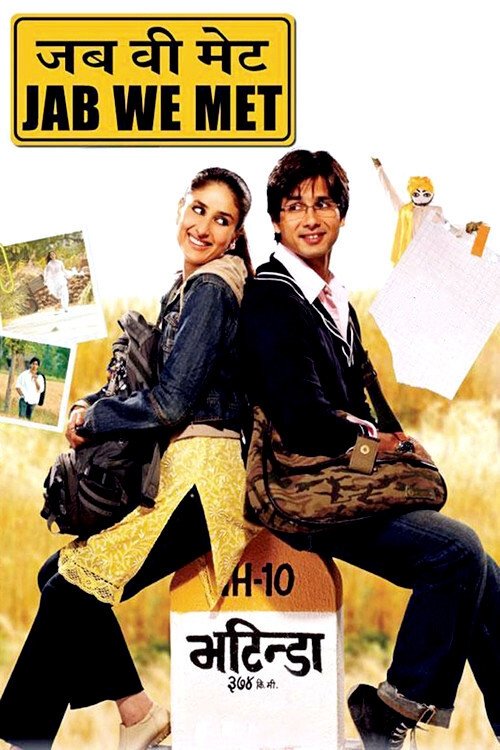
Jab We Met
2007 · Imtiaz Ali
For a cozy night in when you want to fall in love — or when you're low and need a film that believes people can put each other back together. Comfort cinema of the highest order, and a perfect first Bollywood film.
What it's about
A wealthy Mumbai businessman, numb and quietly falling apart, boards a night train going nowhere in particular and collides with Geet — a nonstop-talking, ferociously optimistic Punjabi girl racing home with an elopement on her mind. Missed connections and bad luck throw them together across trains, buses, and back roads of northern India, and her reckless joy starts rewiring his will to live. It's a road-trip romance about how the right stranger at the wrong time can rebuild you.
The experience
Warm, funny, and buoyant, with an ache underneath — the first half is pure screwball travel-comedy energy, and then it deepens into something more bruised and tender. The songs are earworms and the whole thing leaves you lighter than it found you.
Performances
Kareena Kapoor's Geet is one of the defining Hindi-film heroine performances of its era — a motormouth life force who could easily be exhausting and is instead irresistible — and Shahid Kapoor plays the shut-down man opposite her with a stillness that lets her shine while doing quieter, sadder work of his own.
The craft
Imtiaz Ali structures the romance as a literal journey, letting India's trains, stations, and highways set the rhythm, and writes banter that turns character flaws into charm. The soundtrack became beloved in its own right, and the film's two-movement structure — collision, then reunion changed — gives a light comedy real emotional architecture.
Why it matters
A sleeper hit that became one of modern Bollywood's most rewatched romances, made Geet a cultural touchstone, and established Imtiaz Ali's signature theme of travel as self-transformation for a generation of Hindi love stories.
Snapshot
Jab We Met ("When We Met") is a Hindi-language road romance that became one of the defining sleeper successes of mid-2000s Bollywood and the film that consolidated Imtiaz Ali's authorial signature: love as a byproduct of a journey, and the journey as an engine of self-transformation. Its premise is deceptively slight — a suicidally listless Mumbai businessman, Aditya Kashyap (Shahid Kapoor), boards a night train and falls into the orbit of Geet Dhillon (Kareena Kapoor), a garrulous Punjabi Sikh girl racing home to Bhatinda and, ultimately, toward an elopement. What begins as screwball friction across the Indian rail and road network becomes, in its second movement, a reversal: the man Geet inadvertently rebuilt returns, months later, to rescue the now-broken woman who saved him. The film's lasting reputation rests on Kareena Kapoor's performance as Geet, widely regarded as a career-redefining role, and on a two-part structure that lets a bright comedy curdle into melancholy before earning its resolution.
Industry & production
The film was produced by Dhillin Mehta under the banner Shree Ashtavinayak Cine Vision, a company active in mainstream Hindi production during the decade. It arrived in the Diwali corridor of late October 2007, the most competitive release window in the Hindi calendar, and is generally described in industry accounts as a slow-building or "word-of-mouth" hit rather than a front-loaded blockbuster — a film whose commercial life expanded after opening. I will not attach specific gross figures here, as the surviving trade record for individual 2007 releases is inconsistent and I cannot verify a precise number.
Two production circumstances are frequently cited. First, this was Imtiaz Ali's second feature, following the little-seen Socha Na Hoga (2005); Jab We Met is effectively the film that made him bankable and established the template he would refine for a decade. Second, the film is inseparable, in industry memory, from the off-screen relationship between its leads: Kapoor and Kapoor were a couple during production and reportedly separated around the time of release. That biographical backdrop has become part of the film's folklore, though it should be treated as context rather than as an interpretive key the film itself invites.
Technology
Jab We Met is a photochemically-era production, made on 35mm in the standard workflow of Hindi commercial cinema of the period, before digital acquisition became the norm in the industry. Whether it employed a full digital intermediate for color grading I cannot confirm; DI adoption in Bollywood was uneven in 2007, and I will not assert a specific post pipeline without evidence. What matters technologically is more prosaic and more revealing: the film's aesthetic depends on location shooting across a genuinely mobile production — trains, stations, highways, hill towns — rather than on any novel apparatus. Its "technology" is logistical, the discipline of moving a unit through real transit infrastructure and Himalayan geography, and of staging musical numbers in practical exteriors.
Technique
Cinematography
The cinematography is credited to Natarajan Subramaniam (known as Natty), who would become a recurring Imtiaz Ali collaborator. The visual scheme tracks the story's emotional temperature. The first half favors saturated, sunlit, kinetic imagery — crowded platforms, moving carriages, the open road, the tourist brightness of Manali and Shimla — with a handheld looseness that keeps pace with Geet's restlessness. Landscape is used not merely as backdrop but as an index of freedom; the widescreen exteriors of the Punjab-to-hills passage give the runaway premise its lift. In the darker second half the palette and framing cool and tighten, mirroring Geet's collapse from motormouth vitality into withdrawal. The film's most reproduced images belong to the song sequences, where the camera is choreographed to the performers' movement rather than cutting around them.
Editing
Editing is by Aarti Bajaj, one of Imtiaz Ali's closest and most consistent collaborators across his career. The film's structural intelligence is fundamentally an editorial achievement: the screenplay hinges on a mid-film ellipsis and tonal break, and the cut has to sell the audience on a months-long gap and on the same characters returning inverted — Aditya confident, Geet defeated. The comic first half is edited for momentum and overlapping energy, keeping Geet's verbal avalanche buoyant; the second half slows, letting scenes breathe into discomfort. The song picturizations are integrated as narrative beats rather than detachable set-pieces, a hallmark of the Ali–Bajaj method.
Mise-en-scène / staging
The staging is organized around transit spaces and thresholds — train compartments, station platforms, a cheap hotel room, a family home, a school. The recurring image of the doorway and the departing/arriving vehicle gives the film its spatial grammar of leaving and returning. The Bhatinda family household is staged with specificity as a boisterous Punjabi Sikh milieu, and much of the film's warmth comes from the ensemble texture of that home. Geet's costuming and physical business — the constant motion, the talking with her whole body — are central mise-en-scène choices that build character through behavior rather than exposition.
Sound
Music is by Pritam, with lyrics by Irshad Kamil, whose long partnership with Imtiaz Ali effectively begins here. The soundtrack was among the most popular of its year and is inseparable from the film's success: "Tum Se Hi," sung by Mohit Chauhan, functions as the film's romantic through-line; "Mauja Hi Mauja" is its exuberant Punjabi-inflected celebration number; "Nagada Nagada" stages a wedding-band set-piece; and "Aaoge Jab Tum," featuring the Hindustani classical vocalist Ustad Rashid Khan, supplies a note of longing and gravitas. The songs are deployed diegetically and emotionally rather than as interruptions, and the film's sound design leans on the ambient life of stations, trains, and streets to keep the romance grounded in a real, noisy India.
Performance
The film is, above all, a performance vehicle, and Kareena Kapoor's Geet is its center of gravity — a high-velocity, self-delighting characterization ("Main apni favorite hoon," "I'm my own favorite," became a signature line) that risks caricature and instead reads as fully inhabited, precisely because the second half strips the exuberance away and asks the actress to play its absence. The role is broadly credited with reviving and redefining Kapoor's career, and she won the Filmfare Award for Best Actress for it. Shahid Kapoor's Aditya is the deliberately quieter counterweight, an interiorized, reactive performance whose arc runs opposite to Geet's; his restraint is what lets her expansiveness register. The supporting ensemble — the Bhatinda family, the disappointing boyfriend Anshuman — is played for lived-in comic reality rather than for types.
Narrative & dramatic mode
The dramatic mode is romantic comedy braided with the road movie and the coming-of-age story, executed in a strict two-act reversal. Act one is comic and centrifugal: strangers thrown together, misadventures, the slow conversion of irritation into attachment. Act two is melodramatic and centripetal: time has passed, fortunes have flipped, and the emotional debt of the first half is called in. The screenplay's key device is dramatic irony of transformation — each protagonist becomes what the other needed and, in the process, loses or finds themselves. The film also runs on a productive gap between what Geet says she wants (Anshuman, the elopement) and what the narrative reveals she needs, a classic romantic-comedy engine handled with more emotional realism than the genre's froth usually allows.
Genre & cycle
Jab We Met sits at the intersection of the Bollywood romance, the road movie, and the "journey of self-discovery" film. Within Hindi cinema it belongs to a post-DDLJ lineage of travel-inflected romances but reorients that tradition away from the diasporic, family-sanction plot toward a more intimate, character-driven register. It is frequently discussed in relation to the "manic pixie dream girl" archetype imported from Western rom-com criticism — Geet as the vivacious free spirit who awakens a depressive man — but the film complicates the archetype by giving Geet her own devastating downturn and interiority, refusing to leave her a mere catalyst for the hero. More broadly it helped inaugurate a mid-to-late-2000s cycle of urbane, emotionally literate Hindi romances that treated love as entangled with individual becoming.
Authorship & method
The controlling authorship is Imtiaz Ali's, as writer-director. Jab We Met announces his enduring preoccupations: travel as transformation, the mismatch between desire and need, love located in the gap between who a person is and who they are becoming, and a fondness for the two-timeline or two-movement structure that would recur across his work. His method leans on strongly individuated, verbally rich characters and on music as narrative rather than ornament.
The film is also notable for consolidating his core creative team. Aarti Bajaj (editor) and, from this point, Irshad Kamil (lyricist) become fixtures of the Imtiaz Ali unit; Pritam's score and Natty's camera are part of the same collaborative fabric. It is fair to describe the film as the moment Ali's "method" — a specific fusion of screwball energy, folk-and-classical-inflected songcraft, and melancholic interiority — cohered into a recognizable style.
Movement / national cinema
The film is a product of mainstream Bombay Hindi cinema ("Bollywood") in its post-liberalization, multiplex-inflected phase, when a widening exhibition base allowed mid-budget, character-driven films to find audiences alongside star spectacles. It is not an art-cinema or parallel-cinema work; its ambitions are firmly popular. But it participates in a broader 2000s tendency toward more naturalistic performance, contemporary urban settings, and psychologically grounded romance within the commercial mainstream. Its deep engagement with Punjabi Sikh culture — language, music, family life, geography — also situates it within Hindi cinema's long, affectionate centering of Punjab as the emotional homeland of its romances.
Era / period
Released in October 2007, the film is very much of its moment: mobile phones drive several plot turns, the India it traverses is one of trains, highways, and hill-station tourism, and its sensibility reflects a confident, aspirational mid-2000s urban India. It sits at a hinge in Bollywood history — after the family-blockbuster dominance of the late 1990s, and just as the multiplex era was opening room for smaller, sharper stories. Both leads were relatively young stars consolidating their standing, and the film reads as a generational statement about romance on those terms.
Themes
The film's central theme is transformation through encounter: the idea that another person can hand you back a self you had mislaid. Bound to it is the tension between freedom and belonging — Geet's headlong pursuit of her own desires versus the family and social order she is running from, and the film's ambivalence about both. A further theme is the unreliability of what we think we want: the elopement that promises liberation delivers abandonment, while the "wrong" companion turns out to be the right one. Class and temperament are quietly in play — the wealthy, depressive, contained man and the middle-class, effusive, expansive woman as complementary opposites. Underneath the comedy runs a serious meditation on self-love and self-possession, most explicit in Geet's mantra of being her own favorite and most poignant when that self-possession deserts her.
Reception, canon & influence
Critically and popularly, Jab We Met was well received and has grown in stature into a widely beloved modern classic of Hindi romance, routinely cited in retrospectives of the best Bollywood love stories of the 2000s. Kareena Kapoor's Geet is its most canonized element — a role that won her the Filmfare Best Actress award and that is frequently named among the great heroine performances of contemporary Hindi cinema. (I am confident of the Filmfare Best Actress win and of the film's strong awards presence; I am less certain of the full award tally and will not enumerate specific citations I cannot verify.)
Looking backward, the film's influences are legible even if the director's own acknowledgments are not something I can quote precisely. The runaway-woman-meets-guarded-man-on-a-journey structure has clear affinities with the Hollywood screwball tradition and is often compared to Frank Capra's It Happened One Night (1934); the train-and-travel romance and the Punjab homecoming echo the post-Dilwale Dulhania Le Jayenge (1995) grammar of Hindi love stories. Its second-half tonal darkening and interest in psychological interiority push against the genre's default sweetness.
Looking forward, the film's legacy is substantial. It cemented the Imtiaz Ali brand of travel-and-transformation romance that he extended through Love Aaj Kal (2009), Rockstar (2011), Highway (2014), and Tamasha (2015). It is often credited with helping normalize a more character-driven, emotionally realistic mode of mainstream Hindi romance, and Geet became a durable cultural reference point — quoted, meme-ified, and invoked as shorthand for a particular kind of life-force heroine. Its soundtrack has had an unusually long afterlife in Indian popular music. The film has also been a touchstone in Indian critical conversations about the "manic pixie dream girl," precisely because it is one of the more thoughtful examples of, and rebukes to, that archetype. Reports of official or unofficial remakes in other Indian and international markets exist, but I cannot confirm their specifics reliably enough to list them here.
Reception
A modest sleeper in October 2007 that grew on word of mouth into a genuine hit — and has only climbed since, via endless TV reruns and streaming, into consensus 'best Bollywood rom-com of the 2000s' territory that its opening weekend never predicted.
How Jab We Met was received, from release to now →
Influences: the films it descends from and the films it influenced
- It Happened One Night (1934) — The forced-proximity road romance in which a runaway woman and a guarded man bicker toward love across buses and shared lodging (the 'walls of Jericho' propriety beat) is the exact courtship-in-transit template Jab We Met reworks.
- Chori Chori (1956) — The direct Hindi-cinema transposition of Capra's runaway-heiress journey into song-driven form, establishing the Bollywood grammar of a road romance punctuated by musical numbers that Jab We Met inherits.
- Bringing Up Baby (1938) — Hawks's screwball engine of a relentlessly talking, chaos-generating woman dismantling a rigid man's composure is the comic-heroine mode Geet's verbal-overload, life-force performance descends from.
- Roman Holiday (1953) — The single-journey romance where a woman fleeing her prescribed life and a wary man are transformed by shared travel, carrying a bittersweet counter-current beneath the comedy that Jab We Met's darker second half echoes.
- Guide (1965) — Vijay Anand's two-movement structure — a buoyant first half giving way to a darker interior second half as the protagonist is remade by his journey — is the Hindi ancestor of Ali's transformation arc and songs-as-narrative.
- Dilwale Dulhania Le Jayenge (1995) — Chopra's post-'95 template of a train-and-travel courtship culminating in a Punjab homecoming, songs staged across transit, is the multiplex-era grammar Jab We Met works inside of and revises.
- Dil Se.. (1998) — The train-platform meet-cute and enigmatic-woman-on-a-journey, with songs (Santosh Sivan's camera) staged across moving trains and Indian landscapes, model the diegetic-travel song and transit-threshold staging Jab We Met adopts.
- Before Sunrise (1995) — Linklater's stranger-romance built entirely from walk-and-talk conversation across one compressed journey supplies the dialogue-as-plot, character-driven realism behind Jab We Met's talky intimacy.
- Love Aaj Kal (2009) — Ali extends Jab We Met's two-timeline/two-movement structure and its explicit want-versus-need dialectic into a parallel-eras romance.
- Rockstar (2011) — Ali reworks transformation-through-love-and-loss into a two-part rise/fall, with Irshad Kamil's lyrics carrying narrative rather than ornament — the songs-as-beats method Jab We Met consolidated.
- Highway (2014) — Ali literalizes the road-as-therapy premise, using handheld mobility across North Indian landscapes as the vehicle of transformation, descending directly from Jab We Met's transit-threshold staging.
- Tamasha (2015) — Ali's fullest elaboration of want-versus-need and the constructed-self-versus-authentic-self, reprising the travel meet-cute and two-movement architecture the seed established.
- Queen (2014) — Bahl's solo transformation-through-travel arc — a jilted woman remade by a journey abroad — extends Jab We Met's life-force-heroine-reborn-through-movement into a female-led register.
- (500) Days of Summer (2009) — Webb's nonlinear anatomy of a romance that interrogates the manic-pixie projection is a reflexive sibling in complicating the MPDG archetype that Geet both embodies and rebukes.
- Yeh Jawaani Hai Deewani (2013) — Mukerji's multiplex-era travel-and-transformation romance is built on the free-spirited traveler destabilizing a guarded partner, with songs staged across journeys — the same road-romance engine.
- Zindagi Na Milegi Dobara (2011) — Akhtar's road-trip-as-transformation structure, where a journey resolves each traveler's want-versus-need, is a multiplex-era sibling in the travel-transformation mode Jab We Met helped normalize.
Similar films
- Dilwale Dulhania Le Jayenge (1995) — influence & lineage
- Zindagi Na Milegi Dobara (2011) — influence & lineage
- Before Sunrise (1995) — influence & lineage · same viewing thread
- Kabhi Khushi Kabhie Gham (2001) — shared sensibility
- Kuch Kuch Hota Hai (1998) — shared sensibility
- Main Vaapas Aaunga (2026) — shared sensibility
- Lost Ladies (2024) — shared sensibility
- Bajrangi Bhaijaan (2015) — shared sensibility
All the films related to Jab We Met →
Watch it with: curated runs of related films
- Strangers Who Walk and Talk — Watch these back to back for the particular magic of two people, a city, and a few borrowed hours of talk that may not outlast the night.