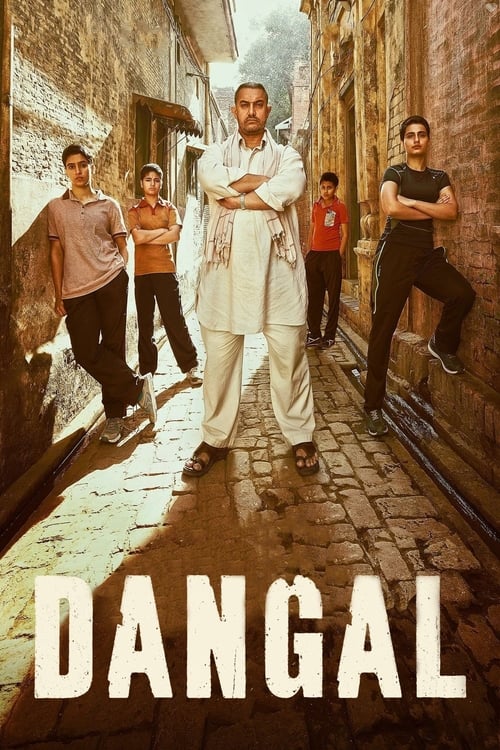
Dangal
2016 · Nitesh Tiwari
For a family movie night when you want to be swept up — an underdog story that leaves you lifted, with real stakes and a lump in your throat at the finish.
What it's about
A former wrestler in rural Haryana, denied his own shot at glory, decides his daughters Geeta and Babita will win the medals he never could — and trains them, against the mockery of an entire village, into world-class freestyle wrestlers. Drawn from the true story of Mahavir Singh Phogat and his daughters, it's a father-daughter saga that runs from muddy village pits to international mats.
The experience
A big, rousing crowd-pleaser that earns its emotion — funny in its first half, genuinely thrilling in its wrestling bouts, and complicated enough about its stubborn patriarch to give you something to chew on. Expect to cheer out loud at least once.
Performances
Aamir Khan disappears into Mahavir — gaining and shedding decades and kilos — but the revelation is the young cast playing Geeta and Babita, whose wrestling looks startlingly real because they trained until it was.
The craft
The wrestling is the craft showcase: bouts choreographed and cut so you can read every hold and reversal, which makes the matches play like genuine sport rather than montage. It's built for a big screen and a loud crowd, and the final act is as well-engineered a piece of sports suspense as mainstream cinema produces.
Why it matters
It became the highest-grossing Indian film of its time and, remarkably, a phenomenon in China — redrawing the map of Indian cinema's global reach and cementing the socially minded sports biopic as Bollywood's signature 2010s mode.
Snapshot
Dangal is a Hindi-language biographical sports drama that dramatizes the life of Mahavir Singh Phogat, a former amateur wrestler from rural Haryana who, denied a shot at national glory himself, trains his daughters Geeta and Babita into champion freestyle wrestlers. Anchored by Aamir Khan in one of the most physically committed performances of his career, and released in India in December 2016, the film became a cultural and commercial phenomenon — not only the highest-grossing Indian film to that point but, unusually, a colossal hit in China, where it opened in 2017 and redrew the map of Indian cinema's overseas reach. Beyond the box office, Dangal crystallized a decade-long Bollywood turn toward the "real-story" sports biopic and toward socially engaged mainstream cinema that folds a gender argument inside a crowd-pleasing underdog arc. It is at once a father-daughter melodrama, a nationalist triumph narrative, and — more contentiously — a film about who gets to author a woman's ambition.
Industry & production
Dangal was produced by Aamir Khan Productions in partnership with Walt Disney's India operation (the studio that had absorbed UTV Motion Pictures), placing it at the intersection of a star-driven independent shingle and a Hollywood-major's local arm — a configuration that had become common for high-budget, prestige-adjacent Hindi releases in the mid-2010s. Khan's production company had by this point built a reputation for socially themed commercial films (Taare Zameen Par, Dangal's spiritual cousin in earnestness), and Khan himself functioned as star, producer, and de facto creative gatekeeper.
The production's defining logistical fact was casting and physical preparation. The two daughters are each played by two actresses spanning childhood and adulthood: Zaira Wasim as the young Geeta and Suhani Bhatnagar as the young Babita, with Fatima Sana Shaikh and Sanya Malhotra as their adult counterparts. Shaikh and Malhotra underwent extended wrestling training — commonly reported as roughly a year to a year and a half — to perform bouts credibly on camera, a demand that shaped the shooting schedule. Sakshi Tanwar, a television-familiar face, plays the mother. Khan's own transformation is the production's signature: he shot the older, heavier Mahavir at a substantial weight gain, then lost the weight to film the younger scenes, an out-of-sequence approach dictated by the biology of the body he was reshaping. This "fat-to-fit" regimen became a central plank of the film's publicity and is well documented, though specific weight figures cited in the press should be treated as approximate.
Commercially the film's story is genuinely exceptional and this is one place where restraint about exact numbers is warranted: Dangal is widely and reliably reported as the highest-grossing Indian film of its era, with the decisive component being its 2017 Chinese theatrical run, where it vastly outperformed its Indian gross. The precise renminbi and rupee totals vary by source and currency conversion, so I flag them as approximate rather than reproduce a single figure as fact; the qualitative outcome — that a Hindi-language family drama became a mainland-China blockbuster — is not in dispute and reshaped distribution expectations for Indian films in East Asia.
Technology
Dangal is a conventionally shot digital feature of its moment; it does not advertise technological novelty, and the record on its specific camera and lens packages is thinner in authoritative sources than for its performances, so I will not assert particulars I cannot ground. Its meaningful "technology" is bodily and procedural rather than photographic: the film relies on trained performers executing real wrestling actions, augmented by choreography, controlled staging of throws and takedowns, and editing to sell impact and continuity across bouts. The mat sequences depend on the coordination of stunt-safe choreography with performances that had to read as competitive sport rather than fight cinema — a different rhythm from the stylized combat of the action genre.
Technique
Cinematography
The cinematography, by Setu (Satyajit Pande), serves the film's realist-populist register: earthy, sun-worn palettes for the Haryana village and akhara (wrestling pit) scenes, and a cleaner, brighter, more institutional look for the later national academy and international-tournament settings. The camera treats the wrestling as sport to be read clearly rather than fragmented into abstraction; matches are covered so that the audience can follow points, reversals, and the geography of the mat, which is essential to the film's suspense mechanics. Coverage tightens on faces at decision points and pulls wide to establish stakes and crowd, a legible grammar that prioritizes emotional and competitive clarity over visual flourish.
Editing
Editing by Ballu Saluja is where much of the film's craft concentrates, because sports drama lives or dies on how bouts are cut. The match sequences are constructed to build and release tension across rounds — establishing an opponent's threat, staging a setback, then engineering a comeback — with rhythm calibrated to the scoring of freestyle wrestling. The film also carries a long time-span (childhood to international competition) and relies on editing and montage to compress training and physical maturation, including the challenge of intercutting two sets of actresses playing the same characters across ages. The much-discussed choice to shoot Khan's scenes out of chronological order placed additional weight on the edit to reassemble a coherent aging arc.
Mise-en-scène / staging
The staging roots the film in specific rural North Indian texture: the Phogat home, the improvised training ground, the diet and drill regimen imposed on the girls, the haircut scene that marks their forced departure from village-normative femininity. These production-design and blocking choices carry the film's argument — the akhara becomes a contested space where a girl's body is trained for something the community does not sanction. Later settings (the national sports academy, brightly lit arenas) are staged as a different world with its own politics, setting up the film's third-act conflict between the father's method and institutional coaching.
Sound
Sound design supports the visceral reading of the sport — the slap of bodies on the mat, breath, crowd — while Pritam's score and songs do heavy narrative lifting (see Authorship). The film uses song sequences less as standalone spectacle than as montage engines: training and hardship are compressed under music, integrating the traditional Hindi-film song into a sports-movie training-montage function.
Performance
Performance is the film's center of gravity. Aamir Khan plays Mahavir with a banked intensity — a man whose warmth is almost entirely sublimated into discipline — and the physical transformation is not a stunt but a characterization, the aging body registering the cost and stubbornness of his project. Zaira Wasim's young Geeta is frequently singled out for conveying resistance curdling into buy-in, and Fatima Sana Shaikh carries the adult Geeta's arc of independence, temptation, and reconciliation. The wrestling performances by Shaikh and Malhotra are notable precisely because they were trained to a level where the camera did not need to hide their technique. Sakshi Tanwar and the actor playing the cousin-narrator provide the domestic and comic registers that keep the film's tone from hardening into pure severity.
Narrative & dramatic mode
The film operates in the mode of the inspirational biopic-melodrama, structured as a classic underdog progression with a father-driven engine. A framing narration (the nephew) provides folksy commentary and comic distance. The dramatic spine is a training narrative: an obsessive parent, an initially unwilling protégé, a turning point where the child internalizes the goal, and a sequence of escalating contests culminating in an international final. Onto this the film grafts a second-act rupture — Geeta's move to the national academy, her adoption of a rival coaching philosophy, her estrangement from her father, and eventual reconciliation — which supplies the interpersonal conflict that pure sport cannot. The mode is unapologetically emotive and manipulative in the craftsmanlike sense: it engineers cheer-and-tear beats with precision, and its climactic bout withholds and delivers on cue.
Genre & cycle
Dangal belongs squarely to the Indian sports biopic cycle that gathered force through the 2000s and 2010s. Its most important antecedent in theme is Shimit Amin's Chak De! India (2007), which used women's field hockey to stage a nationalist-and-gender narrative; its immediate contemporaries include Bhaag Milkha Bhaag (2013), Mary Kom (2014), and — released the same year and also starring Khan's peers in the wrestling milieu — Sultan (2016). Within this cycle Dangal is distinguished by its true-story fidelity to a living family, its rural Haryana specificity, and its foregrounding of the father as protagonist alongside the athletes. It also sits inside the broader Aamir Khan cycle of "message" entertainers that made social argument commercially central to the Hindi A-list film.
Authorship & method
Director Nitesh Tiwari came to Dangal from a background that included advertising and the ensemble comedy Chillar Party; Dangal is the film that established him as a director of large-scale, emotionally engineered mainstream cinema. His method here is legibility and control — a refusal of ambiguity in favor of clean stakes — married to sustained attention to performance and physical authenticity. The screenplay is credited to Tiwari with Piyush Gupta, Shreyas Jain, and Nikhil Mehrotra, and its architecture (the two-daughter structure, the narrator device, the academy-conflict second act) is the film's key writing achievement.
The decisive collaborator is Aamir Khan, whose producer-star authorship shaped the film's scale, its transformation-driven realism, and its socially themed positioning; in practice Dangal is as much a Khan project as a Tiwari one. Cinematographer Setu supplies the realist visual base. Composer Pritam, working with lyricist Amitabh Bhattacharya, produced a score that functions structurally — the title track and training numbers such as the drill-hardship songs act as montage motors, while quieter numbers underscore the emotional beats — and this integration of song into sports-narrative machinery is central to the film's method. Editor Ballu Saluja translates all of this into the paced bout sequences that carry the film's suspense.
Movement / national cinema
Dangal is a flagship of mainstream Bollywood (the Hindi commercial industry) in its most globally ambitious phase. It is not an art-cinema or parallel-cinema work; rather it represents the maturation of the "socially conscious blockbuster," a form in which A-list stars and studio budgets are turned toward issue-driven narratives (here, female athletic empowerment and the critique of daughter-devaluing patriarchy) without abandoning song, spectacle, and broad appeal. Its historic China performance also made it a landmark in the internationalization of Indian popular cinema beyond the traditional diaspora market — a data point frequently cited in discussions of Bollywood's soft-power reach into East Asia.
Era / period
The film is a product of mid-2010s India, a moment when discourse around gender, the girl child, and campaigns concerning daughters' welfare were prominent in national conversation, and when the sports biopic had become a reliable prestige-commercial format. It also belongs to the era of fully consolidated digital production and of studio-plus-star-shingle financing. Set across roughly the 1980s–2010s of its story world — spanning liberalization-era and contemporary India — the film uses period texture chiefly through rural continuity rather than sharp historical markers, locating its drama in a Haryana whose gender norms it treats as a persistent condition to be fought rather than a dated past.
Themes
The film's governing theme is the paradox of patriarchal liberation: a father overturns his community's devaluation of daughters, yet does so by imposing his own unrealized ambition on their bodies and lives, raising the question of whether the girls are being freed or merely redirected. Dangal has been read both as a feminist landmark — daughters achieving what a patriarchal society deemed impossible for women — and as a film in which female achievement is authored and validated by the father, with Geeta's brief assertion of independence (the academy phase) coded as error to be corrected. Adjacent themes include nationalism (individual triumph as national pride, crystallized in the medal-and-anthem climax), discipline and sacrifice, the gendered politics of the body (diet, hair, dress), and generational reconciliation. The film's honesty about the coercion at the heart of Mahavir's project is one of its more interesting tensions, whether or not one thinks it fully reckons with it.
Reception, canon & influence
Critically, Dangal was received in India as one of the strongest mainstream films of its year, widely praised for Khan's performance and transformation, for the young actresses (Zaira Wasim in particular), and for its emotional and technical execution; the most sustained critical reservation concerned the framing of female agency through the father, a debate that has followed the film into scholarship and gender-focused criticism. It won significant recognition in the Indian awards circuit, though I flag that exact award tallies vary by ceremony and I will not enumerate specifics I cannot verify precisely here.
Its influences run backward to the women-in-sport nationalism of Chak De! India and the broader real-story biopic wave (Bhaag Milkha Bhaag, Mary Kom), and to the Aamir Khan tradition of the socially themed blockbuster. Forward, its legacy is substantial: it hardened the commercial template of the family-driven true-story sports drama, elevated Fatima Sana Shaikh and Sanya Malhotra into film careers, and — most consequentially at the industry level — its China success became the reference case for Indian films seeking mainland distribution, encouraging a run of Khan-associated and other Hindi titles targeting that market. Within the canon of 2010s Indian cinema, Dangal is routinely cited as a defining popular film: a work that proved a gender-argument melodrama could be both a domestic mass entertainer and an unprecedented cross-border phenomenon.
A Deleuzian reading
Start with the haircut.
The full Deleuzian reading of Dangal →
Reception
A blockbuster and critical darling on release, it then became a genuine phenomenon in China in 2017 — turning it from a Bollywood hit into the highest-grossing Indian film ever worldwide; more recent rewatches tend to interrogate it rather than just cheer it.
How Dangal was received, from release to now →
How to watch Dangal: what to notice on a first viewing
- Watch the color shift between village scenes and academy scenes. Setu shoots the Haryana akhara in earthy, sun-worn tones, then switches to a cleaner, brighter look once the story reaches the national academy and tournaments. The palette tells you two worlds have different rules before any character says so.
- Watch each match set up a threat, then a setback, then a comeback. Ballu Saluja cuts the bouts in the same three-beat rhythm again and again, building and releasing tension round by round. The pattern is engineered suspense, not just recorded sport.
- Listen for a song arriving right when training needs to speed up. Pritam's songs show up whenever months of drilling and hardship need to be compressed into a few minutes. The song sequence is doing the work of moving time forward, not just adding mood.
- Watch Aamir Khan's face for warmth pushed down into discipline. Khan plays Mahavir with banked intensity; his posture and bulk carry more of the character than his dialogue does. The performance holds the film's tension between love and control inside one body.
- Notice what changes about the girls' hair and clothes as training begins. Diet, drill regimen, and a haircut mark the daughters' visible departure from village-normative femininity. The film puts the cost of the training project directly onto the girls' bodies.
The whole guide to watching Dangal, with the keys for a rewatch →
Influences: the films it descends from and the films it influenced
- Rocky (1976) — Codified the training montage cut to a driving anthem as the film's narrative motor — the same song-as-training-machine device Pritam's title track and drill numbers power in Dangal.
- Raging Bull (1980) — Set the standard that ring realism is built from total actor body-transformation plus subjectively edited bout coverage, the two pillars behind Aamir Khan's weight arc and Ballu Saluja's paced fights.
- Girlfight (2000) — Pioneered filming a young woman's body being trained for a male combat sport as the central gendered-body drama, prefiguring the akhara scenes of the Phogat daughters.
- Lagaan (2001) — Aamir Khan's producer-star template of staking an entire socially-themed blockbuster's climax on the suspense of a single sporting contest, the structural DNA of Dangal's final bout.
- Million Dollar Baby (2004) — Built the gruff patriarch-coach who shapes a female fighter's body and fate, the exact patriarchal-liberation-paradox dynamic Mahavir enacts over his daughters.
- Chak De! India (2007) — Supplied the women-in-sport nationalism model in which a driven male coach hardens a female squad through legibly-covered drills toward a title — the acknowledged blueprint for Dangal's coaching architecture.
- 3 Idiots (2009) — Aamir Khan socially-conscious blockbuster that uses a retrospective framing-narrator to engineer emotion, the narrator device Dangal adopts to organize its bouts and aging.
- Bhaag Milkha Bhaag (2013) — Established the mainstream real-athlete biopic built on a star's visible athletic conditioning and out-of-sequence aging across decades, the physical-realism template Dangal inherits.
- Mary Kom (2014) — Immediate precedent for the female-boxer biopic driven by a leading actress's combat training and manufactured bout-suspense, the wave Dangal both extends and surpasses.
- Lagaan: Once Upon a Time in India (2001) — Aamir Khan's later sports vehicle that perfects Lagaan's cross-cut athletic-contest climax, editing each bout so a physical win reads as social vindication.
- Ghajini (2008) — The extreme conditioning regime Ghajini normalized, taken to its limit: Khan's publicized gain-and-loss cycle functioning simultaneously as the film's principal marketing text and its warrant of seriousness.
- Secret Superstar (2017) — Extends the Aamir Khan producer-star gender-argument melodrama and its cross-border (China) success, replaying the daughter-versus-patriarch liberation structure in a musical key.
- Chhichhore (2019) — Tiwari reuses his own signature framing-narrator and out-of-sequence emotional architecture to build suspense around an underdog contest, directly carrying forward Dangal's writing method.
- Panga (2020) — Advances the gendered-body-politics of the female athlete negotiating a kabaddi comeback against domestic and maternal expectation, softening Dangal's patriarchal framing into self-authored agency.
- Saand Ki Aankh (2019) — Continues the socially-conscious sports blockbuster in which women defy patriarchal village order through a legibly-covered precision sport, inheriting Dangal's rural gendered-liberation template.
- Toofaan (2021) — Later boxing biopic riding the lead's physical transformation and training-montage songs, extending the star-conditioning-plus-song-motor machinery Dangal perfected.
- Warrior (2011) — Shares the estranged patriarch who forges his children into elite fighters, resolving the family conflict through tournament-bracket bout construction like Dangal's academy rupture.
- The Wrestler (2008) — Parallel model of grappling-sport authenticity achieved through an actor's punishing physical remaking and intimate, legible body-in-motion coverage rather than stylized spectacle.
- Sultan (2016) — Same-year Hindi wrestling melodrama built on the star's akhara pehlwani body transformation and drawn-out bout tension, a parallel commercialization of the mud-wrestling milieu.
Similar films
- Bhaag Milkha Bhaag (2013) — influence & lineage
- Lagaan: Once Upon a Time in India (2001) — shared sensibility
- Bajrangi Bhaijaan (2015) — shared sensibility
- Superboys of Malegaon (2025) — shared sensibility
- Like Stars on Earth (2007) — shared sensibility
- Gangs of Wasseypur - Part 1 (2012) — shared sensibility
- How to Make Millions Before Grandma Dies (2024) — shared sensibility
- Sarpatta Parambarai (2021) — shared sensibility