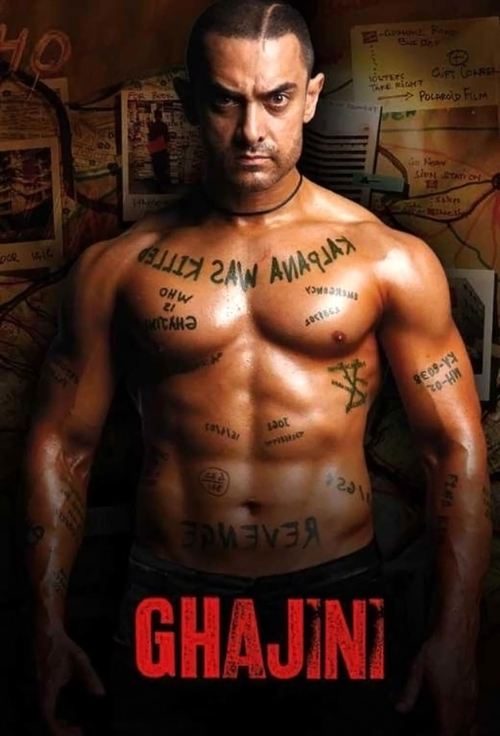
Ghajini
2008 · A. R. Murugadoss
For when you want a big, loud, full-meal Bollywood night — laughter, romance, songs, and a hero on a rampage all in one sitting. It's crowd-pleasing rather than challenging, but the violence is genuinely brutal, so come ready for intensity.
What it's about
A wealthy telecom tycoon is left with only fifteen minutes of memory at a time after a brutal attack, and hunts the men who killed the woman he loved using Polaroids, notes, and tattoos inked across his own body. Woven through the manhunt is a long flashback romance — the story of how a magnate fell for a warm, mischievous woman who had no idea who he really was — pieced together by a medical student who steals his diary and starts investigating the man behind it.
The experience
It swings hard between two registers: a sunlit, playful love story and a savage, thunderous revenge thriller, and the whiplash between them is the point. The action hits with blunt physical force, the songs give you room to breathe, and the memory gimmick keeps you leaning forward, reassembling the story alongside its hero.
Performances
Aamir Khan is the engine: he built a startling new physique for the role and plays the two halves of the man — charming, soft-spoken suitor and feral, scarred avenger — as almost different people. Asin, reprising her role from the Tamil original, brings such easy warmth and comic energy that the entire revenge plot rests believably on her absence.
The craft
Murugadoss rebuilds his own Tamil hit at full Bollywood scale, splitting the film into two visual worlds — a bright, saturated romantic past and a bleached, brutal present — so you always know where you are in a scrambled timeline. A. R. Rahman's songs carry the romance, and the fight scenes are staged with a raw, bone-crunching heaviness that lands best loud and on a big screen.
Why it matters
Widely credited as the first Hindi film to cross ₹100 crore at the domestic box office, it created the benchmark that defined Bollywood blockbuster success for the next decade, and it cemented Aamir Khan's December release as an industry event.
Snapshot
A telecom magnate with fifteen minutes of working memory hunts the men who murdered the woman he loved, using his own skin as a filing system. Ghajini is A. R. Murugadoss's Hindi reworking of his own 2005 Tamil film of the same name, rebuilt at Bollywood scale around Aamir Khan and released on Christmas Day 2008. It is a film of deliberate halves: a brutal, desaturated present-tense revenge thriller wrapped around a long, sunlit romantic comedy told in flashback, the two joined by a medical student's investigation into the man whose diary she has stolen. Commercially it functioned as a threshold event — it is widely credited as the first Hindi film to cross ₹100 crore in domestic net receipts, a figure that hardened almost immediately into an industry benchmark and a decade of trade-press shorthand. Aesthetically it is a hybrid: the high-concept premise borrowed from Christopher Nolan's Memento, the emotional architecture borrowed from the Tamil mass-hero tradition, and the surface polish borrowed from the multiplex-era Hindi film. That it holds together at all is a matter of craft; that it held two very different audiences at once is why it mattered.
Industry & production
Ghajini sits at the hinge of a structural shift in Indian film economics. Through the 2000s the Hindi industry had increasingly split its address: multiplex films for urban, English-comfortable audiences, and mass entertainers for the single-screen circuit, with the two rarely served by the same picture. Murugadoss's original Ghajini (2005), starring Suriya and Asin, had been a major Tamil success, and the remake rights traveled north through a well-established but still relatively informal South-to-Hindi pipeline. The Hindi version was produced by Geetha Arts' Allu Aravind with Madhu Mantena and Tagore Madhu — Telugu money financing a Tamil director's Hindi film, which is itself a useful snapshot of how capital moved across Indian language industries before the pan-Indian release model made remakes largely unnecessary.
Aamir Khan's involvement is the decisive production fact. Coming off Taare Zameen Par (2007), which he had directed himself and which had been received as a serious, sentimental, "quality" picture, Khan's choice of an ultraviolent South remake read as a deliberate swerve. His well-documented physical conditioning for the role — the heavily muscled torso, the shaved and scarred scalp — became a promotional apparatus in its own right, and the "Ghajini haircut" campaign, in which the cut was given away and worn by cinema staff and promotional teams, is one of the more frequently cited Indian marketing exercises of the period. Asin Thottumkal reprised her role from the Tamil film, making her Hindi debut in the process; Pradeep Rawat likewise carried the antagonist across both versions, a rare instance of a remake retaining its villain intact.
Release timing carried unusual weight. The film opened on 25 December 2008, roughly a month after the November attacks in Mumbai had depressed theatrical footfall and rattled exhibition. Its performance was read within the trade as evidence that the audience had returned, which amplified the interpretive significance of its gross beyond the number itself. A caveat belongs here: Indian box-office reporting in this period was unaudited and contested, and the ₹100-crore figure should be understood as an industry-accepted claim rather than a verified accounting fact.
Technology
Ghajini is a late-photochemical, digitally-finished film, and its most conspicuous technical choice depends on that. The picture was shot on 35mm and finished through a digital intermediate — a workflow that had become standard in mainstream Indian production by the mid-2000s — and the DI is doing structural work rather than cosmetic work. The two timelines are graded as two different films: the present is cooled toward steel and slate, drained of skin warmth, while the flashback is pushed toward amber and gold. Where an older Indian film would have signaled a flashback with a dissolve or a change of costume, Ghajini signals it with color temperature, and the audience is trained within twenty minutes to read the grade as a clock.
Distribution technology is the less visible but arguably more consequential factor. The expansion of digital projection networks across small-town and semi-urban India in the mid-to-late 2000s substantially widened the release footprint available to a big Hindi title, and the scale of Ghajini's gross is inseparable from that widened base. The 100-crore threshold was not crossed by ticket price inflation alone; it was crossed because there were more screens capable of playing the film on opening weekend.
There is also a neat internal irony worth noting. The film's protagonist owns a telecom company — his fortune is built on instantaneous, frictionless communication — and yet every device that actually sustains him is analog: instant photographs, handwriting, ink cut into skin. The film never comments on this, but it is the most interesting idea in its production design.
Technique
Cinematography
Ravi K. Chandran shoots the film, and the assignment plays to a distinctive strength. Chandran's reputation had been built on lush, high-key romantic work (Dil Chahta Hai, Saathiya) and on tonally controlled dramatic photography (Kannathil Muthamittal, Black); Ghajini asks him to do both in the same picture and to make the seam legible. The flashback sequences are staged in soft, generous light with a mobile, unhurried camera — the romance is photographed as though it belongs to a different genre, because it does. The present-tense material is harder: tighter lenses, more handheld coverage, heavier contrast, frequent use of shallow focus that isolates Khan's face and body against blurred, illegible environments. The visual grammar is a memory metaphor, and it is applied consistently enough to survive the film's length.
Editing
The cutting, credited to Anthony, faces the film's central structural problem: the protagonist's condition suggests fragmentation, but the film has committed to a conventional, legible chronology of nested flashbacks rather than the reverse-order construction of its most obvious antecedent. The solution is to make the present choppy and the past smooth. Sanjay's fifteen-minute resets are cut hard — abrupt re-entries, disorienting inserts of photographs and tattoos, sudden reorientations that force the viewer to re-read the room alongside him — while the flashback flows in long, comfortable romantic-comedy rhythms. Action is cut in the aggressive South Indian idiom of the period: rapid, impact-forward, favouring the legibility of violence over its choreographic elegance. At roughly three hours, the film is unmistakably built to an interval-based commercial length, and some of its slack is a consequence of that format rather than of miscalculation.
Mise-en-scène / staging
The film's signature image is the body as document. Khan's torso is a wall of text; the walls of Sanjay's apartment are a second, larger version of the same body, papered with photographs, arrows and annotations. The staging repeatedly places him small within these information environments, so that the room reads as an externalized skull. Against this, the flashback's spaces are open, social and warm — advertising sets, streets, a train, the ordinary furniture of Hindi romance. The antagonist's spaces are industrial and unfinished: concrete, scaffolding, rebar. The film's most notorious object, the length of iron rod, belongs to that world and moves from it into the romantic world in the murder sequence, which is the moment the two visual registers collide.
Sound
A. R. Rahman's score and songs carry the tonal split. The romantic songs — "Guzarish", "Kaise Mujhe", "Behka", "Latoo" — are melodic, warm, and belong entirely to the flashback, with Prasoon Joshi's lyrics keeping the register plainspoken rather than ornate. The present-tense material leans on percussion, low drones and processed textures. Rahman is not scoring amnesia so much as scoring the difference between two states of a man. The action sound design is deliberately punishing: amplified impacts, close-miked metal, an aggressive dynamic range that makes the violence feel less choreographed than inflicted.
Performance
Khan's is the performance the film is organized around, and it is more calibrated than its reputation suggests. He plays three distinct men: the charming, class-masquerading suitor of the flashback; the hollowed-out, blank-eyed present-tense Sanjay, whose stillness is the film's most effective device; and the berserk, unmodulated killer the resets produce. The transitions between the second and third are the acting problem, and Khan solves it largely through physical carriage rather than expression. Asin's Kalpana is the film's engine of warmth — a broad, high-energy comic performance that has to be sufficiently vivid to justify three hours of grief, and largely is. Pradeep Rawat plays the antagonist with the flat, unhurried menace of the South Indian villain tradition rather than the theatrical relish of the Hindi one. Jiah Khan, as the medical student who narrates the investigation, has the least grateful role: she is structurally a delivery mechanism for exposition.
Narrative & dramatic mode
The film operates in melodramatic revenge mode, but its construction is closer to a mystery. The audience is placed with the investigating student, not the protagonist — we learn what Sanjay was by reading the same diary she does. This is a significant departure from Memento, which locks the viewer inside the protagonist's epistemic prison. Ghajini instead grants the viewer full knowledge and derives its tension from the gap between what we know and what Sanjay can hold. The romance flashback is not a digression; it is the film's evidentiary core, and its comic lightness is a calculated investment whose return is collected in the murder sequence. The dramatic mode is thus fundamentally sentimental rather than existential: the question is not "who am I?" but "what did they take?"
Genre & cycle
Ghajini belongs to the Indian revenge-action cycle, whose Hindi lineage runs through the vigilante melodramas of the 1970s and 80s, and whose Tamil lineage in the 2000s had developed a harder, more mechanically-plotted variant. It also belongs, more locally, to the mid-2000s international vogue for stylized, morally airless revenge cinema — the film's brutality and its interest in the mutilated avenger are legible against that broader moment. Formally it is a masala film in the classical sense: romance, comedy, songs, action and pathos in one container, sequenced across an interval. Its innovation was to attach a high-concept, quasi-science-fictional premise to that container without abandoning any of its obligations.
Authorship & method
Murugadoss's authorship is programmatic rather than stylistic. Across Ramanaa (2002), the two Ghajinis, Thuppakki (2012) and Kaththi (2014), his method is consistent: take a real social grievance or a high-concept hook, attach it to a star vehicle, and resolve it through extralegal violence performed by an exceptional individual. He writes his own screenplays and is, by disposition, a structure-first director; the pleasure of a Murugadoss film is usually mechanical. In Ghajini, that mechanism is the fifteen-minute clock, and the film is disciplined about honoring its rules.
The collaboration set is telling: Ravi K. Chandran supplying romantic-melodramatic visual sophistication, Rahman supplying tonal authority and crossover prestige, Prasoon Joshi and Piyush Mishra (dialogues) supplying Hindi-specific literacy that a Tamil director could not himself provide. Aamir Khan's participation, in his usual manner, extended well past performance into the film's shaping and presentation. The result is best described as a supervised transplant: Murugadoss's structure, retooled by Hindi-industry specialists for a Hindi-industry audience.
Movement / national cinema
The film is a document of the South-to-Hindi remake economy at its peak. Through the late 2000s and early 2010s, Hindi cinema drew repeatedly on Tamil and Telugu hits for plot and star-vehicle architecture, and Ghajini's success accelerated the practice sharply. It also marks a moment of reunification within Hindi cinema itself: after a decade in which the multiplex film and the mass film had drifted apart, Ghajini was consumed enthusiastically by both, and the industry drew the lesson that the split was a failure of ambition rather than a fact of the market. Within a decade the remake pipeline would be largely obsolete, superseded by direct pan-Indian releases (Baahubali, KGF, Pushpa) that made the North distribute the South's films rather than redo them — but Ghajini is the film that proved the audience for South storytelling in Hindi was very large indeed.
Era / period
2008 was a year of contradictions for Indian cinema: rising multiplex revenues, an approaching global downturn, an unresolved standoff between producers and exhibitors over revenue sharing, and, in November, the Mumbai attacks. Ghajini opened into that atmosphere and was received partly as reassurance. It also arrived in the same season that Slumdog Millionaire was carrying Rahman's music toward international awards recognition, which lent the composer's Indian work an unusual halo. The film's aesthetic — glossy, brand-conscious, corporate in its setting, violent in its release — is recognizably of post-liberalisation India, where the hero can be a telecom CEO and the villain a trafficker, and the two occupy the same city without contradiction.
Themes
Memory is the film's subject but identity is its argument. Sanjay's tattoos and photographs constitute what might be called prosthetic memory: the self maintained externally, as an archive, because it can no longer be maintained internally. The film is unusually literal about this — the body is not a metaphor for a text, it is the text — and the horror it generates is less about forgetting than about depending on a record that others can alter. (The film's cruellest device is a doctored note.)
Around that sits a second theme: love as the only thing that persists beneath cognition. Sanjay cannot remember Kalpana, but he cannot stop wanting her avenged; grief is figured as the residue that survives when memory does not. A third strand concerns class and masquerade — the romance turns on Sanjay concealing his wealth — and a fourth, more uncomfortable one, concerns violence against women as a plot generator. Kalpana is characterized as an active moral agent, intervening against a trafficking operation, which is more than the genre usually grants; she is nonetheless killed to motivate a man, and the film's investment in her vitality does not exempt it from that structure.
Reception, canon & influence
Critical reception was mixed to positive and notably divided along the film's own fault line. Khan's performance and physical commitment drew consistent praise, as did Rahman's songs and Chandran's photography; the flashback romance was frequently singled out as the film's most successful passage. The recurring objections were length, tonal whiplash, the extremity and repetitiveness of the violence, and — most persistently — the film's relationship to Memento.
That relationship deserves precision. Ghajini is not a remake of Memento and does not present itself as one; what it takes is the premise (anterograde amnesia, tattoos, photographs, notes as memory prostheses) and almost nothing of the form. Nolan's film is an epistemological trap built on reverse chronology and an unreliable center; Murugadoss's is a linear revenge melodrama that uses the same condition as a source of pathos and action-scene rules. The borrowing is undisguised and was widely discussed in the Indian and international press at the time; the transformation is nonetheless substantial enough that the two films are best read as different arguments from one premise. Behind both sits a longer lineage — the wronged avenger of Hindi cinema's 1970s cycle, the Tamil vigilante hero, and the mid-2000s Asian revenge film's taste for the disfigured protagonist.
Forward, the film's influence is easiest to trace in three directions. Commercially, the ₹100-crore figure became the organizing metric of Hindi trade discourse for roughly the next decade, shaping what films got greenlit and how success was narrated. Industrially, its success intensified the South-remake pipeline, which in turn seeded the pan-Indian distribution logic that eventually replaced it. And in star practice, Khan's transformation helped normalize the extreme physical-conditioning regime as a marker of seriousness in Hindi male stardom, while his adoption of the Christmas release slot — repeated with 3 Idiots, Dhoom 3 and PK — established a proprietary annual window. For Murugadoss the film confirmed a pan-Indian career; for Asin it opened a Hindi one. Whether Ghajini is a good film remains genuinely arguable. That it is a load-bearing one in the recent history of Indian cinema is not.
Reception
A monster hit in December 2008 that critics sniffed at for its violence even as audiences made it historic — now it's remembered less as a thriller than as the film that invented Bollywood's blockbuster era and kicked off Aamir Khan's 'transformation role' mythology.
How Ghajini was received, from release to now →
How to watch Ghajini: what to notice on a first viewing
- Notice the present look cold and steel, the past look golden. The color grading pushes the present day scenes toward slate and steel and the flashback scenes toward amber and gold, so you can tell which timeline you are in by temperature alone. The color itself tells you whether you are inside memory or inside the gap where memory should be.
- Notice how choppy the present cuts feel next to the flashback. Sanjay's fifteen minute resets are cut hard, with abrupt re-entries and disorienting inserts of photographs and tattoos, while the romance flows in long, comfortable rhythms. The editing makes you feel the difference between remembering and starting over every time.
- Look at how the walls of the apartment mirror his skin. Photographs, arrows, and annotations cover the apartment walls the same way text covers Khan's torso, so the room reads as an externalized version of his mind. The apartment shows you a memory kept outside the body because it can no longer be kept inside it.
- Listen for the shift from Rahman's melodies to percussion and drones. The romantic songs are warm and melodic and belong entirely to the flashback, while the present leans on percussion, low drones, and processed textures. The music marks which version of the man you are watching without a single line of dialogue.
- Watch how still and blank Khan holds himself in the present. Khan plays the present tense Sanjay through carriage rather than expression, a hollowed out stillness that contrasts sharply with the charming man he plays in flashback. The stillness is doing the acting work a face usually would.
The whole guide to watching Ghajini, with the keys for a rewatch →
Influences: the films it descends from and the films it influenced
- Ghajini (2005) — The literal source text — Murugadoss re-shoots his own blocking, fifteen-minute-clock rules and Polaroid-and-tattoo prop economy nearly beat for beat, having already proved on Suriya that a bodybuilt transformation could serve as poster image and plot device at once.
- Memento (2000) — Supplies the prosthetic-memory kit — tattoos, annotated Polaroids, marginal notes — but Ghajini discards the reverse chronology, converting Nolan's epistemological trap into a fixed rule-set governing when the hero may act.
- Deewaar (1975) — Salim-Javed's wronged-avenger architecture: grievance planted in a long flashback, redress delivered extralegally, reckoning staged in dockside concrete and girders — the same industrial geography Ghajini uses for its confrontations.
- Baashha (1995) — The Tamil star-reveal structure in which a nested flashback discloses that the mild man of the present was someone else entirely; Ghajini keeps the nesting but inverts the withholding, giving the audience knowledge the protagonist cannot retain.
- Sethu (1999) — Established the Tamil convention of the leading man surrendering grooming and body to head trauma — shaved scalp, scarring, institutional confinement — as the industry's proof of seriousness; Ghajini's physique-and-scar regime is its gym-built descendant.
- Oldboy (2003) — The mid-2000s Asian revenge grammar of impact-forward combat — blunt instruments, audible bone, a damaged protagonist who absorbs injury as bookkeeping — imported wholesale as Ghajini's percussive, foley-heavy fight design.
- Ramanaa (2002) — Murugadoss's prototype for his own method — documented social grievance plus high-concept mechanism plus star, resolved by an exceptional individual outside the law — structure-first screenwriting that Ghajini simply re-tools around a medical condition.
- Roja (1992) — Rahman's debut set the template Ghajini runs on: a synth-orchestral score that holds the song suite in a warmer, separate tonal register from the thriller frame, letting the flashback romance play as a different film inside the same one.
- Dil Chahta Hai (2001) — Ravi K. Chandran's ad-trained gloss on Aamir Khan — long-lens shallow focus isolating the star against clean, deliberately color-limited urban backgrounds — is the exact visual grammar recycled for Ghajini's Kalpana-era passages.
- Black (2005) — Chandran's showcase for the digital intermediate in Hindi cinema, pushing an entire film to one restricted color signature in the grade; Ghajini bisects that technique, one palette for the romance and a colder, harder one for the revenge present.
- Anniyan (2005) — Tamil cinema's proof that DI grading could assign a distinct color scheme to each of a star's psychological states — the same legibility tool Ghajini uses so an audience can track two timelines its protagonist cannot.
- Wanted (2009) — The South-remake pipeline Ghajini's grosses financed, carrying its impact-forward action design: whip-crack sweeteners, speed ramps into contact, and hits cut on the frame of impact rather than the wind-up.
- Singham (2011) — Makes Ghajini's punch-mix Hindi orthodoxy — sub-bass thud plus metallic transient on every blow, with the sound event rather than the choreography carrying the beat.
- Holiday: A Soldier Is Never Off Duty (2014) — Murugadoss repeating the Ghajini maneuver precisely — remaking his own Tamil hit in Hindi with local dialogue writers and composers grafted onto an unchanged Tamil structure — the 'supervised transplant' as repeatable production method.
- Dangal (2016) — The extreme conditioning regime Ghajini normalized, taken to its limit: Khan's publicized gain-and-loss cycle functioning simultaneously as the film's principal marketing text and its warrant of seriousness.
- Jawan (2023) — End-state of the pipeline Ghajini opened — a structure-first Tamil director handed a Hindi superstar, running grievance plotting and a flashback-doubled identity, with Hindi-industry writers and composers retrofitted over a Tamil mechanism.
- Thuppakki (2012) — The clock-and-count mechanism again — thirteen sleeper cells instead of fifteen minutes — confirming that the Murugadoss pleasure is arithmetical: a rule announced early and then honored with mechanical discipline.
- Kaththi (2014) — Same programmatic engine — a real grievance (farmer water rights) welded to a star vehicle and discharged through extralegal violence — with a doubled protagonist standing in for Ghajini's doubled timeline.
Similar films
- Dangal (2016) — influence & lineage
- Om Shanti Om (2007) — shared sensibility
- 3 Idiots (2009) — shared sensibility
- Ghilli (2004) — shared sensibility
- Dhurandhar (2025) — shared sensibility
- Rang De Basanti (2006) — shared sensibility
- Kabhi Khushi Kabhie Gham (2001) — shared sensibility
- Kill (2024) — shared sensibility