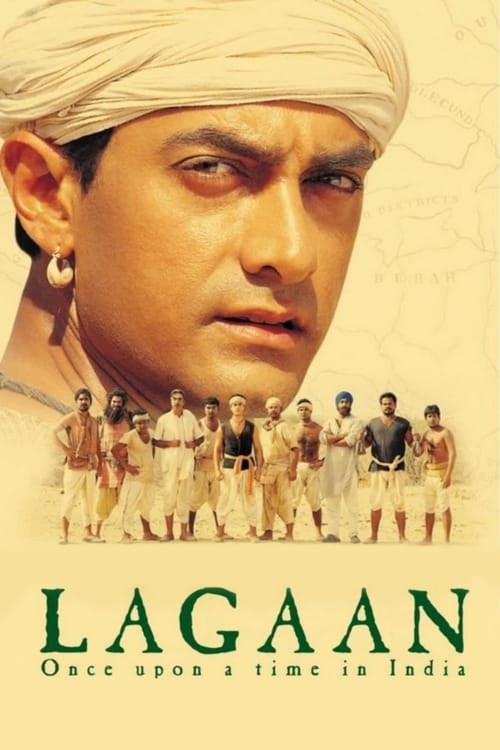
Lagaan: Once Upon a Time in India
2001 · Ashutosh Gowariker
For when you want to be swept up — a big, crowd-pleasing underdog saga to cheer at, ideally with other people and a free evening. Pure rousing comfort on a grand scale.
What it's about
In 1893, a drought-stricken Indian village is crushed under a punitive land tax imposed by a cruel British captain. When a defiant young farmer named Bhuvan talks back, the captain offers a wager: beat the garrison at cricket — a game no villager has ever played — and the tax is canceled for three years; lose, and it triples. What follows is the building of a team from farmers, outcasts, and rivals, with a village's survival riding on a single match.
The experience
A nearly four-hour epic that earns every minute — rousing, funny, openly emotional, with song-and-dance numbers that lift rather than interrupt. The final stretch is genuinely edge-of-seat sports suspense, even if you don't know a thing about cricket.
Performances
Aamir Khan anchors the film as Bhuvan with a movie-star blend of stubbornness and warmth, carrying both the political fury and the musical numbers without strain.
The craft
It fuses three traditions at once — the sports movie, the anti-colonial drama, and the full-blown Bombay musical — and makes the joins invisible, with A.R. Rahman's songs doing real storytelling work. The scale is genuinely epic: dusty vistas, a cast of hundreds, and a match staged with the clarity of a great thriller.
Why it matters
Its Oscar nomination for Best Foreign Language Film made it a landmark crossover moment for Hindi cinema, proving a full-length Bollywood musical could win over audiences worldwide, and it launched Aamir Khan's era as a producer of ambitious popular filmmaking.
Snapshot
Lagaan is a nearly four-hour Hindi-language epic that fuses the sports-underdog picture with the colonial resistance drama and the traditional Bombay-cinema musical. Set in 1893 in the fictional drought-stricken village of Champaner, it stages the entire arc of anti-colonial defiance within a single, invented wager: a cricket match against the British garrison, with three years of the punitive land tax — the lagaan of the title — as the stake. The subtitle "Once Upon a Time in India" openly borrows the incantatory register of Sergio Leone, announcing the film's ambition to be a founding myth rather than a naturalistic history. It was the first production of Aamir Khan Productions, with Khan starring as the farmer-hero Bhuvan, and it became one of the most decorated and internationally visible Indian films of its era, reaching the final five nominees for the Academy Award for Best Foreign Language Film. Its lasting significance lies less in formal innovation than in how completely it revived the confidence of the mainstream Hindi epic while smuggling in a serious argument about caste, unity, and colonial rule.
Industry & production
Lagaan arrived at a hinge moment for the Bombay film industry. Filmmaking in India had only recently (in 1998) been granted formal industry status, opening the door to more organized financing, and the late 1990s "multiplex era" was beginning to reshape distribution and audience expectations. Into this the film introduced an unusually deliberate production model. Aamir Khan, then one of the industry's leading stars, chose an epic anti-colonial subject with a first-time-feature-length collaborator's confidence and mounted it under his own new banner, taking on producer risk in a period when a three-hour-forty-four-minute period musical about cricket was, by any commercial logic, a gamble.
The most-cited feature of the production is its logistical discipline. Rather than the customary Bombay practice of shooting in fragments across many schedules, the unit decamped to the Kutch region of Gujarat and built a working village set near Bhuj, shooting substantially in sequence over an extended, continuous schedule. This approach — closer to a Hollywood location shoot than to conventional Hindi filmmaking of the time — is well documented as central to the film's tonal coherence, and it demanded the coordination of a large ensemble, including several British actors, over months in a remote location. The making of the film was itself later chronicled in a book by Aamir Khan and collaborators, which is among the fuller behind-the-scenes records for a Hindi production of the period. Beyond these established facts, granular budget and box-office figures should be treated cautiously; the film is universally described as a major commercial and critical success, but I will not attach specific numbers that the reliable record does not firmly support.
Technology
Lagaan is most often flagged technologically for its use of synchronous sound. Mainstream Hindi cinema had long relied on post-production dubbing, with dialogue and much ambient sound rebuilt in the studio; Lagaan is widely credited as one of the prominent large-scale Bombay productions to record location sound live, capturing performances and the acoustic texture of the outdoor set in situ. This choice is consistent with the film's realist ambitions for its village world, and it placed unusual demands on a large open-air location with a big cast and animals. It was shot photochemically on 35mm, as was standard for the period, and mounted in a widescreen frame suited to its landscape and crowd staging. Claims beyond these — precise gauges, lab processes, or specific recording equipment — are not something I can verify with confidence, and I will not invent them.
Technique
Cinematography
The photography, by Anil Mehta, is organized around a single dramatic problem: how to make a barren, sun-scorched landscape express both oppression and hope across nearly four hours. Mehta leans on the natural palette of Kutch — cracked earth, dust, hard sunlight, and the longed-for monsoon sky — so that weather becomes narrative. The film's celebrated song "Ghanan Ghanan," anticipating rain that does not come, is a set piece of cloud, light, and open horizon. In the cricket climax, the camera has to solve a distinct problem: sustaining suspense across a game most of the original audience understood intimately and much of the world did not. The coverage there favors clear spatial geography — bowler, batsman, field — punctuated by reaction shots that keep the emotional stakes legible even when the sporting stakes are technical.
Editing
Cut by Ballu Saluja, the film's editorial challenge is scale and duration. The structure is patient in its first movement — establishing drought, tax, humiliation, and the reckless wager — and then accelerates through the recruitment and training of the team before settling into the extended match that occupies the film's final act. The match is essentially a self-contained sports drama built through cross-cutting between play and crowd, engineered so that momentum swings, setbacks, and reversals carry the audience through a very long sequence without slackening. That the film sustains tension across such length is largely an editorial achievement.
Mise-en-scène / staging
The purpose-built village set is the film's foundational design gesture: a coherent, lived-in world that allows the camera to move freely and the ensemble to inhabit continuous space. Costume design was by Bhanu Athaiya, the veteran designer who had won an Academy Award for Gandhi (1982); her work grounds the film's period surface, differentiating villagers by caste, occupation, and means, and setting the coarse homespun of the farmers against the starched formality of the British cantonment. The staging repeatedly builds large tableaux — assemblies, processions, the packed crowd at the match — that visualize the film's central theme of collective identity.
Sound
Sound is doubly important here: as the live-recorded realism discussed above, and as the vehicle for A.R. Rahman's songs and score. The musical numbers are not decorative interludes but structural load-bearing scenes — devotional appeal, romantic triangle, communal resolve — and the sound design must integrate them with the naturalistic village ambience. The match sequence in particular uses crowd sound and score to modulate tension.
Performance
Aamir Khan's Bhuvan anchors the film with a performance calibrated to the mythic register: righteous, stubborn, and charismatic without slipping into invulnerability. Around him the film depends on a large ensemble in which each recruited player is a distinct type — the untouchable Kachra, brought into the team in the film's most pointed statement on caste; the Sikh, the fortune-teller, the wounded and the comic — so that the team becomes a deliberate cross-section of village society. Gracy Singh plays Gauri, and the British roles, including Captain Russell and his sympathetic sister Elizabeth, are played by British actors (Paul Blackthorne and Rachel Shelley), giving the colonial antagonists more dimension than the genre often allows. Elizabeth's outsider sympathy and unrequited feeling add a note of cross-cultural complication rather than pure villainy.
Narrative & dramatic mode
The screenplay's central invention is its economy: it collapses the vast, diffuse subject of colonial exploitation into one concrete contest with clear rules and a fixed deadline. This is the classic underdog-sports structure — impossible challenge, reluctant hero, ragtag team, training montage, climactic game — but grafted onto the "assembling a band" tradition familiar from the ensemble adventure, where each member contributes a particular skill. The dramatic mode is frankly melodramatic and mythic in the honorable sense: broad moral oppositions, heightened emotion, and songs that carry interior states the dialogue leaves unspoken. Crucially, cricket — a British import — is turned into the instrument of resistance, so that the colonizer's own game becomes the ground on which the colonized claim dignity. The length is itself a dramatic choice: the film insists on the time required to earn its catharsis.
Genre & cycle
Lagaan sits at the intersection of several genres: the historical epic, the masala musical, and the sports film. Within Hindi cinema it belongs to the lineage of the socially serious epic — the tradition of Mother India and Mughal-e-Azam — that treats the nation as its true subject. Internationally it reads as a colonial-period underdog drama with obvious kinship to the sports-triumph film. Its "recruit a team of specialists" architecture invites comparison to the ensemble-mission tradition descending from Seven Samurai and The Magnificent Seven, though Lagaan redirects that structure from combat to sport and from mercenaries to a community defending itself.
Authorship & method
The film is closely identified with Ashutosh Gowariker, who directed and wrote the screenplay and story, and whose willingness to bet on scale, length, and a serious theme defines its character; Lagaan established him as a director of ambitious historical subjects, a vein he continued with later period films. But authorship here is genuinely shared with Aamir Khan, whose producing and star presence were decisive, and whose subsequent reputation as an unusually deliberate, socially minded star begins with this film.
The key collaborators form an exceptional roster. A.R. Rahman composed the score and songs, with lyrics by Javed Akhtar — a partnership that produced some of the film's most enduring numbers, including the devotional "O Paalanhaare," the rain-invoking "Ghanan Ghanan," the marching "Chale Chalo," and the romantic-triangle song "Radha Kaise Na Jale." Cinematography was by Anil Mehta, editing by Ballu Saluja, and the Hindi dialogues — pitched in a rustic, period-flavored register — by the noted writer K.P. Saxena. Costume design by Bhanu Athaiya lent the production its authoritative period surface. The method, in sum, married a Hollywood-style commitment to a single continuous shoot with the emotional grammar of the Bombay musical.
Movement / national cinema
Lagaan is a landmark of mainstream Hindi cinema — "Bollywood" — at the precise moment that industry was gaining new institutional legitimacy at home and new visibility abroad. Alongside a small cluster of turn-of-the-millennium films, it helped make Hindi cinema legible to international festival and art-house audiences without abandoning the popular form's defining elements: songs, length, melodrama, and stardom. In that sense it is a self-conscious statement about national cinema — both about India as subject (the anti-colonial founding myth) and about the confidence of Indian popular filmmaking as a form worthy of the world stage.
Era / period
The film is set in 1893, in the high noon of the British Raj, and belongs to the small tradition of Hindi films that dramatize colonial oppression directly rather than through the later independence struggle. Its historical specifics — the village, the tax, the match — are invented, and the film is candid in its subtitle about being a legend rather than a chronicle. Made in 2001, it reflects a post-liberalization, increasingly globalized India looking back at colonial subjugation with a mixture of righteous anger and mythmaking generosity, extending even to a sympathetic British character.
Themes
The governing theme is unity across division: the wager can only be won if a fractured village — split by caste, religion, and self-interest — acts as one. The film's most deliberate statement is the inclusion of Kachra, an untouchable, whose acceptance onto the team stages a critique of caste prejudice as itself a form of internal oppression mirroring colonial rule. Adjacent themes include dignity and self-respect under domination; faith and collective hope (the recurring appeal for rain, folded into devotional song); and the turning of the colonizer's culture back against him, as cricket becomes the medium of liberation. The romance between Bhuvan, Gauri, and the sympathetic Elizabeth adds a strand about desire across the colonial line and the impossibility of certain crossings.
Reception, canon & influence
Lagaan was received as a major event and is widely regarded as a modern classic of Hindi cinema. Its most conspicuous external honor was selection as India's official entry for the Academy Award for Best Foreign Language Film, where it advanced to the final five nominees — a rare reach for a popular Hindi musical, and one that markedly raised the international profile of Bombay cinema. It was also heavily honored at India's National Film Awards and the major Hindi-film awards of its year. Detailed award tallies and receipts vary across sources, and where the record is not firm I flag it rather than fabricate specifics.
Backward influences on the film include the epic tradition of Mother India and Mughal-e-Azam (the socially serious Hindi epic as national statement), the Western sports-underdog film, the ensemble-mission structure of the Seven Samurai lineage, and, at the level of title and tone, Sergio Leone's mythic "Once Upon a Time" register.
Forward influence is substantial within Indian cinema. Lagaan is frequently cited as the film that reinvigorated confidence in the ambitious, socially conscious mainstream epic and helped legitimize the sports film as a serious Hindi genre — a current that runs on to underdog sports dramas such as Chak De! India (2007) and later biographical sports films. It also inaugurated Aamir Khan's influential run as a producer-star associated with high-concept, message-driven films, and cemented Gowariker's identity as a director of large historical subjects. Perhaps most durably, it demonstrated that a Hindi film could be uncompromisingly itself — songs, length, melodrama intact — and still command international attention, a proof of concept whose effects on the industry's self-image outlasted any single box-office run.
A Deleuzian reading
Clouds come over Champaner.
The full Deleuzian reading of Lagaan: Once Upon a Time in India →
Reception
No reappraisal needed — it was a blockbuster and critical darling on release in 2001, rode all the way to an Oscar nomination, and has only hardened since into 'greatest Indian film' shortlist material and the default gateway recommendation for Bollywood newcomers.
How Lagaan: Once Upon a Time in India was received, from release to now →
How to watch Lagaan: Once Upon a Time in India: what to notice on a first viewing
- Watch the cracked earth and hard sunlight throughout the village scenes. Mehta shoots the drought-stricken landscape of Kutch so that the weather itself becomes part of the story, especially in the song longing for rain. The land's suffering is visible in nearly every frame, not just stated in dialogue.
- Notice how differently the villagers and the British are dressed. Athaiya sets the coarse homespun of the farmers against the starched formality of the cantonment, and differentiates villagers by caste and means within their own group. You can read status and allegiance from the costumes before a character says a word.
- Notice how many people fill the frame during the village gatherings. The staging repeatedly builds large tableaux, assemblies and processions, that put the whole community in view at once. The crowded frame is the film's argument for collective identity, made visually before it is ever said aloud.
- Watch each recruited player for what single trait defines him. The team is built from distinct types, each contributing a specific skill or standing, so the group reads as a cross-section of the village. The team is a portrait of the whole community, not just eleven individual characters.
- Listen for how the songs carry feelings the dialogue doesn't say. Rahman's musical numbers function as structural scenes rather than decoration, carrying devotional appeal, romance, and communal resolve. Skipping a song means missing information the story never gives you any other way.
The whole guide to watching Lagaan: Once Upon a Time in India, with the keys for a rewatch →
Influences: the films it descends from and the films it influenced
- Seven Samurai (1954) — Supplies the recruit-the-ensemble/village-under-threat architecture — a cross-section of reluctant specialists assembled one by one and drilled toward a single climactic collective contest — which Lagaan transplants onto cricket.
- Mother India (1957) — Models the socially serious Hindi epic in which a village's fight against an exploitative tax/moneylender becomes a national allegory, giving Lagaan its rural-peasantry-as-nation template.
- Mughal-e-Azam (1960) — Establishes the grand historical-epic surface where a set-piece song functions as a dramatic pivot rather than an interlude, the register Lagaan revives for its period statement.
- Once Upon a Time in the West (1968) — Lends the mythic 'Once Upon a Time' titling register and the ritualized, drawn-out cross-cut showdown grammar that Lagaan applies to its climactic match.
- Sholay (1975) — Demonstrates the masala fusion of the village-defense ensemble with Leone's widescreen mythic staging on a single ambitious shoot, the immediate Hindi precedent for Lagaan's scale.
- Rocky (1976) — Codifies the sports-underdog grammar — training the untrained via montage, then cross-cutting a climactic contest to build an emotional rather than merely athletic victory arc.
- Victory (Escape to Victory) (1981) — Provides the exact 'colonizers' game reclaimed' device — the oppressed beating their captors at the captors' own sport as an act of resistance staged as the film's climax.
- Gandhi (1982) — Direct collaborator debt: costume designer Bhanu Athaiya's authoritative British-Raj period surface, honed here, is the same authorial hand that dresses Lagaan's 1893 village.
- Rang De Basanti (2006) — Extends the Aamir Khan producer-star run of high-concept, message-driven films that Lagaan inaugurated, again binding an ensemble to a socio-political awakening.
- Chak De! India (2007) — Inherits Lagaan's legitimization of the serious Hindi sports film: a cross-section national team welded into unity-across-division, resolved in a cross-cut match climax.
- Bhaag Milkha Bhaag (2013) — Rides the biographical sports-epic current Lagaan made viable, cross-cutting an athlete's ordeal into a nation-building emotional payoff.
- Dangal (2016) — Aamir Khan's later sports vehicle that perfects Lagaan's cross-cut athletic-contest climax, editing each bout so a physical win reads as social vindication.
- RRR (2022) — Extends Lagaan's British-Raj anti-colonial epic into maximalist collective-tableaux musical set-pieces staged on purpose-built scale, the same colonizer-defied-through-spectacle logic.
- Jersey (2019) — Established the Indian grammar of cricket legibility — making an entire match dramatically readable to a mass audience through ball-by-ball match cutting and crowd-reaction inserts — the editorial vocabulary Naveen Nooli reuses to make Jersey's play emotionally trackable.
- Swades (2004) — Reapplies the Gowariker–A.R. Rahman method — patient long-form realism scored to build communal uplift — to a socially conscious mainstream drama rather than an epic contest.
- Jodhaa Akbar (2008) — Continues Gowariker's large-scale historical-epic authorship with Rahman's score and purpose-built period staging, the vein Lagaan opened for him.
- Slumdog Millionaire (2008) — Realizes the Bollywood-to-global crossover that Lagaan's Oscar-shortlist run prefigured, and does so on the back of A.R. Rahman's score breaking into the Western mainstream.
Similar films
- Bhaag Milkha Bhaag (2013) — influence & lineage
- Dangal (2016) — influence & lineage
- Rang De Basanti (2006) — influence & lineage
- RRR (2022) — influence & lineage
- Slumdog Millionaire (2008) — influence & lineage
- Sholay (1975) — influence & lineage
- Seven Samurai (1954) — influence & lineage · often watched together
- Kabhi Khushi Kabhie Gham (2001) — shared sensibility
All the films related to Lagaan: Once Upon a Time in India →