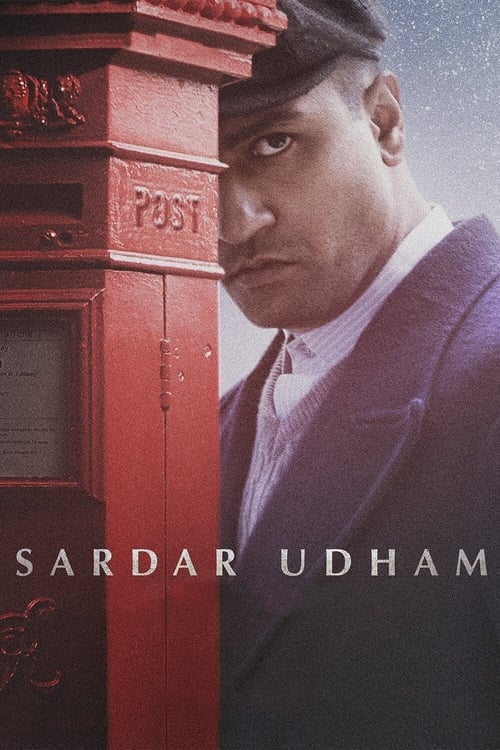
Sardar Udham
2021 · Shoojit Sircar
When you want a serious, meditative historical film to sit with — one that treats atrocity with patience instead of spectacle. Choose it on a night you're ready to be sobered, not entertained.
What it's about
A quiet Punjabi revolutionary named Udham Singh slips out of British India, crosses continents under false names, and surfaces in 1930s London — carrying a wound from the 1919 Jallianwala Bagh massacre that has never closed. The film traces his twenty-one-year path toward a single act: the 1940 assassination of Michael O'Dwyer, the colonial administrator who presided over Punjab when the killing happened. It moves like a memory, circling the event at its center before finally facing it.
The experience
Slow-burning, hushed, and heavy — more vigil than thriller, with long wordless stretches and a grief that accumulates rather than spikes. The final act is genuinely harrowing, and the film trusts you to sit with it.
Performances
Vicky Kaushal gives an unusually interior performance, carrying the film through stillness and silence — a man defined by what he withholds — and it ranks among his most acclaimed work.
The craft
The craft is the reason to watch: fog-wrapped London and lamplit Punjab are built with extraordinary period detail, and the cinematography favors darkness, patience, and long takes. Its boldest choice is structural — withholding the massacre until the end, so history arrives as exhumed trauma rather than opening spectacle. Reward it with a dark room and no phone.
Why it matters
One of the most discussed Indian streaming releases of its year and a major awards presence, it pushed the mainstream Hindi historical film toward restraint and mourning rather than chest-thumping triumphalism.
Snapshot
Sardar Udham is a biographical historical drama that reconstructs the life of the revolutionary Udham Singh, from his survival of the 1919 Jallianwala Bagh massacre in Amritsar to his 1940 assassination of Michael O'Dwyer, the former Lieutenant-Governor of Punjab, in London. Directed by Shoojit Sircar and headlined by Vicky Kaushal, it premiered on Amazon Prime Video on 16 October 2021 after a long gestation and a pandemic that pushed it away from theatrical release. The film is notable less for narrative propulsion than for its funereal patience: it withholds the massacre it is "about" until its final act, treating the event as trauma to be exhumed rather than spectacle to be delivered. Widely praised for its craft — cinematography, production design, and Kaushal's interiorized performance — it became one of the most discussed Hindi films of its year, both for its formal seriousness and for the controversy over its non-selection as India's Academy Awards submission.
Industry & production
The film emerged from Rising Sun Films, the production house associated with Sircar and his long-time producing partner Ronnie Lahiri, with Sheel Kumar also credited as producer, and was made in association with Kino Works. Its most cited piece of production history is that the project had been in development for years and had, at an earlier stage, been attached to Irrfan Khan in the title role; his illness and subsequent death in 2020 reshaped the film, with Vicky Kaushal — by then established through Uri: The Surgical Strike (2019) and Sanju (2018) — taking the part. This lineage is well established in the public record and matters because it frames the film as a passion project carried across the better part of a decade rather than a quick commercial vehicle.
Distribution is itself a production fact here: rather than a theatrical run, the film went directly to Amazon Prime Video, part of the broader migration of ambitious, mid-to-large-budget Indian titles to streaming during and after the COVID-19 period. Because it bypassed theaters, conventional box-office figures do not apply, and any account of its "commercial performance" should be treated with caution — there are no reliable theatrical grosses to cite. Its economic logic was that of a prestige streaming original: reach and reputation rather than opening weekends.
Technology
Sardar Udham is a digitally-shot period film whose technological signature lies in large-scale historical reconstruction. Its two principal challenges were recreating 1930s London and, above all, staging the Jallianwala Bagh massacre and its aftermath. The production combined constructed sets, location work, and visual-effects extension to render period environments — gaslit London streets, the walled Bagh, colonial-era Amritsar and Punjab. The climactic massacre sequence, filmed in extended low-light conditions and rendered as a long, near-wordless passage, depended on the film's ability to sustain image quality across dusk-to-night exposures and to integrate crowds, environment extension, and practical bodies into a coherent, unsettlingly quiet tableau. Precise details of camera systems and pipeline are not something I can specify reliably, so I will not invent them; what is clear from the finished work is a deliberate marshalling of modern digital tools toward an anti-spectacular, texture-first realism rather than toward overt effects display.
Technique
Cinematography
The cinematography, by Avik Mukhopadhyay, is the film's most-lauded element and was recognized at the National Film Awards. Mukhopadhyay works in a desaturated, cold-leaning palette — steel blues, browns, and grays — that binds the London and Punjab timelines into a single mournful register. Interiors are frequently underlit, sculpted by single sources; exteriors in the massacre sequence move into a prolonged blue-hour darkness. The camera is patient and often static or slow, favoring composition and duration over coverage. The most discussed passage is the post-massacre night, in which Udham carries the wounded and the dead through the Bagh: the imagery is composed with a painterly stillness that converts documentary horror into something closer to a requiem, and the restraint of the lighting — bodies emerging from and receding into darkness — is central to the film's ethical stance of witnessing rather than exploiting.
Editing
Chandrashekhar Prajapati's editing is defined by a fractured, non-linear architecture. The film moves across decades — 1919, the 1930s, 1940 — cross-cutting Udham's interrogation and the assassination's aftermath with earlier chapters of radicalization and exile. Rather than a clean chronological arc, the structure works associatively, letting the massacre surface in fragments before its full-length reconstruction near the end. The pacing is deliberately slow, and the extended climactic sequence is the clearest editorial gamble: it refuses conventional acceleration, holding on aftermath long past the point where a more commercial cut would move on. Reactions to the film's rhythm were divided precisely along this line — admirers read the slowness as gravity, while some viewers found it inert.
Mise-en-scène / staging
The production design (associated with Dmitrii Malich and Mansi Dhruv Mehta) and costume work (Veera Kapur Ee) are meticulous, and both were honored at the National Film Awards. The staging privileges period authenticity and atmosphere: fog and lamplight in London, the enclosed geometry of the Bagh, the textures of colonial administration. Crucially, the mise-en-scène is organized around confinement and witness — the walled garden as a trap, interrogation rooms as pressure chambers, the recurrent imagery of Udham as a solitary figure moving through indifferent spaces. The massacre is staged not as a single act of violence but as a durational field of suffering, with the environment (the well, the walls) doing much of the dramatic work.
Sound
Sound is used sparingly and pointedly. Much of the film is quiet, and the climactic sequence in particular leans on near-silence, ambient detail, and the absence of music to intensify unease. Shantanu Moitra's score is restrained and elegiac rather than swelling, deployed to color grief rather than to cue heroism. The film's audiography was noted in awards recognition, and its overall sound strategy is of a piece with its visual restraint: withholding sonic release where a conventional patriotic drama would supply a crescendo.
Performance
Vicky Kaushal's central performance is interiorized and controlled, built on stillness, watchfulness, and suppressed grief rather than oratory. The film asks him to carry long passages with little dialogue, communicating two decades of unhealed trauma through physical bearing and eyes; it is a study in withheld emotion that pays off in the climactic sequence's wordless labor. The surrounding cast — including Shaun Scott as Michael O'Dwyer and Stephen Hogan as figures of the colonial establishment, with Amol Parashar appearing as the revolutionary Bhagat Singh in Udham's political formation — functions largely to situate Udham historically and ideologically rather than to generate competing arcs.
Narrative & dramatic mode
The film's dramatic mode is elegiac and investigative rather than propulsive. It opens near the end of Udham's story — his release from prison, his movement toward the assassination — and reconstructs cause backward from effect, so that the "why" of the killing is answered only in the final, full recreation of Jallianwala Bagh. This is a deliberate reversal of the biopic's usual forward march: motivation is treated as buried trauma to be excavated, and the assassination, delivered relatively early, is drained of catharsis so that the massacre can carry the film's emotional weight. The dominant registers are memory, mourning, and moral witness. The film largely resists the rousing beats of the patriotic action-biopic; its climax is not vengeance but the depiction of loss.
Genre & cycle
Sardar Udham sits at the intersection of the historical biopic, the freedom-struggle film, and the political drama. It belongs to a long Indian tradition of films about the anti-colonial independence movement, and specifically to the cluster of works about revolutionary martyrs — the same historical and mythic terrain occupied by the many screen treatments of Bhagat Singh, to whom Udham Singh is explicitly linked within the film. Within the 2010s–2020s cycle of Hindi patriotic and nationalist cinema, however, it is a deliberate outlier: where much of that cycle trades in triumphalism and spectacle, Sircar's film adopts an austere, sorrowful, art-cinema idiom. It is better understood as a revisionist entry in the martyr-biopic — one that interrogates the toll of revolutionary trauma rather than celebrating heroic action.
Authorship & method
Shoojit Sircar's authorship here is somewhat against type. Best known for intimate, humane, urban dramas — Vicky Donor (2012), Piku (2015), October (2018) — Sircar brings to Sardar Udham the same attention to interiority, restraint, and the texture of ordinary suffering, scaled up to a historical epic. His method is patient and character-first, and the film's refusal of conventional biopic uplift reads as a considered authorial choice consistent with his sensibility.
The film is fundamentally a collaborative craft achievement. Cinematographer Avik Mukhopadhyay shapes its cold, painterly image; composer Shantanu Moitra, a frequent Sircar collaborator, supplies its restrained score; editor Chandrashekhar Prajapati constructs its non-linear architecture. The screenplay is credited to Shubhendu Bhattacharya and Ritesh Shah, working from Bhattacharya's story, and its structural boldness — the backward excavation, the deferred massacre — is central to how the film means. Production design and costume (Dmitrii Malich and Mansi Dhruv Mehta; Veera Kapur Ee) are integral rather than incidental to the authorship, given how much the film's argument is carried by environment and period texture.
Movement / national cinema
The film belongs to Indian — specifically Hindi-language, "Bollywood"-adjacent — cinema, but it consciously aligns itself with a more austere, internationalist art-cinema register than mainstream Hindi production. It participates in the broader 2020–2021 shift of prestige Indian filmmaking onto global streaming platforms, which allowed a slow, formally severe historical film to reach audiences without the commercial constraints of a theatrical release. Within national cinema it functions as a bridge between the popular freedom-struggle film and the sensibility of Indian parallel/art cinema, and its subject — a Punjabi revolutionary avenging a colonial atrocity on British soil — foregrounds the enduring cinematic reckoning with the legacy of the Raj.
Era / period
Made in 2020–2021 and released amid the pandemic-era streaming boom, the film reconstructs a period spanning roughly 1919 to 1940: the Jallianwala Bagh massacre, the interwar revolutionary underground, exile across Afghanistan, the Soviet Union, and Europe, and 1930s London. Its historical consciousness is doubled — a contemporary work looking back at both the colonial past and, implicitly, at how that past is remembered and represented. The choice to center Jallianwala Bagh and O'Dwyer's culpability engages directly with debates about colonial accountability that remained live at the time of production, including around the massacre's centenary in 2019.
Themes
The film's governing themes are trauma and its long half-life, memory as an unhealed wound, and the moral weight of witness. Udham's twenty-one-year pursuit is framed less as revenge than as the impossibility of forgetting; the film insists on the cost of political violence to the one who carries it. It engages the ethics of martyrdom and the meaning of freedom — drawing, through the Bhagat Singh thread, a distinction between spectacular assassination and the deeper revolutionary aspiration for justice and equality. Colonial accountability is central: by staging the massacre at length and naming O'Dwyer's responsibility, the film treats historical atrocity as something that demands to be seen rather than summarized. Above all it is a film about grief — national and personal — and about the labor of bearing witness to the dead.
Reception, canon & influence
Critical reception was strong and centered on craft. Reviewers widely praised Mukhopadhyay's cinematography, the production and costume design, Moitra's score, and Kaushal's restrained lead performance, while a recurring reservation concerned the film's length and deliberate slowness, particularly the extended climax; opinion divided over whether that patience read as profundity or as inertia. The film was recognized at the National Film Awards, winning in multiple craft categories including cinematography, production design, and costume, among others — a level of institutional honor consistent with its reputation as one of the most accomplished Hindi films of its year. (I am confident it won several 69th National Film Awards in these craft areas; readers wanting the exact category list should verify the specific citations.)
The most durable controversy concerns its non-selection as India's official entry for the Academy Awards' international feature category, a decision that generated significant public debate, with reporting that a selection-jury member characterized the film's treatment of the British in terms of its anti-colonial anger. I will not reproduce a specific quotation, as I cannot verify the exact wording, but the episode itself — and the wide dismay it prompted among critics who considered the film worthy — is well documented.
Backward influences are legible in the film's DNA: the long Indian tradition of Bhagat Singh and freedom-fighter films against which it defines itself; the anti-spectacular, witness-oriented approach to historical atrocity associated with international art cinema; and Sircar's own body of intimate dramas, whose restraint it scales up. Forward, its influence is best understood as a proof of possibility: it demonstrated that a slow, formally austere, morally serious historical film could find prestige and a large audience on streaming, strengthening the case within Hindi cinema for craft-forward, non-triumphalist treatments of the national past. Its lasting standing rests on its refusal to convert atrocity into uplift — a choice that made it both divisive and, for many, a benchmark for how the genre might mature.
Reception
Dropped straight to Prime Video in October 2021 to warm reviews, then its stock kept rising — an Oscar-entry snub that outraged fans, five National Film Awards, and a growing consensus that it's one of the finest Hindi films of the streaming era that never got the big screen it deserved.
How Sardar Udham was received, from release to now →
How to watch Sardar Udham: what to notice on a first viewing
- Notice the cold, steel blue color across every timeline. Avik Mukhopadhyay shoots London and Punjab in the same desaturated palette of blues, browns, and grays, so two decades and two countries feel like one continuous mourning. The color tells you this is one long grief, not two separate stories decades apart.
- Watch Vicky Kaushal's stillness in scenes with almost no dialogue. Kaushal plays Udham through physical bearing and watchfulness rather than speeches, carrying long stretches of the film on posture and eyes alone. You're being asked to read decades of unhealed history off a face that refuses to explain itself.
- Listen for how little music plays under the tense scenes. Shantanu Moitra's score stays restrained and elegiac rather than swelling, and much of the film leans on near-silence and ambient detail instead of a musical cue telling you how to feel. The quiet keeps the film feeling like grief rather than a patriotic drama building to a crescendo.
- Notice how often Udham is shown alone in large spaces. Fog-heavy London streets, interrogation rooms, and the walled Bagh garden are staged as confinement and exposure at once, with Udham repeatedly a solitary figure moving through indifferent space. The environment itself keeps telling you he's carrying something alone that the people around him can't see.
The whole guide to watching Sardar Udham, with the keys for a rewatch →
Influences: the films it descends from and the films it influenced
- Come and See (1985) — The immobilized witnessing face and durational atrocity-as-endurance — refusing cutaways or relief so suffering is measured in real time — directly models the extended Jallianwala Bagh climax where Udham carries the dying through the night.
- The Battle of Algiers (1966) — Anti-spectacular, documentary-textured staging of colonial violence as collective witness rather than heroic set-piece, the template for treating atrocity as evidence instead of thrill.
- Gandhi (1982) — Its reconstruction of the Jallianwala Bagh massacre as a discrete atrocity set-piece is the direct precursor sequence Sircar re-stages, but slows and de-dramatizes into durational witness.
- The Legend of Bhagat Singh (2002) — Supplies the martyr-biopic template of the freedom-struggle film — patriotic uplift, courtroom defiance, sacrificial climax — that Sardar Udham defines itself against by withholding catharsis.
- Munich (2005) — The revisionist procedural of political assassination that interiorizes the avenger's moral disintegration and drains retribution of triumph, ending in exhaustion rather than justice served.
- The Conformist (1970) — Non-linear flashback architecture fused to painterly, cold-toned expressionist cinematography (Storaro) in which the image externalizes buried memory — the backward-excavation grammar Sardar Udham inherits.
- The Assassination of Jesse James by the Coward Robert Ford (2007) — Roger Deakins' diffused, low-light painterly frames paired with an elegiac restrained score and deliberately anticlimactic violence — the elegiac-investigative mode rendered as slowness.
- October (2018) — Sircar's own prior experiment in near-silence, interiorized restraint, and durational suffering that refuses dramatic beats — the intimate method later scaled up to historical epic.
- Garam Hava (1973) — Indian parallel-cinema restraint applied to political/colonial rupture, privileging interiorized, non-melodramatic performance and lived period texture over declamation.
- Rang De Basanti (2006) — The freedom-struggle film that intercuts colonial past and present to reframe the martyr genre — a sibling revision, though it energizes where Sardar Udham mourns.
- Hey Ram (2000) — A nonlinear, memory-fractured assassination biopic of a real political killing rendered in stratified period color — extending Hey Ram's counterfactual/assassination-history mode of building a nation's trauma around a single act of violence.
- Sam Bahadur (2023) — A post-Udham prestige biopic that inherits the license for craft-forward, non-triumphalist period restraint on a large-canvas historical subject, favoring character interiority over hagiographic spectacle.
- Silence (2016) — Shares the near-silent sound design, durational suffering, and interiorized faith-and-witness restraint, building meaning through endurance and withheld resolution rather than incident.
- Sicario (2015) — Deakins' desaturated cold palette and blue-hour low-light photography wedded to dread-laden near-silence (Jóhannsson) — the same austere sensory grammar of tension without spectacle.
- Zero Dark Thirty (2012) — An austere procedural of a long, deferred hunt that withholds catharsis and closes on emotional depletion rather than victory — the deferred-climax structure applied to political obsession.
- Masaan (2015) — Shares cinematographer Avik Mukhopadhyay's naturalist, grief-toned low-light imagery and parallel-cinema restraint, carrying trauma through environment and quiet performance.
- Raazi (2018) — A restrained, interiorized treatment of nationalist history built on withheld performance and moral cost rather than spectacle, part of the same craft-forward turn in Hindi historical drama.
- Main Vaapas Aaunga (2026) — Works the same dual-timeline interrogation frame and cold-present/warm-past two-register grade, but lets its atrocity set piece consume the last act — the negative model this film answers by keeping the private loss in the foreground while history removes it.
Similar films
- Gandhi (1982) — influence & lineage
- Masaan (2015) — influence & lineage
- Dhurandhar (2025) — shared sensibility
- Main Vaapas Aaunga (2026) — shared sensibility
- Uri: The Surgical Strike (2019) — shared sensibility
- Haider (2014) — shared sensibility
- Chithha (2023) — shared sensibility
- Kill (2024) — shared sensibility