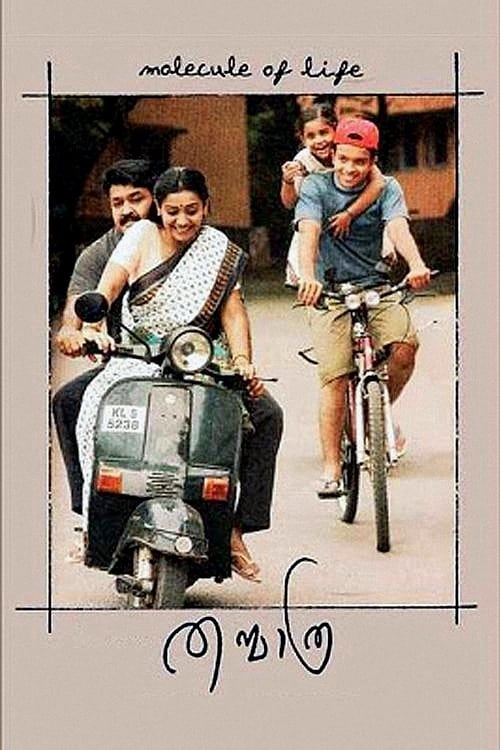
Thanmathra
2005 · Blessy
For when you need a good cry and a film with real emotional honesty — best watched when you're ready to feel something deeply, ideally with tissues in reach.
What it's about
Ramesan Nair is a middle-class government employee with a loving wife, two kids, and modest, cherished ambitions for his family — until small lapses of memory begin to multiply. The diagnosis is early-onset Alzheimer's, and the film follows what that does to a household: to a marriage, to a son's future, to a man watching his own self slip away.
The experience
Tender, patient, and quietly shattering — a chamber drama that earns its tears through observation rather than melodrama. It will wreck you, but gently, and it leaves you thinking about the people you love.
Performances
Mohanlal gives one of the defining performances of his career, charting a mind's disintegration from tiny lapses to total erasure with almost unbearable precision — the film is built around him, and he carries it.
The craft
Director Blessy works in the great Malayalam 'middle cinema' tradition — literate, restrained, emotionally exact — keeping the scale domestic so every small loss registers. The craft is invisible in the best way: it simply refuses a false note.
Why it matters
One of the most beloved Malayalam films of the 2000s, it confirmed Blessy as a major dramatist and stands as a benchmark for how Indian cinema portrays illness and family without sensationalism.
Snapshot
Thanmathra (transliterated variously as Thanmatra, meaning roughly "molecule" or "essential element") is a Malayalam-language domestic drama directed by Blessy, his second feature after the acclaimed Kaazhcha (2004). It follows Ramesan Nair, a middle-class government employee whose ordinary, aspirational family life is dismantled by early-onset Alzheimer's disease. The film is best understood as a work of the Malayalam "middle cinema" tradition — neither the star-vehicle mass entertainer nor the austere art film, but a literate, emotionally exacting chamber drama built around a single sustained performance by Mohanlal, one of the two dominant leading men of Malayalam cinema. That performance, tracing a mind's disintegration from small lapses to total erasure of self, is the film's organizing principle and the reason it endures in critical memory. The film was widely honored, including at the national level, and it remains a touchstone reference point in Indian cinema whenever the subject of dementia or caregiving is raised.
Industry & production
Thanmathra emerged from a specific corner of the Malayalam industry in the mid-2000s: a moment when the commercially dominant superstar system coexisted with a persistent appetite for "content-driven" family drama rooted in literary sensibility. Blessy had trained in the lineage of Malayalam's serious commercial cinema — he worked as an associate to major figures of the preceding generation before debuting with Kaazhcha, also starring Mohanlal — and Thanmathra consolidated his reputation as a director who could extract restrained, interior work from a star more often deployed in expansive registers.
The project's production logic is inseparable from Mohanlal's participation. By 2005 Mohanlal was an established box-office draw whose willingness to take a de-glamorized, physically and emotionally punishing role gave a modest domestic drama both financing viability and a marquee. The film was a mid-budget production by the standards of the industry, with resources concentrated on performance, ensemble casting, and controlled interior settings rather than scale or spectacle. Precise budget and box-office figures are not reliably documented in the accessible record, and I will not invent them; the film's commercial standing is better described qualitatively — a respectable performer whose reputation grew substantially through awards recognition and subsequent television and home-video life. The supporting ensemble drew on the deep bench of Malayalam character actors, including Nedumudi Venu, Innocent, and others whose presence signals the film's grounding in a recognizable Kerala social milieu.
Technology
Thanmathra was produced in the mid-2000s during the twilight of the fully photochemical era in Indian regional cinema, and it was shot and finished on 35mm film in the conventional workflow of its moment — location and set photography, negative processing, and a traditional post chain. There is nothing in the film that foregrounds technological novelty; its ambitions are dramaturgical rather than formal-technological, and its tools are deliberately transparent. This is worth stating plainly because the film's power derives from an almost anti-technological aesthetic: natural-feeling domestic lighting, unobtrusive lensing, and an avoidance of the visual effects or digital manipulation that were beginning to enter Indian production pipelines in this period. Any account of the film that claimed digital-intermediate finishing or effects work would be speculative; the safer and more accurate characterization is of a straightforward film-based production whose craft investments lie in performance capture, blocking, and sound rather than in imaging technology.
Technique
Cinematography
The cinematography — credited to Ajayan Vincent, per the standard record — serves the drama with deliberate self-effacement. The visual strategy is domestic realism: interiors of a lower-middle-class Kerala home rendered in soft, naturalistic light, compositions that keep the family in relational proximity, and a camera that observes rather than editorializes. The most important cinematographic decision is one of restraint. As Ramesan's cognition fragments, the film largely resists the obvious temptation to render subjectivity through distorting devices; the disorientation is carried by performance and situation, with the camera holding steady on faces and on the widening gaps between a man and the world he no longer maps. Where the framing does intervene, it tends toward isolation — separating the afflicted figure within the frame, or holding him at a distance that makes his growing strangeness legible to us as it is to his family. The palette is muted and warm, keyed to the textures of everyday domestic life rather than to any heightened symbolic scheme.
Editing
The editing governs the film's central formal problem: how to dramatize a gradual, non-eventful decline without either rushing it into melodrama or letting it slacken. The cut favors continuity and duration over montage, allowing scenes to breathe so that small failures — a forgotten name, a missed routine, a repeated question — land with cumulative weight. The film's rhythm is patient and accretive; its structure is essentially chronological, tracking the disease's progression as a descending staircase of losses. I do not have a firmly verifiable editor credit to cite with confidence, and rather than attribute the work to a specific hand I will simply note that the cutting discipline is consistent with the film's overall aesthetic of unshowy observation.
Mise-en-scène / staging
Staging is where Thanmathra does much of its quiet work. The film is organized around the household as a total environment — kitchen, courtyard, bedroom, the spaces of a specific class and region — and the blocking continually places Ramesan in relation to his wife, his children, and, crucially, his own aged father. That intergenerational staging is the film's structural signature: the presence of an elderly parent within the same frame doubles and foreshadows the protagonist's fate, so that the household becomes a diagram of the life cycle and of the burden of care passing between generations. Props and routines — the son's studies, the paraphernalia of a government clerk's respectability, the small rituals of family life — are established early precisely so that their later derangement registers as loss. The mise-en-scène is naturalistic throughout, avoiding stylization in favor of a lived-in specificity that grounds the melodrama in social texture.
Sound
Mohan Sithara's score and the film's sound design work in a restrained, supportive register. The music is used to underscore emotional turning points rather than to drive them, and the film generally trusts silence and ambient domestic sound to carry its most difficult passages. I will not enumerate specific song titles, as I cannot verify them with confidence, but the film sits within a tradition in which melody is integral to emotional address; here that address is tempered by the subject matter, kept largely subdued. The sound of ordinary life — household activity, conversation, the textures of a Kerala home — is as important as the score in establishing the reality that the disease erodes.
Performance
Performance is the film's raison d'être. Mohanlal's Ramesan Nair is a study in graduated disintegration: the actor charts the arc from a confident, affectionate paterfamilias through the bewilderment of early symptoms, the terror of partial awareness, and finally the vacancy of advanced decline, when personhood itself seems to drain from the body. The achievement lies in its physical and behavioral precision — the changing gait, the emptying eyes, the erosion of speech and continence — enacted without vanity and without the crutch of overt sentiment. It is widely regarded as one of the defining performances of his career and of Malayalam screen acting generally. The ensemble supports this centerpiece with grounded, unshowy work: Meera Vasudevan as the wife who becomes caregiver, the child performer playing the son whose own future ambitions are bound up with his father's collapse, and senior actors including Nedumudi Venu and Innocent lending the film its weight of lived Kerala reality.
Narrative & dramatic mode
The dramatic mode is domestic tragedy in a realist key. The narrative is deceptively simple and rigorously linear: an ordinary man, defined by his roles as husband, father, and dutiful son, is progressively unmade by illness. There is no antagonist and no reversal in the conventional sense — the "villain" is a disease, and the drama derives from the family's helpless witness to an irreversible descent. This gives the film an almost classical inevitability; we are watching a fate, not a mystery. The emotional structure is built on dramatic irony and cumulative loss: the audience, like the family, retains the memory of who Ramesan was, and every new deficit is measured against that intact earlier self. The film's aspirational subplot — the family's investment in the son's future and the father's dream for him — sharpens the tragedy by setting the ordinary trajectory of a hopeful middle-class life against the disease's cancellation of futurity. It is melodrama in the precise, non-pejorative sense: a drama of moral and emotional feeling organized around the family, pitched to move.
Genre & cycle
Thanmathra belongs to the family melodrama, and within that broad category to a specific and honorable Malayalam cycle: the literate "issue" or "disease" drama that treats a social or medical affliction as the ground for a character study of endurance and care. It participates in a wider Indian and global cycle of dementia-and-caregiving films, and it is frequently grouped, comparatively, with international treatments of Alzheimer's — though the resemblances are thematic rather than derived. Within Malayalam cinema specifically, it sits in the "middle cinema" tradition — the space between arthouse and mass entertainer — that had long distinguished the industry, and it functions almost as an actor's-showcase subgenre in which a major star submits to a de-glamorized, illness-defined role. Its cycle position is therefore double: a socially-minded issue film and a prestige performance vehicle.
Authorship & method
Blessy is the film's clear author, and Thanmathra is central to his reputation as a director of sincere, emotionally direct family dramas rooted in literary source material and in the Malayalam humanist tradition. His method, evident here, is to build a film around a strong central conceit and a strong central performance, to prefer restraint and realism over stylistic flourish, and to trust patient observation of ordinary life to generate feeling. His formation in the serious commercial wing of Malayalam cinema — as a longtime associate to major directors before his own debut — is legible in the film's confident handling of actors and its unfashionable earnestness.
Among key collaborators, the director's partnership with Mohanlal is the decisive one; across Kaazhcha and Thanmathra the two established a working relationship that drew unusually interior work from the star. Ajayan Vincent's cinematography and Mohan Sithara's music are the other principal craft contributions on the record. The film is understood to derive from a literary source in the Malayalam tradition — the subject and treatment are frequently associated with the region's rich culture of the short story and novella — but I want to be careful not to overstate a specific authorship of the underlying material that I cannot verify precisely; the safest claim is that the film reflects Malayalam cinema's characteristic closeness to serious regional literature, whether through direct adaptation or a literarily-shaped screenplay.
Movement / national cinema
The film is a product of Malayalam cinema, the film culture of Kerala, which occupies a distinctive place in Indian film history for its sustained tradition of literate, socially engaged, performance-driven filmmaking. Malayalam cinema had produced, from the 1970s onward, both a celebrated parallel/art wing and a strong "middle cinema" of humane commercial dramas, and Thanmathra is a direct inheritor of the latter. Its values — restraint, realism, respect for the audience's intelligence, a grounding in Kerala's specific social textures of class, family, and generational duty — are the values of that regional tradition rather than of pan-Indian mainstream cinema. The film's honest treatment of illness, aging, and care reflects a national cinema long comfortable with unglamorous subject matter and with the family as a site of serious moral drama.
Era / period
Made in 2005, Thanmathra sits at a hinge moment for Indian regional cinema: the last years of the fully photochemical, pre-digital production and distribution order, and a period when the middle-class family drama still commanded a viable place alongside the rising tide of youth-oriented and technologically flashier fare. The mid-2000s Malayalam industry was navigating commercial pressures that would intensify later in the decade, and films like this one — modestly scaled, performance- and content-led — represented a continuity with the industry's earlier prestige even as the broader landscape shifted. The film's very subject, the care of the aged and afflicted within the family, also speaks to a contemporary social reality: changing family structures and the pressures on domestic caregiving in a modernizing Kerala.
Themes
The film's governing theme is the erosion of the self — the terrifying proposition that identity, memory, and personhood are contingent and revocable, that a man can be present in body while progressively absent as a person. Around this it develops several interlocking concerns. Memory and its loss are treated not abstractly but as the very substance of relationship: to forget one's wife and children is to lose the relational fabric that constitutes a life. Care and duty form a second axis — the film is deeply concerned with the burden and grace of caregiving, and with the way illness transfers roles, turning wife into nurse and, poignantly, unmaking a man who is himself the caretaker of his own aged father. That intergenerational mirroring yields a theme of the life cycle and mortality: the household contains, simultaneously, youth's ascending hope and age's descending loss. Finally, the film is quietly about middle-class aspiration and its fragility — the dream of the son's advancement, the respectability of ordinary work — and the way catastrophic illness exposes how thin the membrane is between a secure life and its collapse.
Reception, canon & influence
Thanmathra was received as a serious achievement and, above all, as the vehicle for a landmark performance. Critical response centered on Mohanlal's work, widely praised as among the finest of his career and as a demonstration of a mass star's range in a de-glamorized register; the film's honesty and emotional restraint were also credited. It earned significant honors, including recognition at the national level in India — the film and its lead performance were among the awarded, and the picture is routinely cited in that context. I want to be precise rather than expansive here: the film is firmly established as an award-winning, critically esteemed work, but I will not enumerate a specific slate of trophies I cannot verify line by line, because the exact award record should not be embellished.
Backward, the influences on the film are those of its tradition rather than of any single antecedent text: the Malayalam middle-cinema lineage of humane family drama, the region's literary culture of the interior character study, and the broader global tradition of the illness-and-caregiving film. Forward, its legacy is twofold. Within Malayalam and Indian cinema it stands as a canonical treatment of dementia and caregiving — the reference point invoked whenever the subject returns to the screen — and a demonstration that a major star can anchor a modest, content-led drama to both prestige and lasting reputation. For Blessy, it cemented a directorial identity built on sincere emotional realism. And in the wider culture it has served a quasi-documentary function, becoming for many viewers a primary popular text for understanding Alzheimer's disease and the family labor it demands. That afterlife — as a film people return to, cite, and use to make sense of a hard reality — is the clearest measure of its influence.
Reception
An instant classic rather than a slow burner — it swept the Kerala State Film Awards in 2005 (including Best Film and Best Actor for Mohanlal) and has only hardened since into the default answer to 'peak dramatic Mohanlal.'
How Thanmathra was received, from release to now →
Influences: the films it descends from and the films it influenced
- Tokyo Story (1953) — Establishes the low, static, duration-held tableau of intergenerational blocking — parents and grown children arranged across the depth of a domestic room — that Thanmathra reuses to stage the family's redistribution of caregiving labor.
- Ikiru (1952) — Model of stripping a leading man of charisma to observe an ordinary bureaucrat's confrontation with terminal decline through patient, unhurried watching — the deglamorized-star template Mohanlal inhabits.
- Wild Strawberries (1957) — Renders the erosion of self from inside an aging protagonist, using memory-slippage and receding faculties as the film's central subjective device rather than external plot.
- Umberto D. (1952) — Neorealist attention to the small daily indignities of an aging man's dependence — the domestic-realist, dignity-preserving observation that Ajayan Vincent's restrained camera echoes.
- Elippathayam (1981) — The Malayalam art/middle-cinema grammar of isolating framing and long-take duration charting one man's shrinking mental and physical world inside a decaying house.
- Piravi (1989) — Malayalam minimalism of an aging father in slow decline, built on subdued scoring and near-silence over incident — the restraint-over-melodrama register Thanmathra adopts.
- Vanaprastham (1999) — Directly precedes the Blessy collaboration in drawing unusually interior, de-glamorized work from Mohanlal, proving the mass star could anchor a somber, content-led performance.
- Kaazhcha (2004) — Blessy's own debut that established his Mohanlal partnership and his method — a strong central conceit, literary-humanist realism, and emotion generated by observation, not style — carried straight into Thanmathra.
- The Savages (2007) — Extends the same unsentimental study of adult children absorbing the logistical and emotional burden of a dementing parent, staging caregiving as intergenerational duty and friction.
- Away from Her (2006) — Carries forward the caregiving-spouse structure with formal restraint, treating a partner's dementia through quiet duration and withheld sentiment rather than melodramatic peaks.
- A Separation (2011) — Makes a father's dementia the mechanical engine of a family's intergenerational duty conflict, rooting the disease in domestic-realist detail and moral obligation rather than pathos.
- Amour (2012) — Pushes the duration-over-montage, single-apartment observation of a spouse's cognitive-physical decline to its formal extreme — caregiving rendered as attritional real-time labor.
- Still Alice (2014) — A de-glamorized star (Julianne Moore) anchors a linear-decline dementia narrative, mirroring Thanmathra's structure of a capable professional losing selfhood step by step.
- The Father (2020) — Formalizes the erosion-of-self subjectively — shifting rooms, faces, and chronology — turning the interior POV that Thanmathra implied into the film's explicit editing device.
- Home (2021) — Malayalam continuation of the tradition: a deglamorized elder-father performance and gentle domestic realism about aging and intergenerational neglect, working in Blessy's sincere-humanist register.
- Iris (2001) — Contemporaneous Alzheimer's drama that fixes on a single performance tracking the incremental loss of language and self, the same cognitive-decline arc as its center of gravity.
Similar films
- A Separation (2011) — influence & lineage · same viewing thread
- Amour (2012) — influence & lineage · same viewing thread
- The Father (2020) — influence & lineage · same viewing thread
- Thaniyavarthanam (1987) — shared sensibility
- Mahanadhi (1994) — shared sensibility
- Kireedam (1989) — shared sensibility
- Kannathil Muthamittal (2002) — shared sensibility
- Vaaranam Aayiram (2008) — shared sensibility
All the films related to Thanmathra →
Watch it with: curated runs of related films
- When the Family Comes Undone — Watch these when you want intimate, one-household dramas where love and grief are the same thing — a parent fading, a marriage on trial, a child at the center of the wreckage.