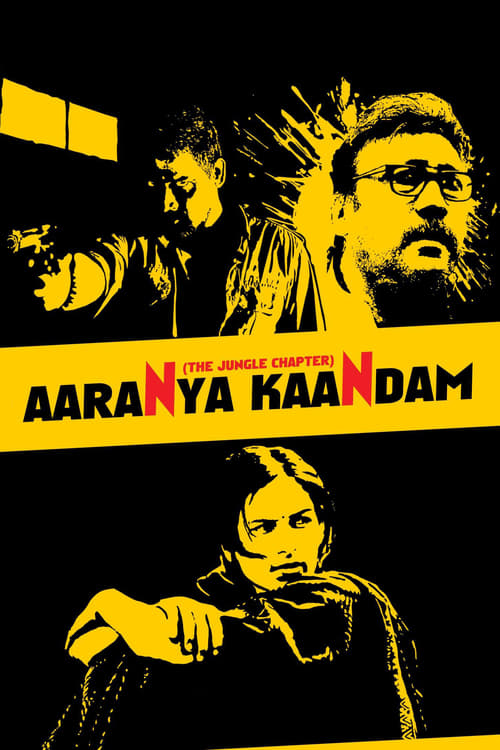
Aaranya Kaandam
2011 · Thiagarajan Kumararaja
For when you're craving a smart, twisty crime film — a lean, cult-favorite thriller for a night when you want to be surprised. Edgy rather than cozy, and best watched with full attention.
What it's about
Over a single day in Chennai, a bag of stolen cocaine sets two rival gangs on a collision course — and pulls in an aging don gripped by paranoia, his long-suffering henchman nursing a slow revolt, and two innocents who grabbed the wrong bag. Multiple storylines ricochet off each other by accident, with everyone scrambling to survive the fallout.
The experience
Tense, sardonic, and gleefully unpredictable — black comedy and sudden violence trading places without warning. It's the kind of tightly wound crime picture where you're grinning at the dialogue one moment and holding your breath the next.
Performances
Jackie Shroff, cast against type as the aging, paranoid don Singaperumal, gives the film its menacing center of gravity.
The craft
Kumararaja's debut is shot in a desaturated, grimy register far from mainstream Tamil gloss, with interlocking storylines engineered to collide like clockwork. The writing is the star — epigrammatic dialogue, patient setups, and payoffs that land a full act later.
Why it matters
Widely regarded as the first Tamil neo-noir — by many accounts the first in Indian cinema — it flopped commercially, then became a critical touchstone whose influence runs through the following decade of Indian crime films.
Snapshot
Aaranya Kaandam is a Tamil-language crime film that compresses a gang war, a stolen consignment of cocaine, an aging don's paranoia, and a downtrodden henchman's slow-burning revolt into the span of a single day in Chennai. Written and directed by Thiagarajan Kumararaja as his feature debut, it is routinely described in Indian film criticism as the first Tamil — and, by many accounts, the first Indian — neo-noir, a claim that is defensible in spirit even if such "firsts" are always contestable. Structured as several storylines that collide by accident, laced with black comedy and sudden violence, and shot in a desaturated, grimy register far from the gloss of mainstream Tamil cinema of its moment, the film became a critical touchstone and a cult object despite a muted commercial reception. Its title — "the forest chapter," borrowing the name of the Aranya Kanda, the third book of the Ramayana — frames the criminal milieu as a jungle governed by predation, and signals the mythic scaffolding beneath the pulp.
Industry & production
The film was produced by S. P. Charan under the banner Capital Film Works. Charan, a singer and the son of composer-producer S. P. Balasubrahmanyam, backed a first-time director working in an idiom with no proven commercial template in Tamil, which marks the project as a genuinely risk-tolerant independent production rather than a star vehicle. Its most conspicuous industrial gambit was the casting of Hindi cinema veteran Jackie Shroff in the central role of the geriatric don Singaperumal — a Bollywood star anchoring a Tamil neo-noir, dubbed into Tamil for release. That cross-industry casting gave the film visibility while underscoring its outsider positioning.
The production's defining ordeal was censorship. The Central Board of Film Certification initially refused the film a certificate, and its release was delayed by a protracted battle over content — the profanity, violence, and unsparing tone that were integral to the work. The film was eventually cleared with an "A" (adults-only) certificate and reached theaters in 2011, roughly a year after it had begun screening on the festival circuit. The precise procedural details of the CBFC dispute are reported unevenly across sources, so the safest summary is that the film was held up by certification and released only after revisions and appeals. Commercially, the consensus in trade and critical writing is that Aaranya Kaandam underperformed at the box office; specific figures should be treated with caution, and I will not assert numbers the record does not reliably support.
Technology
The film was produced and finished in the conventional digital-intermediate-era workflow of early-2010s Indian cinema; I have no reliable, specific record of the exact camera package or capture format used, and will not invent one. What is technologically legible on screen is a deliberate embrace of low-light, high-contrast image-making and an aggressive color grade in post — a muted, jaundiced palette of concrete grays, sickly greens, and pooled shadow that reads as a designed aesthetic rather than a budget limitation. The soundtrack likewise exploits contemporary mixing to foreground ambient grit and the percussive punctuation of violence. These are choices enabled by the digital-finishing tools standard to the period rather than by any novel apparatus, and the film's achievement is one of taste and control rather than technical invention.
Technique
Cinematography
Cinematographer P. S. Vinod gives the film a hard, unglamorous surface: available-light-styled interiors, compositions that trap characters against grimy walls and in cramped rooms, and a palette drained of the saturated warmth typical of Tamil commercial cinema. The camera favors observation over spectacle, holding on faces and letting menace accumulate. Violence is staged with restraint in framing but bluntness in impact, so that the film's shocks land as intrusions into an otherwise watchful, deliberate visual rhythm. The overall look — cold, dirty, noirish — is one of the film's clearest statements of intent, aligning image with theme: a world without moral illumination.
Editing
Editing is the film's most externally celebrated craft element: Praveen K. L. and N. B. Srikanth won the National Film Award for Best Editing for Aaranya Kaandam, a rare instance of a debut genre film being honored at the national level for cutting. The recognition is apt, because the film's architecture depends on the editors' management of parallel storylines that must feel independent until they converge, on the timing of its comedy (where a held beat or an abrupt cut carries the joke), and on the calibrated release of information toward the ending's reversal. The cutting sustains a single-day propulsion without sacrificing the loitering, character-study passages that give the violence its weight.
Mise-en-scène / staging
Kumararaja stages the film within a tight geography of dens, safe houses, roadside spaces, and back rooms, so that Chennai becomes a labyrinth of interiors rather than a scenic city. A recurring motif of cockfighting — roosters bred and pitted against one another — furnishes the film's controlling image, staging the human predators as gamecocks in a ring and literalizing the "jungle" of the title. Props and spaces are dressed for squalor and function, not display. The staging repeatedly frames power as spatial: who commands a room, who is cornered in one, who is made to wait.
Sound
Sound design leans into the film's noir-comic tonality, alternating oppressive ambient texture with sharp bursts, and the score by Yuvan Shankar Raja works against the grain of the crime-thriller cliché — using idiosyncratic, at times playful cues to underline the black comedy rather than merely score the tension. The music's willingness to be strange, and to comment ironically on the action, is part of the film's overall refusal of genre solemnity.
Performance
Jackie Shroff's Singaperumal — an impotent, aging kingpin whose authority is curdling into paranoia — is the performance around which the ensemble orbits, and the casting of a Hindi star lends the role an apt air of faded, imported grandeur. The ensemble includes Ravi Krishna as the beaten-down henchman whose arc drives the film's covert engine, Sampath Raj as a rival, Yasmin Ponnappa as Singaperumal's mistress Subbu, and Somasundaram in a comic-criminal register as one of the two petty thieves who blunder into the cocaine, alongside a young performer as the boy in that strand. Performances are pitched between deadpan comedy and sudden brutality, and the film asks its actors to hold both registers within single scenes — a tonal tightrope that is central to its effect.
Narrative & dramatic mode
The dramatic mode is the interlocking-strands crime mosaic: several plots — the don and his mistress, the henchman's suppressed rebellion, the two innocents who steal a bag of cocaine, the rival gang's maneuvers — unfold in parallel across one day and are drawn together by chance and greed. The film withholds a full understanding of its own machinery until late, so that a retrospective reversal reframes what the audience thought it was watching, revealing calculated manipulation beneath apparent accident. This puzzle-box quality — the sense that the day's chaos has a hidden author — is essential to the film's design and to its rewatchability. Tonally it operates as tragicomedy: the violence is real and consequential, but it is continually undercut and reframed by absurdist comedy, so that dread and laughter share the same scene.
Genre & cycle
Aaranya Kaandam belongs to the neo-noir crime-comedy cycle: morally compromised protagonists, a fatalistic universe, a MacGuffin (the drug consignment) that sets predators in motion, and a comic-ironic distance from its own genre furniture. Within Indian cinema it arrived as an outlier, importing a sensibility more familiar from international crime cinema into a Tamil context and helping to license a bolder, darker strain of Tamil filmmaking in the years that followed. Its blend of interlocking timelines, deadpan criminals, and sudden brutality invites comparison to a lineage of ensemble crime films, though the film localizes that mode thoroughly within its own idiom and mythic frame.
Authorship & method
The film is a singular authorial statement by Thiagarajan Kumararaja, who both wrote and directed it, and whose control over tone — the precise modulation between comedy and menace — is its signature. Kumararaja's method is legible in the film's density of design: the mythic title, the cockfighting motif, the withheld structure, the refusal of moral consolation. His key collaborators form a coherent authorial unit: cinematographer P. S. Vinod, whose cold, grimy imaging realizes the film's worldview; composer Yuvan Shankar Raja, whose against-the-grain score sharpens the irony; and editors Praveen K. L. and N. B. Srikanth, whose nationally awarded cutting builds the mosaic and lands the reversal. The writing is Kumararaja's own, and the film's dialogue and profanity — the very elements that triggered the censorship fight — are inseparable from its authorial voice. Kumararaja would not direct another feature for years, making Aaranya Kaandam a debut that stood for a long time as his entire, and complete, statement until Super Deluxe (2018).
Movement / national cinema
The film sits at the leading edge of a 2010s renewal in Tamil cinema, in which directors pushed against the conventions of the mainstream — star worship, tonal safety, moral tidiness — toward darker themes, formal ambition, and genre experimentation. Kumararaja is frequently invoked as an emblem of this "new-wave" or "new-age" Tamil sensibility, and Aaranya Kaandam functions in retrospect as one of its founding texts. That it emerged from the Tamil industry rather than from India's art-cinema institutions is significant: it demonstrated that formally adventurous, thematically transgressive work could be attempted within a popular-industry framework, a demonstration that shaped subsequent Tamil filmmaking.
Era / period
Released in 2011, the film is a product of the digital-finishing, festival-and-theatrical moment just before streaming reshaped Indian distribution. Its censorship travails belong to a specific era of CBFC contestation over profanity and violence in regional cinema, and its cross-industry casting reflects a period in which Tamil productions were increasingly willing to reach beyond their own star system. Culturally it registers as a turn-of-the-decade work: skeptical, ironic, and impatient with the pieties of the preceding mainstream, arriving as Tamil cinema was beginning to broaden what its popular films could look and sound like.
Themes
The governing theme is predation — the "law of the jungle" that the Ramayana-derived title makes explicit. The criminal world is figured as a food chain in which the strong feed on the weak until the order inverts, and the cockfighting motif renders this literal. Adjacent themes include impotence and decaying patriarchal power (embodied in the aging don), the revolt of the abject against those who have degraded them, and the operation of chance versus design — the film's late reversal suggesting that what looked like random catastrophe was engineered by the least-regarded figure in the hierarchy. Greed, humiliation, and the transactional nature of loyalty run throughout. The mythic overlay invites reading the characters as debased echoes of epic figures, though the film wears this lightly, as resonance rather than allegory, and I would not press specific one-to-one mappings the film only gestures toward.
Reception, canon & influence
Critically, Aaranya Kaandam was received as a bold, accomplished debut and has since hardened into a canonical reference point for adventurous Tamil cinema, frequently cited on retrospective lists of the finest Tamil films of its era. Its most concrete institutional honor is the National Film Award for Best Editing (Praveen K. L. and N. B. Srikanth). It also earned recognition on the international festival circuit — it was screened and awarded at the South Asian International Film Festival in New York around 2010, where it received a top jury honor; the exact award title varies across sources, so I flag that detail as reported rather than verified in every particular. Additional regional and critics' awards are associated with the film, but the specifics are inconsistently recorded and I will not assert them with false precision.
Looking backward, the film draws on the international neo-noir and interlocking-crime tradition — fatalistic tone, MacGuffin-driven plotting, ensemble structure, dark comedy — while grounding that inheritance in a distinctly Tamil setting and in the Ramayana's forest chapter. Looking forward, its influence is substantial relative to its modest commercial footprint: it is widely credited with expanding the tonal and formal range available to Tamil filmmakers, helping legitimize neo-noir, black comedy, and morally ambiguous storytelling in a popular-industry context. For Kumararaja himself, it established an authorial reputation that his later Super Deluxe (2018) confirmed and extended. The film's afterlife is thus that of a cult classic that outgrew its box office — a debut whose reputation has steadily risen, and whose standing as a pivotal work of twenty-first-century Tamil cinema is now firmly established.
Reception
A box-office flop on release in 2011 after a bruising two-year fight with the censors, it's since been fully canonized as the film that kickstarted Tamil neo-noir — the ancestor every 'quirky Tamil gangster film' of the 2010s gets traced back to.
How Aaranya Kaandam was received, from release to now →
How to watch Aaranya Kaandam: what to notice on a first viewing
- Notice how drained of color everything looks. P. S. Vinod strips the usual warm gloss of Tamil commercial film, trading it for cold grays and sickly greens in grimy interiors lit mostly by available light. The image itself refuses glamour before a single character does anything wrong.
- Watch for the roosters bred to fight each other. Kumararaja keeps returning to gamecocks pitted against one another, staging the human criminals in the same terms: bred, matched, and set loose on each other. The title means forest chapter, and the birds are the film telling you outright what kind of world this is.
- Notice who gets to stand and who has to wait. Kumararaja frames power spatially throughout: who enters a room standing, who is cornered against a wall, who is left outside a door while others decide things. Before anyone speaks, the geometry of a room already tells you who has power in it.
- Follow how many separate storylines you're tracking at once. The film cuts between a don, his mistress, a henchman, two petty thieves, and a rival gang, each thread feeling self-contained until the day forces them together. The editing makes you hold several stories in your head so the collision, when it comes, feels inevitable rather than convenient.
- Listen for the score turning playful during tense scenes. Yuvan Shankar Raja refuses to underline dread the way a crime score usually does, using odd, almost cheerful cues that comment on the action instead of amplifying it. The music keeps you off balance about whether to laugh or brace yourself, scene to scene.
The whole guide to watching Aaranya Kaandam, with the keys for a rewatch →
Influences: the films it descends from and the films it influenced
- Pulp Fiction (1994) — Supplies the chaptered, out-of-order interlocking-crime mosaic bound by a coveted MacGuffin and the comedy-to-menace tonal whiplash carried by profane, digression-heavy dialogue that Aaranya Kaandam reproduces almost as a template.
- Amores Perros (2000) — Establishes the hyperlink structure of colliding crime strands organized around an animal blood-sport motif (dogfighting), which Kumararaja transposes directly into the cockfighting metaphor that frames his law-of-the-jungle predation theme.
- No Country for Old Men (2007) — Models the drug-money bag as a fatal, hand-to-hand MacGuffin whose pursuit exposes an aging order's collapse, delivered through deadpan menace and withheld, elliptical staging of violence.
- Snatch (2000) — Provides the crime-comedy caper grammar — a single sought object chased through a bumbling criminal ensemble, propelled by hard-cut momentum and farce-of-thugs register.
- Fargo (1996) — Sets the precedent for tragicomic fatalism in which incompetent criminals and casual brutality are held in the same frame, the black-comic decay of authority that Kumararaja's tone descends from.
- Satya (1998) — Legitimized the desaturated, available-light Indian neo-noir idiom — grimy interiors, morally ambiguous gangsters, on-location realism — that P.S. Vinod's cold imaging inherits and localizes to Tamil streets.
- Nayakan (1987) — The Tamil-cinema template of the aging, elegiac don and shadow-heavy underworld lighting against which Jackie Shroff's decaying-patriarch performance is legibly positioned.
- City of God (2002) — Demonstrates virtuoso parallel editing weaving interlocking lower-world crime lives into a mosaic, the kinetic cross-cut technique that won Praveen K.L. and N.B. Srikanth their National Award here.
- Once Upon a Time in America (1984) — The elegiac treatment of a crumbling patriarchal crime order across a non-linear timeline, whose mournful undercutting of gangster grandeur informs the film's decaying-power theme.
- Thalapathi (1991) — Tamil neo-noir that titles its gangster ensemble after an epic 'kanda,' inheriting Thalapathi's habit of reading the underworld through a mythic frame while modernizing its formal register.
- Pudhupettai (2006) — Tamil neo-noir formal experiment that builds on Pudhupettai's permission to de-glamorize and structurally play with the gangster film rather than heroize it.
- Super Deluxe (2018) — Kumararaja's own scaling-up of the same authorial system — multi-strand interlocking narrative, precise comedy-menace modulation, and a withheld structure that lands on a metaphysical reversal.
- Pizza (2012) — Extends the puzzle-box-reversal engine into low-budget Tamil genre film, building its entire architecture toward a late structural twist in the neo-noir space Aaranya Kaandam opened.
- Soodhu Kavvum (2013) — Carries forward the Tamil black-comedy-crime register — bungling kidnappers, morally slippery ensemble, deadpan tonal irony — that Aaranya Kaandam made commercially viable.
- Jigarthanda (2014) — Deploys neo-noir gangster iconography with self-aware tonal play and a genre-bending mid-film pivot, inheriting the ambiguous-morality gangster and comedy-violence oscillation.
- Maanagaram (2017) — Builds a hyperlink city-crime narrative of strangers' interlocking strands converging on an object passed hand to hand, applying the parallel-storyline cutting logic to a Chennai ensemble.
- Vada Chennai (2018) — Advances the non-linear, puzzle-box Tamil gangster epic with desaturated realist cinematography and a withheld chronology that reorders allegiances through late reveals.
- Vikram Vedha (2017) — A Tamil crime film architected around moral-ambiguity reversals and nested storytelling, sharing the refusal of clean moral consolation and the reveal-driven restructuring of sympathy.
- Jigarthanda DoubleX (2023) — The first Tamil neo-noir, which legitimized the pulp gangster grammar — chapter structure, black comedy, stylized violence — that Subbaraj's reflexive crime cinema builds upon.
- Andhadhun (2018) — An Indian puzzle-box tragicomedy of crime whose against-the-grain, jaunty scoring ironizes escalating violence — the same sound-against-image irony Yuvan Shankar Raja uses to sharpen menace.
- Virumaandi (2004) — Extends Virumaandi's appetite for non-linear, intercut construction into Tamil neo-noir, treating chronology as something to be fractured and reassembled rather than delivered straight.
Similar films
- Vikram Vedha (2017) — influence & lineage · same viewing thread
- Vada Chennai (2018) — influence & lineage · same viewing thread
- Nayakan (1987) — influence & lineage · same viewing thread
- Jigarthanda (2014) — influence & lineage
- Soodhu Kavvum (2013) — influence & lineage
- Andhadhun (2018) — influence & lineage
- Maharaja (2024) — same viewing thread
- Pudhupettai (2006) — same viewing thread
All the films related to Aaranya Kaandam →
Watch it with: curated runs of related films
- Blood Feuds and Broken Men — A run of Indian films about ordinary men swallowed by violence, vendetta, and moral compromise — watch these together when you want fate, murky righteousness, and gunpowder sharing the same frame.