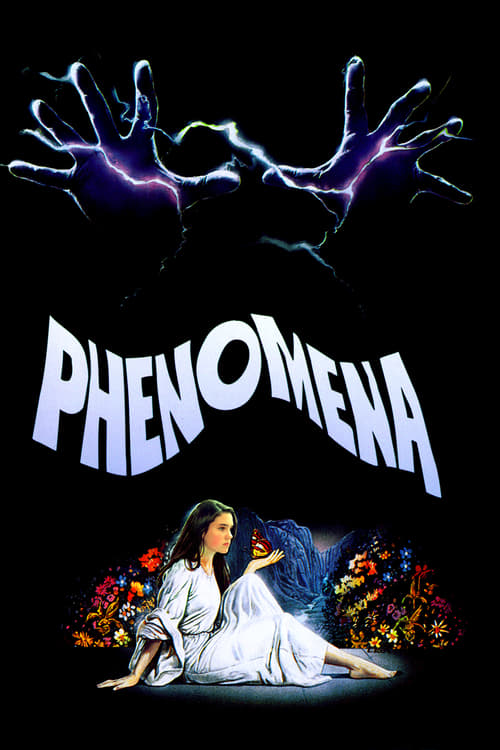
Phenomena
1985 · Dario Argento
For when you want horror that feels like a fever dream — strange, gorgeous, and unbound by good taste or strict logic. A challenge-and-delight pick for adventurous viewers, not a comfort watch.
What it's about
Jennifer, the teenage daughter of an American movie star, is sent to a strict girls' boarding school in the Swiss Alps while a serial killer murders young women in the surrounding valley. She sleepwalks, and she has an uncanny bond with insects — a gift that draws the attention of a wheelchair-using entomologist who realizes she could become a living instrument of forensic detection. Girl, scientist, chimpanzee assistant and a cloud of flies close in on the killer together.
The experience
Dreamlike and lurching — part murder mystery, part dark fairy tale, with alpine wind, sleepwalking sequences, and sudden eruptions of baroque violence set to heavy metal. It's beautiful and ridiculous in the same breath, and its final stretch goes to genuinely wild places.
Performances
A very young Jennifer Connelly anchors the delirium with grave, wide-eyed sincerity, playing the strangest material absolutely straight; Donald Pleasence brings warmth and gravity as the entomologist who believes in her.
The craft
Dario Argento shoots the Swiss landscape as an enchanted, hostile wonderland — gliding camerawork, insect's-eye views, and set pieces of operatic excess, with a score that swings from Goblin's eerie themes to blasts of metal. The sound and imagery are designed for immersion; it rewards a dark room and good speakers.
Why it matters
A cult touchstone of Italian horror that marked Argento at his most personal and unhinged, it introduced many viewers to Jennifer Connelly and has only grown in reputation as its fairy-tale strangeness came to look visionary rather than sloppy.
Snapshot
Phenomena is Dario Argento's strangest and most openly fairy-tale-like horror film. It sits between the delirium of his supernatural "Three Mothers" films and the hard-edged giallo murder mysteries that made his name. Jennifer Corvino (Jennifer Connelly), the teenage daughter of an American film star, arrives at a girls' boarding school in a remote part of Switzerland. A serial killer has been murdering young women in the area. Jennifer sleepwalks, and she has an unexplained bond with insects. A wheelchair-bound Scottish entomologist, John McGregor (Donald Pleasence), looked after by a chimpanzee named Inga, sees in her a living version of the forensic entomology he practises. Insects become the means of solving the case. The film combines the procedural logic of the giallo, a supernatural innocence story close to Alice in Wonderland, and some of the most extreme gross-out imagery in Argento's work, with a soundtrack that cuts Goblin's synthesiser prog against 1980s heavy metal. It has been both derided and loved as one of the oddest major Italian horror films of the decade. It survives in several versions: an integral Italian cut of nearly two hours, a shorter international English-language version, and a heavily cut US release titled Creepers.
Industry & production
Phenomena came at a time when Argento was producing his own films. It was made under his production banner and released in Italy by Titanus. The Italian popular cinema around it was shrinking fast: domestic attendance was collapsing, television had taken over much of the audience, and genre filmmaking was moving towards cheap direct-to-video work and co-productions aimed at foreign markets. Argento was one of the few Italian genre directors who could still raise substantial budgets and get international distribution. Phenomena is a relatively lavish production for Italian horror of the mid-1980s, with Swiss location work and interiors built and shot in Rome.
Casting shows the international reach. Jennifer Connelly had just appeared in Sergio Leone's Once Upon a Time in America (1984) and was cast as the American lead. Donald Pleasence was internationally recognisable from Halloween (1978) and its successors. Daria Nicolodi, Argento's long-time partner and collaborator, plays Frau Brückner, the school's supervisor. Dalila Di Lazzaro plays the headmistress and Patrick Bauchau plays Inspector Geiger. Argento's young daughter Fiore Argento plays the first victim in the opening sequence. Michele Soavi, who was becoming Argento's protégé, worked on the production as assistant director, and the shoot was part of his training before his own directing career began.
The film was shot in English with an international cast, which was standard practice in Italy, and post-synchronised. Its US release through New Line Cinema as Creepers lost roughly half an hour, which damaged the film's mood and coherence and shaped its poor American reputation for years. Reliable box-office figures are not consistently documented in English-language sources. Contemporary accounts generally describe it as commercially successful in Italy, but this dossier does not give specific numbers.
Technology
The film's technical ambitions lie mainly in its effects and its moving camera. Sergio Stivaletti, who was emerging as the leading Italian makeup-effects artist of the period, supplied prosthetic and makeup effects. These include decaying corpses, a rotting severed head, a maggot-filled pit and the deformed killer revealed at the climax. Insect swarms were achieved with a mix of real insects, optical compositing and miniature or practical work. Some swarm shots show their seams, and the film's mix of real and optical flies has been criticised and defended in equal measure. The fireflies that guide Jennifer to evidence were produced with optical light effects.
Argento continued his habit of elaborate camera rigs. The film is known for gliding, wind-driven tracking and crane shots through the Swiss landscape and the school's corridors, and for subjective shots that suggest the movement of an insect. These sequences extend the technical bravura he developed in Tenebrae (1982), whose famous crane shot over a house had already shown his appetite for mechanically complex camera movement. The detailed specification of the rigs used on Phenomena is less firmly documented in the record than the results on screen.
Technique
Cinematography
Romano Albani, who had shot Argento's Inferno (1980), photographed the film. Phenomena drops the saturated primary colours of Suspiria and Inferno for a cooler, more naturalistic palette of alpine greens, blues and greys. This is broken up by bursts of stylisation: the blue-tinged night exteriors, the shimmering fireflies and the sickly glow of Frau Brückner's house in the final act. Wind is the visual motif. The Föhn, which the film presents as a warm wind blamed locally for madness, moves through trees and curtains, and the camera often seems to travel with it. Wide shots stress the isolation of the "Swiss Transylvania" setting. Close-ups of insects, maggots and Connelly's face set up a scale of intimacy and revulsion.
Editing
Franco Fraticelli, Argento's regular editor since the early 1970s, cut the film. The cutting follows two rhythms. The procedural and dialogue scenes are often loose, even meandering. The set pieces are built from sharp musical punctuation, abrupt cuts to graphic detail and sudden switches of soundtrack register. The opening murder, in which a tourist left behind by her bus is killed and her head crashes through a pane of glass before falling into a waterfall, is cut almost like a music-video sequence and sets the film's tone at once. The several release versions mean the film's pacing depends on which cut you see. The trimmed versions mostly lose exposition, atmosphere and the slower stretches with McGregor.
Mise-en-scène / staging
The staging works through fairy-tale archetypes: the boarding school as a cold institution, the stern female authorities, the kind old wise man in a wheelchair with his animal companion, the haunted house with a hidden room, and the heroine who sleepwalks between these places. The school recalls the Freiburg dance academy of Suspiria. The Brückner house, with its locked rooms, covered mirrors and underground pool of decomposing bodies and larvae, brings Argento's architectural horror to a peak of disgust. The finale moves from the house to a lake, where the threat changes once more. The narrative drifts by design between procedural, supernatural and grotesque modes, and the staging follows it.
Sound
The soundtrack is one of the film's most talked-about elements. Claudio Simonetti wrote the main theme. Goblin, by then essentially a reconfigured band, and Simon Boswell contributed further score cues, and Bill Wyman contributed music as well. Most strikingly, Argento put heavy metal tracks by Iron Maiden ("Flash of the Blade") and Motörhead ("Locomotive") over several violent set pieces. These cues are often judged jarring, even crass, but they show how deliberately Argento used popular music as aggression rather than illustration. The insect soundscape, buzzing and swarming, works as a second score. Wind sounds carry the Föhn motif. As was standard for Italian productions of the time, dialogue was post-synchronised, and this adds to the film's slightly unreal feel.
Performance
Jennifer Connelly, then about fourteen, gives the film its centre. Her stillness and unworldly composure suit a heroine more at home with insects than with people. Critics have often identified her guileless quality as essential to the fairy-tale register, and it anticipates her casting in Jim Henson's Labyrinth (1986). Donald Pleasence plays McGregor with warmth and melancholy, a rare benevolent father figure in Argento's work. Daria Nicolodi's Frau Brückner moves from officious to monstrous, and her final-act performance is broad and operatic. Inga the chimpanzee, whose loyalty to McGregor drives the climax, is one of the film's most remembered presences.
Narrative & dramatic mode
The narrative grafts a giallo investigation (serial murders, a detective, a clue-carrying object, the reveal of the killer's identity) onto a supernatural coming-of-age story. Jennifer's insect communication is never explained. It is simply treated as a gift, linked in the film to her purity and to sleepwalking. The structure is episodic. Exposition about forensic entomology, delivered by McGregor and supported by Inspector Geiger, gives the investigation a pseudo-scientific basis. The film is particularly interested in the insects that colonise corpses and how they can be used to work out the time of death.
The dramatic mode moves between whimsy, menace and grotesque escalation. The final act is a string of escalating shocks: a pit of corpses, a deformed child-killer, a boat attacked by swarming flies, a razor-wielding chimpanzee. Some viewers read the accumulation as incoherence. Others see it as a deliberate trip through nightmare logic. Like much of Argento's work, the film puts sensation and image ahead of narrative plausibility. Reading it as a dark fairy tale, rather than as a murder mystery, makes the best sense of its shape.
Genre & cycle
Phenomena belongs to the late phase of the Italian horror boom that ran from the 1960s to the 1980s. It combines two cycles Argento himself had defined. One is the giallo, which he reshaped with The Bird with the Crystal Plumage (1970) and Deep Red (1975). The other is the supernatural Gothic of Suspiria (1977) and Inferno (1980). It also fits the international cycle of "nature strikes back" and creepy-crawly horror, though it reverses that cycle's logic: here the insects are the heroine's allies. Its use of forensic entomology looks ahead to procedural crime fiction, where the field later became a familiar trope.
The film also sits inside the 1980s fashion for teenage heroines in horror. It shares its boarding-school setting and adolescent protagonist with Suspiria, but adds the decade's soundtrack-driven, youth-market sensibility. The heavy metal and the rock-video style of some sequences place it firmly in the mid-1980s.
Authorship & method
Dario Argento co-wrote, produced and directed the film. Phenomena is often described as one of his most personal films, and he has reportedly spoken of it with particular affection, though how he ranks it among his own work varies across interviews. His usual method is all here: the murder set piece treated as a choreographed spectacle, unconventional camera movement, a strong reliance on music, an investigator figure working out a puzzle, and an interest in perception and how it can be trusted. Unusually, the investigator is a child whose perception goes beyond the human.
Franco Ferrini co-wrote the screenplay. He worked with Argento on several films of the 1980s and later, including Opera (1987). The Argento–Ferrini partnership shaped the director's middle period.
Romano Albani (cinematography) had previously shot Inferno. Here he brings a more naturalistic, wind-and-light-based approach suited to the alpine setting.
Franco Fraticelli (editing) was a long-standing member of Argento's crew, and his continuity with the director runs across more than a decade of work.
Claudio Simonetti / Goblin, Simon Boswell, Bill Wyman (music) wrote the score, with licensed tracks by Iron Maiden and Motörhead alongside it. Simonetti's theme carries on the Goblin–Argento partnership that began with Deep Red.
Sergio Stivaletti (makeup and special effects) delivered some of his first major showcase work. He went on to become central to Italian horror effects in the later 1980s and 1990s.
Daria Nicolodi acts in the film and was a key creative presence in Argento's career; she co-wrote Suspiria. Her role here is as performer, and the record does not clearly show that she had a writing role on Phenomena.
Michele Soavi (assistant director) took experience from this production, and from Argento's other productions of the period, into his own directorial work.
Movement / national cinema
The film belongs to Italian cinema popolare, the industrial genre cinema of westerns, gialli, peplum, poliziotteschi and horror that ran parallel to the auteur art cinema of Fellini, Antonioni and Pasolini. By 1985 that popular cinema was in crisis. Phenomena is one of the last high-profile Italian horror productions aimed at the world market before the sector contracted sharply around the end of the decade.
It is also typical of the transnational habits of Italian genre cinema. The English-language shoot, the American and British leads, the Swiss setting and the mixed Italian, British and American music all reflect an industry that had long built its films to travel. The "Swiss Transylvania" setting carries on Argento's preference for northern European, Germanic settings, as in Suspiria's Freiburg. The national identity sits in the film's crew and methods more than in its geography.
Era / period
Phenomena came out in the mid-1980s. Horror worldwide was then dominated by the American slasher, by body-horror effects, and by the arrival of home video, which would reshape both the economics of Italian genre film and the way its films circulated abroad. Its MTV-influenced use of rock and metal reflects the era's mix of music video and cinema. Its gore effects place it in the same moment of competitive prosthetic escalation as American films of the period.
In Britain, the "video nasties" moral panic (1982–84) had recently hit Italian horror hard. Several Argento contemporaries had films prosecuted or banned, and Phenomena entered an international market wary of Italian gore. The release history of trimmed versions and the American Creepers cut reflects that commercial climate.
Themes
Communion with the non-human. The film's central idea is a sympathy between a human outcast and creatures that most people find disgusting. Insects, often coded as corruption and death, become guardians, guides and avengers. The chimpanzee Inga's loyalty extends the theme. Animals in Phenomena are more trustworthy than most of the adults.
Innocence and monstrosity. Jennifer's purity is set against the murderer's deformity, and both are children in a sense. The film links abnormality to persecution: Jennifer is mocked as a freak by her schoolmates, and the killer is a hidden, rejected child. Commentators have noted the uneasy ethics of a horror climax that uses physical deformity as its final shock.
Decay and the forensic gaze. Forensic entomology turns decomposition into knowledge. The film asks us to look at the rotting body as evidence, and in doing so collapses revulsion and investigation into one gesture. Argento's long-running interest in the unreliable look becomes here a meditation on reading what remains.
Abandoned daughters and absent fathers. Jennifer's famous father is absent. McGregor becomes a surrogate. The institutional mothers of the school are cold or murderous. This family pattern, with a predatory mother figure in particular, links the film to Argento's "Three Mothers" mythology and to his recurring dark maternity.
Sleepwalking and altered states. Jennifer's somnambulism and the madness-inducing wind make the film's world one of half-consciousness. The boundary between dream and waking, typical of Argento, becomes the narrative's means of travel.
Reception, canon & influence
Critical reception. Contemporary reception was mixed. The film is commonly reported as a commercial success in Italy, but English-language critics, who mostly met the cut Creepers version in the US, were often dismissive. Their objections were narrative incoherence, the jarring metal soundtrack and the excesses of the climax. Over the following decades, uncut home-video releases and the growth of serious critical writing on Argento and Italian horror led to substantial reappraisal. Many critics and fans now see the film as one of his most distinctive, lyrical and idiosyncratic works. Detractors still find it uneven, and its place in his canon is usually set below Deep Red and Suspiria. Critics regularly single out Connelly's performance as one of the best leads in Argento's filmography.
Influences on the film (backward). Phenomena draws heavily on Argento's own Suspiria: a young foreign girl at a sinister European academy, a hidden monstrous presence, and an investigation of the institution's secrets. Its fairy-tale register has been compared to Lewis Carroll's Alice in Wonderland and to the Grimm tradition. Argento has said that his interest in forensic entomology, and in how insects can reveal a time of death, fed into the premise. The heavy-metal-driven set pieces reflect the music-video aesthetic of the period. Its blend of investigation and the uncanny continues the giallo lineage from Mario Bava's The Girl Who Knew Too Much (1963) and Blood and Black Lace (1964), which Argento had reinvented. Beyond his own earlier films, specific sources are more a matter of critical inference than of documented statement.
Legacy (forward). Within Argento's career, Phenomena led directly to the more controlled set-piece cinema of Opera (1987), again co-written with Ferrini and again using metal over its violence. Michele Soavi's directing career, beginning with StageFright (1987) and continuing with The Church (1989) and The Sect (1991), grew out of his apprenticeship on Argento's productions of this period. The Sect in particular develops a similar uncanny logic involving animals. Stivaletti's work established him as a leading effects artist and later director of Italian horror. Connelly's casting in Labyrinth the following year continued her screen persona as a fairy-tale heroine.
More broadly, the film became a cult object in home-video and festival horror culture. Its restoration and reissue history, with several cuts, long-standing confusion over versions and later restorations of the integral Italian version, are part of the film's story in their own right. Later filmmakers and critics who draw on the Italian horror tradition often cite it as an example of horror that commits fully to dream logic and to images ahead of plot. Firm attributions of specific later films to its direct influence are scarce in the scholarly record, and its forward legacy is best described as part of Argento's wider influence on the stylised, music-driven horror cinema that followed.
Influences: the films it descends from and the films it influenced
- The Girl Who Knew Too Much (1963) — Sets up the plot Phenomena reuses: a young foreign woman abroad in Italy has a perception of murder that the authorities doubt, so the investigation runs on the reliability of what she sees.
- Blood and Black Lace (1964) — Bava's saturated, slowly built murder set pieces in a closed female institution (a fashion house) are the model for Argento's killings staged as choreographed spectacle inside the Swiss academy.
- The Birds (1963) — Ub Iwerks's composited swarms of coordinated attacking animals are the effects ancestor of Phenomena's optically printed fly swarms descending on the hidden house at the climax.
- Phase IV (1974) — Ken Middleham's macro photography of insects as an intelligent collective set the close-up insect imagery that Phenomena turns into subjective camera and insect POV.
- The Bird with the Crystal Plumage (1970) — Argento's first use of natural-science expertise as the forensic key (an ornithologist identifies a rare bird's call on a tape), which Phenomena widens into McGregor's forensic entomology.
- Four Flies on Grey Velvet (1971) — Its pseudo-scientific forensic gimmick (retinal optography of the victim's last image) prefigures the fly that leads Jennifer to the killer's lair, a scientific instrument used as a device to reveal the murderer.
- Carrie (1976) — An outcast schoolgirl's paranormal power, mocked by her peers, is released in a single climactic set piece. Phenomena reworks this in the dormitory humiliation scene, where Jennifer calls down the insect swarm.
- Suspiria (1977) — Phenomena directly reworks its structure: a foreign girl at a sinister European academy uncovers a hidden monstrous presence in a secret room, under an aggressive Goblin score.
- Inferno (1980) — Romano Albani's camera work and the scenes where cats and rats act as agents of death (the Kazanian drowning) are the direct forerunners of Phenomena's animals as executors of justice, shot by the same cinematographer.
- Tenebrae (1982) — The synth-rock score by Simonetti, Pignatelli and Morante after Goblin, set against wide, bright, clinical murder spaces, carries straight into Simonetti's Phenomena theme and its daylight horror.
- Opera (1987) — Ferrini and Argento return to metal laid over the murders, and the avenging insects become ravens, filmed with raven-POV camera rigs that develop Phenomena's subjective animal camera.
- StageFright (1987) — Soavi, Argento's assistant director on Phenomena, carries over the isolated-location stalking set pieces and the animal-headed killer (the owl mask) as his directing debut.
- The Sect (1991) — Co-written and produced by Argento, it extends Phenomena's uncanny animal logic: a ritual beetle crawls into the heroine's nostril, and animals act as occult intermediaries around a guileless woman.
- Candyman (1992) — Live bee swarms filmed on the actors (Tony Todd's bee-filled mouth) act as a supernatural familiar bound to the heroine, a practical-effects take on Phenomena's insects summoned by a woman.
- Innocence (2004) — An isolated girls' boarding school in the woods is shot as a dark fairy tale in naturalistic forest light, extending Phenomena's alpine academy as a Grimm-like threshold space for a girl's initiation.
- Amer (2009) — Builds giallo almost entirely out of a girl's extreme sensory perception in near-wordless, music-driven set pieces, the images-before-plot dream logic that Phenomena fully commits to.
- Shallow Grave (1994) — Direct collaborator lineage — Simon Boswell scored it, and imports the giallo idiom of stabbing string clusters over pulsing synth ostinato, music that announces a murder set-piece as spectacle rather than accompanying it as tragedy.
- Demons (1985) — Produced by Argento the same year with the same toolkit: Stivaletti's prosthetic transformations, a Simonetti score and licensed heavy-metal tracks cut as music-video carnage.
Similar films
- Opera (1987) — influence & lineage
- Suspiria (1977) — influence & lineage
- The Bird with the Crystal Plumage (1970) — influence & lineage
- Deep Red (1975) — shared sensibility
- Santa Sangre (1989) — shared sensibility
- Perfect Blue (1998) — shared sensibility
- Malignant (2021) — shared sensibility
- A Nightmare on Elm Street (1984) — shared sensibility