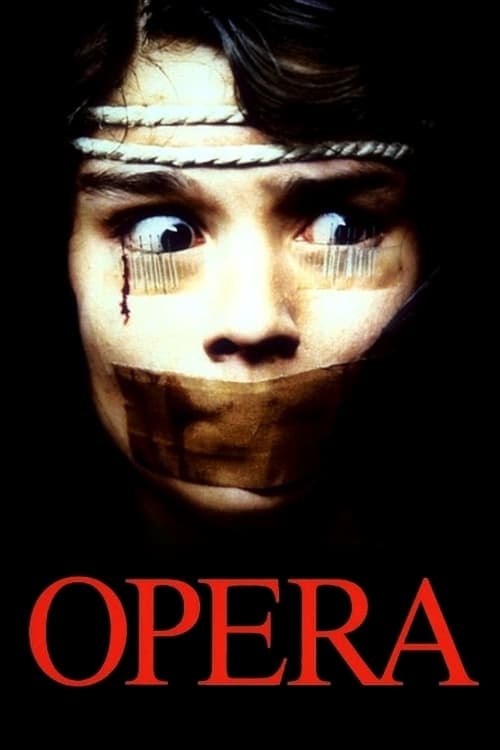
Opera
1987 · Dario Argento
For when you want horror as pure style — a lush, vicious thriller to put on loud with the lights off. This is a challenge watch for viewers who want to be dazzled and rattled, not soothed.
What it's about
Betty, a young understudy, is thrust into the lead of an avant-garde staging of Verdi's Macbeth after the star is injured — and a hooded killer begins murdering the people around her. Each time he strikes, he binds her and tapes rows of needles beneath her eyes so she cannot look away, forcing her to witness everything. A backstage whodunit unfolds inside an opera house that seems as cursed as the play itself.
The experience
Cold, virtuosic and genuinely cruel — the suspense sequences are engineered to make you feel the heroine's forced watching in your own eyes. Swooping camerawork, ravens, opera and sudden brutal violence combine into something closer to nightmare than mystery, elegant and punishing at once.
The craft
Dario Argento's camera is the star: it flies through the opera house, rides a raven's point of view, and stages one of the most famous slow-motion moments in horror. The sound design whipsaws between Verdi and slashing metal, and the needles-under-the-eyes device is an unforgettable image of forced spectatorship — this one demands a big screen and serious speakers.
Why it matters
Widely regarded as the last great giallo of Argento's peak and a summation of the genre's obsession with watching, it closed out the classic Italian thriller era and remains a reference point for stylized murder set pieces.
Snapshot
Opera (released in some English-language markets as Terror at the Opera) is Dario Argento's last major giallo of the 1980s. Many critics see it as the end of his most productive period. Betty, a young understudy, is thrust into the lead of an avant-garde production of Verdi's Macbeth after the star is hit by a car. A hooded killer then begins murdering the people around her. Each time, he ties her up and tapes a row of needles beneath her eyes so that she cannot close them without tearing her lids, and he forces her to watch. Argento takes the giallo's long fascination with looking and turns it into a literal device of torture. The film is at once a bravura showcase of camera movement, an essay on spectatorship and complicity, and a backstage melodrama about the "cursed" Scottish play. It was a prestige production for its maker, shot largely in Parma's Teatro Regio, and its international release was troubled. Its reputation has grown steadily since. It is now widely ranked alongside Deep Red, Suspiria and Tenebrae as one of Argento's essential works.
Industry & production
The film grew out of a failed project. In the mid-1980s Argento was invited to stage Verdi's Rigoletto for the opera festival at the Sferisterio in Macerata. According to most accounts, his proposed staging was considered too radical and the collaboration fell apart. He turned the experience into a screenplay, written with Franco Ferrini, his regular co-writer of the period (Phenomena, later Trauma). The script's fictional director, a horror filmmaker hired to modernise Macbeth and scorned by the opera establishment, is a thinly veiled self-portrait.
Argento produced through his own company, ADC, with financing from the Cecchi Gori group, one of the strongest Italian production and distribution powers of the decade. By most reports the budget was the largest he had worked with to that point. Reliable figures are hard to find, and this account does not cite one. Interiors and the performance sequences were shot at the Teatro Regio in Parma. The finale moves to an Alpine landscape in Switzerland.
The production is remembered as a difficult one. Vanessa Redgrave was announced for the role of the diva Mara Czekova and withdrew before shooting. As a result, the diva appears in the finished film only as a voice, a pair of legs and an off-screen tantrum. Argento's father, the producer Salvatore Argento, died during the period of production. Accounts by participants describe friction between Argento and his lead actress, Cristina Marsillach. These anecdotes come mostly from later interviews and are uneven in detail. Abroad, the film had a tortured release history. American rights went to Orion, which did not give it a significant theatrical release. It eventually reached US home video in a shortened version under the Terror at the Opera title. For years many English-speaking viewers knew it only in compromised form, until uncut home-video editions in the 2000s restored it.
Technology
Opera is a 35mm production. Its technical signature is its mobile camera rather than any novel format. The best-known example is a series of "raven's-eye" shots, in which the camera swoops over the stalls and wheels around the auditorium of the Teatro Regio. These required a rig that could carry a camera on fast, sweeping paths through a working opera house. Argento had pursued this kind of disembodied, motorised movement since Tenebrae's famous crane shot over the outside of a house. Opera pushes it further, letting the camera adopt the point of view of birds in flight. Exactly what equipment was used is not well documented in English-language sources.
The film also relies on practical effects for its extreme moments: the needle apparatus, a knife pushed up through a victim's jaw and out of his mouth, and a gunshot through a door's peephole. Live ravens were trained and filmed in the theatre, and the film relies heavily on them. Sound mixing mattered as much as the image. The track has to blend recorded operatic performance, heavy-metal cues and an amplified, subjective heartbeat-and-breath soundscape for the killer.
Technique
Cinematography
The cinematographer was Ronnie Taylor, a British veteran who had shared the Academy Award for Gandhi with Billy Williams. Taylor would go on to shoot Argento's The Phantom of the Opera (1998) and Sleepless (2001). His work on Opera trades the saturated primary colours of Suspiria for a cooler, more polished look. The palette is dominated by the theatre's gilt and red velvet, the steely blues and blacks of Betty's apartment, and the hard white light of the stage.
The camera is the film's most insistent presence. It prowls corridors in the killer's subjective view, plunges into extreme close-up on a pulsing brain (the killer's agitation is rendered as a literal, beating organ), and soars over the audience as a raven. Very large close-ups of Betty's eye, held open by needles, become the film's signature image. Argento also returns to his trick of hiding crucial information in plain sight. The opening shot shows the stage reflected in a raven's eye, and that announces the film's theme at once: seeing, being seen, and the eye as a mirror.
Editing
Franco Fraticelli, a long-standing Argento editor, cut the film. The cutting alternates long, gliding takes with violent bursts of fragmentation. The murders are built from close details: the needles, the tape, the twitch of an eyelid, a blade, a hand. The cuts are timed to the pounding metal score, so each kill plays almost like a music video, which was a deliberate and much-discussed choice in 1987. The most praised set piece is the peephole killing of Betty's agent Mira. Its suspense comes from cross-cutting and from the slow escalation of who is behind which door. The death itself is a single shock cut, with the bullet travelling through the peephole and through Mira's eye in apparent slow motion.
Mise-en-scène / staging
The Teatro Regio is used as a labyrinth. The film moves through stage, fly-tower, boxes, dressing rooms and workshops, and through the backstage tunnels behind them. The fictional Macbeth production, with live ravens, a modern-dress design and stark lighting, is staged as both Argento's riposte to the opera world and a stand-in for his own cinema. Betty's apartment is a cold, modern space of glass and doors. It is staged so that every threshold, including the peephole, the air vent and the ventilation ducts through which a child guides her escape, becomes a place for looking or for hiding.
The climax returns to the theatre. The ravens are released over the audience to find the man who killed their fellows, and they tear at his eye. This is the film's most explicit image of revenge by gaze. The coda shifts abruptly to a sunlit Alpine meadow, and that change of setting has divided viewers ever since.
Sound
The score is a deliberate collage. It sets excerpts from opera repertoire against an original score and a group of heavy-metal tracks. The opera material centres on Verdi's Macbeth and also draws on other Italian repertoire, including Verdi, Puccini and Bellini. The original music is by Claudio Simonetti (formerly of Goblin), with contributions from Brian Eno and Roger Eno and from Bill Wyman with Terry Taylor. The metal cues are by bands including Gow and Steel Grave.
The metal mostly bursts in during the killings, a choice that many critics at the time and since have found jarring. Others defend it as a willed clash of high and low culture that mirrors the film's subject. In either reading, the soundtrack makes an argument: opera and splatter are both spectacles of excess and blood, and the film refuses to rank them. The killer's sections add an amplified heartbeat and a breathy, subjective sound.
Performance
Cristina Marsillach plays Betty as brittle, withdrawn and sexually wary. Some critics find the performance flat, and others find it eerily fitting for a heroine whose inner life the film keeps opaque. Ian Charleson, best known for Chariots of Fire, plays Marco, the horror director turned opera auteur, with a dry, self-mocking edge. It was one of his last film roles before his death in 1990. Urbano Barberini plays Inspector Santini. Daria Nicolodi, Argento's longtime partner and collaborator, plays Mira, Betty's agent. Their relationship was ending around this time, and commentators have often noted the bitter irony of the vicious death Argento wrote for her. Coralina Cataldi-Tassoni plays the costume mistress Giulia, and William McNamara plays the stage manager Stefano. Performances are uneven across the multinational, partly dubbed cast. That is typical of Italian co-productions of the period, in which voices and faces often did not originate together.
Narrative & dramatic mode
The structure is classic giallo. An unseen killer, a series of increasingly elaborate murders, an amateur investigator (Betty, with Marco's help), and a final unmasking tied to a buried trauma. Argento's emphasis is not on detection, however. Betty does almost no investigating; she is made to watch. The dramatic mode is ordeal and spectacle, and suspense depends on the audience waiting for the next set piece rather than on clues.
The resolution is famously excessive. The killer is unmasked in the theatre, apparently dies in a fire, then turns up alive in Switzerland for a second confrontation. Once again the theatre is the setting for violence. The backstory ties him to Betty's mother, who, it is revealed, involved him in sadistic murders years earlier. The Swiss coda, in which Betty kneels in the grass, frees a lizard and speaks in disjointed phrases about nature and about not being like her mother, is one of the most debated endings in Argento's work. It has been read as a breakdown, as a liberation and as an unresolved ambiguity. Argento has reportedly said the coda was cut in some releases; the shortened American version, for instance, ended earlier. It is the film's clearest break from the giallo's logic of closure.
Genre & cycle
Opera belongs to the late phase of the giallo, the Italian thriller-horror form that peaked in the early 1970s. Argento was largely responsible for that peak, after the success of The Bird with the Crystal Plumage (1970). By 1987 the cycle had faded. Opera is one of a handful of ambitious late entries, alongside Michele Soavi's StageFright (1987), which also stages a killer in a theatre and was made by a former Argento collaborator.
The film also sits within the long "Phantom" tradition of opera-house horror that descends from Gaston Leroux's novel and its film adaptations. Its obsessive fan and his stalking anticipate the celebrity-stalker thriller as well. Its graphic set pieces show an awareness of the American slasher cycle, though its preoccupation with the gaze sets it apart from most of that cycle.
Authorship & method
Opera is a highly personal film, and probably the most openly self-reflexive work of its director. Argento writes himself into the plot twice. Marco is the horror director scorned by high culture. The killer, who stages murders so that someone is forced to watch them, is a dark caricature of the director who demands the audience's gaze. The needles taped under Betty's eyes are often read as Argento's literalising of his own aesthetic. He has commented in interviews that the device came from his irritation at audiences covering their eyes during his films.
Key collaborators:
- Franco Ferrini (co-writer), Argento's main writing partner in this period.
- Ronnie Taylor (cinematography), who brought a slicker, more international polish.
- Franco Fraticelli (editing), a longtime Argento editor.
- Claudio Simonetti (music), continuing the Goblin connection, alongside the Enos, Wyman and the metal bands.
Daria Nicolodi's presence is also part of the film's authorial history, given her earlier role in shaping Suspiria and the Three Mothers cycle. As usual for Argento, the method puts set pieces first. Plot logic is subordinate to the designed sequence, and camera movement and sound carry the meaning.
Movement / national cinema
The film is a product of the Italian filone system, the popular genre cycles that sustained Italian commercial cinema from the 1960s through the early 1980s. It was made just as that system was collapsing. Theatrical attendance was falling sharply, commercial television was booming, and genre production was shifting toward cheaper, TV- and video-oriented work. In that context Opera is an act of defiance: a large-scale, technically ambitious genre picture from one of the few Italian genre directors with international recognition. It was backed by Cecchi Gori and shot in one of Italy's great opera houses. Its subject, a confrontation between popular horror and Italy's most prestigious national art form, gives that defiance a cultural edge.
Era / period
Opera is a late-1980s film in both its aesthetic and its industrial position. Its use of heavy metal, its glossy surfaces and its MTV-adjacent rhythms belong to the period, as does its passage into the international video market rather than theatres. It also marks the end of an era for its director. Argento's next films, the Romero collaboration Two Evil Eyes (1990) and the American-set Trauma (1993), were made largely outside the Italian industry. Critics often date his decline from about this point, which has given Opera a reputation as the last film of his "classic" period.
Themes
- The gaze and its violence. The needles turn spectatorship into a torment. Betty is made the audience for murders she cannot look away from, and the film plainly implicates its own viewers, who have paid to watch.
- High versus low culture. Opera, with its own tradition of murder, madness and blood, is set against splatter and metal. The film argues that the two are kin.
- Performance and possession. Betty's rise from understudy to star is entangled with the killer's need to own her. The diva is replaced, and the "curse" of Macbeth comes true.
- Inherited sin. The mother's sadism hangs over the daughter. Betty's final fragmented speech is about not repeating her.
- Eyes, birds and revenge. The ravens are witnesses who remember and avenge. The pecking-out of the killer's eye inverts the needle device.
- Self-portrait. Marco and the killer split Argento's authorial self in two: the misunderstood artist and the tyrant who stages spectacle.
Reception, canon & influence
Critical reception. Reviews in Italy were mixed, and box office was reportedly respectable but not spectacular; reliable figures are not readily available. Abroad, the film's critical life was limited at first by its lack of proper distribution. In English-language writing it was established mostly through genre criticism and fan publications. Maitland McDonagh's study Broken Mirrors/Broken Minds: The Dark Dreams of Dario Argento was important here, and so were critics such as Kim Newman. Uncut DVD and later Blu-ray editions consolidated its standing. Today it routinely appears in lists of Argento's best films and in canons of Italian horror. Critics still argue about its metal score, its uneven performances and its coda, but its set pieces are widely seen as among the most accomplished in Italian genre cinema.
Influences on the film. The plot draws on the Phantom of the Opera tradition and on the theatrical superstition around Macbeth. It draws on Hitchcock as well, especially the treatment of voyeurism and the concert-hall set piece in The Man Who Knew Too Much (1956), and Argento's career-long debt to Hitchcock is well documented. The film also builds on Argento's own giallo grammar from The Bird with the Crystal Plumage through Tenebrae. In addition it draws on his frustrated Rigoletto experience and on the contemporary aesthetics of the music video.
Legacy. The needles-taped-under-the-eyes image has become one of the most quoted icons of Italian horror and a shorthand for the giallo's obsession with the gaze. Argento himself returned to the opera house with The Phantom of the Opera (1998), again shot by Ronnie Taylor. The film is regularly cited in the 21st-century critical and artistic revival of the giallo. Filmmakers working in that neo-giallo vein, such as Hélène Cattet and Bruno Forzani (Amer, 2009), draw on the eye fetishism and sensory excess the film embodies, though direct attributions of influence should be treated cautiously. Within film studies, Opera has become a standard text for discussing spectatorship, horror's self-reflexivity and the meeting of high and popular culture in Italian cinema.
Influences: the films it descends from and the films it influenced
- Un Chien Andalou (1929) — Its razor-across-the-eye insert set up the extreme eye close-up as an attack on the viewer, which Opera turns into a whole film with its eyeball inserts and the threat of needles.
- The Phantom of the Opera (1925) — It established the opera house as a vertical labyrinth of boxes, flies, cellars and hidden passages, with an obsessed watcher stalking a young soprano, and Opera rebuilds that architecture around Betty.
- The Man Who Knew Too Much (1956) — In the Albert Hall sequence, violence is cut to the score of a live performance and the audience goes on watching without knowing, a model for Opera's murders timed to the opera and staged in the auditorium.
- Peeping Tom (1960) — Mark makes his victims watch their own deaths in a mirror mounted on his camera, the direct model for Opera's killer, who makes Betty watch by taping needles under her eyes.
- The Birds (1963) — Hitchcock shoots trained bird attacks from the birds' point of view and holds on a corpse with pecked-out eyes, and Opera's ravens repeat both: the raven's-eye crane flight over the auditorium and the attack on the killer's eye.
- Blood and Black Lace (1964) — Bava made each murder a separately designed, color-lit set piece with only a thin investigation linking them, the set-piece-first structure that Opera takes to its extreme.
- A Clockwork Orange (1971) — The Ludovico Technique's lid-locks, which hold Alex's eyes open while he is made to watch violence set to classical music, are the closest precedent for Opera's needles under Betty's eyes.
- Deep Red (1975) — Its gloved-killer POV, its prog-rock score by Goblin played against murder and its opening in a theatre all form the grammar that Opera, scored partly by Simonetti, carries over into an opera house.
- Tenebrae (1982) — Argento's first open self-portrait, a genre author accused of inspiring violence, combined with the Louma-crane shot that travels over a house's façade, which leads straight to Opera's double portrait of Marco and the killer and its crane flights through the auditorium.
- Phenomena (1985) — Here Argento first set heavy metal (Iron Maiden, Motörhead) against Goblin and Simonetti scoring during violent scenes, the collision of musical registers that Opera pushes into opera-versus-metal.
- Phantom of the Paradise (1974) — De Palma's Phantom story set in rock opera crashes popular music into the operatic tradition and uses split-screen and voyeur set pieces, a precursor to Opera's clash of high and low culture in sound and image.
- The Stendhal Syndrome (1996) — Argento extends Opera's link between high art and violence by having paintings in the Uffizi trigger a subjective, hallucinatory crisis, again a heroine forced into a traumatic act of looking.
- The Phantom of the Opera (1998) — Argento returns to the opera-house labyrinth with Ronnie Taylor again as cinematographer, making explicit the Phantom source that Opera had kept beneath its plot.
- Amer (2009) — It builds a whole film out of Opera's macro eye inserts, peephole framings and amplified bodily sound, keeping the giallo's sensory set pieces and dropping its plot.
- Black Swan (2010) — An understudy is pushed into a starring role in a canonical high-art production and suffers a physical and perceptual ordeal backstage, the plot of Opera transposed to ballet with mirrored and subjective camerawork.
- Berberian Sound Studio (2012) — Set inside the making of a 1970s Italian horror film, it makes the giallo's sound design and the complicity of its craftsmen its subject, the self-reflexive turn Opera took through Marco and the killer.
- Demons (1985) — Produced and co-written by Argento, it turns a sealed cinema audience into victims of the horror they paid to see and plays metal tracks over the carnage, the same spectator-complicity premise and needle-drop scoring as Opera.
- StageFright (1987) — Soavi was Argento's assistant director, and his film is Opera's contemporary twin: a performance space locked down as a labyrinth, a killer who turns the rehearsal into a staged tableau, and a bird motif (the owl mask) that echoes Opera's ravens.
Similar films
- Deep Red (1975) — influence & lineage
- Blood and Black Lace (1964) — influence & lineage
- Phenomena (1985) — influence & lineage
- Suspiria (1977) — shared sensibility
- The Bird with the Crystal Plumage (1970) — shared sensibility
- Dressed to Kill (1980) — shared sensibility
- Salò, or the 120 Days of Sodom (1976) — shared sensibility
- Audition (2000) — shared sensibility