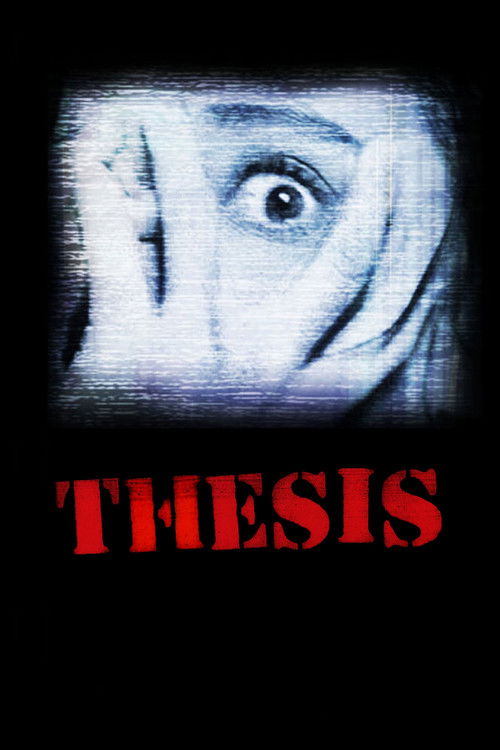
Thesis
1996 · Alejandro Amenábar
For when you're craving a real, serious-minded scare — a smart slow-burn to watch alone with the lights off, more unnerving than gory. A challenge, not a comfort.
What it's about
Ángela, a film student in Madrid writing her thesis on audiovisual violence, gets hold of a videotape that turns out to be a snuff film — a real murder, recorded. Worse: the victim was a student at her own university, and whoever made the tape is still close by. Her investigation, alongside a horror-obsessed classmate she isn't sure she can trust, pulls her deeper into the school's corridors and archives, and into her own uneasy urge to keep watching.
The experience
Cold-sweat suspense that gets under your skin precisely because it shows so little — the dread lives in sounds, dark hallways and faces lit by a screen. It's the kind of thriller that makes you paranoid about every character and a little uncomfortable with yourself for leaning in.
The craft
Alejandro Amenábar wrote, directed and scored it in his early twenties, and the discipline is startling: the cruelest moments happen off-frame, with sound design and the flicker on a watcher's face doing the damage. Watch it with good speakers in the dark — the film weaponizes what you hear over what you see.
Why it matters
It swept Spain's Goya awards including Best Film, launched Amenábar toward Open Your Eyes and The Others, and helped ignite the Spanish thriller boom that followed. Its question — why do we watch? — has only gotten sharper.
Alejandro Amenábar was in his early twenties, still a film student, when he wrote, directed, and scored this thriller set inside the very Madrid film faculty he attended — and it promptly swept the Goyas, taking Best Film and announcing Spanish genre cinema's most precocious new voice. A student researching audiovisual violence stumbles onto a snuff tape, and the investigation that follows doubles as an interrogation of everyone watching: why do we lean toward the screen when we should look away? Amenábar stages his cruelest moments off-frame, letting sound and the flicker on a viewer's face do the damage — a discipline that makes the film more unnerving than any explicit rival. Its paranoid corridors and dead-eyed cinephilia anticipate both his own Open Your Eyes and The Others and the broader Spanish thriller boom that followed. Three decades on, its central question — about the appetite that connects the killer's camera to the audience's eye — has only grown sharper in an era when atrocity streams on demand.
A Deleuzian reading
A face in the dark, lit by a monitor we are never shown.
The full Deleuzian reading of Thesis →
Reception
A modest film-student debut that stunned Spain by sweeping the 1997 Goyas, it stayed a mostly local treasure for years — now it's been rediscovered internationally as an eerily prescient thriller about screen violence, arguably ahead of the internet gore-site era it seemed to predict.
How Thesis was received, from release to now →
Influences: the films it descends from and the films it influenced
- Peeping Tom (1960) — Establishes the camera-as-murder-weapon device in which the killer films his victims' terror, making the audience's hunger for filmed death the actual subject — the exact indictment of spectatorship Amenábar rebuilds around a snuff tape.
- Rear Window (1954) — Converts pure voyeurism into an investigation plot, assembling a murder from watched fragments while implicating the spectator's own looking — the watcher-as-detective structure Ángela inherits.
- Psycho (1960) — Codifies staging atrocity through montage and sound rather than depiction (the shower scene), plus the terrified reaction shot as the real image of violence — Amenábar's off-frame grammar descends directly from it.
- M (1931) — Foundational grammar of implied atrocity through absence — the child's murder rendered only by the abandoned ball and drifting balloon — the off-frame-violence technique Tesis leans on entirely.
- Blow-Up (1966) — Introduces investigation-by-replaying-recorded-media, where a crime surfaces only through obsessive re-examination of captured images — the mechanism by which Ángela and Chema decode the tape.
- Blow Out (1981) — A media technician uncovers murder buried in his own recordings, foregrounding sound as the carrier of implied atrocity — the sonic-evidence method Tesis uses when the scream is heard before anything is seen.
- Videodrome (1983) — Frames media violence as an appetite that feeds on and reshapes the viewer via snuff broadcast — the 'appetite-for-violence' thesis Amenábar dramatizes literally through a film-school investigation.
- Cannibal Holocaust (1980) — Found atrocity footage that turns the accusation outward, asking whether the audience craves the violence it claims to condemn — the spectatorship-complicity argument at the heart of Tesis.
- Henry: Portrait of a Serial Killer (1986) — Stages the watched-watching structure — killers replaying their own camcorder home-invasion footage as spectators — the recursive snuff-tape viewing Amenábar builds a mystery around.
- Benny's Video (1992) — A teenager desensitized by endlessly replayed recorded death, foregrounding media violence and the watched killing — the same tape-mediated numbness Tesis interrogates.
- Who Can Kill a Child? (1976) — Takes the seed's most argued-over gesture — the found atrocity footage — and makes the ethics of watching it the entire plot, turning the prologue's implication of the viewer into a thriller mechanism.
- 8mm (1999) — Builds the same snuff-film-mystery investigation plot — an ordinary seeker drawn into verifying whether a filmed death is real — the exact genre engine Tesis pioneered three years earlier.
- The Others (2001) — Matures the Amenábar restraint aesthetic — dread built from sound and the deliberately unshown — into a full horror grammar first tested in Tesis's off-frame atrocities.
- Caché (2005) — Turns surveillance/videotape footage into an accusation aimed at the viewer, advancing spectatorship-as-complicity into the anonymous-recording thriller that Tesis prefigured.
- The Silence of the Lambs (1991) — Places a lone young investigator descending into a predator's world with POV and reaction-shot proximity while keeping the worst off-frame — the protagonist template and restraint Tesis mirrors.
- Scream (1996) — Same-year self-reflexive horror that weaponizes cinephile literacy, making film knowledge the plot's machinery — the meta, media-critique register Tesis runs in parallel.
- Funny Games (1997) — Directly indicts the viewer's appetite for on-screen violence, keeping the killings off-frame while accusing the spectator — the complicity argument Amenábar makes a year earlier in narrative form.
- Open Your Eyes (1997) — Extends Amenábar's writer-director-composer control and unreliable-spectator subjectivity into the following year, refining the immersive-scoring and reaction-driven suspense method debuted in Tesis.
Similar films
- Open Your Eyes (1997) — influence & lineage
- The Others (2001) — influence & lineage
- Caché (2005) — influence & lineage
- The Silence of the Lambs (1991) — influence & lineage
- Funny Games (1997) — influence & lineage
- Amores Perros (2000) — often watched together
- Close Your Eyes (2023) — shared sensibility
- Violet Perfume: Nobody Hears You (2001) — shared sensibility
All the films related to Thesis →
Watch it with: curated runs of related films
- The Killer You Can't Look Away From — A run of murder mysteries where obsession — the witness's, the investigator's, the killer's own — curdles into pure style, from the gloved-hand giallo that invented the look to the modern heirs still working the vein.