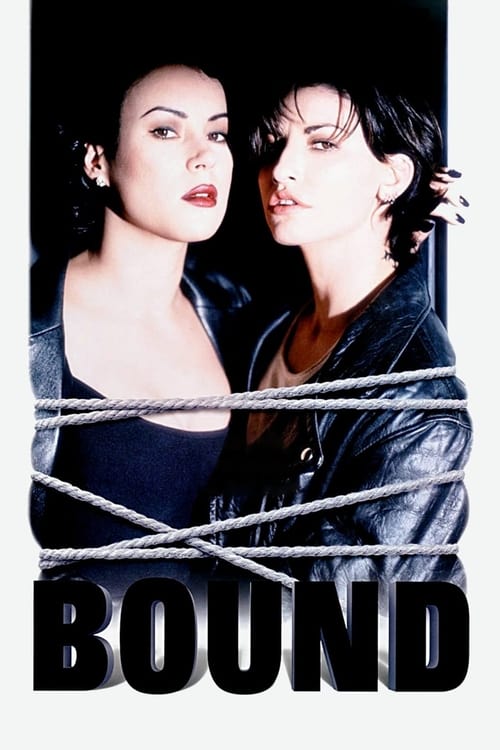
Bound
1996 · Lana Wachowski
For when you want a sexy, nasty, airtight thriller for a late night in — something stylish you can devour in one sitting and immediately want to recommend.
What it's about
Corky, a tough ex-con working as a handywoman in a Chicago apartment building, meets the couple next door: Caesar, a paranoid mob money-launderer, and Violet, his girlfriend, who wants out. The attraction between the two women is instant — and soon they're plotting to steal two million dollars of mob money and make Caesar take the fall. Nearly everything unfolds inside two adjacent apartments, where one wrong sound can get everyone killed.
The experience
Sleek, wicked and coiled tight — a thriller that turns thin walls and a briefcase of cash into pure suspense, with a streak of dark humor and real heat between its leads. Once the plan is in motion, it plays like a held breath.
Performances
Gina Gershon and Jennifer Tilly are electric together — Gershon all wary swagger, Tilly weaponizing her breathy voice into something far smarter than anyone in the room assumes. Joe Pantoliano's twitchy, sweating Caesar is a great portrait of a small man unraveling.
The craft
The Wachowskis' debut is almost indecently assured: Bill Pope's camera slinks through walls and follows phone cords like a co-conspirator, and the mechanics of the heist click together with Swiss precision. The confined setting becomes an asset — every creak and doorbell lands like a gunshot. The filmmakers brought in writer Susie Bright to get the intimacy right, and it shows.
Why it matters
A landmark for putting a lesbian love story at the engine of an American genre picture — not as subtext or tragedy — years before that was common, and the calling card that got the Wachowskis The Matrix. Its stature as a foundational queer noir has only grown.
Before The Matrix, the Wachowskis made this: a lean, wicked neo-noir set almost entirely in two adjacent Chicago apartments, where an ex-con handywoman and a mobster's girlfriend plot to lift two million dollars from the mob and pin it on the man who thinks he owns them both. As a debut it is almost indecently assured — Bill Pope's camera slinks through walls and follows phone cords like a co-conspirator, and the plumbing of the heist clicks together with Swiss precision. What made it a landmark was its center: a lesbian love story played by Gina Gershon and Jennifer Tilly not as subtext or tragedy but as the engine of the plot, with writer Susie Bright consulted to get the intimacy right. In 1996 that was nearly unprecedented in an American genre picture, and the film has only grown in stature as a foundational text of queer noir — and, in retrospect, as the Wachowskis' first story about escaping a controlling system built by violent men. Joe Pantoliano's Caesar, sweating and scheming, remains one of the great small-time hoods of the nineties.
A Deleuzian reading
A camera goes down a telephone cord.
The full Deleuzian reading of Bound →
Reception
A modest indie hit in 1996 that some dismissed as a steamy noir exercise, Bound was fully reclaimed after the Wachowskis came out as trans women — what once read to skeptics as male-gaze titillation is now celebrated as one of the most authentic queer thrillers of the '90s.
How Bound was received, from release to now →
Influences: the films it descends from and the films it influenced
- Basic Instinct (1992) — Queers and reclaims the neo-noir femme fatale that Basic Instinct's bisexual scheming had been protested for, extending the gliding-camera, double-cross erotic-thriller craft with self-aware authorship.
- Double Indemnity (1944) — Establishes the noir template Bound queers wholesale: a scheming lover and a partner conspiring to murder a controlling man for money, with the crime's precise clockwork and the femme-fatale voice driving the plot.
- The Postman Always Rings Twice (1946) — Supplies the adulterous-couple-plots-to-kill-the-proprietor engine and the sweaty erotic charge between conspirators that Bound reroutes through Corky and Violet.
- Rope (1948) — Model for wringing suspense from a single confined apartment and a body-disposal problem, forcing tension entirely out of who-knows-what within four walls.
- Gun Crazy (1950) — Prototype of the lovers-on-the-run couple who fuse desire and crime, treating the romantic bond itself as the getaway plan.
- The Evil Dead (1981) — Direct source of the Wachowskis' virtuoso low-budget 'roving camera' — the swooping, object-hugging, wall-piercing moves (down a phone cord, through paint) learned from Raimi, who produced Bound-adjacent Wachowski scripts and mentored their kinetic grammar.
- Body Heat (1981) — Reintroduces the explicit neo-noir femme fatale who seduces an accomplice into a lethal scheme, the erotic-thriller register Bound inherits and subverts.
- Blood Simple (1984) — The Coens' precision-plotted, confined neo-noir of double-crosses and mislaid money — the tight cause-and-effect machinery and dark comic bloodletting the Wachowskis openly emulate.
- The Grifters (1990) — Jim Thompson–derived con-artist noir of layered betrayals where every character is running a scheme, sharpening the double-cross-upon-double-cross structure Bound perfects.
- Reservoir Dogs (1992) — Sibling in mid-90s indie crime staging: a nearly single-location standoff, mob-money paranoia, and stylized off-screen/threatened violence played for suspense (Pantoliano's Caesar is cut from the same jittery-heist cloth).
- The Last Seduction (1994) — Peak-90s neo-noir built on a woman weaponizing a lover to outmaneuver dangerous men and walk away with the cash — the femme-fatale-as-mastermind Bound genders anew.
- Set It Off (1996) — Contemporary sibling: women executing a heist to escape a controlling economic system, foregrounding queer desire (Queen Latifah) inside a crime plot the same year Bound does.
- Wild Things (1998) — Descendant erotic-thriller whose engine is queer/bisexual desire fueling a cascade of financial double-crosses — the 'who's really conning whom' twist architecture Bound popularized.
Similar films
- The Matrix (1999) — influence & lineage
- Reservoir Dogs (1992) — influence & lineage
- Double Indemnity (1944) — influence & lineage · often watched together
- sex, lies, and videotape (1989) — often watched together
- Girl, Interrupted (1999) — often watched together
- Point Blank (1967) — often watched together
- The Handmaiden (2016) — shared sensibility
- Working Girls (1987) — shared sensibility
All the films related to Bound →