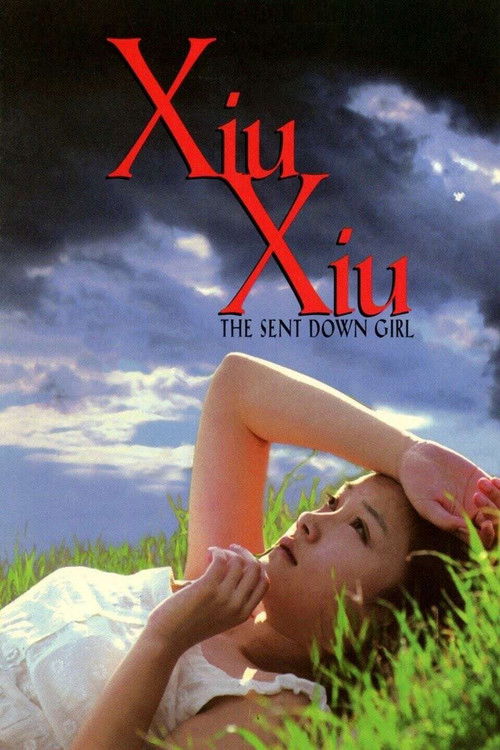
Xiu Xiu: The Sent-Down Girl
1998 · Joan Chen
For when you're ready to be wrecked by a film and want the kind of tragedy that's earned, not manipulative. This is a challenge pick — reach for it when you have the emotional room.
What it's about
China, 1975, in the last years of the Cultural Revolution: a fifteen-year-old girl from Chengdu is 'sent down' from the city to the remote Sichuan grasslands for manual labor, then posted even farther out to learn horse-herding from Lao Jin, a solitary, gentle Tibetan herdsman who becomes her quiet protector. As the promised transfer back home keeps receding, she begins bargaining with the men who claim they can get her papers signed — and the cost of hoping keeps rising.
The experience
Spare, achingly beautiful, and devastating — the vast open landscape only sharpens how trapped she is. It's a slow, quiet film that ends up hitting with tremendous force; it will sit heavily with you afterward.
Performances
Lu Lu is piercing as Xiu Xiu, tracking a girl's brightness dimming almost imperceptibly, and Lopsang gives Lao Jin a wordless tenderness that becomes the film's broken heart.
The craft
Joan Chen's directorial debut is remarkably assured: she and writer Yan Geling adapt Yan's own novella with total restraint, letting silence and the immense plateau landscapes do the talking. The cinematography turns the grasslands into something both ravishing and pitiless.
Why it matters
A courageous reckoning with the 'sent-down youth' campaign — subject matter that got the film banned in China — it announced Joan Chen as a serious filmmaker beyond her acting career.
Snapshot
Xiu Xiu: The Sent-Down Girl is Joan Chen's directorial debut, a spare, devastating tragedy set against the "sent-down youth" (xiaxiang) campaign of the late Cultural Revolution. A fifteen-year-old city girl, Wen Xiu — nicknamed Xiu Xiu — is dispatched from Chengdu to the high grasslands of the Sichuan-Tibetan plateau in 1975 for manual labor, then reassigned to learn horse-herding under Lao Jin, a solitary Tibetan herdsman who has been castrated and thus can offer her only a chaste, protective devotion. As the promise of a return home recedes, Xiu Xiu begins trading her body to a succession of men who claim influence over the transfer papers that never come. The film moves inexorably toward ruin. Adapted by Chen and the writer Yan Geling from Yan's own novella, and photographed by the veteran cinematographer Lü Yue, the picture is at once an intimate coming-of-age story and a controlled indictment of a system that treats a young life as disposable. It was shot in China without official sanction, banned there, and went on to sweep the Golden Horse Awards in Taiwan — a trajectory that has shaped both its reputation and the circumstances of its making.
Industry & production
The film sits at the intersection of the Chinese diaspora and independent American art-house financing. Joan Chen — born in Shanghai, a star of Chinese cinema in the 1980s before emigrating and building a Hollywood career (The Last Emperor, Twin Peaks) — mounted the project as a first-time director working largely outside the official Chinese studio system. That decision is the central production fact of the film. The story's subject matter (the human cost of a state campaign, sexual exploitation tied to Party privilege) was politically unwelcome, and the production proceeded on the remote plateau without the approvals ordinarily required to film in China.
The consequences were significant and are among the best-documented facts about the picture: after the film's completion and its success abroad, Chen was penalized by Chinese authorities, reported to have been fined and barred from directing in China for a period, and the film itself was banned from domestic exhibition. The exact terms of the sanction vary across secondary accounts, so precise figures should be treated cautiously; what is firm is that the film was made in defiance of the official apparatus and that Chen paid a professional cost for it.
The screenplay derives from Yan Geling's novella — variously rendered in English as "Tian Yu" or "Celestial Bath" — with Yan and Chen sharing the adaptation credit. The film was completed for the international festival and specialty-theatrical market rather than the Chinese box office it could never reach; it received U.S. distribution in the specialty circuit (through Stratosphere Entertainment). Reliable box-office figures are thin, and given the ban and the art-house release pattern, its commercial footprint was modest by design. The picture's economic logic was reputational and festival-driven, not theatrical scale.
Technology
Xiu Xiu is a late-1990s photochemical production, shot on 35mm film and finished by conventional means; there is no meaningful digital-imaging story to tell here, and it would be an invention to claim one. The salient technological reality is instead environmental and logistical: the film was made on location at high altitude on the Tibetan plateau, where thin air, cold, wind, and extreme, fast-changing natural light impose their own discipline on any celluloid production. The photography works with available daylight and the vast luminance range of open grassland under big sky — conditions that reward exposure judgment and film stock's tonal latitude rather than any special apparatus. Where the record does not specify the exact camera package or stock, this dossier does not guess. What matters is that the film's look is a product of location and light management on film, not of technological novelty.
Technique
Cinematography
Lü Yue's photography is the film's most immediately distinguished craft element, and it carries much of its meaning. Lü — already established through his work with Zhang Yimou on To Live and Shanghai Silk / Shanghai Triad — brings a landscape sensibility that sets the enormity of the grassland against the smallness of the girl inside it. The wide, open plateau reads as both beautiful and carceral: there is nowhere to go, and the horizon that ought to signify freedom instead measures Xiu Xiu's isolation. The film repeatedly frames the single tent, the two figures, and the herd as tiny incidents in an overwhelming space. As Xiu Xiu's situation degrades, the imagery grows more enclosed and the earlier grandeur curdles. The contrast between the sublime setting and the squalid transactions occurring within it is a deliberate visual argument, and it is Lü's compositions that make it.
Editing
The cutting, credited to Ruby Yang, favors observation over acceleration. The film's rhythm is patient — it lets scenes settle so that the passage of seasons and the erosion of hope register as duration rather than plot. The tragedy accrues through accumulation: repeated arrivals of men, repeated deferrals of the transfer that never arrives. The editing supports this structure of repetition-with-decline, allowing the viewer to feel the mechanism closing. (Ruby Yang would later become widely known as a documentarian; her sensibility for real time and human process is legible in the film's measured assembly.)
Mise-en-scène / staging
The staging is built on radical spatial and social contrast: the crowded, slogan-saturated collective world Xiu Xiu comes from versus the near-empty two-person world of the tent. The single tent becomes the film's essential set — a space that is at first a site of unlikely tenderness between Xiu Xiu and Lao Jin and later the stage for her exploitation. Period detail (the sent-down youth's uniform of the era, the props of collective life, the herding gear) is handled for authenticity rather than nostalgia. The staging of the men's visits is calibrated so that the abuse is legible without being spectacularized; the camera's distance and the plainness of the setting make the transactions more, not less, unbearable.
Sound
The soundscape leans on the plateau itself — wind, weather, the animals, the vast silence of a place far from the collective's loudspeakers. Against this, moments of human voice and music become charged. The film is narrated in retrospect (framed from the perspective of a young man who knew Xiu Xiu), and the voice-over lends the events an elegiac, already-lost quality. On the specifics of the sound mix and the music score, the readily verifiable record is comparatively thin; the film did receive craft recognition at the Golden Horse Awards, but this dossier will not attach a composer's name or score description it cannot confirm.
Performance
The film rests on two performances of very different registers. Lu Lu (Li Xiaolu), in the title role, must chart Xiu Xiu's passage from a bright, hopeful adolescent to a hollowed young woman, and she does so with a transparency that makes the descent almost unwatchable in the intended way; her work was honored with the Golden Horse Best Actress award. Lopsang, as Lao Jin, gives the film its moral center: a man rendered powerless in the specific way that his castration allegorizes — able to love and protect but not to save — and his restrained, watchful presence is the counterweight to the men who visit. The dynamic between the two is the film's emotional spine, and both actors play it without sentimentality.
Narrative & dramatic mode
The dramatic mode is tragedy in a near-classical sense: a young protagonist destroyed by forces she cannot see the full shape of, her own choices (the desperate bargains for a ticket home) becoming the instruments of her ruin. The narration is retrospective and elegiac, framing the story as already-concluded and mourned, which removes suspense about outcome and redirects attention to how and why. The structure is one of steady deferral — each promised rescue proving false — so that hope functions as the trap. There is no redemptive turn; the film's power lies in its refusal to soften the ending. It is a coming-of-age story inverted into a coming-of-death.
Genre & cycle
The film belongs to the drama of the Cultural Revolution and its aftermath — a body of Chinese and diaspora filmmaking that reckons with the "scar" of the Mao years — while also functioning as a coming-of-age narrative and a chamber tragedy of two people in a landscape. It stands adjacent to the Fifth Generation's historical reckonings (the films of Zhang Yimou and Chen Kaige that used the recent past to examine individual suffering under political upheaval), sharing personnel with that world through cinematographer Lü Yue. But its diasporic authorship, its unofficial production, and its unusually direct treatment of sexual exploitation set it somewhat apart from the officially sanctioned historical epics of that cycle.
Authorship & method
This is fundamentally Joan Chen's film, and its interest is heightened by her transition from in-front-of-camera stardom to authorship behind it. Chen's method here is one of restraint and control — she resists melodrama in material that could easily tip into it, and she trusts landscape and duration to carry emotion. Her bicultural position (a Shanghai-trained star who became a Hollywood actor) informs both the film's access to Chinese material and its address to an international art-house audience.
Her key collaborators shape the result decisively. Yan Geling, the source author and co-screenwriter, supplies the literary architecture and the unsparing moral clarity of the story. Lü Yue, the cinematographer, imports the landscape-and-history visual grammar honed alongside Zhang Yimou. Ruby Yang, the editor, gives the film its patient, observational tempo. On the composer and full department heads, the confidently verifiable record is limited, and this dossier declines to assign credits it cannot substantiate. The through-line is that Chen assembled collaborators steeped in serious Chinese-language cinema and directed them toward a spare, uningratiating tragedy.
Movement / national cinema
Xiu Xiu is best understood as a diaspora work standing at the edge of mainland Chinese cinema rather than squarely within any single national movement. It draws on the Fifth Generation's practice of using the recent past to examine the individual — and shares crew with it — yet it was made outside the mainland's official channels, financed and completed for the international market, and banned domestically. It is simultaneously a Chinese-language film about Chinese history and an American-facilitated independent production, and it circulated through Taiwan's award culture (the Golden Horse Awards) and Western festivals and art houses. That in-between status is central to its identity.
Era / period
The film depicts 1975 and its immediate surround — the twilight of the Cultural Revolution and the sent-down youth (xiaxiang) campaign, under which millions of urban adolescents were relocated to the countryside for "re-education" through labor. Xiu Xiu's dispatch to the plateau and her longing for a transfer back to the city are period-specific realities of that program. The film was made two decades later, in the late 1990s, a moment when diaspora and mainland filmmakers alike were revisiting the Mao years — but doing so remained politically sensitive, as the film's ban attests. The gap between the depicted era and the era of production is part of the work's meaning: it is a reckoning made possible only from outside and after.
Themes
The film's governing theme is the destruction of the individual by an impersonal political machine — the way a bureaucratic campaign converts a hopeful girl into a body to be used and discarded. Sexual exploitation is treated as the concrete form that political power takes at the ground level: the men who abuse Xiu Xiu do so by dangling the very state permission that the state has withheld. Lao Jin's castration renders the film's central relationship an allegory of powerlessness — love that cannot protect, tenderness stripped of the capacity to rescue. Innocence and its ruin, the false promise of "return," the indifference of grand landscape to individual suffering, and the collision of the personal with the historical all run through the picture. It is also, quietly, a film about witness: the retrospective narration insists that this life be remembered rather than erased.
Reception, canon & influence
Critically, the film was received abroad as a striking and painful debut, praised especially for Lü Yue's photography, Lu Lu's central performance, and Chen's unflinching handling of harrowing material; some viewers and critics found its bleakness and the depiction of the young protagonist's exploitation difficult, which is consistent with the film's uncompromising design. Its most concrete institutional recognition came at Taiwan's Golden Horse Awards, where it was a major winner — including Best Feature Film and Best Director for Chen, with acting and craft honors as well; it is often described as having swept the ceremony, though the precise tally should be checked against a definitive source rather than asserted here. In mainland China it was banned, and Chen faced professional sanction — a reception that is itself part of the film's history.
Looking backward, the film's influences are literary and cinematic: Yan Geling's novella provides the narrative and thematic backbone, while the landscape-driven historical mode and the presence of Lü Yue connect it to the Fifth Generation's cinema of the recent past. Looking forward, its legacy is twofold. It established Joan Chen as a director as well as a star and stands as a notable entry in diaspora filmmaking that confronts Cultural Revolution history from outside the mainland's official cinema. And it remains a reference point in discussions of the sent-down youth generation on screen and of the costs — political and personal — of making such films without state approval. Its canonical standing is that of an admired, hard-to-watch debut rather than a widely popular title, its reputation sustained by festival and critical memory more than by box-office scale.
Reception
Acclaimed on the 1998 festival circuit but banned in China and barely released in the US, it spent years as a film more talked about than seen — now it circulates as a rediscovered devastation, regularly topping 'saddest films ever' threads.
How Xiu Xiu: The Sent-Down Girl was received, from release to now →
How to watch Xiu Xiu: The Sent-Down Girl: what to notice on a first viewing
- Watch how small the tent looks against the grassland. Lü Yue repeatedly frames the single tent, two figures, and the herd as tiny incidents inside an overwhelming, wide-open plateau. The horizon that should mean freedom instead measures how far she is from anywhere else.
- Notice the tent stays the film's only real shelter. Almost every scene happens in or near one tent on the grassland, a single set that starts as a place of shared quiet between Xiu Xiu and Lao Jin. One small space is asked to hold both tenderness and everything that goes wrong, and you watch it hold both.
- Watch Lao Jin's stillness whenever visitors arrive at the tent. Lopsang plays the herdsman as watchful and restrained, a steady presence beside Lu Lu's Xiu Xiu, who visibly brightens then dims as the story goes on. You can track exactly how she's doing just by watching her face, scene to scene.
- Listen for the wind instead of a score under most scenes. The soundtrack leans on wind, weather, and the animals of the plateau, so a rare human voice or piece of music stands out sharply against the quiet. The emptiness of the sound matches the emptiness of the place she's stuck in.
- Count how many times a promise of a ticket home returns. The story repeats a pattern of a man arriving, a bargain being struck, and the transfer papers still not coming, over and over across the seasons. Watching hope arrive and fail on a loop is how the film makes you feel the trap closing.
The whole guide to watching Xiu Xiu: The Sent-Down Girl, with the keys for a rewatch →
Influences: the films it descends from and the films it influenced
- Yellow Earth (1984) — Founds the Fifth Generation grammar Xiu Xiu inherits: static wide compositions in which a vast, indifferent landscape occupies most of the frame and dwarfs the human figure into fate — the same terrain-as-destiny framing Lü Yue later deploys on the plateau.
- Sacrificed Youth (1985) — The most direct precursor: a female sent-down student among an ethnic-minority community rendered as lyrical, observational coming-of-age, establishing the very subgenre Chen inverts into tragedy.
- The Horse Thief (1986) — Pioneers ethnographic observational duration on the Tibetan grassland — ritual, weather and herdsman life observed in long takes with minimal exposition — the exact register Xiu Xiu uses for Lopsang's tent-and-plateau world.
- The King of the Children (1987) — Strands an urban sent-down youth in a remote landscape and lets temps morts and unresolved deferral, rather than plot, carry the sense of a life suspended by the campaign.
- The Story of Qiu Ju (1992) — Supplies the narrative engine of repetition-with-decline: a woman's serially repeated quest that structurally defers and finally traps her rather than delivering resolution — the same escalating-futility mechanism as Xiu Xiu's succession of men.
- The Blue Kite (1993) — Models Cultural Revolution history told in restrained domestic observation from outside official approval (it was banned), refusing melodrama for a cumulative unspectacularized accounting of political damage.
- Farewell My Concubine (1993) — Stages the political machine crushing the individual performer on an epic scale, treating the body as a site the Cultural Revolution violates — the theme Xiu Xiu miniaturizes to a single girl in a tent.
- To Live (1994) — Shot by Lü Yue himself: this is where he honed the muted-palette, landscape-and-recent-history grammar that he imports wholesale into Xiu Xiu, mapping decades of political upheaval onto controlled, unshowy frames.
- Shanghai Triad (1995) — Lü Yue's cinematography again — his precise, restrained framing and desaturated period color; the concrete craft continuity between his Zhang Yimou work and his method on Chen's debut.
- Balzac and the Little Chinese Seamstress (2002) — Extends the sent-down-youth coming-of-age in a remote mountain setting as a diaspora production made outside official mainland channels, the same unofficial-authorship position Chen occupies.
- Kekexili: Mountain Patrol (2004) — Carries forward landscape-as-carceral: the high plateau shot as a lethal, indifferent environment with unspectacularized, near-documentary bleakness that punishes the human bodies inside it.
- The Flowers of War (2011) — Adapts source author Yan Geling again around a young woman's coerced sacrifice, extending the literary architecture and unsparing moral clarity Yan brought to Xiu Xiu.
- Coming Home (2014) — A Yan Geling adaptation that applies the same restraint-over-melodrama treatment to Cultural Revolution damage, holding on the aftermath rather than dramatizing the atrocity.
- Youth (2017) — Extends Yan Geling's method structurally: a Cultural Revolution-era story narrated in retrospect by a peripheral witness recalling doomed young lives, the same literary framing device as Xiu Xiu's remembering narrator.
- In the Heat of the Sun (1994) — Frames a Cultural Revolution adolescence through a subjective, retrospective narrator's voiceover that colors and reorders the past — the same after-the-fact narrating-witness device Xiu Xiu uses via the boy who knew her.
- The Road Home (1999) — A near-contemporary experiment in letting landscape and duration carry emotion in place of dialogue, the same trust in terrain-as-feeling that structures Xiu Xiu's grasslands.
Similar films
- In the Heat of the Sun (1994) — influence & lineage
- Farewell My Concubine (1993) — influence & lineage
- To Live (1994) — influence & lineage
- Raise the Red Lantern (1991) — shared sensibility
- A City of Sadness (1989) — shared sensibility
- Flowers of Shanghai (1998) — shared sensibility
- Cloud (2007) — shared sensibility
- A Sun (2019) — shared sensibility