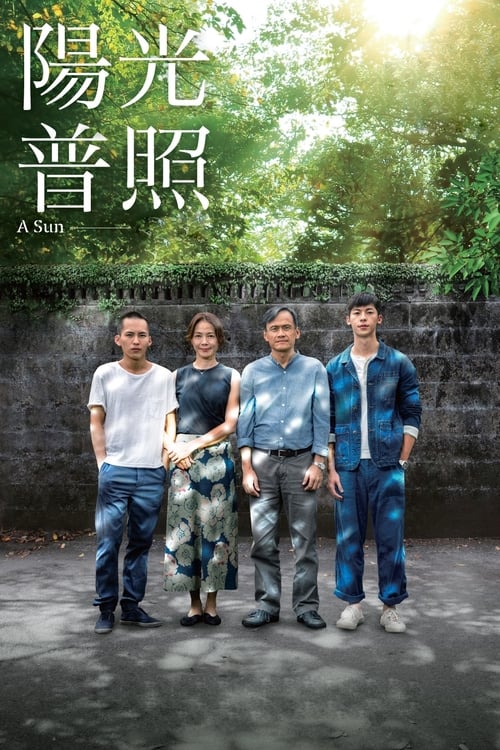
A Sun
2019 · Chung Mong-hong
For when you're ready to feel something big and don't mind being wrecked a little — a serious, absorbing night with a capital-D drama, closer to reading a great novel than watching TV.
What it's about
A working-class Taipei family of four comes apart across several years: the younger son, A-ho, is sent to juvenile detention after a violent assault, while the father — a driving instructor fond of the slogan "seize the day, decide your path" — quietly disowns him and pins every hope on the golden elder son. The mother absorbs the damage in near-silence. What begins as a delinquency story widens into a moral epic about pride, favoritism and what a family owes its own.
The experience
Long, novelistic and emotionally heavy, with sudden flashes of violence and dark humor — it earns its two and a half hours, tightening its grip until scenes late in the film land like body blows. You come out shaken and moved.
Performances
Chen Yi-wen is extraordinary as the father, a proud, withholding man whose certainties slowly crack — a performance that swept awards at home and anchors the whole film.
The craft
Chung Mong-hong (who also shoots his own films) gives the story a striking painterly look — hard sunlight and deep shadow doing thematic work the dialogue never states. The structure is patient and bold, trusting you to assemble the family's whole history from pieces.
Why it matters
It swept Taiwan's Golden Horse Awards in 2019, became the country's Oscar submission, and announced Chung Mong-hong internationally as a major voice in Taiwanese cinema.
Snapshot
A Sun (陽光普照, Yángguāng pǔzhào — literally "sunlight shining everywhere") is a Taiwanese family drama that expands, over roughly two and a half hours, into something closer to a moral epic. It follows the Chen family across several years bracketed by two catastrophes: the younger son A-ho's involvement in a violent assault that sends him to juvenile detention, and the elder son A-hao's unforeseen suicide. Around these poles Chung Mong-hong builds a study of a father, a driving instructor who repeats the school's slogan — "seize the day, decide your path" — while quietly disowning one son and idealizing the other, and of a mother who absorbs the family's damage in near-silence. Released domestically in 2019, the film swept the major categories at that year's Golden Horse Awards, was chosen as Taiwan's submission for the Academy Award for Best International Feature Film (reaching the shortlist but not the final nominations), and was acquired by Netflix for global streaming, which gave it an international audience well beyond the usual festival circuit. It stands as the fullest statement to date of Chung's distinctive authorship — a filmmaker who serves as his own cinematographer and fuses melodrama's emotional scale with an austere, painterly visual control.
Industry & production
A Sun was produced within Taiwan's mid-budget art-cinema sector, the same ecosystem that has sustained auteur-driven features since the New Taiwan Cinema of the 1980s but under considerably tighter commercial pressures. Chung Mong-hong came to feature filmmaking from a background in commercials and advertising, and he works through his own production apparatus with the veteran producer Yeh Jufeng, one of the most prolific and respected figures in contemporary Taiwanese production, attached. The film's financing and release followed the standard pattern for prestige Taiwanese cinema: a domestic theatrical run timed to position the film for the Golden Horse Awards — still the most important Chinese-language film honors — followed by international festival exposure.
The decisive industrial event in the film's life was its Golden Horse sweep at the 56th ceremony in 2019, where it took Best Feature Film and Best Director alongside major acting and craft awards. That recognition converted a domestic drama into an awards-season contender and underwrote its selection as Taiwan's official Oscar entry. The subsequent Netflix acquisition is significant in industrial terms: streaming distribution has become a primary channel through which Taiwanese and other East Asian art films reach Western viewers, bypassing the narrow theatrical windows that once confined such work to festivals and a handful of arthouse screens. A Sun is a representative case of that shift — a film whose critical reputation was built on the festival-and-awards axis but whose actual audience was substantially formed by a streaming platform.
Technology
A Sun was shot digitally, and its technological interest lies less in novel equipment than in what Chung extracts from a controlled digital pipeline. The film's most conspicuous technical signature is color: deeply saturated, sculpted light that lends interiors and landscapes a lacquered, near-painterly density. This is achieved through the combination of precise on-set lighting and meticulous color grading in post — the digital intermediate is where much of the film's temperature and contrast are finally decided. Chung's images frequently push toward heightened, almost artificial hues (surgical blues, sodium-lit oranges, the flat white glare implied by the title) without tipping into obvious stylization, a balance that depends on the latitude of modern digital capture and grading tools.
One departure from live-action technology is a brief animated/illustrated interlude, rendered in a different register from the photographed material, used to visualize a fable recounted within the story. Its presence marks a deliberate technical and tonal shift, isolating a moment of interior reflection from the surrounding realism. Beyond that, the film's technology is conventional in kind but exacting in execution; the achievement is craft discipline rather than technical novelty.
Technique
Cinematography
Chung Mong-hong photographed A Sun himself, as he does his other features, working under the Japanese pseudonym Nakashima Nagao — a long-running practice that underscores how central the camera is to his authorship. The cinematography is the film's most celebrated element and its organizing intelligence. Compositions are frontal and architecturally precise, often centering figures within doorways, windows, and vehicle frames so that the built environment becomes a set of enclosures pressing on the characters. Light is used thematically: the title's promise of universal sunshine is answered by images in which brightness is oppressive rather than consoling, and in which shadow becomes a coveted refuge. The elder son's confession that he has no shade, no place to hide from a relentless sun, is realized visually across the film in high, flat, exposing light.
The camera tends toward stillness and measured movement, favoring the held frame over restless coverage; when it moves, the movement is motivated and controlled. This composure gives the melodramatic events — assault, imprisonment, death — a paradoxical calm that intensifies rather than softens them. The result is a visual style that reads as classical in its rigor while remaining emotionally charged through color and light.
Editing
The film's editing, which was recognized at the Golden Horse Awards, manages an unusually large temporal and dramatic span with clarity. A Sun covers years and braids together multiple family members' arcs, several of which advance off-screen and are registered through their consequences rather than shown directly. The cutting sustains a patient, accumulative rhythm across long stretches, allowing scenes to breathe, then executes decisive tonal pivots — most powerfully at the abrupt introduction of the elder son's death, which the structure withholds and delivers as rupture. The editorial strategy of eliding key events and letting the audience reconstruct them is central to the film's mode; it trusts inference over exposition and thereby deepens the sense of a family that cannot speak its own history aloud.
Mise-en-scène / staging
Chung stages the Chen family within a tightly coded set of domestic and institutional spaces: the cramped apartment, the driving school with its fleet of cars, the juvenile detention facility, hospital corridors, roadside and mountain exteriors. Cars are a recurring staging element — fitting for a father who teaches driving — functioning as mobile enclosures where confession and confrontation occur. Blocking repeatedly isolates the father from his sons, positioning him at the head of tables or behind glass, physically enacting his emotional withholding. The mother is often staged in the middle distance, present but marginalized within the frame, a compositional expression of her role as the family's silent shock-absorber. The overall design is realist in its textures — this is recognizably contemporary Taipei and its outskirts — but heightened by lighting and color into something more stylized than documentary.
Sound
The film's sound design leans toward restraint, using ederidden ambient quiet and everyday texture to hold the drama in a naturalistic register between its more overtly emotional passages. Music is deployed selectively rather than continuously, reserved for moments of transition and emotional crest. The specific composition credits and the extent of the original score are matters better confirmed against the film's official credits than asserted from memory; what is clear in the work itself is a preference for spare, punctuating scoring over wall-to-wall accompaniment, consistent with the cinematography's disciplined tone.
Performance
Performance is a pillar of the film's reception. Chen Yi-wen, as the father A-wen, anchors the drama with a study in repression — a man whose rigidity and denial are legible beneath a mild, almost genial surface, and whose late-film disclosures land with devastating weight precisely because so little has been shown before. His work was honored as Best Leading Actor at the Golden Horse Awards. Ke Shu-qin, as the mother, gives a performance built largely from watchfulness and endurance, carrying the family's grief in gesture and expression rather than speech. Liu Kuan-ting, as A-ho's friend and co-defendant Radish, provides a volatile counterweight and was recognized with the Best Supporting Actor award. The two sons — the disgraced younger and the idealized elder — are played with a naturalism that resists easy sympathy or blame, keeping the family's moral accounting genuinely open. The ensemble's collective restraint is essential to the film's method: emotion is dammed rather than performed, so that its eventual release feels earned.
Narrative & dramatic mode
A Sun operates in the register of the family melodrama but strips it of melodrama's usual signposting. Its dramatic mode is elliptical and accretive: the film advances by consequence, letting pivotal events — a crime, a birth, a suicide — arrive obliquely or after the fact, so that the viewer is always reconstructing the family's fractures rather than witnessing them cleanly. The narrative distributes point of view across the family rather than centering a single protagonist, though the father's arc of denial and belated reckoning provides the through-line. A key structural device is a recounted fable — a classical Chinese story about a child who saves a drowning boy by shattering the water jar — which the elder son reframes as a parable of a person with no shadow, nowhere to hide from the sun. This embedded story functions as the film's interpretive key, converting a naturalistic drama into a meditation on visibility, expectation, and the impossibility of refuge. The dramatic engine, finally, is not the crimes themselves but the family's inability to speak, and the slow, costly movement toward acknowledgment.
Genre & cycle
The film sits at the intersection of family drama and crime film, drawing on the conventions of both without being fully governed by either. Its crime elements — juvenile violence, detention, the pull of a delinquent milieu — connect it to a strand of Asian cinema concerned with youth on the social margins, while its central preoccupation with parental expectation, filial duty, and generational failure places it firmly within the tradition of the East Asian family drama. Within contemporary Taiwanese cinema it belongs to a cycle of socially observant, auteur-driven features that examine the pressures of family and class in modern Taiwan. It is not a genre exercise; rather, it uses crime as an inciting mechanism to open a broader inquiry into how families assign worth to their children and pay for those judgments.
Authorship & method
A Sun is the work of a strongly signed authorship. Chung Mong-hong directs, serves as his own cinematographer (under the pseudonym Nakashima Nagao), and co-writes — a concentration of roles that makes the film's visual and narrative design unusually unified. Coming from commercials, Chung brings a precise, image-first sensibility to feature work; across earlier films including Parking (2008), The Fourth Portrait (2010), Soul (2013), and Godspeed (2016), he developed the saturated palette, frontal compositions, and blend of the mundane and the uncanny that A Sun refines into its most controlled expression. The screenplay was written with Chang Yao-sheng, a recurring collaborator, and the production was carried by producer Yeh Jufeng. The film's editing — honored at the Golden Horse Awards — is integral to Chung's method of narrating by ellipsis. Exact craft credits, including the composer and editor of record, should be verified against the official credits, as Chung's practice of working under pseudonyms can complicate the paper trail; what is not in doubt is that the film's authorial center of gravity rests with Chung himself, whose combination of directing and shooting duties makes him the decisive shaping intelligence.
Movement / national cinema
A Sun is a product of contemporary Taiwanese cinema and stands in a considered relationship to its national tradition. The New Taiwan Cinema of the 1980s and 1990s — the era of Hou Hsiao-hsien, Edward Yang, and their contemporaries — established a durable template: the family as a lens on social change, long takes and patient observation, and an emphasis on the textures of ordinary Taiwanese life. Chung inherits that concern with the family-as-society and its social realism, but he modifies the tradition's characteristic style, replacing observational neutrality with a more sculpted, expressive image and a stronger current of genre incident. In this he represents a later generation that absorbed the New Cinema's thematic seriousness while opening it to melodrama and heightened visual design. The film's international success also speaks to the ongoing global visibility of Taiwanese art cinema, a small national cinema that continues to punch above its weight on the festival and awards circuit.
Era / period
The film is a document of its late-2010s moment, set in a recognizably contemporary Taiwan of driving schools, hospitals, detention centers, and urban apartments. Its concerns — the crushing weight of educational and professional expectation, the narrow definitions of success imposed on the young, the strain these place on family bonds — are keyed to pressures felt acutely across East Asian societies in this period. It arrived at a high-water mark for Taiwanese cinema's international standing and for the streaming era's reshaping of art-film distribution, and it reflects both: a domestically rooted drama built for the Golden Horse and Oscar circuits, then carried worldwide by a streaming platform. In that sense it is very much a film of the years around 2019–2020, both in what it depicts and in how it reached its audience.
Themes
The film's governing theme is the corrosive power of parental expectation — the way a father's decision to invest all hope in one child and abandon another distorts every life it touches. The title supplies the central metaphor: sunlight that promises warmth but delivers exposure, a relentless brightness with no shade to hide in. Around this run the film's deep concerns: the impossibility of speaking within a family that communicates through silence and slogan; the transmission of failure and guilt across generations; the human cost of pride and the refusal to acknowledge weakness. Crime and punishment function as thematic instruments — the film asks who is truly guilty, and finds the answer distributed across a family and a value system rather than located in a single offender. Redemption, when it comes, is partial, ambiguous, and purchased at great price, arriving through the father's belated and morally compromised assumption of responsibility. Underlying all of this is a meditation on visibility and worth: on who is seen, who is favored, who is cast into shadow, and what it does to a person to live always in the light or always in the dark.
Reception, canon & influence
Critically, A Sun was received as a major achievement of contemporary Taiwanese cinema. Its Golden Horse sweep — Best Feature Film, Best Director, and major acting and craft honors — marked it as the year's most acclaimed Chinese-language film, and its selection as Taiwan's Academy Award submission, culminating in a place on the shortlist for Best International Feature, extended that recognition internationally. The Netflix acquisition broadened its reach considerably, and English-language criticism was largely admiring, singling out the cinematography, the performances (especially Chen Yi-wen's father), and Chung's control of tone across a long, tonally shifting narrative.
Looking backward, the film draws on the New Taiwan Cinema's tradition of the family drama as social portrait, on the broader East Asian preoccupation with filial expectation and educational pressure, and on classical Chinese narrative material — most explicitly the embedded fable that supplies its central metaphor. Its crime-adjacent elements connect it to Asian cinemas' long engagement with wayward youth. Looking forward, its most consequential legacy may be reputational: it consolidated Chung Mong-hong's standing as a leading auteur of his generation and served as a high-profile demonstration that a domestically produced Taiwanese family drama could achieve global visibility through the streaming-plus-awards pathway. As the film is recent, claims about its concrete influence on subsequent filmmakers should be made cautiously — the record is still forming — but its role in raising the international profile of contemporary Taiwanese cinema, and in modeling how such films now reach the world, is already clear.
Reception
Swept the 2019 Golden Horse Awards (including Best Film and Director) but slipped almost unnoticed onto Netflix abroad in 2020 — then a slow-burn word-of-mouth wave, an Oscar shortlist spot, and year-end raves recast it as the great 'secret' film of the pandemic year.
How A Sun was received, from release to now →
How to watch A Sun: what to notice on a first viewing
- Notice how harsh and flat the sunlight looks in outdoor scenes. Chung shoots bright exteriors as exposing rather than warm, while shadow becomes a place characters seem to seek out and rarely find. The title's promise of sunlight everywhere plays here as something closer to a threat than a comfort.
- Watch for characters framed inside doorways, windows, or car windshields. Chung, who shoots his own films, repeatedly centers people inside built frames within the frame, so architecture presses in on them. The compositions turn ordinary rooms and cars into a kind of enclosure before anything dramatic happens inside them.
- Notice where the father sits or stands relative to his sons. The father is repeatedly staged at the head of tables or behind glass, physically separated from the people he is supposedly closest to. His position in the frame shows an emotional distance the dialogue never states outright.
- Notice where the mother stands when the family argues or grieves. She is often placed in the middle distance of the frame, present in the scene but pushed toward its edges. Her position visualizes a role: the one who absorbs the family's damage without being centered in it.
- Watch the father's face for how little it changes under pressure. Chen Yi-wen keeps the father mild and genial on the surface, so his rigidity and denial only register in small, withheld moments. The stillness shows how much he holds in.
The whole guide to watching A Sun, with the keys for a rewatch →
Influences: the films it descends from and the films it influenced
- Yi Yi (2000) — Parcels narration across each member of a single household so the family becomes a distributed-POV social cross-section — the structural template A Sun adopts for splitting focus between father, mother, and two sons.
- A Brighter Summer Day (1991) — Establishes the New Taiwan Cinema treatment of a son's fatal act and juvenile delinquency with sociological weight rather than genre thrill, the wayward-son-and-crime spine A Sun inherits.
- The Terrorizers (1986) — Frames characters frontally inside the grids, windows and doorways of modern apartments, the architectural geometry of enclosure that Chung's boxed, symmetrical compositions extend.
- A City of Sadness (1989) — Narrates a family's catastrophes by ellipsis, holding pivotal violence and death off-screen and registering them only in the aftermath — Chung's exact editing strategy.
- Vive L'Amour (1994) — Isolating blocking and near-wordless repression, stranding bodies alone in interiors with spare-to-absent scoring, the performance-and-sound restraint A Sun practices.
- In the Mood for Love (2000) — With DP Christopher Doyle, models the saturated, sculpted, expressionist color grade in which hue and directional light carry emotional subtext rather than realism.
- Do the Right Thing (1989) — Ernest Dickerson stages heat and sunlight as an oppressive physical antagonist pressing down on the drama, the 'oppressive-sunlight' device Chung titles his film around.
- Traffic (2000) — The paradigmatic director-as-own-cinematographer working under a pseudonym (Peter Andrews), concentrating image authorship in one shaping eye exactly as Chung shoots under 'Nakashima Nagao.'
- A Borrowed Life (1995) — The contemporary bentu family chronicle still built on Wu's structure: an elliptical, episodic account of years in which the withholding father's inability to speak to his sons is the film's central formal problem, resolved only in a late monologue rather than by dramatic confrontation.
- The Great Buddha+ (2017) — Shot by Chung himself as Nakashima Nagao: the same sculpted-light hand, a monochrome frame punctured by saturated color, plus a wry narrator/fable device paralleling A Sun's embedded parable.
- Godspeed (2016) — Chung's prior feature uses cars as mobile enclosures for extended two-handers under saturated night light, with the same lurching family-crime tonal shifts.
- The Fourth Portrait (2010) — Earlier Chung film centered on a wayward child and family fracture, deploying the mundane-uncanny blend and imagined/animated interludes A Sun refines.
- Soul (2013) — Chung applies saturated frontal compositions and domestic uncanny to a study of repression inside a family home, the tonal register A Sun controls at feature length.
- Parking (2008) — Chung's debut builds a night of distributed encounters around a car as trap, the staging of the vehicle-as-enclosure that recurs across his authorship.
- Shoplifters (2018) — Contemporaneous East Asian family portrait built as social critique, distributing sympathy across a household and disclosing its buried crime by ellipsis and delayed revelation.
- Burning (2018) — Shares the restrained-spare scoring, class-pressure repression study and an ambiguous off-screen crime withheld from the audience, narrating violence through absence.
- Parasite (2019) — Same-year family-crime drama that weaponizes architecture and built space to stage class, executing the abrupt tonal pivot from domestic drama into violence that A Sun also risks.
- The Pig, the Snake and the Pigeon (2023) — Taiwanese crime-drama deploying institutional staging to map moral condition through architectural space — prison, home, hospital as morally coded interiors — within a three-part structure tracking a family's criminal disintegration, the closest Sinophone peer to Wong's structural and staging approach.
- How to Make Millions Before Grandma Dies (2024) — Fractures a single family unit through restrained, observational melodrama that withholds catharsis, the same undemonstrative Taiwanese-inflected tone the seed pursues.
- Dear Ex (2018) — Rotates sympathy across parents and sons and manages harsh-to-warm tonal swings within one family, a sibling instance of the post-2008 revival's script-driven multi-perspective family melodrama.
Similar films
- A Brighter Summer Day (1991) — influence & lineage · same viewing thread
- Yi Yi (2000) — influence & lineage · same viewing thread
- A City of Sadness (1989) — influence & lineage · same viewing thread
- Burning (2018) — influence & lineage
- Parasite (2019) — influence & lineage
- Shoplifters (2018) — influence & lineage
- So Long, My Son (2019) — same viewing thread
- The Time to Live and the Time to Die (1985) — same viewing thread
All the films related to A Sun →
Watch it with: curated runs of related films
- Sinophone Slow Cinema — A run of Chinese-language films — Taiwan's New Wave and its mainland and Bi Gan heirs — where time pools and city, family, and memory recur; watch them near each other, from A Brighter Summer Day to An Elephant Sitting Still, for how they rhyme on drift and the weight of the past.