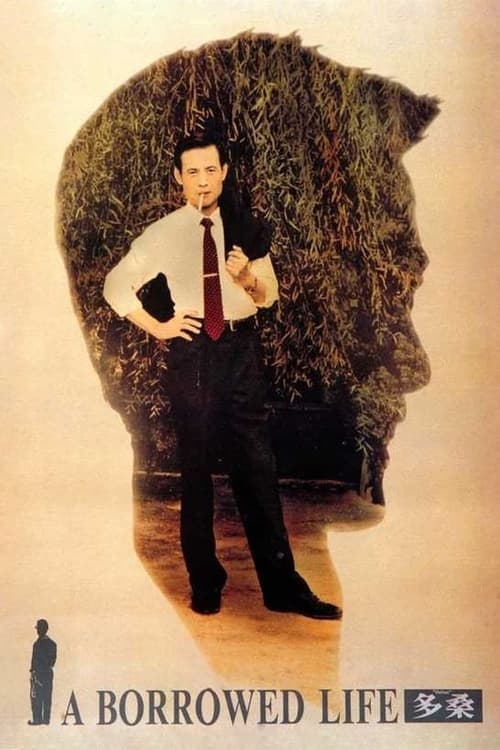
A Borrowed Life
1995 · Wu Nien-jen
For a reflective evening when you want to think about your own parents — what they lived through, what you never asked them. A gentle watch on the surface with a deep ache underneath; bring patience and maybe tissues.
What it's about
A coal miner in the mountains of northern Taiwan was born a subject of the Japanese Empire and spent the rest of his life a reluctant citizen of the Chinese republic that replaced it — still speaking of Japan as home, still dreaming of seeing it once. His children, raised in the new order, can't fathom his attachment. Written and directed by Wu Nien-jen as a chronicle of his own father, it follows the family across three decades as the mines decline and the gulf between generations widens.
The experience
Tender, unhurried, and quietly devastating — a memory film that accumulates its power through daily routines, family meals, and things left unsaid. It sneaks up on you; the sadness lands late and stays.
The craft
Wu Nien-jen, the great screenwriter of the Taiwan New Cinema, directs his debut with the movement's signature patience: long takes, real locations in mining villages, and drama carried by gesture rather than speeches. The film's layering of languages — Taiwanese Hokkien, Japanese, Mandarin — is itself the story, and hearing the mix is essential to its meaning.
Why it matters
A landmark of 1990s Taiwanese cinema, it opened up the island's colonial history and generational identity divide on screen, and marked the screenwriter behind many New Cinema classics as a director in his own right.
Snapshot
A Borrowed Life (多桑, Duo-sang) is Wu Nien-jen's debut as a director, made after more than a decade as the most prolific screenwriter of the Taiwan New Cinema. It is an autobiographical chronicle of his father — a coal miner in the mountain pits of northern Taiwan, born a subject of the Japanese Empire, who lived out the second half of his life as a citizen of a Chinese republic he never accepted and whose language he never really learned. The title is the point: duo-sang is Taiwanese Hokkien phonetics wrapped around the Japanese とうさん (tōsan), "father." The word a Taiwanese family uses for its own patriarch arrives secondhand, from an empire that left in 1945 and never stopped occupying the house.
The film covers roughly three decades, from the postwar 1950s through the collapse of the mining economy and the father's death from black lung, told in a chain of domestic episodes observed by the eldest son, Wu's surrogate. Its subject is not colonialism as policy but colonialism as personality — how a regime installs itself in a man's calendar, his songs, his sports loyalties, his sense of what counts as civilized, and then abandons him inside a country that regards those attachments as treason. Made eight years after the lifting of martial law, it is one of the essential documents of Taiwan's 1990s reckoning with its own layered pasts, and it remains the film that best explains what the Japanese period felt like to the generation that had to carry it.
Industry & production
Wu Nien-jen (b. 1952) came to directing through the story department at the Central Motion Picture Corporation, the state-affiliated studio where, alongside Hsiao Yeh, he helped push through the low-budget omnibus productions that launched the Taiwan New Cinema in the early 1980s. He wrote or co-wrote a substantial share of the movement's canon, including work for Hou Hsiao-hsien (Dust in the Wind, A City of Sadness) and Edward Yang, and he was among the signatories of the 1987 Taiwan Cinema Manifesto, the declaration that defended a cinema of cultural seriousness against a domestic industry rapidly abandoning it.
By 1995 that industry had largely evaporated. Taiwanese commercial production had been hollowed out by Hong Kong genre films and, after the loosening of import restrictions, by Hollywood; the surviving art cinema depended heavily on the Government Information Office's film-guidance subsidy scheme, on international festival exposure, and on foreign sales. A Borrowed Life belongs squarely to that economy: a long, unhurried, star-free period film in Taiwanese Hokkien and Japanese, financed and released into a market that could not plausibly reward it commercially, and validated instead abroad, where it circulated on the festival circuit and collected prizes. English-language accounts of its exact awards and production financing are inconsistent enough that I would not want to state figures; what is not in doubt is that its reputation was built at festivals and retrospectives rather than at the Taipei box office.
The most consequential production fact is geographic. Wu shot in the real mining districts of the Keelung River valley — the Ruifang–Jiufen–Houtong terrain of steep hillsides, tin roofs, and pit heads. By the mid-1990s that landscape was already a ruin: Taiwan's coal industry had been destroyed in the mid-1980s by a sequence of catastrophic mine disasters and by cheaper imported fuel. The film's "period" settings were therefore not so much reconstructed as inherited, standing derelict and available. A film about a world that ended could be shot in the actual wreckage of that world.
Technology
This is a 35mm film in the plainest sense of the term: color negative, mostly available and practical light, optical soundtrack, no opticals or effects of any consequence. Nothing about its technical program is novel, and that restraint is itself the position — the New Cinema and its successors defined themselves against the studio artifice of the 1970s "healthy realism" and melodrama tradition.
Technology matters far more inside the film, as the clock by which its decades are told. The mine is the film's machine: the cage, the lamps, the coal dust that will eventually fill the father's lungs. In the house, the era is marked by the arrival of new apparatus — radio giving way to a television set, the set becoming the household hearth, and the broadcast schedule becoming the medium through which the state's language policy enters the family living room. The last stretch of the film is dominated by medical technology: oxygen, hospital beds, the machinery that keeps a pneumoconiotic miner breathing without letting him live.
The film's own afterlife has been shaped by technology too. Like much 1990s Taiwanese cinema, it spent years difficult to see outside Taiwan, surviving in poor tape and disc transfers before archival digital restoration work brought the period's films back into circulation for retrospectives and streaming.
Technique
Cinematography
The film works in the observational register the New Cinema had established: predominantly static setups, medium-long to long framings, deep staging in cramped interiors, and a strong preference for letting an event play out inside one frame rather than dividing it into coverage. Interiors are lit low and warm against the perpetual gray-blue of the mountain weather outside; the mining town is shot in its actual damp, and the persistent rain of the Keelung basin functions as a climate of the whole film. Exteriors favor the topography — houses stacked up hillsides, staircases, the sea visible far below — so that the family is continually framed as small against an industrial landscape that owns them.
Crucially, the camera keeps a respectful middle distance from the father. He is rarely psychologized in close-up. We watch him the way a child watches an adult: from across a room, from a doorway, understanding his moods well before understanding his reasons.
Editing
The structure is elliptical and episodic, built from discrete domestic scenes separated by unannounced jumps of months or years, with the children's ages doing much of the work of chronology. Scenes are allowed to begin before their dramatic content and to continue after it. There is little cross-cutting and almost no montage; the cutting rhythm is the rhythm of a memoir, which lingers where memory lingers and skips what memory has lost. The cumulative effect is that the father's decline registers not as a plotted arc but as accretion — a body and a household wearing down between cuts.
Mise-en-scène / staging
The miner's house is the film's central set and its central argument: a few small rooms in which the family's private life, its arguments about nationality, and its economic precarity all have to happen at once, in earshot of one another. Wu stages the family as a group in the frame, with the father often positioned slightly apart — at the table, in a doorway, on his way out to the pit or to the gambling table. Period detail is worked in as lived texture rather than display: school uniforms and textbooks, election posters and official portraiture, the household altar, the calendar on the wall. The calendar is not a throwaway. The father reckons his own life in Japanese imperial reign years while his children learn the Republican era count, and the film lets that clerical discrepancy carry the entire historical wound.
Sound
The soundtrack is dominated by source music rather than by scoring — Japanese popular song, Taiwanese Hokkien song, the radio and the television. The result is a sonic history of the island's competing sovereignties, playing in one room. Language operates the same way, and it is the film's sharpest instrument: Taiwanese Hokkien is the family's tongue, Japanese is the father's language of feeling and prestige, and Mandarin arrives as the language of school, of officialdom, of the newsreader — a language the children acquire and the father declines. Ambient sound is naturalistic and unglamorized: rain, the mine, the television talking over dinner, and toward the end the labored, ruined breathing that becomes the film's dominant noise.
Performance
Playing is naturalistic and non-declamatory, in the New Cinema manner, with children directed to behave rather than to perform. The father is played by Tsai Chen-nan, far better known in Taiwan as a Taiwanese-language singer, and the casting pays off exactly as it should: the performance carries an unforced vernacular authority and a singer's ease with the film's musical culture. The role is built out of stubbornness — a man who is frequently unreasonable, occasionally a poor husband and father, and never softened into a symbol. The film's moral achievement is that it neither forgives him nor turns him into a case study.
Narrative & dramatic mode
This is autobiographical family chronicle, narrated implicitly from the son's vantage and structured as a life rather than a plot. There is no antagonist and no crisis-and-resolution architecture; the dramatic engine is generational incomprehension, renewed in each episode and never settled. The mode is realist and elegiac, closer to the memoir novel than to the biopic — it declines the biopic's habit of turning a life into a thesis with milestones.
Its most striking dramaturgical decision is to let the father's central desire remain unfulfilled. He wants to see Mount Fuji and the Imperial Palace — the metropole he was raised to consider his own — and the mundane economics of a miner's life ensure that he never does. The film's closing movement, in which that pilgrimage is completed on his behalf after his death, is the rare gesture of consolation in a film otherwise unsentimental about what it cost to be him.
Genre & cycle
Formally it is a family drama; historically it belongs to the cycle of post-martial-law Taiwanese films that returned to the twentieth century to recover what the Kuomintang's official history had suppressed. That cycle includes Hou Hsiao-hsien's A City of Sadness (1989) and The Puppetmaster (1993), and — released the same year as Wu's film — Wan Jen's Super Citizen Ko, on the White Terror. Within it, A Borrowed Life occupies a specific and uncomfortable niche: rather than dramatizing Taiwanese victimhood under the KMT, it takes seriously a Taiwanese man's affection for the previous colonizer, a position that neither Chinese-nationalist nor straightforwardly anti-colonial framings can easily absorb.
Authorship & method
Wu wrote the film himself, from his own family history, and his method as a director is legible as an extension of his method as a screenwriter: episodic construction, vernacular dialogue, class-specific detail, and an insistence on ordinary people as the proper subject of history. There is a direct line to Dust in the Wind (1986), which he wrote for Hou Hsiao-hsien out of his own adolescence in the same mining district; A Borrowed Life returns to that terrain from the parent's side of the table.
His collaborators are where the English-language record is genuinely thin — below-the-line credits for this film are poorly and inconsistently documented outside Taiwan, and I would rather describe the work on screen than attach names I cannot verify. What can be said is that the film's musical identity is built primarily from pre-existing popular song rather than from an original score, and that its shooting and cutting sit within the shared craft vocabulary of Taipei's small New Cinema crew pool, whose personnel circulated among Hou, Yang, Tsai Ming-liang and their successors throughout the period.
Wu's own authorship extends well past this film. He is a familiar public voice in Taiwan — a television presenter of documentary programs about local life, a prolific advertising figure, and later a major force in Taiwanese theater — and he is known internationally as an actor, above all as NJ in Edward Yang's Yi Yi (2000), a performance of weary decency that rhymes suggestively with the fathers of his own work.
Movement / national cinema
A Borrowed Life is second-generation Taiwan New Cinema: made by a founding participant, after the movement proper had dispersed, in its idiom but with a different emphasis. Where Hou's historical films pursue an elliptical, sometimes hermetic monumentality, Wu's is domestic, garrulous and legible — a populist inheritance of the New Cinema's ethics without its most difficult formal strategies.
It is also a landmark of bentu (nativist, "of this soil") cinema. Its commitment to Taiwanese Hokkien as the language of intimate life, its regional specificity, and its refusal of a Chinese-national frame align it with the broader localization of Taiwanese culture and politics in the Lee Teng-hui years, when the island's own history became a legitimate and contested public subject for the first time in decades.
Era / period
Two eras are in play. The depicted era runs from the aftermath of 1945 — when Taiwan passed from fifty years of Japanese rule to the Republic of China, through the February 28 Incident and into the long martial-law decades of Mandarin-only schooling and enforced de-Japanization — to the mining industry's collapse in the 1980s. The father belongs to the Japanese-language generation: educated in Japanese, formed by the imperialization campaigns of the late 1930s, and then made functionally illiterate and politically suspect overnight in his own country.
The era of production is post-1987 Taiwan: martial law lifted, media-language restrictions eased, democratization underway, and a national argument raging over who the Taiwanese are. The film is unthinkable a decade earlier. Its ability to present a man who preferred the Japanese to the Chinese, and to treat that preference as biography rather than pathology, is a direct measure of how far the sayable had expanded.
Themes
Colonized subjectivity. The film's core insight is that the colonizer's deepest work is done not in law but in taste — in which songs move you, which team you want to win, which calendar you count by. The father is not a collaborator; he is a man whose interior life was furnished by an empire and never refurnished.
The father as historical stranger. The generation gap here is a regime gap. The children's schoolbooks teach them that their father's formative loyalties were the enemy's. Filial love has to be conducted across a border drawn through the middle of the family.
Labor, the body, and class. Coal is not metaphor. The mine pays for the household and bills the father's lungs for it; pneumoconiosis was endemic among Taiwanese miners, and the film's long dying is an occupational as much as a personal fate.
Language as sovereignty. Hokkien, Japanese, and Mandarin do not merely coexist; they mark who has power over whom in any given room.
Memory and filial debt. The film is offered as a son's late attempt to understand a man he spent his childhood arguing with — an act of repair conducted, necessarily, too late.
Reception, canon & influence
Critically, the film was received — at home and on the festival circuit — as a major debut and as one of the definitive Taiwanese films about the Japanese legacy, praised for the humanity of its central performance and for a treatment of the colonial question notable for withholding judgment. Some contemporary commentary found it long and loosely built by comparison with the tighter, more radical formal experiments of Hou or Yang; that unhurriedness is inseparable from what it does.
Its influences run backward to the New Cinema Wu helped write into existence — Hou's Dust in the Wind above all, whose landscape and youthful vantage this film effectively reverses — and to the tradition of Taiwanese nativist literature (xiangtu wenxue) that gave the movement its subjects and its faith in vernacular ordinary life. Behind both stands the postwar Japanese domestic-drama tradition, whose patience with family time is audible here, though Wu's families argue far more loudly than Ozu's.
Forward, its influence is felt in the sustained Taiwanese cinematic interest in the Japanese period and in the bentu family chronicle. Wu himself followed it with Buddha Bless America (1996), a comic-satiric account of a village requisitioned for American military exercises — a companion piece that swaps one occupying culture for the next and confirms the diptych's argument: that Taiwanese modernity has been serially furnished by other people's empires. In Taiwan, the film's title has entered general usage as shorthand for that entire generation of Japanese-speaking fathers. Internationally, it has been limited less by reputation than by availability; as archival restoration and retrospective programming of Taiwan New Cinema continue, it is steadily being recognized as belonging in the first rank of that cinema rather than at its margin.
A Deleuzian reading
There is a calendar on the wall of the miner's house.
The full Deleuzian reading of A Borrowed Life →
Reception
A festival darling on release — grand prize at Torino, prizes at Thessaloniki and Singapore — it then spent decades almost impossible to see with English subtitles, becoming a whispered-about grail until restoration finally put it back in circulation for a new wave of admirers.
How A Borrowed Life was received, from release to now →
How to watch A Borrowed Life: what to notice on a first viewing
- Notice the camera stay across the room from the father. Wu keeps a respectful middle distance from the father, watching him from a doorway or across the room the way a child actually watches an adult, in mood before reason. The distance is the son's own point of view, not a stylistic choice made from nowhere.
- Notice the calendar on the wall of the house. The father reads his own life off Japanese imperial reign years while his children, in the same house, are learning to count the same days from a Chinese republic. Nobody argues about the discrepancy, the calendar just quietly carries the whole historical wound.
- Notice the warm indoor light against the gray weather. Interiors are lit low and amber against a persistent gray blue outside, the damp mining town weather of the Keelung basin functioning as the whole film's climate. The weather never breaks, so the household's warmth always has to work against something outside it.
- Listen for three different languages inside one dinner scene. Hokkien, Japanese, and Mandarin all move through the household, on the radio, the television, and in conversation, without the film ever pausing to translate the difference for you. Which language a sentence arrives in is doing real historical work, quietly, every time someone speaks.
- Watch how often the father is framed slightly apart. Wu stages the family as a group in the frame but keeps positioning the father a little separate, at the table, in a doorway, on his way out. His separateness in the frame is the film's argument before a single line of dialogue makes it.
The whole guide to watching A Borrowed Life, with the keys for a rewatch →
Influences: the films it descends from and the films it influenced
- Dust in the Wind (1986) — Wu wrote this from his own adolescence in the same Ruifang-Jiufen mining district, and A Borrowed Life reuses its exact grammar — the branch-line train, the static wide shot that keeps figures small against slag hills and mountain fog, the ellipsis that skips the dramatic event and holds the aftermath — while flipping the vantage from the departing son to the father left at the table.
- The Sandwich Man (1983) — Wu's adaptations of Huang Chun-ming established the working method he directs with here: discrete short-story episodes joined by tone rather than plot, dialogue written in Taiwanese vernacular rather than dubbed Mandarin, and class-specific labor detail (the job, the wage, the uniform) doing the characterization.
- A City of Sadness (1989) — Wu co-wrote its multilingual sound design, where Japanese, Taiwanese, Mandarin and Shanghainese collide inside one household and the choice of language in a given line is itself the historical event — the precise device A Borrowed Life narrows to a single father whose interior life is only fully available in Japanese.
- The Puppetmaster (1993) — Supplies the memoir architecture: a Japanese-era laboring artist's life recounted in Taiwanese, with time indexed by Japanese reign years rather than Western dates, staged in unbroken frontal long takes at observational distance so that testimony, not montage, carries the chronology.
- Taipei Story (1985) — Yang's casting of a pop singer (Tsai Chin) and a non-actor director as leads is the New Cinema precedent for Wu building his film on Tsai Chen-nan, a Taiwanese-ballad singer whose unschooled physical bearing and voice supply the father; both films also fix the camera on cramped apartment interiors and let unfulfilled desire register as people simply not moving through the frame.
- Hill of No Return (1992) — The immediate Taiwanese precedent for mining as cinematic labor — pit-mouth geography, the physical toll on the body, and Japanese-era management filmed in Taiwanese-language dialogue — treating the colonial workplace as a documentary-textured location rather than a period backdrop.
- Banana Paradise (1989) — Builds an entire narrative engine out of language politics — survival depending on which tongue and accent you can perform under a new regime — the mechanism Wu inverts into a father whose Japanese fluency becomes an untranslatable liability to his Mandarin-schooled children.
- Tokyo Story (1953) — The postwar domestic-drama tempo behind the film's patience: a low, frontal, unmoving camera on the interior; scenes that begin before and end after their business; and the held shot of the emptied room after the family has gone — though Wu keeps the setup and lets his family shout across it, which Ozu's never do.
- Twenty-Four Eyes (1954) — Its decades-spanning chronicle is stitched by pre-existing diegetic songs functioning as chapter markers and emotional dating devices — precisely how A Borrowed Life uses Japanese wartime and Taiwanese popular records instead of an original score to mark where in a life we are.
- Buddha Bless America (1996) — Wu's direct companion piece, made with the same toolkit — episodic village chronicle, source-song scoring, static observational framing that refuses to editorialize on the occupier — swapping the Japanese legacy for the American military presence to complete the argument about serially borrowed modernity.
- Yi Yi (2000) — Yang cast Wu himself as NJ and built the role on the same figure Wu had directed — a decent, inarticulate father whose deepest register surfaces abroad in a second language (the Tokyo passage with Ota) — staged in Yang's doorway- and window-framed domestic long shots that keep the family at observational distance.
- Café Lumière (2003) — Carries the Taiwan-Japan bilingual family into Ozu's own idiom — static long takes, train geography, a father who cannot say the important thing and communicates by sitting down to eat — closing the loop between the Japanese domestic-drama ancestor and the Taiwanese films that metabolized it.
- Cape No. 7 (2008) — The popular-hit inheritor of the source-song method: colonial residue is carried entirely by pre-existing music and by Japanese-language letters read aloud over the present, making language and song, not exposition, the vehicles of the 1945 rupture.
- Darkness and Light (1999) — Takes the non-professional casting and the long observational take into a Keelung port family — an impaired father, a household filmed in real cramped rooms, and narrative built from accumulated daily incident rather than causal plotting.
- A Sun (2019) — The contemporary bentu family chronicle still built on Wu's structure: an elliptical, episodic account of years in which the withholding father's inability to speak to his sons is the film's central formal problem, resolved only in a late monologue rather than by dramatic confrontation.
- Super Citizen Ko (1995) — Released the same year and made from the other end of the same generation: a Japanese-educated man's postwar guilt tracked through long observational takes as he walks a city that has erased his coordinates, with era-specific song and address used to date memory.
- Song of the Exile (1990) — The other great autobiographical Chinese-language chronicle organized around a parent's Japanese formation, structured so that the parent's untranslated language is the exact site of the child's incomprehension — the same dramaturgy of a family divided by mother tongue rather than by conflict.
- The River (1997) — Extends the same Taipei crew-pool vocabulary to the ailing patriarch: a fixed camera at a middling distance inside a cramped apartment, illness registered through breath, wheeze and body sound rather than dialogue, and the father's unspeakable interior life left structurally unresolved.
Similar films
- A Sun (2019) — influence & lineage
- Taipei Story (1985) — influence & lineage
- Yi Yi (2000) — influence & lineage
- Dust in the Wind (1986) — influence & lineage
- Tokyo Story (1953) — influence & lineage
- A City of Sadness (1989) — influence & lineage
- Twenty-Four Eyes (1954) — influence & lineage
- The Time to Live and the Time to Die (1985) — shared sensibility