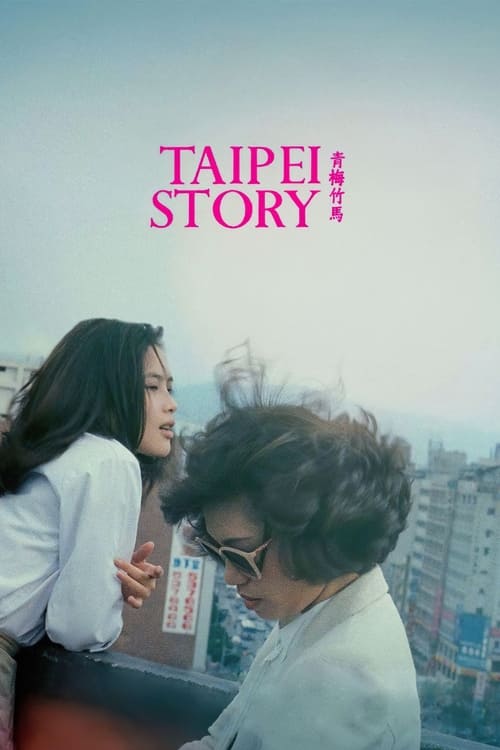
Taipei Story
1985 · Edward Yang
For a contemplative night when you want a slow, melancholy film to sit with — heartbreak by erosion, not explosion. This is a challenge-and-reward watch, not comfort viewing; save it for when you have patience and quiet.
What it's about
In mid-1980s Taipei, a young woman climbing through the city's new corporate world is counting on her longtime boyfriend to be her way out — maybe to America, maybe just to somewhere with a future. He's a former Little League baseball hero turned textile trader who can't stop honoring old debts and old friendships, and he quietly drains his savings rescuing her insolvent father. The film follows the two of them, childhood sweethearts, as the city modernizes around them and the relationship starts to give.
The experience
Slow, hushed, and quietly devastating — the sadness accumulates in glances, pauses, and neon-lit streets rather than big scenes. It leaves you with the ache of watching two people drift apart in real time, and a strange tenderness for a city caught mid-change.
Performances
Lung is played by Hou Hsiao-hsien — himself one of Taiwan's great directors — and his restrained, wounded stillness is central to the film's power; Tsai Chin matches him as Chin, ambitious and increasingly alone.
The craft
Edward Yang composes the city itself into the story: office towers, apartment interiors, and glowing signage frame the couple until Taipei feels like a third character pulling them apart. The framing is precise and patient, full of meaning held at a distance, and it rewards a big screen where the architecture and light can breathe.
Why it matters
A cornerstone of the Taiwanese New Wave and a key early work from Edward Yang, whose city films reshaped how a generation of filmmakers portrayed modern urban life; long hard to see, it has grown into a revered classic.
Snapshot
Taipei Story — Chinese title Qingmei zhuma (青梅竹馬), literally "green plums and a bamboo horse," an idiom for childhood sweethearts — is Edward Yang's second feature, a quietly devastating anatomy of a couple, and a city, caught between a receding past and an unarrived future. Chin (Tsai Chin), a young woman rising inside the corporate service economy of 1980s Taipei, pins her hopes for escape on her longtime boyfriend Lung (played by fellow director Hou Hsiao-hsien), a former Little League baseball star now drifting as a textile trader with vague plans to emigrate to the United States. Lung is loyal, decent, and paralyzed — bound to old codes of male friendship and family obligation, he drains his savings bailing out Chin's insolvent father. As Chin's world accelerates and Lung's stalls, the relationship corrodes, and the film moves toward a sudden, almost offhand act of violence. Made at the height of the Taiwan New Cinema, financed in part by Hou himself, and a commercial failure on release, Taipei Story has since been recognized as one of the foundational works of modern Asian art cinema and among Yang's essential portraits of urban modernity.
Industry & production
The film emerged from the brief, extraordinary window of the Taiwan New Cinema (roughly 1982–1987), when a cohort of young filmmakers — several returned from study or work abroad — pushed against the escapist genre product that had dominated the Taiwanese and Mandarin-language market: martial-arts pictures, "healthy realism" melodramas, and the romantic "three-hall" (san ting) love films. Yang had made his feature debut with That Day, on the Beach (1983) and had contributed to the omnibus In Our Time (1982), one of the movement's inaugural texts.
Taipei Story was, by most accounts, an intensely personal and precarious undertaking. Its most-cited production fact is that Hou Hsiao-hsien — already a leading director in his own right — not only starred as Lung but helped finance the film, reportedly putting up his own money (frequently described as mortgaging or selling property) to keep the production alive. That collaboration is emblematic of the New Cinema's collegial, mutually subsidizing ethos, in which directors wrote, acted in, and produced one another's work. The screenplay is credited to Yang together with Hou and Chu Tien-wen (Zhu Tianwen), the writer most closely associated with Hou's own films, which situates Taipei Story squarely at the crossroads of the movement's two central figures.
Commercially the film failed; it is routinely reported to have had a very short theatrical run in Taipei. That failure has hardened into part of the film's legend — a lucid, unsentimental portrait of the city that the city's own audience largely declined to watch. Beyond these broad contours, some below-the-line production specifics circulate less consistently in English-language sources, and I will flag those thin patches where they arise rather than fill them with invention.
Technology
The film was shot on 35mm color stock and staged largely on location in contemporary Taipei — offices, apartments, expressways, bars, and construction sites — rather than on constructed sets, consistent with the New Cinema's location-based realism. Its technological afterlife is better documented than its original production package: Taipei Story was digitally restored under Martin Scorsese's World Cinema Project in partnership with Cineteca di Bologna's L'Immagine Ritrovata laboratory, a restoration that returned the film to circulation and underpinned its Criterion Collection home-video release in the mid-2010s. That restoration is the reason the film's precise, glass-and-neon surfaces are now widely visible in a form close to Yang's intended image; earlier the film had been comparatively hard to see outside festival and archival contexts.
Technique
Cinematography
Yang's visual method here is one of patient, architecturally organized observation. The camera favors stillness and distance: fixed or minimally moving setups, medium and long shots that place figures within the geometry of rooms, doorways, and windows rather than isolating them in close-up. Glass is everywhere — office towers, apartment windows, car windshields, storefront reflections — so that characters are repeatedly seen through, layered against, or doubled by the reflected city. This is the beginning of a signature Yang would refine across The Terrorizers and Yi Yi: the metropolis rendered as a lattice of transparent and reflective planes in which people appear both exposed and sealed off. Night interiors lit by lamplight and the ambient glow of the city, and compositions that let empty architecture carry emotional weight, give the film its cool, diagnostic mood. Specific camera-department credits are less consistently reproduced in circulating English-language references, so I will describe the achieved style rather than assign it to a name I cannot verify.
Editing
The cutting is unhurried and elliptical. Yang builds scenes from sustained takes and lets time pass within the frame; transitions frequently withhold connective exposition, so that narrative developments — a job change, a financial ruin, a rupture between the lovers — register belatedly, through their consequences. The rhythm is one of accumulation and drift rather than dramatic acceleration, which makes the film's late eruption of violence land with disorienting suddenness precisely because the surrounding tempo has been so measured.
Mise-en-scène / staging
Staging is where the film's meaning most densely accrues. Yang blocks his actors within charged spaces — the sterile modern office, the half-furnished apartment that Chin and Lung imagine sharing, the traditional family home, the anonymous hotel and bar — and lets the environment editorialize on the characters. Bare walls, unfinished rooms, and the recurring backdrop of Taipei's construction and demolition literalize a society mid-transformation, perpetually building itself into a future no one has fully imagined. The apartment the couple hopes to move into functions as a spatial thesis: a container for a shared life that never quite gets lived in.
Sound
The film leans on a naturalistic, location-based soundscape — traffic, the ambient hum of the city, the murmur of rooms — over conventional scoring. Popular and source music appear in keeping with the milieu (Tsai Chin, who plays Chin, was herself a prominent pop singer), and the general restraint of the sound design reinforces the film's observational detachment. I am not confident of a specific credited composer and will not attribute a score I cannot confirm; the dominant impression is of a film that trusts silence and urban noise over musical underlining.
Performance
The two central performances are casually radical in their underplaying. Hou Hsiao-hsien, better known as a director, gives Lung a heavy, inward stillness — a man whose loyalty and passivity are almost indistinguishable, his nostalgia for baseball and old friendships a kind of emotional immobility. Tsai Chin's Chin is more mobile and modern, her restlessness legible in gesture and glance rather than declamation. Both work in the New Cinema's low-affect register, avoiding the histrionics of commercial melodrama; the drama lives in what is withheld.
Narrative & dramatic mode
Dramatically, Taipei Story operates in a mode of muted realism and structural irony rather than plotted crisis. Its story is simple — a couple's slow estrangement under economic and generational pressure — but its telling is deliberately undramatic, built from the textures of daily life: business dealings, family debts, drinks with old friends, aimless drives. The film's central tension is thematic and situational: two people who love each other but face in opposite directions in time, one toward a past of baseball glory and traditional male honor, the other toward a precarious modern future of jobs, apartments, and emigration. Yang refuses catharsis. The late violence that befalls Lung is staged without heroism or clear moral resolution — an almost arbitrary end that reads less as tragedy in the classical sense than as the logical terminus of a life that could not move.
Genre & cycle
Nominally a drama, the film belongs most precisely to a cycle of urban modernist portraits of Taipei that Yang would go on to author across two decades — from The Terrorizers (1986) through A Confucian Confusion (1994), Mahjong (1996), and Yi Yi (2000). Within that body of work, Taipei Story is the early, distilled statement of the theme: the contemporary city as a site of alienation, economic churn, and spiritual drift. It sits alongside the broader New Cinema cycle of contemporary-set social observation that distinguished the movement from the period nostalgia of some of Hou's films, giving Yang the role of the movement's great urbanist.
Authorship & method
Edward Yang (Yang Dechang, 1947–2007) came to filmmaking by an unusual route that shapes everything about his style. Trained as an engineer — he studied in the United States and worked in the American computer and defense industries before returning to Taiwan to make films — Yang brought an engineer's structural, systemic imagination to cinema. His films are built like designed systems: precise, patterned, attentive to how individuals are positioned within social and architectural structures. Taipei Story is an early demonstration of that sensibility, its rigor of framing and refusal of sentiment marking Yang as the most formally exacting of the New Cinema directors.
The authorship of Taipei Story is genuinely shared in ways worth naming. Hou Hsiao-hsien's involvement as co-writer, lead actor, and financier makes the film a rare summit meeting of the two directors who would define Taiwanese cinema's international standing — and the contrast between Hou's humanist, landscape-and-memory sensibility and Yang's cooler urban geometry is productively legible in the finished work. Chu Tien-wen's presence on the screenplay further binds the film to the movement's shared writing culture. Tsai Chin, the film's female lead, would later become Yang's wife; her casting drew on her stature as a pop performer and lent Chin's modernity a real-world resonance. Some other key craft collaborators — cinematographer, editor, composer — are less reliably documented in the English-language record, and I decline to assign those roles to names I cannot verify.
Movement / national cinema
Taipei Story is a canonical work of the Taiwan New Cinema (Taiwan xin dianying), the movement that, beginning around 1982, redefined the island's film culture and put Taiwanese cinema on the global festival map. Its practitioners — Yang, Hou, Wan Jen, Ko I-chen, Chang Yi, and others, often working with writers like Chu Tien-wen — favored realism, contemporary or recent-historical settings, long-take aesthetics, restrained performance, and an interest in Taiwan's rapid modernization and its social costs. The movement was partly enabled by shifts at the state-linked Central Motion Picture Corporation and partly a generational revolt against escapist genre fare. Within it, Yang became the chronicler of the modern city, and Taipei Story is his defining early contribution to that national-cinematic project — a film about Taiwan's economic miracle told from inside its psychic vacancies.
Era / period
The film is a document of Taiwan in the mid-1980s, on the cusp of enormous change: an economy industrializing and internationalizing at speed, a society still under authoritarian rule (martial law would not be lifted until 1987), and a generation weighing emigration — especially to the United States — as both aspiration and escape. Lung's fading identity as a baseball hero taps a specific national memory: Taiwan's Little League baseball triumphs of the 1960s and 1970s, a source of collective pride now receding into the past. The recurring pull of America — the imagined move, the returning relatives — captures the era's ambient sense that the future lay elsewhere. The film thus reads as a precise period portrait: the anxieties of a boom that enriched the city while hollowing out its inhabitants' sense of belonging.
Themes
At its center is the collision of tradition and modernity — Lung's world of loyalty, obligation, and nostalgic masculinity against Chin's world of corporate mobility, self-invention, and forward motion. From this flow the film's other preoccupations: urban alienation and the isolating architecture of the modern city; the emotional costs of economic transformation; the dream and disappointment of emigration; the failure of communication and intimacy under these pressures; and a pervasive sense of stalled or wasted potential. Baseball functions as a governing metaphor for a past that can neither be recovered nor let go. Money — debts, bailouts, the ruinous generosity that binds Lung to Chin's father — becomes the medium through which obligation strangles possibility. Above all the film dramatizes a temporal misalignment: two people who cannot inhabit the same moment, and a city racing ahead of the lives lived inside it.
Reception, canon & influence
On release Taipei Story was a commercial disappointment, widely reported to have played only briefly in Taipei — a fate that has become inseparable from its reputation as a film ahead of its audience. Its critical fortunes have inverted that verdict over the decades. Backward, the film draws on the realist and modernist currents of the Taiwan New Cinema and, more broadly, on the tradition of contemplative, long-take art cinema; Yang's engineering-trained precision and his interest in the alienations of modern life also invite comparison to the architectural modernism of filmmakers like Antonioni, though Yang's idiom is distinctly his own and rooted in Taipei's specific textures. The film's most direct internal influence is the creative partnership with Hou Hsiao-hsien, whose sensibility both shapes and counterpoints Yang's.
Forward, Taipei Story stands as a keystone of Yang's career-long project and, through it, of the international recognition Taiwanese cinema would achieve — a lineage that runs to Hou's Golden Lion for A City of Sadness (1989) and Yang's own Best Director prize at Cannes for Yi Yi (2000). The film anticipates the concerns of later global "slow cinema" and urban-alienation filmmaking, and its rediscovery — powered by the World Cinema Project restoration and Criterion release — has secured it a place on serious critical maps of the era. If the precise contours of its original reception are thinly recorded in English-language sources, its retrospective standing is not: Taipei Story is now read as one of the essential portraits of a society, and a couple, stranded between what was and what might be.
A Deleuzian reading
Two people walk through an apartment they are thinking of taking.
The full Deleuzian reading of Taipei Story →
Reception
It bombed in 1985 — pulled from Taipei theaters within days — and stayed nearly impossible to see for decades; the 2017 World Cinema Project restoration and subsequent Criterion release completed one of cinema's great flop-to-masterpiece arcs.
How Taipei Story was received, from release to now →
Influences: the films it descends from and the films it influenced
- L'Eclisse (1962) — The template Yang draws on for treating architecture and glass as emotional weather — figures dwarfed and de-centered in the frame, and dead-time held on the built environment after the characters have left it.
- L'Avventura (1960) — Pioneers the elliptical drama that abandons plot momentum for drift and unresolved incident, refusing the catharsis Yang likewise withholds at his ending.
- La Notte (1961) — The alienated-couple structure — a marriage dissolving across a single stretch of modern city — mapped onto architectural voids, the direct armature for Chin and Lung's estrangement.
- Tokyo Story (1953) — Static, patiently held framings and generational tradition-versus-modernity drift rendered through restrained, low-affect underplaying rather than dramatized conflict.
- Au Hasard Balthazar (1966) — The model-not-actor principle of flattened, non-expressive performance that Yang extends to a cast (including non-professional Hou) delivering emotion by withholding it.
- The Boys from Fengkuei (1983) — By Yang's co-writer/star/financier, it establishes the Taiwan New Cinema idiom of location-shot long takes and provincial-to-urban displacement that Taipei Story inverts toward the metropolis.
- The Sandwich Man (1983) — The founding anthology of the movement, codifying the naturalistic-location sound and unadorned realism that Taipei Story treats as its shared house style.
- That Day, on the Beach (1983) — Yang's own debut feature that first tests the elliptical flashback architecture and reflective-glass compositions he refines into the tighter geometry of Taipei Story.
- A City of Sadness (1989) — The Golden Lion winner that carried the New Cinema's static tableau long-take method to international canonization, the export triumph Taipei Story's craft anticipated.
- Rebels of the Neon God (1992) — Inherits the Taipei-youth alienation, static long shots, and neon-and-glass reflective surfaces, extending Yang's urban geometry into a colder, near-silent register.
- Vive L'Amour (1994) — Pushes Taipei Story's naturalistic-location realism and refusal of catharsis to an extreme — an empty apartment as architectural protagonist and a final unbroken take of inconsolable stasis.
- Yi Yi (2000) — Yang's own Cannes-winning culmination of the systemic method, its signature reflective-window frames superimposing city over face grown directly from the glass-surface staging of Taipei Story.
- Platform (2000) — Transposes the long-take chronicle of lives stranded in economic transition to mainland China, extending Yang's tradition-versus-modernity theme through observational static framing.
- Goodbye, Dragon Inn (2003) — Carries the static long take and architectural-space staging to their slow-cinema limit, treating a decaying cinema as the kind of alienating modern structure Yang framed his couple within.
- A Brighter Summer Day (1991) — Establishes Yang's low-key-lit, glass-and-window compositions of characters dwarfed by modernizing Taipei architecture.
- A Borrowed Life (1995) — Yang's casting of a pop singer (Tsai Chin) and a non-actor director as leads is the New Cinema precedent for Wu building his film on Tsai Chen-nan, a Taiwanese-ballad singer whose unschooled physical bearing and voice supply the father; both films also fix the camera on cramped apartment interiors and let unfulfilled desire register as people simply not moving through the frame.
- A Time to Live and a Time to Die (1985) — Released the same year by Yang's collaborator, it works the parallel New Cinema vein of memory-and-landscape long takes, the humanist counterpoint to Yang's cooler urban framing.
- The Terrorizers (1986) — Yang's immediate follow-up applies the same engineer's systemic design — interlocking strangers positioned within Taipei's architecture — pushing the muted realism of Taipei Story toward formal abstraction.
- Dust in the Wind (1986) — Taiwan New Cinema companion work (Hou co-wrote, produced and starred) using held long takes and reflective urban surfaces to register alienated modern life with the same refusal of dramatization.
- The Time to Live and the Time to Die (1985) — Hou co-wrote and starred in it; the two directors were trading the same planimetric static framing and natural-light interiors that define the Taiwan New Cinema look in the same year.
Similar films
- Yi Yi (2000) — influence & lineage · same viewing thread
- A City of Sadness (1989) — influence & lineage · same viewing thread
- Goodbye, Dragon Inn (2003) — influence & lineage · same viewing thread
- The Boys from Fengkuei (1983) — influence & lineage
- That Day, on the Beach (1983) — influence & lineage
- Tokyo Story (1953) — influence & lineage
- Long Day's Journey Into Night (2018) — same viewing thread · often watched together
- Dust in the Wind (1986) — same viewing thread
All the films related to Taipei Story →
Watch it with: curated runs of related films
- Sinophone Slow Cinema — A run of Chinese-language films — Taiwan's New Wave and its mainland and Bi Gan heirs — where time pools and city, family, and memory recur; watch them near each other, from A Brighter Summer Day to An Elephant Sitting Still, for how they rhyme on drift and the weight of the past.