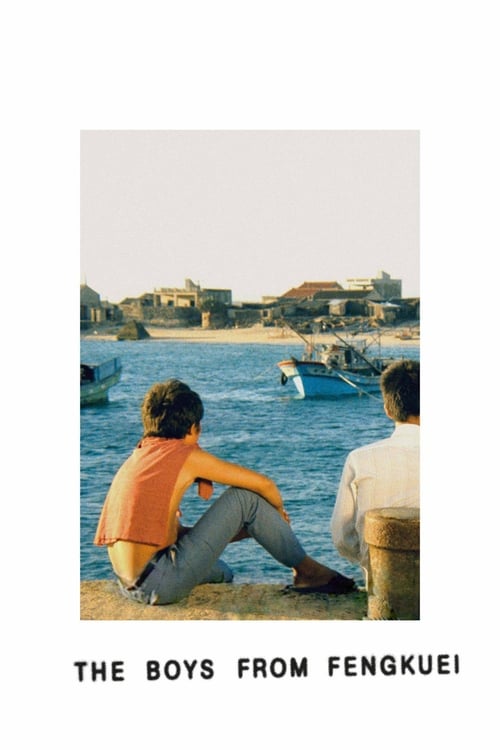
The Boys from Fengkuei
1983 · Hou Hsiao-hsien
For a patient, contemplative evening when you want a film that trusts you — one to sit with quietly and think about your own restless years. This is challenge-adjacent comfort: slow, but deeply rewarding.
What it's about
In a fishing village on Taiwan's windswept Penghu islands, Ah-Ching and his friends have finished school and fill their days with drinking, billiards, and pointless fights. Three of them move to the industrial port city of Kaohsiung to find work, where cheap apartments, dull jobs, and Ah-Ching's quiet attraction to a neighbor's girlfriend teach them what growing up actually costs.
The experience
Unhurried and observational — the camera keeps its distance and lets scenes breathe, so small moments of boredom, embarrassment, and longing accumulate into something unexpectedly piercing. It sneaks up on you; the ache arrives late and stays.
The craft
This is the film where Hou Hsiao-hsien found his signature: long, fixed takes framed at a distance, elliptical storytelling, and drama located in landscape and light rather than plot mechanics. The contrast between the bare, wind-scoured islands and the concrete sprawl of Kaohsiung does the emotional work dialogue won't.
Why it matters
The breakthrough that turned a director of commercial romances into one of world cinema's essential modernists, and a foundational work of the Taiwan New Cinema movement. Its patient, watchful style shaped decades of art-house filmmaking across Asia and beyond.
Snapshot
The Boys from Fengkuei (風櫃來的人; also circulated in English as All the Youthful Days) is the film in which Hou Hsiao-hsien became the director now recognized as one of world cinema's essential modernists. Made after three well-received commercial romances — Cute Girl (1980), Cheerful Wind (1981), and The Green, Green Grass of Home (1982) — it marks the moment his style broke from popular Taiwanese entertainment toward the distanced, observational, long-take manner that would define A City of Sadness, The Puppetmaster, and the rest of his mature work. The story is deceptively slight: a handful of aimless young men from Fengkuei, a fishing village on the windswept Penghu (Pescadores) islands, drift into idleness after finishing school, and three of them — led by Ah-Ching — migrate to the industrial port of Kaohsiung in search of work and adulthood. What they find is dislocation, low-wage labor, petty crime, an unfulfilled attraction to a neighbor's girlfriend, and the first intimations of mortality and loss. It is a coming-of-age film about leaving the province, but Hou films it with a detachment that turns adolescence into something closer to a study of memory and time. Emerging alongside the Taiwan New Cinema movement of the early 1980s, The Boys from Fengkuei is both a document of that movement's ambitions and, retrospectively, its aesthetic breakthrough.
Industry & production
The film belongs to the brief, decisive opening of Taiwan New Cinema (roughly 1982–1987), when a younger generation of directors — backed in part by the state-linked Central Motion Picture Corporation's willingness to fund lower-budget, realist work — challenged the escapist genre product (martial-arts films, weepies, propaganda) that had dominated Taiwanese and Mandarin-language commercial cinema. Hou entered this moment already an industry professional: he had worked his way up as screenwriter and assistant director through the 1970s before directing his own commercial successes, which gave him unusual freedom to experiment. The Boys from Fengkuei was an independent, modestly budgeted production shot on location in Penghu and Kaohsiung rather than on studio sets, consistent with the movement's ethos of location realism and non-professional or lightly trained performers. Precise production-company and budget details for the film are thinly documented in accessible English-language sources, and I will not invent them; what is secure is that the picture was made outside the logic of the big commercial hit, aimed instead at a nascent art-cinema audience and the international festival circuit that would soon embrace it.
Technology
The Boys from Fengkuei was shot on 35mm color film with synchronous and post-synchronized sound, the standard technical apparatus of early-1980s Taiwanese production. There is nothing technologically novel about the equipment; the film's significance lies entirely in how conventional tools were used. Working with available light and real locations — the concrete and salt-bleached textures of an island village, the raw high-rises and construction sites of a booming port city — Hou and his crew embraced the imperfections and contingencies of location shooting rather than smoothing them out. Post-synchronized dialogue was then normal practice in Chinese-language cinema, and the film's soundtrack reflects that method. The one technologically inflected choice worth flagging is the use of pre-existing Western classical recordings on the soundtrack (discussed below under Sound), a decision that had as much to do with taste and economics as with any technical capability.
Technique
Cinematography
This is where the film's importance is concentrated. Hou has repeatedly recounted — in interviews and in the standard critical literature — that during the making of The Boys from Fengkuei his screenwriter and collaborator Chu T'ien-wen gave him the autobiography of the modern Chinese writer Shen Congwen, and that Shen's calm, compassionate, seemingly god's-eye narrative viewpoint — observing human folly and suffering from a serene distance, "with the sun looking down on it all" — reoriented his whole approach to the camera. The result is the emergence of Hou's signature grammar: the static or minimally mobile camera, the long take, the medium-to-long shot that holds figures within their environment rather than isolating them in close-up. Characters are frequently observed from across a room, down an alley, or through a doorway, so that architecture and landscape carry as much weight as faces. The Penghu exteriors — flat horizons, wind, sea, and stone — and the vertical, crowded frames of Kaohsiung are composed to register the gulf between the boys' rural origins and their urban present. The cinematography is credited to Chen Kun-hou, Hou's close collaborator of this period and himself a director; readers should note that crew attributions for early Hou films occasionally vary between sources, so this credit is worth confirming against a primary print.
Editing
The editing follows from the shooting style: because so much action is staged within sustained long takes, cutting is sparing and unemphatic, favoring the duration of the shot over montage-driven acceleration. Scenes are allowed to breathe past the point where a conventional narrative film would cut, and time is registered as lived, uneven, and sometimes idle — appropriate to a story about youths who have nothing much to do. This elliptical, patient construction, in which meaning accumulates across held images rather than being spelled out by editing rhythm, is a hallmark of the mature Hou. The film is generally credited to editor Liao Ching-song, who would become Hou's long-term editing collaborator across the major works to come; this partnership is one of the most consequential in the director's career.
Mise-en-scène / staging
Hou's staging is built on deep space and the choreography of figures within a fixed frame. Rather than moving the camera to follow characters, he tends to let them move into, through, and out of a stable composition, so that the frame becomes a kind of stage or window onto which life passes. Interiors — the shared apartment in Kaohsiung, cramped and provisional — are staged in depth, with foreground and background action coexisting; exteriors set small human figures against large, indifferent landscapes and cityscapes. The mise-en-scène is documentary in its attention to real textures (peeling walls, market streets, the fishing village's stone lanes) but composed with a painter's sense of balance. This tension between raw location and rigorous framing is the visual signature of the film.
Sound
The most discussed sonic element is Hou's use of Western classical music, most notably Vivaldi, on the soundtrack — an unexpected pairing of Baroque European music with images of Taiwanese working-class youth. Accounts of the film often note that this classical scoring lends the boys' small, inarticulate lives an unexpected grandeur and melancholy, universalizing their coming-of-age. (The exact provenance and later history of the film's musical track have been described somewhat differently across sources; I flag this rather than assert a single definitive account.) Beyond the music, the film's sound design leans on ambient environmental sound — wind, sea, traffic, the noise of the port — that reinforces the contrast between village and city and grounds the film's realism.
Performance
Hou draws restrained, naturalistic performances that avoid the emotive pitch of commercial melodrama. The lead, Ah-Ching, is played by Doze Niu (Niu Chen-zer), who would himself go on to a significant career as an actor and director; his performance is watchful and inward, embodying the film's mode of observation rather than declaration. The young men's camaraderie, bravado, boredom, and confusion are conveyed through behavior — drinking, fighting, loitering, small humiliations — more than through dialogue or psychological explanation. This behavioral, understated acting style is inseparable from Hou's distanced camera: by refusing close-ups and big emotional beats, the film asks performers to exist rather than to perform.
Narrative & dramatic mode
The Boys from Fengkuei is a coming-of-age narrative built on the classic movement from country to city, but it deliberately withholds conventional dramatic shaping. There is no strong plot engine, no clear antagonist, no climax-and-resolution architecture; instead the film proceeds episodically, accumulating incidents — the migration, the search for work, the flirtation with the neighbor's girlfriend, encounters with petty crime and violence, and the intrusion of family memory and death. Its dramatic mode is elegiac and observational rather than propulsive. Flashbacks and memory (notably of Ah-Ching's father) thread through the present, so that the film is as much about the persistence of the past as about the passage into adulthood. The effect is to convert a genre premise — youths leaving home — into a meditation on time, loss, and the irreversibility of growing up, told in a register closer to the modernist art film than to the social-realist problem picture.
Genre & cycle
Nominally a drama and a youth/coming-of-age film, The Boys from Fengkuei participates in and helped define the cycle of realist, autobiographically inflected films that constitute Taiwan New Cinema's first phase. Within Hou's own filmography it belongs to the loose sequence of coming-of-age and memory films — extending into A Summer at Grandpa's (1984), A Time to Live, a Time to Die (1985), and Dust in the Wind (1986) — that mine childhood, adolescence, and rural-to-urban migration in postwar Taiwan. The country-to-city migration narrative it dramatizes was itself a broad regional and historical theme, but Hou's treatment distinguishes it from the melodramatic or moralizing versions of that story by refusing sentimentality and social thesis.
Authorship & method
The film is a foundational text of Hou's authorship because it is where his method crystallized: the Shen Congwen–inspired distanced viewpoint, the long take, the deep-focus static frame, the behavioral direction of actors, the elliptical narration of memory. Equally, it is a landmark of collaboration. The screenplay is credited to Chu T'ien-wen, the novelist who became Hou's most important and enduring writing partner, shaping the literary sensibility of his subsequent masterworks; the Shen Congwen anecdote itself testifies to how directly Chu's literary influence entered Hou's visual thinking. The cinematography is credited to Chen Kun-hou, Hou's close peer and collaborator of the early 1980s, and the editing to Liao Ching-song, who would remain Hou's editor for decades. Together these relationships — director, writer, cinematographer, editor — form the nucleus of the creative team that would produce Hou's canonical films, making The Boys from Fengkuei not just a stylistic origin point but an origin point for a way of working.
Movement / national cinema
The Boys from Fengkuei is one of the defining early works of Taiwan New Cinema, the movement that began around 1982 with the omnibus feature In Our Time and gathered force in 1983 — the same year as the portmanteau film The Sandwich Man, to which Hou contributed. The movement's project was to replace escapist commercial genres with films rooted in Taiwan's own social experience, history, and landscapes, told in a realist and often autobiographical idiom. Hou, along with Edward Yang (whose That Day, on the Beach also dates to 1983), became the movement's leading figure. The Boys from Fengkuei embodies its core commitments — location shooting, non-melodramatic acting, attention to ordinary lives and to the rural periphery, and a reckoning with modernization and migration — while pushing furthest toward a distinctive formal language. As such it is often treated as the film in which Taiwan New Cinema found its most influential aesthetic.
Era / period
Made and set in the early 1980s, the film registers a specific historical moment in Taiwan: rapid industrialization and urbanization, the pull of booming cities like Kaohsiung on rural and island populations, and the social dislocations that accompanied economic transformation. Politically, this was still the late martial-law era, and the New Cinema's turn toward everyday Taiwanese reality carried an implicit cultural assertiveness. The film does not foreground politics; rather it captures the texture of the period — the gap between a traditional fishing economy and a modern industrial one — through the experience of young men caught between the two. It stands as a period record of Taiwan on the cusp of the prosperity and social change of the 1980s.
Themes
The film's central themes are the passage from adolescence to adulthood; the displacement of migration from country to city; the collision of tradition and modernity; boredom, aimlessness, and masculine restlessness; and the workings of memory, mourning, and the irretrievable past (crystallized in Ah-Ching's memories of his father). Underlying these is a preoccupation with time itself — its slow, uneven flow, and the way growing up entails loss. Hou's distanced style is the formal correlate of these themes: by observing his characters from a compassionate remove, he frames their small dramas within the larger, indifferent movement of life and landscape, giving a modest youth story the resonance of something elegiac and universal.
Reception, canon & influence
Critically, The Boys from Fengkuei is regarded as Hou's breakthrough — the film where a talented commercial director became an art-cinema auteur — and it earned him early international recognition, notably at the Festival des Trois Continents in Nantes, France, where it took the festival's top honor and helped launch Hou's European reputation. (Award records should be verified against festival archives; the film's success at Nantes is well attested, and I flag any finer detail as worth confirming rather than asserting beyond the record.) Its influences run backward to Chu T'ien-wen's introduction of Shen Congwen's literary viewpoint, to the broader realist ambitions of Taiwan New Cinema, and to Hou's own prior commercial apprenticeship, against which this film defines itself.
Its legacy runs forward in two directions. Within Hou's oeuvre, it inaugurates the style and the collaborative team that would yield the internationally canonized works of the later 1980s and 1990s, from Dust in the Wind to A City of Sadness (winner of the Golden Lion at Venice) and beyond. More broadly, the long-take, contemplative, observational aesthetic it helped establish became one of the most influential currents in global art cinema, informing the international vocabulary of "slow cinema" and shaping filmmakers across Asia and the West who cite Hou as a model. As the point of origin for that influence, The Boys from Fengkuei occupies a secure place in the canon of modern Asian cinema — not as Hou's most famous film, but as the one where his art, and much of what followed from it, began.
A Deleuzian reading
The camera sits at the end of a stone lane in Fengkuei and waits.
The full Deleuzian reading of The Boys from Fengkuei →
Reception
Barely registered at the Taiwanese box office in 1983, it won the top prize at the Nantes Three Continents Festival in 1984 — Hou's first international recognition — and is now widely treated as the moment 'Hou Hsiao-hsien' as we know him begins. Recent restorations have only cemented its keystone status in the Taiwanese New Cinema story.
How The Boys from Fengkuei was received, from release to now →
Influences: the films it descends from and the films it influenced
- Bicycle Thieves (1948) — Neorealist location shooting with non-professional, behaviorally-directed actors — the observational street-level realism Taiwan New Cinema and Hou adopted against studio artifice.
- The 400 Blows (1959) — Autobiographical delinquent-youth coming-of-age built from loosely episodic, documentary-observed vignettes and capped by an open seaward ending — the same drift-toward-the-shore structure and unresolved boyhood gaze Fengkuei uses.
- Tokyo Story (1953) — The static, low-set frame held past the dramatic beat and the elliptical cutting around off-screen events — the contemplative grammar of distance within which critics canonize Hou, and which he later paid back in Café Lumière.
- L'Eclisse (1962) — Figures dwarfed and decentered within landscape and architecture, with dead time (temps mort) left in after the action ends — the dedramatized long-shot staging Hou builds his frames around.
- Au hasard Balthazar (1966) — Direction of performers as affectless 'models,' suppressing psychological acting in favor of behavior and gesture — the method behind Fengkuei's naturalistic, unemphatic performances.
- Taipei Story (1985) — Static long takes of urban alienation dramatizing tradition-vs-modernity, with Hou co-producing and starring — the New Cinema's shared craft of holding the frame on stalled modern lives.
- A Time to Live and a Time to Die (1985) — Extends Fengkuei's Shen Congwen-derived distanced viewpoint into autobiography: static deep-focus domestic frames and elliptical memory, made with the same Chu T'ien-wen / Liao Ching-song nucleus.
- Dust in the Wind (1986) — The direct successor — same rural-to-city migration coming-of-age, same writer, editor and figures-in-landscape long-shot method, deepening the elliptical treatment of youth leaving home.
- A City of Sadness (1989) — Scales the long-take, static-tableau, elliptical-narration method to historical epic, letting off-screen and withheld events carry the story — the canonized culmination of the grammar Fengkuei crystallized.
- Maborosi (1995) — Openly Hou-influenced: distant static long shots of figures in landscape, grief conveyed through ellipsis and duration rather than dialogue — Hou's observational aesthetic transplanted to Japan.
- Platform (2000) — Long-held static frames and an episodic, elliptical chronicle of provincial youth swept by modernization — Jia's explicit application of Hou's distance and duration to mainland China.
- Rebels of the Neon God (1992) — Second-wave Taiwan cinema extending the static long take and stripped-down performance into urban alienation — the slow-cinema minimalism that grows out of the New Cinema Hou defined.
- Kaili Blues (2015) — Contemplative rural memory rendered through extended long takes and fluid elliptical time — a later-generation inheritance of Hou's duration-and-memory craft in the global slow-cinema lineage.
- The Time to Live and the Time to Die (1985) — Hou's own pivot film: after Chu T'ien-wen gave him Shen Congwen's autobiography, he pulled the camera back into the distanced, static long shot that this film systematizes.
- That Day, on the Beach (1983) — Shot the same year by Hou's own cinematographer Chen Kun-hou, using long-take modernist observation of Taiwanese modernity and memory-flashback framing — the peer film of the New Cinema breakthrough.
- The Sandwich Man (1983) — The omnibus (Hou directed the lead segment) adapting Hwang Chun-ming's nativist fiction with location realism — the founding statement of Taiwan New Cinema's rural-to-urban, tradition-vs-modernity realism.
- Growing Up (1983) — Directed by Hou's cinematographer and co-written by Hou with Chu T'ien-wen — the same coming-of-age, naturalistic-performance team working in parallel, sharing the literary-realist sensibility.
Similar films
- Taipei Story (1985) — influence & lineage
- Dust in the Wind (1986) — influence & lineage
- A City of Sadness (1989) — influence & lineage
- That Day, on the Beach (1983) — influence & lineage
- Tokyo Story (1953) — influence & lineage
- The 400 Blows (1959) — influence & lineage
- The Time to Live and the Time to Die (1985) — shared sensibility
- Millennium Mambo (2001) — shared sensibility