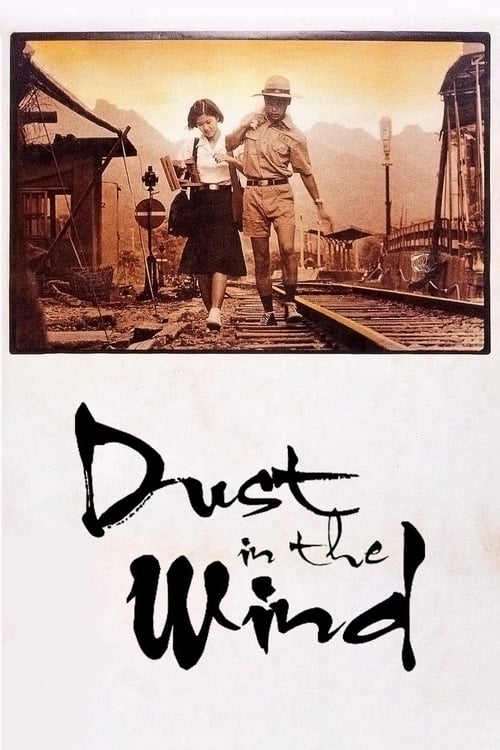
Dust in the Wind
1986 · Hou Hsiao-hsien
For a quiet, contemplative evening when you want to feel time passing — the film equivalent of looking through an old box of photographs. A slow-cinema commitment that pays you back in pure feeling.
What it's about
A-yuan and A-yun grow up together in a small Taiwanese mining town, then move to Taipei as teenagers — he apprentices by day and studies at night school, she works at a tailor's shop. Everyone assumes they'll marry, including them. Then adult life, obligation, and military service begin quietly rearranging everything they took for granted.
The experience
Hushed, patient, and achingly tender — it unfolds in long, still takes where the biggest events happen at the edge of the frame or between scenes. The sadness accumulates so gently that the ending lands with the weight of a whole remembered youth.
The craft
Hou Hsiao-hsien shoots from a calm, respectful distance — misty green hillsides, train tunnels, cramped Taipei rooms — letting landscape and weather carry the emotion the characters won't speak. It's drawn from lived memory, and every frame feels like it; the images of Jiufen's hills are quietly stunning on a big screen.
Why it matters
A canonical work of the Taiwan New Cinema and one of the films that established Hou's international reputation, it helped define a whole approach to telling personal history through stillness and distance.
Snapshot
Dust in the Wind (戀戀風塵, Lian lian feng chen) is a quiet, autobiographically rooted account of first love dissolved by time, distance, and the ordinary machinery of adult life. Its young protagonists, A-yuan and A-yun, leave the mining hillsides of Jiufen for Taipei, where he apprentices in a print shop and attends night school while she works at a tailor's. Everyone around them, and the couple themselves, assumes they will marry; instead, A-yuan is conscripted, and during his military service on the Kinmen (Quemoy) frontline A-yun marries the postman who has been delivering his letters. The film closes not on this rupture but on A-yuan returned home, sitting with his grandfather among the sweet-potato fields as the old man talks of typhoons and harvests. It is a canonical work of Taiwan New Cinema and one of the defining statements of Hou Hsiao-hsien's mid-1980s autobiographical cycle, admired for its long-take restraint, its refusal of melodrama, and the way it lets grief arrive as absence rather than event.
Industry & production
Dust in the Wind was made at the height of Taiwan New Cinema (台灣新電影), the movement that emerged from around 1982 when younger filmmakers, many working under or adjacent to the state-linked Central Motion Picture Corporation (CMPC), broke from the commercial genre output — martial-arts pictures, weepies, and propaganda romances — that had dominated the domestic industry. By 1986 Hou had already completed the loosely linked coming-of-age films The Boys from Fengkuei (1983), A Summer at Grandpa's (1984), and the more directly autobiographical A Time to Live and a Time to Die (1985). Dust in the Wind continued that vein, but shifted the biographical source: rather than Hou's own childhood, the screenplay drew on the youth of his co-writer Wu Nien-jen, a native of the Jiufen–Ruifang mining district. The film belongs to the modest, artisanal production culture of the period — small budgets, real locations, non-professional and semi-professional performers alongside a tight repertory of collaborators. It was a festival film by design and reception rather than a domestic commercial hope; its afterlife has been on the international art-cinema circuit and in retrospectives. Precise budget and box-office figures are not part of the reliably documented record and should not be asserted.
Technology
The film was shot on 35mm color film stock and finished in the standard photochemical workflow of mid-1980s Taiwanese production. Nothing about its technology is showy; the interest lies in how conventional tools are used with unusual patience. Available and practical light dominate the interiors — the print shop, the tailor's, cramped Taipei lodgings, the family home — producing a naturalistic, sometimes underlit palette that suits the material. The film's most conspicuous technical resource is not a device but a discipline: extended takes held on a near-static or barely moving camera, which places the burden on staging, framing, and duration rather than on optical effects or rapid coverage. In later decades Dust in the Wind has circulated in restored form as part of the broader effort to preserve and re-present Hou's 1980s work, though the specifics of any given restoration should be checked against the issuing archive rather than assumed here.
Technique
Cinematography
The cinematography — widely attributed to Mark Lee Ping-bing (Lee Ping-bin / Li Ping-bin), whose long partnership with Hou is generally dated to this mid-1980s period — is the film's most celebrated formal element. Hou and his cameraman favor the long shot and the long take: figures are frequently small within the frame, observed at a respectful distance, so that landscape, architecture, and weather share the image with the actors. The celebrated opening sequence rides the mountain railway through darkness and out into daylight, the twin rails and tunnel mouths establishing the film's governing motif of movement, threshold, and passage. Compositions are often organized in depth, through doorways and window frames, so that action occurs in receding planes and the viewer must locate the human incident within a larger, indifferent space. The camera rarely chases emotion; it waits, and the emotion accumulates in what is withheld.
Editing
Liao Ching-sung, Hou's longtime editor, cuts for ellipsis and breath. Scenes are allowed to run past their dramatic "point," and transitions frequently omit the connective events a conventional narrative would dramatize — a departure, a decision, the reading of a letter's contents. Time skips forward across cuts, and the viewer reconstructs what has passed. The rhythm is slow but not inert: the film's structure is a series of held observations separated by gaps, and the accumulated gaps are where fate does its work. Crucially, the central catastrophe — A-yun's marriage to another man — is handled through omission and aftermath rather than through a staged confrontation, an editorial choice that defines the film's emotional register.
Mise-en-scène / staging
Hou stages life in wide, deep set-ups that keep whole rooms and whole social units in view. Meals, work, and family gatherings unfold in real spatial relationships, with characters entering and exiting the frame rather than being isolated in close-up. The two worlds of the film — the vertical, mist-wrapped mining town of Jiufen and the flat, crowded, transactional grid of Taipei — are built through location and blocking as much as through dialogue: the country is where people are held within family and landscape; the city is where they are dispersed into labor and drift apart. Objects and gestures (a bicycle, a raincoat, letters, the print shop's machinery) carry meaning without being underlined.
Sound
The soundtrack leans on ambient, diegetic texture — trains, rain, machinery, the murmur of shops and streets — which grounds the film in a material, worked-in world. Against this, Chen Ming-chang's score, built around folk-inflected acoustic guitar, is used sparingly and is one of the film's signatures (see below). Dialogue is unforced and often overlapping in the manner of overheard life; silence and environmental sound are permitted to carry long stretches, so that when music does enter it registers as a lift of feeling rather than as continuous scoring.
Performance
The performances are deliberately undemonstrative. As A-yuan and A-yun, the young leads (Wang Ching-wen and Xin Shu-fen) play reticence, routine, and unspoken attachment rather than declaimed passion; their bond is conveyed through proximity, habit, and small acts of care. The most storied piece of casting is Li Tien-lu, the venerable Taiwanese hand-puppet master, as A-yuan's grandfather — the same performer whose life Hou would later dramatize in The Puppetmaster (1993). Li's earthy, aphoristic presence anchors the film's frame and delivers its closing note of weathered acceptance. Across the ensemble Hou draws the naturalistic, non-histrionic playing that Taiwan New Cinema prized.
Narrative & dramatic mode
Dust in the Wind works in an observational, elliptical mode that resists the causal, climax-driven shape of conventional romance. Its subject is not a dramatic conflict to be resolved but a passage of time to be witnessed. The narrative advances through episodes of everyday labor and small incident; the great turns of fortune — conscription, separation, another man's proposal — occur offscreen or in the interstices, so that the film registers change as something already accomplished by the time we see its effects. This is a dramaturgy of aftermath and implication. The love story is genuine but is framed as one strand within a wider fabric of family, work, migration, and social duty, and its ending is presented less as tragedy than as the ordinary, irreversible operation of circumstance. The final scene with the grandfather reframes the whole: private heartbreak is set against the long cycles of weather and harvest, and endurance is offered in place of catharsis.
Genre & cycle
Nominally a drama and romance, the film is better understood as a coming-of-age chronicle within Hou's larger 1980s cycle of youth-and-memory films — The Boys from Fengkuei, A Summer at Grandpa's, A Time to Live and a Time to Die, and Dust in the Wind form a recognizable group, unified by autobiographical or semi-autobiographical sources, provincial-to-urban trajectories, and an elegiac attention to the recent Taiwanese past. It also belongs to a broader regional and international current of slow, observational art cinema. Within Taiwan New Cinema it stands beside the contemporaneous work of Edward Yang, though Hou's rural lyricism contrasts with Yang's urban, analytic sensibility.
Authorship & method
The film is a Hou Hsiao-hsien work in the fullest sense — his long-take aesthetic, his ethic of distance and duration, his interest in memory and the texture of ordinary life all shape it — but it is also a document of a remarkably stable collaborative circle. The screenplay is credited to Wu Nien-jen and Chu T'ien-wen (Zhu Tianwen); Wu supplied the autobiographical material of his own Jiufen youth, and Chu, a major fiction writer, was Hou's essential writing partner across this era and beyond. Mark Lee Ping-bing is generally credited with the photography, part of a cinematographer–director partnership that became one of world cinema's most celebrated. Liao Ching-sung edited, as he did most of Hou's films, and is often described as a co-shaper of Hou's elliptical rhythm. The score is by Chen Ming-chang, for whom this was a landmark early credit; his folk-guitar idiom became inseparable from the film's identity. Hou's method — real locations, extended takes, a mix of non-professional and trained actors, and a script used as an armature for observed behavior rather than a blueprint for coverage — is on clear display.
Movement / national cinema
Dust in the Wind is a keystone of Taiwan New Cinema (also called the Taiwanese New Wave), the movement of the 1980s in which a generation of filmmakers turned toward realism, local history, and the lived experience of ordinary Taiwanese, often in Taiwanese (Hokkien) as well as Mandarin. The movement's concerns — rural-to-urban migration, the memory of the postwar decades, modernization's costs, and the search for a specifically Taiwanese identity distinct from official narratives — are all legible in the film. Hou, with this cycle, became the movement's leading figure internationally, and Dust in the Wind is frequently taught as an exemplary case of its aesthetic and thematic program.
Era / period
The film is set in the recent past relative to its making — roughly the era of Wu Nien-jen's own youth in the 1960s–70s — and is steeped in the social realities of a Taiwan moving from an agrarian and mining economy toward urban industrial modernity. The Jiufen mining district, already past its peak, stands for a receding way of life; Taipei represents the wage economy that absorbs the young. The plot's turn on compulsory military service, and its setting of that service on the militarized offshore island of Kinmen facing mainland China, situates the private story within the specific political geography of Cold War–era Taiwan without foregrounding ideology. The film's own moment — mid-1980s, on the eve of the lifting of martial law in 1987 — was one in which Taiwanese cinema was newly able to look candidly at the island's own recent history.
Themes
The governing theme is time and fate as forces beyond human control: the couple, and everyone around them, plan a future that circumstance quietly dismantles. Around this cluster related motifs — first love and its loss, treated without sentimentality; migration and displacement, the pull of the city and the fraying of provincial bonds; labor and duty, the way work, family obligation, and conscription structure and constrain young lives; and memory and transience, announced by the title's image of dust scattered on the wind. The recurring imagery of trains, tunnels, and rails threads these together into a meditation on passage and irreversibility. Against loss the film sets endurance: the grandfather's closing talk of typhoons flattening the crops and the land recovering offers a fatalistic but sustaining vision of continuity, resituating personal grief within nature's larger cycles.
Reception, canon & influence
Dust in the Wind was received internationally as a mature work of a major emerging auteur and has retained a secure place in the canon of Taiwan New Cinema and of 1980s art cinema more broadly; it is a fixture of Hou retrospectives, critical surveys of Taiwanese film, and slow-cinema genealogies. It was honored on the festival circuit, including at France's Nantes Three Continents Festival (Festival des 3 Continents), where Chen Ming-chang's music in particular is often noted as having been recognized; readers should confirm exact award citations against festival records, as popular accounts vary.
Influences on the film (backward): it draws on the observational realism and long-take traditions that Hou had absorbed and refined across his early-1980s films, on the autobiographical fiction and screenwriting sensibility of Wu Nien-jen and Chu T'ien-wen, and — as critics frequently note — on affinities with the domestic realism and elliptical restraint associated with earlier Asian masters such as Ozu Yasujirō, though Hou has cautioned that such lineages are read onto his work as much as inherited by it; the specific claim of direct Ozu influence should be treated as interpretive rather than documentary.
Legacy (forward): the film helped consolidate Hou's international reputation ahead of the breakthrough of A City of Sadness (1989) and cemented the collaborative team — Chu T'ien-wen, Liao Ching-sung, and cinematographer Mark Lee Ping-bing — whose work would define subsequent Taiwanese and pan-Asian art cinema. Mark Lee's later international career (including his celebrated work for Wong Kar-wai) and Chen Ming-chang's standing in Taiwanese music both trace back through this period. More broadly, Dust in the Wind became a touchstone for the global "slow cinema" and contemplative-realist tendency, cited by critics and filmmakers as a model of how duration, distance, and ellipsis can render emotion without dramatization. Its influence is felt less in direct imitation than in the widespread legitimation of an observational, time-based approach to memory and everyday life.
A Deleuzian reading
The film opens on a railway.
The full Deleuzian reading of Dust in the Wind →
Reception
For years it was one of the hard-to-see Hou films — passed around in murky prints while critics abroad slowly caught on to Taiwanese New Cinema — until retrospectives and a 4K restoration turned it into consensus canon, now routinely named among the most beloved of all Taiwanese films.
How Dust in the Wind was received, from release to now →
Influences: the films it descends from and the films it influenced
- Tokyo Story (1953) — Renders the family's central death entirely offscreen and dwells on its quiet aftermath in static, low-height domestic tableaux — the elliptical, undramatized treatment of catastrophe critics read into Hou's staging.
- Bicycle Thieves (1948) — Neorealist template of non-professional actors performing ordinary economic hardship in real streets and interiors, the location-and-behavior method Hou uses as an armature instead of scripted coverage.
- The Sandwich Man (1983) — Founding Taiwan New Cinema anthology adapting Huang Chun-ming's vernacular fiction (via Wu Nien-jen's circle), establishing the plain-spoken provincial realism Dust in the Wind extends.
- The Boys from Fengkuei (1983) — Hou's first fully distanced long-shot deep-staging of youths leaving a provincial town for the city, where Liao Ching-sung's editing begins cutting on ellipsis rather than action.
- A Summer at Grandpa's (1984) — First Chu T'ien-wen collaboration establishing the child's-eye observational frame and fixed wide takes that let behavior unfold at real duration.
- A Time to Live and a Time to Die (1985) — Immediate autobiographical predecessor that codifies Hou's method of staging successive family deaths offscreen and holding on the surviving household in long static setups.
- An Autumn Afternoon (1962) — Distant, static wide tableaux of a rural family with trains and elliptical time and events dropped between scenes — the Ozu ellipsis and fixed frame absorbed into Taiwanese New Cinema.
- The Time to Live and the Time to Die (1985) — Hou immediately extends the same autobiographical coming-of-age ellipsis with Mark Lee Ping-bing's natural-light long takes, keeping the departures and losses in the gaps between shots.
- A City of Sadness (1989) — The breakthrough Dust consolidated: same Chu T'ien-wen / Liao Ching-sung team scaling wide-deep tableaux and offscreen violence into national historical trauma, keeping the massacre at the edges of the frame.
- In the Mood for Love (2000) — Mark Lee Ping-bing's cinematography carries Dust's expressive framing-through-doorways and restrained longing into Wong's cinema, the direct through-line of the Hou–Mark Lee partnership.
- Yi Yi (2000) — Sustains TNC's deep-staged domestic long takes and offscreen handling of birth and death, closing the movement's decade-long project of undramatized everyday observation.
- Cafe Lumiere (2003) — Hou's commissioned Ozu-centenary film that makes explicit the low, patient domestic-realist lineage critics had read into Dust in the Wind, mapping it onto Tokyo train life.
- Goodbye, Dragon Inn (2003) — Pushes the Taiwanese fixed-frame long take to its slow-cinema limit — duration and near-empty space carrying emotion without incident, the tendency Dust helped legitimize.
- Still Walking (2008) — Aftermath dramaturgy of a family gathered around an absent death, built from patient domestic tableaux — the elliptical, Ozu-inflected everyday realism Hou revived for a later generation.
- The Assassin (2015) — Hou and Mark Lee Ping-bing reunite to apply the wide-deep long-shot and offscreen-action grammar of Dust to wuxia, staging combat at a distance and cutting away from its climaxes.
- Vive L'Amour (1995) — The distant, near-motionless long take with minimal coverage that codified Taiwan New Wave observational stillness and licensed Tsai's extended static shots.
- Linda Linda Linda (2005) — Models the long-take, distanced, elliptical observation of adolescence in which naturalistic non-actors are framed in unbroken wides and emotion is withheld to the edges — the template for Linda Linda Linda's refusal to cut in for reaction shots.
- Left-Handed Girl (2025) — New Taiwan Cinema's foundational treatment of tradition-versus-modernity and inherited familial obligation dragging on the young, the thematic substrate here.
- Maborosi (1995) — Hou's patient wide shots of trains, tunnels and coastal thresholds, and his refusal to dramatize turning points, feed Maborosi's undramatized departures and its scale of tiny human against vast setting.
- Christmas in August (1998) — Hou's static long-take grammar, diegetic ambient sound in place of underscore, and love registered as absence and waiting supply the New-Cinema realist template Hur adapts to a provincial photo-studio milieu.
- Taipei Story (1985) — Taiwan New Cinema companion work (Hou co-wrote, produced and starred) using held long takes and reflective urban surfaces to register alienated modern life with the same refusal of dramatization.
- The Terrorizers (1986) — Contemporaneous TNC experiment building meaning through elliptical, fragmented cross-cutting of coincidence rather than causal plotting — the movement's shared elliptical grammar in an urban register.
- Daughter of the Nile (1987) — Same team's immediate follow-up transposing the elliptical, restrained observation of drifting youth into a neon Taipei, testing Hou's aftermath dramaturgy in a contemporary city.
- That Day, on the Beach (1983) — Extends the parallel New Wave grammar of the static composed long shot and post-synchronized sound, the shared formal vocabulary Yang and Hou developed in tandem.
Similar films
- Taipei Story (1985) — influence & lineage · same viewing thread
- A City of Sadness (1989) — influence & lineage · same viewing thread
- Goodbye, Dragon Inn (2003) — influence & lineage · same viewing thread
- Yi Yi (2000) — influence & lineage · same viewing thread
- The Boys from Fengkuei (1983) — influence & lineage
- The Assassin (2015) — influence & lineage
- In the Mood for Love (2000) — influence & lineage
- Tokyo Story (1953) — influence & lineage
All the films related to Dust in the Wind →
Watch it with: curated runs of related films
- Sinophone Slow Cinema — A run of Chinese-language films — Taiwan's New Wave and its mainland and Bi Gan heirs — where time pools and city, family, and memory recur; watch them near each other, from A Brighter Summer Day to An Elephant Sitting Still, for how they rhyme on drift and the weight of the past.