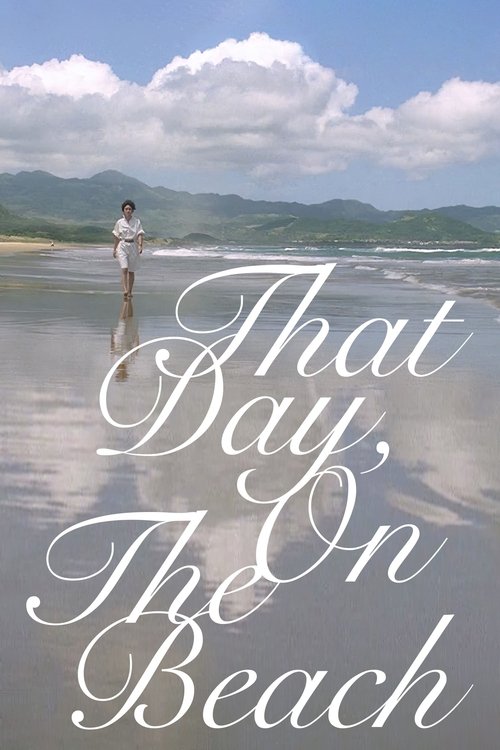
That Day, on the Beach
1983 · Edward Yang
For when you want to sink into a long, contemplative film about how a life actually gets shaped — a slow afternoon or evening where you're happy to be absorbed rather than gripped. This is reflective challenge, not comfort viewing, though it's tender rather than bleak.
What it's about
Two women meet again after thirteen years apart: one a concert pianist just back from a European tour, the other the sister of the man the pianist once loved. Over a single afternoon's conversation, the second woman unspools her life story — a flight from an arranged match, a marriage to a businessman swallowed by Taiwan's economic boom, and its slow coming apart — all circling back to one day at the beach that left her with a question no one can answer. It's a portrait of a generation of Taiwanese women measuring what independence actually cost.
The experience
Long, patient, and quietly devastating — it moves like memory itself, drifting between past and present until small domestic moments carry enormous weight. You settle into its rhythm and come out the other side feeling like you've lived alongside someone for years.
Performances
Sylvia Chang anchors the film, aging convincingly from sheltered younger sister to a woman taking stock of her own marriage, with Terry Hu as the poised pianist whose composure hides its own regrets.
The craft
Edward Yang's debut is startlingly assured: a nearly three-hour structure of nested flashbacks that never loses its thread, told in composed, unhurried frames that let conversations breathe. The film trusts silence and duration, and its beach scenes have a stark, open-air melancholy that rewards patience and a quiet room.
Why it matters
A founding work of the Taiwanese New Wave, it announced Edward Yang as a major filmmaker and helped open the door for a generation of directors examining modern Taiwan with fresh honesty.
Snapshot
That Day, on the Beach (海灘的一天, Haitan de yitian) is Edward Yang's feature-directing debut and one of the founding works of the Taiwanese New Wave. Running some 166 minutes—an audacious length for a first film—it stages a reunion between two women who have not met in thirteen years: Tan Wei-qing (Terry Hu), a concert pianist newly returned from a European tour, and Lin Jia-li (Sylvia Chang), once the younger sister of the man Wei-qing loved. Over the course of a single afternoon's conversation, Jia-li recounts the story of her life—her flight from an arranged match, her marriage to a businessman consumed by Taiwan's economic boom, and its slow disintegration, culminating in a day at the beach when her husband walked into the sea and was never found. The film refuses to resolve whether he drowned, staged his own disappearance, or something else entirely. Yang uses that irresolution not as a thriller's hook but as the emblem of a modern subjectivity in which certainty itself has dissolved. The film also marks the feature debut of cinematographer Christopher Doyle, later Wong Kar-wai's essential collaborator, making it a hinge point for two of Asian cinema's most important careers.
Industry & production
The film was produced under the Central Motion Picture Corporation (CMPC), the state-affiliated studio whose willingness—beginning around 1982—to hand modest budgets to young, untested directors effectively launched New Taiwan Cinema. Yang had come to notice through the portmanteau film In Our Time (1982), to which he contributed the segment "Expectations"; That Day, on the Beach was his step up to a full solo feature. The commission was itself a gamble by CMPC's reform-minded management, and the film's extreme length and non-linear structure reportedly created friction with a studio accustomed to conventional commercial product. The picture is generally described as a CMPC production made in association with the Hong Kong company Cinema City, a linkage often tied to Sylvia Chang, who was both a major star and an increasingly powerful creative force in the regional industry; the precise financial arrangement is one of the details on which published accounts are thin and worth verifying against primary sources. What is not in doubt is that the film's production embodied the New Wave's defining bargain: institutional backing from an old-guard studio placed, unusually, at the service of a personal, formally ambitious vision.
Technology
The film was shot on 35mm color stock in the standard technology of early-1980s Taiwanese studio production, and post-synchronized in the regional norm of the period—dialogue and much of the soundscape assembled in the dubbing studio rather than captured live. Within these ordinary means, the significant technical fact is an aesthetic one: Doyle's naturalistic handling of available and motivated light, and a compositional restraint that leans on the depth and stillness of the frame rather than on optical effects or camera pyrotechnics. There is no evidence the production reached for any novel apparatus; its modernity is one of sensibility, not hardware. I note here, rather than invent, that granular technical records for the shoot—stock, lab, lens choices—are not reliably documented in the accessible literature.
Technique
Cinematography
This is Christopher Doyle's first feature as director of photography, and it already shows the eye that would later define a certain strand of Asian art cinema: an attention to glass, reflection, and the way domestic and office interiors trap figures in geometric compartments. Doyle and Yang favor a cool, observational distance—characters framed through doorways, windows, and partitions, held at a remove that mirrors the emotional estrangement of the drama. The palette is muted and urban; the beach sequences, by contrast, open onto a flat, overexposed expanse that reads less as scenic release than as blankness, an emptiness commensurate with the vanishing at the story's center. The camera tends to watch rather than pursue, letting the human figure sit within a composed field.
Editing
The film's architecture is its most radical formal gesture: a frame conversation that nests flashbacks within flashbacks, sliding across thirteen years without the reassuring signposts of conventional continuity. Voice-over recollection carries the viewer between time frames, and the editing repeatedly withholds the orienting cue—so that the past is experienced as memory is experienced, provisionally and out of sequence. Rather than building suspense toward the beach, the cutting circles it, approaching the event from multiple temporal vantages. The result is a structure closer to modernist literature than to melodrama, demanding that the spectator actively assemble the chronology. (The specific editing credit is not something I can attribute with confidence from the available record, and I decline to guess at a name.)
Mise-en-scène / staging
Yang's signature—already legible in this debut—is the composed long shot in which social space does the dramatic work. Marriages cool and businesses swell within apartments, restaurants, and offices that are themselves characters: the mise-en-scène tracks Taiwan's move from cramped familial dwellings into the glassy, anonymous interiors of a new bourgeoisie. Staging emphasizes separation—figures at opposite ends of a room, divided by furniture and architecture—and the accumulation of consumer objects that signal prosperity even as intimacy erodes. Yang directs the frame like an urban planner, and the environment carries the theme.
Sound
In keeping with the era's practice, the soundtrack was substantially constructed in post-production. The film's aural texture leans on the ambient hum of the modern city and, crucially, on the pianist's music, which threads Wei-qing's Western classical vocation through the story as a counterpoint to Jia-li's domestic drift. Voice-over is the film's connective tissue, the recollecting voice binding disparate times. I will not attribute the score to a named composer, as I cannot verify that credit reliably.
Performance
Sylvia Chang, as Jia-li, carries the film through a performance of interiorized endurance—a woman narrating her own disillusionment with the composure of someone who has already survived it. The role reframes a star best known for glamour into a study of ordinary female resilience, and the film rests on her ability to make recollection dramatic. Terry Hu's Wei-qing supplies the listening presence and the counter-life of the artist who chose vocation over attachment; the two women's exchange is the film's true stage. The supporting playing sustains Yang's naturalist register, favoring understatement over the emphatic gesture of contemporary commercial melodrama.
Narrative & dramatic mode
Formally, the film converts the raw materials of the "woman's picture"—a marriage, a betrayal, a possible death—into a modernist inquiry into memory and knowledge. Its dominant mode is retrospective narration filtered through subjectivity: everything reaches us as one woman's remembered account, and the film quietly foregrounds the unreliability and partiality of that telling. The unresolved disappearance is the structuring absence; by refusing closure, Yang shifts the dramatic question from "what happened?" to "how does a life come to feel like this?" It is a melodrama disarmed of its catharsis, an epic-length domestic chronicle told in the interrogative rather than the declarative mood.
Genre & cycle
On its surface the film sits among drama and romance—a marriage story with the outline of a disappearance mystery. But it belongs most meaningfully to the emergent cycle of urban, realist, socially observant films that CMPC's young directors were making in the early 1980s: intimate chronicles of contemporary Taiwanese life that broke with the studio's prior output of costume romances, propaganda pictures, and martial-arts fare. Within that cycle, That Day, on the Beach stakes out the modernist-metropolitan pole, using genre expectation—the romance, the mystery—as scaffolding to be dismantled rather than fulfilled.
Authorship & method
The film is, above all, the arrival of Edward Yang as an author. Trained in engineering and having worked in the United States before returning to Taiwan, Yang brought a designer's precision and a cosmopolitan, analytic temperament to the New Wave; where his contemporary Hou Hsiao-hsien would mine rural memory and Taiwanese vernacular, Yang was the poet of the modern city, its architecture, and its middle-class discontents. The screenplay is credited to Yang; the writer Wu Nien-jen, CMPC's key in-house screenwriter and a collaborator across many New Wave films, is associated with this circle, but I will not assert a specific co-writing credit here without firmer grounding. The decisive collaboration on the film is with cinematographer Christopher Doyle, whose partnership with Yang gives the debut its visual authority and whose career it inaugurated. Sylvia Chang functions as more than lead actor—her stature and industry position helped make so uncommercial a project viable. Composer and editor credits I leave unstated rather than invented. Yang's method, visible from the outset, is architectural: build the world in space and time with rigor, then let the human meaning accrue within it.
Movement / national cinema
The film is a cornerstone of New Taiwan Cinema (also called the Taiwanese New Wave), the movement that emerged around 1982 as CMPC empowered a generation of young filmmakers to make personal, realist works about contemporary and historical Taiwanese experience. Yang and Hou Hsiao-hsien became its twin poles. Against the backdrop of a still-authoritarian state—martial law would not be lifted until 1987—these films practiced an oblique realism, addressing social change through the texture of everyday life rather than through overt polemic. That Day, on the Beach is the movement's early manifesto of formal ambition, proof that this new cinema would not merely be sincere but structurally adventurous.
Era / period
The film is inseparable from the Taiwan of its making: a society in the throes of the "economic miracle," rapidly industrializing, urbanizing, and Westernizing under a one-party state. Its drama of a husband swallowed by his business, of a marriage hollowed by prosperity, is a direct portrait of that transformation's human ledger—the price, in intimacy and selfhood, of the boom. The generation the film depicts stands between an older order of arranged marriage, filial obedience, and family authority, and a newer world of individual choice, consumer abundance, and its attendant loneliness. Made under martial law, the film registers its era less through political statement than through the emotional weather of a nation remaking itself.
Themes
Chief among the film's concerns is female subjectivity and independence: Jia-li's arc—from a daughter fleeing an arranged match, to a disillusioned wife, to a woman who authors her own account—traces the emergence of the modern, self-determining Taiwanese woman. Bound to this is the theme of marriage as disillusionment, the romance of youth curdling into the estrangement of middle-class adulthood. Running beneath both is modernization and its discontents—the way economic ascent corrodes the very ties it was meant to secure. And structuring everything is the theme of memory and uncertainty: the film insists that a life can only be known belatedly, partially, through the fallible act of retelling, and that some questions—like the fate of a man who walked into the sea—admit no answer. Its long central conversation is finally about how women narrate, and thereby survive, their own experience.
Reception, canon & influence
Critically, That Day, on the Beach was received as a bold and unusually sophisticated debut, and it has since been firmly canonized as a foundational New Taiwan Cinema work—the film that announced Edward Yang. It drew regional attention for its cinematography in particular; specific award citations from the period (for instance at the Asia-Pacific Film Festival) circulate in the literature, but I flag that I cannot confirm the exact honors here and would verify them against primary festival records before asserting them. Its length and difficulty made it a critics' and cinephiles' film more than a broad commercial hit, and for years its international circulation was limited, though restoration and retrospective programming have latterly widened its audience.
Looking backward, the film's lines of influence run to the European art cinema of subjective memory and modernist narration—the tradition of nested, unreliable recollection and unresolved event—filtered through Yang's engineer's rigor and his cosmopolitan formation abroad. Looking forward, its legacy is substantial. It set Yang on the path to Taipei Story (1985), The Terrorizers (1986), the epic A Brighter Summer Day (1991), and Yi Yi (2000), consolidating him as the great chronicler of the modern Asian city. It launched Christopher Doyle, whose subsequent work with Wong Kar-wai and others reshaped the look of Asian art film. And more broadly it helped establish the template—the composed, spatially attentive, socially observant urban chronicle—that would inform a generation of Taiwanese and East Asian filmmakers. As both an origin point and an achievement in its own right, That Day, on the Beach remains one of the essential first films of modern Asian cinema.
A Deleuzian reading
The beach is where this film keeps arriving, and there is nothing in it.
The full Deleuzian reading of That Day, on the Beach →
Reception
A quietly released debut that Taiwan's studio system barely knew what to do with — nearly three hours long, from a first-timer — it was hard to see for decades and has since been reappraised as a founding text of the Taiwanese New Cinema, with restoration screenings turning it into a rediscovery event for Yang devotees.
How That Day, on the Beach was received, from release to now →
Influences: the films it descends from and the films it influenced
- Citizen Kane (1941) — Reconstructs a life from multiple witnesses' contradictory flashbacks framed by an investigation — the nested, multi-narrator recollection architecture Yang adopts to assemble a marriage from Sylvia Chang's account.
- Rashomon (1950) — Establishes the single event retold through mutually incompatible subjective testimonies, the model of unreliable nested flashback that Yang turns inward into private memory rather than courtroom dispute.
- Hiroshima mon amour (1959) — Interleaves present-tense conversation with involuntary memory-flashes carried by a woman's voice-over, the female-subjective montage of remembrance Yang uses to braid past and present.
- L'Avventura (1960) — Builds a whole film around an unresolved disappearance and refuses closure, the open-ended structure and architecture-driven composed framing of alienation Yang echoes in the beach vanishing.
- La Notte (1961) — Tracks a woman drifting through modern urban architecture in composed long shots, the female interiority-against-cityscape staging that shapes Yang's chronicle of middle-class discontent.
- Last Year at Marienbad (1961) — Pushes modernist narration to where the central event may never have occurred, the non-chronological, unverifiable memory logic behind Yang's ambiguous, possibly-imagined recollections.
- Persona (1966) — Frames two women's fused interiority through tight partitioned compositions, a precedent for Yang's psychology-through-framing and his study of female subjectivity.
- Taipei Story (1985) — Deepens the composed, spatially rigorous urban chronicle — static architectural framing of characters dwarfed by the modernizing city — that the debut first systematized.
- The Terrorizers (1986) — Fractures the story into interlocking multi-strand fragments with an ambiguous, possibly-fictional ending, radicalizing the debut's nested, unreliable narration into full narrative multiplicity.
- A Brighter Summer Day (1991) — Scales the engineer's-precision method — worlds built first in space and time, meaning accruing within — to epic length, extending the debut's architectural approach to social memory.
- Yi Yi (2000) — Perfects framing-through-partitions with glass reflections layering interior and exterior life, the culmination of the debut's compositional device of shooting characters through windows and doorways.
- Days of Being Wild (1990) — Christopher Doyle, whose feature cinematography career the seed inaugurated, brings that expressive lensing to Wong here, propagating the debut's visual DNA into the defining Asian art-film look.
- Vive L'Amour (1994) — Carries the composed long-take study of urban alienation and inarticulate female subjectivity (Yang Kuei-mei's wordless final breakdown) into Taiwan's Second New Wave, extending Yang's city cinema.
- In the Mood for Love (2000) — Systematizes framing-through-partitions — doorways, corridors, foreground obstructions boxing the couple in — the same spatially attentive composed staging Yang and Doyle pioneered on the debut.
- In Our Time (1982) — The CMPC anthology whose 'Expectations' segment was Yang's directing debut, launching the same observational, socially attentive New Wave idiom one year before the feature.
- Growing Up (1983) — Emerges from the identical CMPC New Wave production circle (Hou Hsiao-hsien scripting), sharing the low-key vernacular realism and coming-of-age memory-recall structure of Yang's cohort.
- Dust in the Wind (1986) — Extends the parallel New Wave grammar of the static composed long shot and post-synchronized sound, the shared formal vocabulary Yang and Hou developed in tandem.
- The Time to Live and the Time to Die (1985) — Christopher Doyle's natural-light long takes structuring a memory told in elliptical flashback — the New Cinema's parallel experiment in durational recollection.
- The Boys from Fengkuei (1983) — Shot the same year by Hou's own cinematographer Chen Kun-hou, using long-take modernist observation of Taiwanese modernity and memory-flashback framing — the peer film of the New Cinema breakthrough.
Similar films
- Taipei Story (1985) — influence & lineage
- Yi Yi (2000) — influence & lineage
- A Brighter Summer Day (1991) — influence & lineage
- Dust in the Wind (1986) — influence & lineage
- Days of Being Wild (1990) — influence & lineage
- The Boys from Fengkuei (1983) — shared sensibility
- The Time to Live and the Time to Die (1985) — shared sensibility
- What Time Is It There? (2001) — shared sensibility