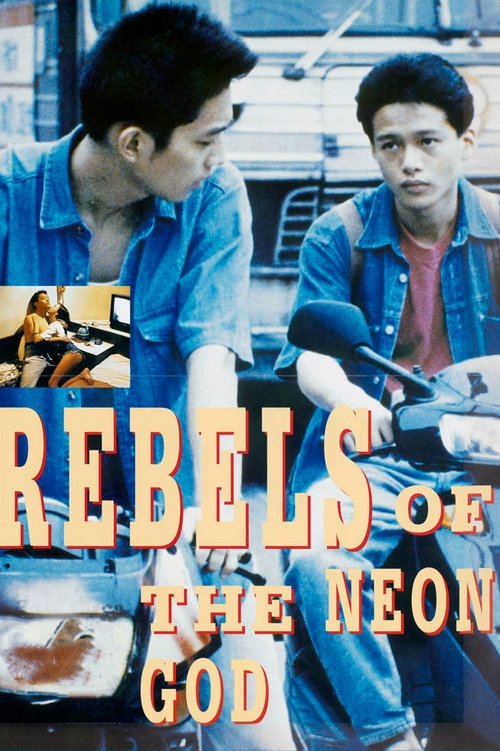
Rebels of the Neon God
1994 · Tsai Ming-liang
For when you're in the mood to marinate in atmosphere — a rainy-night city film for patient viewers who'd rather feel a mood than follow a plot. This is challenge-viewing, not comfort, and all the better for it.
What it's about
Four young people drift through neon-lit Taipei, barely connecting: a cram-school student who cashes out his tuition and quits, two petty thieves who rob payphones and arcade machines, and a girl circling between the roller rink and a flooded apartment. When one of the thieves smashes the mirror of a taxi driven by the student's father, the student begins secretly following him — a stalking his target never even notices.
The experience
Slow, deadpan, and saturated in urban loneliness — long takes, dripping water, arcade glow, almost no conversation. It's alienating by design, but the mood gets under your skin, and there's dry, absurd humor flickering through the gloom.
Performances
Lee Kang-sheng, in his first collaboration with Tsai Ming-liang, makes blankness magnetic as Hsiao-kang — a nearly wordless performance that launched one of cinema's longest actor-director partnerships.
The craft
Tsai's debut already has his complete visual language: fixed camera setups, water leaking into every space, city architecture framed like a trap, and an electronic score that pulses under the neon. The arcade and street photography of 1990s Taipei is a time capsule worth seeing on the biggest screen you can.
Why it matters
It announced Tsai Ming-liang as a major voice of the Taiwanese New Wave and set the template — urban drift, alienation, Lee Kang-sheng — for his entire body of work.
Snapshot
Tsai Ming-liang's first feature is a film about four young people in Taipei who almost never speak to one another and never quite meet. A cram-school student, Hsiao-kang, abandons his university entrance preparation and cashes in the refund; a small-time thief, Ah Tze, robs payphone coin boxes and pries circuit boards out of arcade cabinets with his friend Ah Ping; Ah Kuei drifts between the roller rink and Ah Tze's flooded apartment. A single act of vandalism at a traffic light — Ah Tze smashing the side mirror of a taxi driven by Hsiao-kang's father — sets off a stalking that the object of the stalking never notices. Nothing is resolved. The English title's nod to Rebel Without a Cause is a commercial fiction; the Chinese title, Qingshaonian Nezha (青少年哪吒, "Teenage Nezha"), names the film's real subject, the rebellious boy-god of Chinese myth who severed himself from his father. Shot in 1992 and circulated internationally from 1993, the film was for two decades the least-seen entry in a body of work that would define one strand of world art cinema — it did not receive a US theatrical release until 2015. Seen now, it is startlingly complete: the static long take, the leaking apartment, the muteness, the family of Miao Tien and Lu Yi-ching, and above all Lee Kang-sheng are all here at the outset.
Industry & production
The film was produced by the Central Motion Picture Corporation (CMPC), the Kuomintang-affiliated studio that had bankrolled the Taiwan New Cinema of the 1980s — the studio behind Hou Hsiao-hsien's and Edward Yang's early features, and behind the portmanteau In Our Time (1982) that is conventionally taken as the movement's starting gun. The producer, Hsu Li-kong, was CMPC's most consequential executive in this period, the figure who kept a door open for first-time directors when the commercial logic pointed elsewhere. That door mattered because the Taiwanese industry of the early 1990s was in freefall: domestic production had contracted sharply under the double pressure of Hong Kong genre cinema and American imports, and the pool of local films competing for local screens was shrinking year on year. The state's response, a Government Information Office subsidy scheme for feature production instituted at the turn of the decade, is the fiscal substrate on which much Taiwanese auteur cinema of the 1990s was built. Tsai's debut belongs to this economy of small budgets, short shoots, real locations, and directors who came to features from elsewhere.
Tsai came from theater and television. Born in Kuching, Sarawak, in 1957, ethnic Chinese and Malaysian, he moved to Taiwan in 1977 to study drama and film, and spent the 1980s writing and directing for the Taipei stage before moving into television work for Taiwan Television. Two elements of that apprenticeship carry directly into Rebels: a stage director's confidence that a single unbroken viewpoint can hold an audience, and the television habit of shooting in found spaces with performers who are not stars. The most consequential thing he took from it was a person. In 1991, while preparing a television film, Tsai noticed a young man loitering outside an arcade in Ximending, Taipei's youth-culture district. That was Lee Kang-sheng, who has appeared in every feature Tsai has made since — one of the longest continuous director-actor collaborations in the history of the medium, and one in which the character's name, Hsiao-kang, is essentially the actor's own.
Rebels is set almost entirely in Ximending and its surrounding streets: arcades, a roller rink, fast-food counters, hotel corridors, cram schools, night traffic. This is location shooting as method rather than as economy — the film's texture is inseparable from the specific commercial infrastructure of early-1990s Taipei.
Technology
Shot on 35mm in color, largely at night, the film depends on the light that Taipei already produces: neon signage, arcade cabinet glow, fluorescent tubes in stairwells and cram-school classrooms, headlights on wet asphalt. There is very little evidence of elaborate supplementary lighting; the palette is the sodium-and-fluorescent green-amber of the city itself, and the "neon" of the English title is at least accurate about the film's illumination.
More interesting is the film's attention to technology as the material of loneliness. Almost every human connection in Rebels is routed through a machine, and almost every machine is either broken, being robbed, or being used to avoid contact. Ah Tze and Ah Ping's crimes are technological in a precisely dated way: they steal the coin boxes out of public payphones and lever printed circuit boards out of coin-op arcade cabinets, monetizing the guts of the analog leisure economy. Hsiao-kang's surveillance of Ah Tze is conducted by motorbike, mirrored in the taxi that his father drives for a living. The film's last movement sends Hsiao-kang to a telephone dating club, dialing strangers from a booth — a pre-internet apparatus for mediated intimacy that now reads as almost archaeological. Water infrastructure is the counter-technology: Ah Tze's apartment floor is permanently under several inches of backed-up drain water that he bails and wades through and eventually simply lives with, the first appearance of the failing plumbing that runs through The River (1997), The Hole (1998), and Stray Dogs (2013).
The film also inherits the Taiwan New Cinema's decisive technical break with the Mandarin-language commercial norm: direct, synchronous sound rather than wholesale post-dubbing. This is what allows the film's mixture of Mandarin and Taiwanese Hokkien to sit naturally in the frame, and what makes its ambient soundscape possible at all.
Technique
Cinematography
Liao Pen-jung, who would shoot Tsai's next several features, works almost entirely in static medium and long shots on a locked-off camera, with occasional slow reframing. The compositional principle is architectural: characters are placed inside doorframes, corridors, stairwells, window grilles and vehicle interiors, so that the built environment does the work of framing and the characters appear as tenants of a geometry indifferent to them. Depth is used constantly — action in the far background of a held shot, a figure passing through a doorway at the rear of a room. There is very little coverage in the conventional sense and almost no shot/reverse-shot, which is the technical mechanism of the film's central effect: because the grammar of exchange is withheld, characters who share a frame do not seem to share a scene. Mirrors, glass, and reflective surfaces recur, most pointedly the smashed side mirror that initiates the plot.
Editing
The cut is the film's least assertive element, by design. Shots are held past the point at which narrative information has been delivered and into the duration of ordinary time — waiting, eating, wading, riding. Transitions are typically hard cuts between two static setups with no establishing logic, so that spatial relationships between the two storylines have to be inferred rather than shown. Crucially, the two strands are cross-cut without ever being resolved into a meeting: parallel montage, the classical device for promising convergence, is deployed here as a machine for withholding it. The circulating credits for the film's editing are thin enough that I would not want to attribute the cut to a named hand with confidence; what is clear from Tsai's practice across his career is that shot duration is fixed at the point of shooting, not discovered in the edit.
Mise-en-scène / staging
This is where the theater training shows. Tsai stages in depth within a fixed frame, moving performers through the shot rather than moving the camera to them, and he lets spaces accumulate meaning through repetition — the same apartment, the same corridor, the same arcade, returned to until the viewer knows their dimensions. Water is the governing material: rain outside, flooding inside, condensation, bathing. Food and its consumption occupy long stretches. Objects are given time to become significant: a compass, an insect, a lock, a can of spray paint, a plastic bag. The mother's household shrine and her consultation with a medium introduce Taiwanese folk religion not as local color but as the film's interpretive frame — she becomes convinced her son is the incarnation of Nezha, the Third Prince.
Sound
There is essentially no non-diegetic score, and the film's soundtrack is its locations: arcade attract-modes and coin drops, motorbike engines, rain on metal, traffic, the hum of fluorescent light, television at low volume, water. Dialogue is extremely sparse and frequently functional — requests, refusals, transactions. Silence is not an absence here but a positive quantity, and the film's dramatic peaks are often marked by a reduction in sound rather than an increase.
Performance
Tsai directs against psychological expression. Lee Kang-sheng's Hsiao-kang is famously opaque — a face that registers without explaining, an affect that resists being read as motivation. Tsai has described repeatedly, in interviews across his career, how he came to build his cinema around Lee's naturally slow tempo rather than correcting it, and Rebels is the origin point of that decision. Chen Chao-jung's Ah Tze supplies the film's only conventional charisma and is the closer thing to a screen actor's performance; Wang Yu-wen's Ah Kuei carries a watchfulness that the film never converts into interiority. Miao Tien, as the father, is a veteran of an entirely different Chinese-language cinema — he had appeared in King Hu's wuxia films of the 1960s, a lineage Tsai would make explicit years later in Goodbye, Dragon Inn (2003), where Miao Tien sits in a dying cinema watching his own younger self. Lu Yi-ching, as the mother, was a non-professional whom Tsai brought to the screen. Together the three constitute a family unit that Tsai reassembled across subsequent films — the same actors, differently configured, in The River and What Time Is It There? (2001).
Narrative & dramatic mode
The film is structured as two parallel lines that touch once, glancingly, and then diverge. There is an inciting incident, a vendetta, and a retaliation, but the causal chain never closes: Ah Tze does not learn who spray-painted "AIDS" on his motorbike and toppled it, and Hsiao-kang's revenge produces no acknowledgement, no confrontation, no relief. What replaces plot is a system of rhymes — two young men in cramped rooms, two forms of petty theft, two failed households, two kinds of waiting. Dramatic mode is behavioral rather than expressive: we are given actions without stated motives and asked to infer, and the inferences never fully settle. The refusal of catharsis is the point. Tsai's characters are not repressing something that the film will eventually release; the film proposes that there may be nothing behind the affect but the condition of being twenty in this city.
Genre & cycle
Nominally a juvenile-delinquency film, Rebels belongs to the international lineage that runs from Los Olvidados (1950) and Rebel Without a Cause (1955) through Truffaut's The 400 Blows (1959) and Bresson's Pickpocket (1959) — the last two are especially relevant, the first for the runaway adolescent and the second for the anti-psychological treatment of petty theft. But the film systematically defeats genre expectations. The crimes generate no suspense, no pursuit, no consequence; there is no gang, no code, no initiation. The "crime" tag on the film is technically accurate and critically misleading.
Within East Asian cinema, it opens a cycle rather than joining one: the 1990s films of disaffected urban youth in stalled economies, of which Jia Zhangke's Xiao Wu (1997) and Fruit Chan's Made in Hong Kong (1997) are the closest siblings — parallel developments across three Chinese-speaking industries responding to comparable pressures, rather than a case of direct transmission.
Authorship & method
Tsai wrote the screenplay alone, as he did on his early features, and the film is unusually pure as an authorial statement: nearly every element that would define the next thirty years is present at full strength on the first attempt. His method is accretive and personal — the same actor, the same family, the same city, the same apartment blocks, the same failing plumbing, reworked film after film into what is effectively a single continuous work. Hsiao-kang, begun in Tsai's television work and given feature form here, is still being played by Lee Kang-sheng in Stray Dogs (2013) and Days (2020), aging in real time across three decades.
Key collaborators: cinematographer Liao Pen-jung, who established the static-frame grammar and stayed for Vive L'Amour, The River, and The Hole; producer Hsu Li-kong at CMPC, without whose institutional cover the film is hard to imagine; and the repertory company — Lee Kang-sheng, Miao Tien, Lu Yi-ching, Chen Chao-jung — that Tsai carried forward. On the music and editing credits the readily available record is genuinely thin, and I would rather note that than guess; what can be said with confidence is that the film's score is functionally negligible and that its rhythm is a matter of shot length rather than assembly. From The Hole onward Tsai would reverse this completely, importing Grace Chang's 1950s Mandarin pop as full-blown musical numbers.
Movement / national cinema
Rebels is usually placed at the head of Taiwan's "Second New Wave" — the generation that emerged around 1990–1994, including Ang Lee, Yee Chih-yen and Chen Yu-hsun, following the Taiwan New Cinema of Hou Hsiao-hsien and Edward Yang. The inheritance from the first wave is direct: long takes, real locations, synchronous sound, non-professional performers, refusal of melodramatic convention. The break is equally clear. Where Hou's cinema is historical and rural-to-urban in its imagination, and Edward Yang's Taipei films — Taipei Story (1985), The Terrorizers (1986), A Brighter Summer Day (1991) — anatomize a whole social order, Tsai narrows radically to bodies, rooms, appetites and fluids, and drops national-historical allegory almost entirely. His Taipei is not a nation in miniature; it is a set of adjacent boxes containing people who cannot get out of them.
Tsai's own position as a Malaysian-Chinese who arrived in Taipei at twenty is legible throughout, and it is one reason the city in his films is rendered as a place nobody is from.
Era / period
The film registers early-1990s Taiwan with documentary precision. Martial law had been lifted in 1987; the first direct presidential election was still years away; the export-driven boom of the 1980s had produced a prosperous, rapidly urbanizing society whose young people had money for arcades and motorbikes and a credential system — the university entrance examination and the cram-school industry built around it — that structured their adolescence entirely. Hsiao-kang's revolt is against that machine specifically: he does not run away or join anything, he simply withdraws his tuition and stops. The film's sociology is exact and almost entirely unstated. It also, in the spray-painted word on Ah Tze's motorbike, catches the period's particular fear of AIDS as an instrument of insult, which will look forward to the illness and bodily dread that dominate Tsai's later films.
Reception, canon & influence
The film's critical trajectory was slow and inverted. It circulated on the international festival circuit from 1993, picking up attention at festivals oriented toward first features, but its wider visibility abroad came only after Vive L'Amour took the Golden Lion at Venice in 1994 — after which Rebels was reappraised as the origin text rather than encountered on its own terms. Its Anglophone afterlife was extraordinarily delayed: the film did not receive a US theatrical release until 2015, more than two decades after production, when a restoration was distributed there for the first time and generated a full wave of American criticism for a film already regarded as canonical elsewhere. Reviews at that point were near-uniformly admiring, and frequently remarked on how little the film had dated.
Backward: the inheritance runs from Taiwan New Cinema, from European modernism — Antonioni's studies of urban estrangement, Fassbinder (whom Tsai has consistently named as formative), Bresson's non-expressive performers, Truffaut's adolescent — and from Chinese myth. The Nezha frame is not decorative. In the Investiture of the Gods tradition, Nezha is the unmanageable boy-god who comes into fatal conflict with his father, the general Li Jing, and returns his flesh and bones to his parents to sever the debt of filiation. Reading the film through that story — the mother's conviction, the medium's counsel, the son's mute war on a man whose taxi stands in for the father's authority — is an interpretation the film clearly invites, and the Chinese title makes it the primary one.
Forward: the film's descendants are, first, Tsai's own — a body of work that pushed duration, silence and the fixed frame to their limits and ended by migrating into gallery and museum space with the Walker series. Beyond that, Rebels is a founding document of what came to be discussed in the 2000s and 2010s as "slow cinema," the critical category in which Tsai is routinely named alongside Béla Tarr, Lisandro Alonso and Apichatpong Weerasethakul; and it is a touchstone for queer Asian cinema, where Tsai's treatment of desire, bodies and unspoken longing — developed explicitly from Vive L'Amour and The River onward — was foundational. Its most durable legacy may be simply the demonstration it made: that a first feature could dispense with dialogue, plot resolution, score, and camera movement, and still hold.
A Deleuzian reading
There's a floor in this film that never dries.
The full Deleuzian reading of Rebels of the Neon God →
Reception
It made little noise outside the festival circuit in the early '90s, living in the shadow of Taiwan's more famous auteurs — then didn't even get a US theatrical release until 2015, over two decades late, and has since become a Letterboxd-era favorite for anyone chasing neon-lit urban loneliness.
How Rebels of the Neon God was received, from release to now →
How to watch Rebels of the Neon God: what to notice on a first viewing
- Notice characters framed inside doorways, corridors, and window grilles. Tsai and cinematographer Liao Pen-jung keep the camera locked off and let doorframes, stairwells, and grilles do the framing, so people read as tenants of the building. The architecture, not the actors, runs the show.
- Listen for the total absence of background music. There is no score at all. What fills the soundtrack is arcade noise, motorbike engines, rain, and fluorescent hum, the city's own sound standing in for feeling. The missing music makes the ordinary noise of Taipei feel like the film's real subject.
- Notice two people share a frame but seem to share nothing. Tsai avoids the usual back and forth of shot and reverse shot, so characters occupying the same room rarely feel like they are in the same scene. The missing exchange of glances is why everyone in this film feels alone even in company.
- Watch the standing water on the apartment floor. Ah Tze's drain has backed up, and rather than fixing it he wades through it, the flooded floor becoming an ordinary, unremarked feature of his home. A small, unfixed disaster sits at the center of daily life and nobody treats it as one.
- Watch Lee Kang-sheng's face for what it refuses to show. Tsai builds his cinema around Lee's naturally slow, blank tempo instead of correcting it, so Hsiao-kang registers feeling without ever explaining it. You are left to guess at a motive the film may not actually be hiding.
The whole guide to watching Rebels of the Neon God, with the keys for a rewatch →
Influences: the films it descends from and the films it influenced
- Pickpocket (1959) — Supplies the model rather than the actor — Lee Kang-sheng's blank, unreadable face and unexplained petty theft repeat Bresson's method of stripping motive from crime and letting hands, coins and mechanical gesture carry the scene where psychology would normally go.
- L'Eclisse (1962) — The device of holding a locked-off frame on built space before characters enter and after they leave, so the architecture — stairwells, intersections, hard modernist surfaces — outlasts the human event and becomes the film's true subject.
- The 400 Blows (1959) — The delinquent-adolescent structure kept observational rather than moralized: parental verdicts stay off-screen, the boy is simply followed through the city, and the film ends on arrest of movement instead of resolution — Tsai's refusal of catharsis is a direct inheritance.
- The Merchant of Four Seasons (1971) — The formative model Tsai names: melodramatic family cruelty staged in flat frontal tableaux and doorway framings, with performers held at emotional zero so that the composition, not the acting, delivers the violence.
- The Terrorizers (1986) — The exact structural template of non-convergent parallel montage — Taipei lives cut against each other for a whole film while barely intersecting, contact registered as coincidence or damage rather than as plot convergence.
- A Brighter Summer Day (1991) — Establishes the Taiwanese juvenile-delinquency film as a study of available-light darkness and off-screen violence: static wide takes in unlit interiors and alleys, with the decisive act placed at the edge of the frame or outside it.
- The Boys from Fengkuei (1983) — Fixes the New Cinema grammar Tsai starts from — aimless youths shot in distant long takes with no shot/reverse-shot coverage, ambient direct sound as the only score, and scenes ended by the shot's duration rather than by narrative punctuation.
- Boys (1991) — The television work where Hsiao-kang and Lee Kang-sheng were invented; the drifting Taipei street kid, the arcade-and-alley geography and the casting of Lee as a non-performer are carried into the feature almost intact.
- Taipei Story (1985) — Inherits the Taipei-youth alienation, static long shots, and neon-and-glass reflective surfaces, extending Yang's urban geometry into a colder, near-silent register.
- Vive L'Amour (1994) — Takes the non-convergent trio and empties it further — an unsold apartment as the only shared space, near-total dialogue removal, and a closing unbroken take of weeping held far past its dramatic use, with Liao Pen-jung's static frame unchanged.
- The River (1997) — Escalates the water motif from Rebels' backed-up drain into a permanently leaking ceiling that organizes the whole apartment set, and reassembles the same repertory family — Lee Kang-sheng, Miao Tien, Lu Yi-ching — as a household that never shares a frame in dialogue.
- The Hole (1998) — Pushes the flooding staging to a total condition — endless rain, a hole punched between two apartments — while inverting the no-score rule of Rebels by importing Grace Chang's Mandarin pop as full musical numbers spliced into the same locked frames.
- What Time Is It There? (2001) — Extends the street-commerce and payphone material of Rebels into a two-city parallel structure whose strands are guaranteed never to meet, with the watch and the clock replacing the arcade token as the object that stands in for contact.
- Goodbye, Dragon Inn (2003) — The endpoint of the fixed-frame method: a decaying cinema shot as architecture with almost no dialogue, where shot length and the sound of rain and footsteps do all the work the arcade sequences of Rebels first assigned to duration.
- Stray Dogs (2013) — Completes the accretive project by having Lee Kang-sheng age two decades inside the same role, holding shots for ten-plus minutes and returning to rain, ruined interiors and standing water as the film's only weather and only event.
- The Missing (2003) — Tsai's lead turning director with Tsai producing: the same locked-off Taipei frames, the same drift through arcades and public spaces, and Miao Tien reused so the repertory grammar passes directly into a second filmmaker's hands.
- Blissfully Yours (2002) — Builds a film out of a bifurcated, non-convergent structure and real-time duration in which ambient jungle and traffic sound replaces score entirely, and performers give nothing readable — the slow-cinema grammar Rebels helped codify.
- Left-Handed Girl (2025) — Turns Taipei's neon arcades and rain-slicked night streets into expressive social texture, the nocturnal urban palette this film inherits for its market.
- Xiao Wu (1997) — The Bressonian pickpocket relocated to a demolition-era Chinese town and shot the same way Tsai shoots Taipei — a non-professional lead with unreadable affect, long static or minimally adjusted takes, and direct sound with no score.
- Distant (2002) — Two men sharing an apartment without speaking, framed in immobile compositions that make furniture and doorways the mediators of a relationship, with the sound of the building substituting for dialogue and no resolution offered.
- A City of Sadness (1989) — Carries New Taiwan Cinema's durational aesthetic into the city, holding on static frames and near-wordless waiting until time itself becomes the expressive material.
Similar films
- What Time Is It There? (2001) — influence & lineage · same viewing thread
- Goodbye, Dragon Inn (2003) — influence & lineage · same viewing thread
- A Brighter Summer Day (1991) — influence & lineage · same viewing thread
- The Boys from Fengkuei (1983) — influence & lineage
- Taipei Story (1985) — same viewing thread
- Millennium Mambo (2001) — same viewing thread
- A City of Sadness (1989) — same viewing thread
- The Time to Live and the Time to Die (1985) — same viewing thread
All the films related to Rebels of the Neon God →
Watch it with: curated runs of related films
- Sinophone Slow Cinema — A run of Chinese-language films — Taiwan's New Wave and its mainland and Bi Gan heirs — where time pools and city, family, and memory recur; watch them near each other, from A Brighter Summer Day to An Elephant Sitting Still, for how they rhyme on drift and the weight of the past.