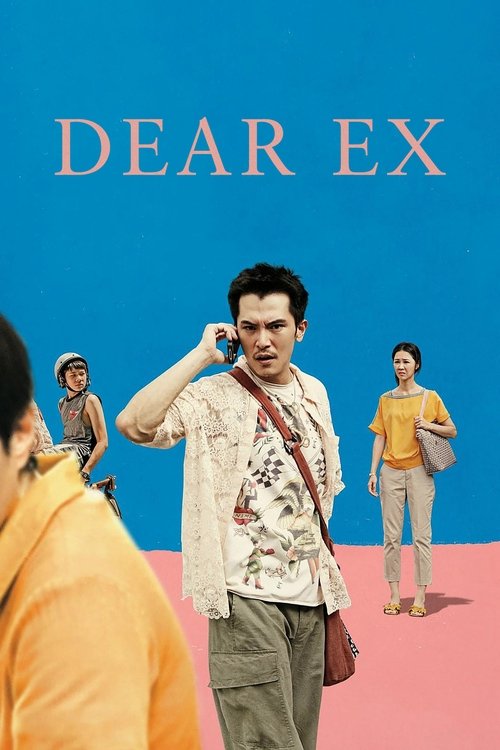
Dear Ex
2018 · Mag Hsu
For when you want a good cry that comes with laughter attached — a film about complicated, imperfect love that leaves you wrung out but softened. Reach for it when you're ready to feel a lot.
What it's about
When her ex-husband dies of cancer, San-lian discovers he changed his life insurance to cut out their teenage son in favor of a stranger — Jay, the man he left the family for. Her furious campaign to claw back the money collides with her son running away to camp out in Jay's cramped apartment, and the three of them — angry widow, grieving boyfriend, sullen kid — are forced into each other's lives by the man none of them fully knew. The question hiding inside the fight over money is who actually loved him, and who he actually loved.
The experience
A tragicomedy in the truest sense: it lets you laugh at shouting matches and petty sabotage, then blindsides you with grief. It's messy, humane, and builds to an emotional payoff that earns every tear.
Performances
Hsieh Ying-xuan is ferocious and wounded as the widow whose rage keeps cracking open into heartbreak, and Roy Chiu gives Jay a prickly, wisecracking surface over bottomless grief — the two of them make enemies you root for equally.
The craft
The writing is the marvel: a probate dispute becomes a three-way portrait of mourning, with perspective shifting between wife, lover, and son until your sympathies have flipped several times over. It threads farce and devastation through the same scenes without either undercutting the other.
Why it matters
One of the most acclaimed Taiwanese films of its year, it caught a cultural moment — arriving as Taiwan debated marriage equality — by treating a gay love story and a wronged wife's grief with equal, unranked compassion.
Snapshot
Dear Ex (誰先愛上他的, literally "Who Loved Him First") is a Taiwanese tragicomedy directed by Mag Hsu and Hsu Chih-yen, released on 2 November 2018. Its premise is a probate dispute charged with grief: when Song Zheng-yuan dies of cancer, his widow Liu San-lian discovers that he redirected his life-insurance payout away from their teenage son and toward Jay, the male lover for whom he had years earlier left the family. What begins as a widow's furious campaign to reclaim the money becomes an anatomy of three people bound by one absent man — the angry wife, the grieving boyfriend, and the sullen adolescent son, Cheng-xi, who runs away from his mother to camp out in Jay's cramped apartment. The film's animating question is embedded in its Chinese title: in a love triangle where one point is dead and another is a man, who exactly is the interloper, and who has the right to mourn? Across roughly 100 minutes, Dear Ex converts a story that could have been a courtroom melodrama into a warm, brightly colored, often very funny meditation on love unrecognized by law and family. It emerged as the standout Taiwanese narrative feature of its year, winning three prizes at the 55th Golden Horse Awards, and reached a global audience through Netflix.
Industry & production
Dear Ex was a modestly budgeted Taiwanese independent production, credited to Dear Studio alongside partners including Comic Communication Studio, Ocean Entertainment, and Hervoice Concept. It belongs to the post-2008 ecology of Taiwanese filmmaking, in which locally rooted, mid-budget dramas and comedies — descendants of the commercial revival often dated to Cape No. 7 (2008) — compete for domestic attention against Chinese-market blockbusters. Its release timing is inseparable from its meaning: it opened three weeks before Taiwan's 24 November 2018 referendums on same-sex marriage, and roughly six months before Taiwan became the first place in Asia to legalize it in May 2019. The film thus arrived as a piece of popular culture in direct conversation with a live national debate about whose families count.
Both directors were making their feature debuts. Mag Hsu came to the project as one of Taiwan's most decorated television screenwriters, and the film's development reflects that television pedigree — a script-first sensibility, tightly drawn domestic conflict, and an emotional structure built for broad audiences rather than festival abstraction. International distribution through Netflix substantially expanded the film's footprint beyond a theatrical run that, by most accounts, was commercially modest relative to its awards profile; precise box-office figures are not something I can state reliably here.
Technology
Dear Ex is a conventionally mounted digital production of its era, shot for a standard theatrical release; I do not have verified details of the specific camera system, sensor, or capture format, and will not invent them. What is worth noting technologically is less the hardware than the delivery pipeline: the film is a clear instance of the streaming-era Taiwanese feature whose primary route to a worldwide audience was a subscription platform rather than international theatrical distribution. That distribution reality shaped its afterlife more than any on-set technology, giving a small Taipei-set family drama a viewership that a comparable film a decade earlier would rarely have reached, and helping seed the international critical writing that now surrounds it.
Technique
Cinematography
Shot by Lin Chih-peng, the film's visual scheme leans deliberately away from the muted naturalism associated with Taiwan's art-cinema tradition. Its palette runs warm and saturated — the reds and yellows of cramped Taipei interiors, night streets, and Jay's ramshackle apartment and theater — a chromatic energy that keeps the material buoyant even as the subject matter is bereavement and estrangement. The camera favors close, mobile, human-scaled framing that keeps faces and reactions central; this is a film of looks exchanged across kitchen tables and theater seats rather than of landscape or architectural composition. The visual approach is expressive and character-forward, matched to a story that lives in the fluctuating temperatures between its three leads.
Editing
Editing is the film's most award-recognized craft element: Lei Chen-ching won Best Film Editing at the 55th Golden Horse Awards. The recognition is apt, because the film's tonal management is fundamentally an editing achievement. Dear Ex pivots rapidly between comedy and grief, between the present-day conflict and glimpses of the past, and between the son's subjective vantage and the wider drama — and it is the cutting that holds these registers together without whiplash. The rhythm is brisk and pop-inflected, using elisions and abrupt tonal turns to puncture sentimentality before it curdles, a strategy essential to a dramedy that must earn its tears without drowning in them.
Mise-en-scène / staging
The film is organized around a small number of intensely used spaces: the widow's respectable middle-class home, Jay's disordered apartment, and the fringe theater where Jay works as a director-performer. That theater is the film's central staging conceit — a play-within-the-film whose rehearsal and performance rhyme with the emotional action, letting the movie externalize private feeling through the artifice of the stage. The clutter and improvisation of Jay's world are set against the ordered surfaces of Sanlian's household, so that the production design itself argues the film's theme: two competing definitions of a proper life, neither wholly adequate.
Sound
The score and songs come from Lee Ying-hung, the Taiwanese musician also known as DJ Didilong, whose sensibility — a contemporary, Hokkien-inflected, city-pop-adjacent idiom — gives the film a distinctly local, unstuffy texture. The theme song, "Bali Song" (峇里島), won Best Original Film Song at the Golden Horse Awards and functions as more than a closing-credits flourish: the fantasy of a trip to Bali recurs as an image of the ordinary happiness the dead man both promised and withheld. The music's pop warmth is one of the chief instruments by which the film keeps its melodrama humane and modern rather than mournful.
Performance
Performance is where Dear Ex is strongest and most celebrated. Hsieh Ying-xuan won Best Leading Actress at the Golden Horse Awards for Liu San-lian, a role that begins as caricature — the shrieking, wronged widow — and is progressively excavated into a portrait of a woman terrified that her whole married life may have been a lie she was never told. Roy Chiu, previously known primarily as an idol-drama lead, reinvented his screen identity as Jay, finding tenderness and defensiveness in a man the plot invites us to distrust; the role earned a Golden Horse nomination for Best Leading Actor and marked a decisive critical turn in his career. Joseph Huang, as the son whose diary and narration frame much of the story, anchors the film's point of view and was recognized with a Golden Horse nomination for a newcomer, while Spark Chen appears as the dead father in the film's memory passages.
Narrative & dramatic mode
The film's dramatic mode is domestic tragicomedy filtered through an adolescent's subjectivity. Much of the story is framed by Cheng-xi's writing — a diary/notebook device and voiceover that positions the boy as both narrator and unreliable witness, a child trying to adjudicate an adult catastrophe he only half understands. This framing is crucial: by routing the material through the son, the film earns its comedy (the deadpan bafflement of a teenager stuck between a furious mother and his father's boyfriend) and defers its judgments, letting sympathy migrate across all three characters rather than settling on a villain. The structure braids present-tense conflict with fragments of the past, and uses the theater subplot as a mirror in which the characters' buried feelings are performed aloud. It is melodrama in the precise sense — a drama of moral legibility and heightened feeling about family — but continually undercut by comedy and by the refusal to let any one party own the grief.
Genre & cycle
Dear Ex sits at the intersection of the family melodrama and the LGBTQ+ drama, and it is best understood within a specific cycle: the wave of mainstream-facing Taiwanese queer cinema that crested around the marriage-equality years. Where earlier landmark Taiwanese films treated homosexuality through art-cinema distance or coming-of-age tenderness, Dear Ex approaches it obliquely and after the fact — the gay relationship is never the "issue" to be debated but the settled premise whose social consequences (inheritance, recognition, a widow's and a lover's competing claims) drive the plot. It is nearly contemporaneous with, and thematically adjacent to, the broader mainstreaming of Taiwanese gay-themed film that would continue with titles such as Your Name Engraved Herein (2020). Its generic hybridity — grief comedy, inheritance dispute, coming-of-age, backstage theater story — is the point: it smuggles a serious argument about queer kinship inside an accessible, crowd-pleasing dramedy.
Authorship & method
The authorship of Dear Ex is genuinely collaborative, but its guiding intelligence is Mag Hsu's. Hsu built her reputation as a television screenwriter — most famously the acclaimed romance series In Time with You (我可能不會愛你) — and Dear Ex is legibly the work of a dramatist who thinks in dialogue, character reversal, and structure. She co-directs with Hsu Chih-yen, a younger filmmaker whose partnership supplied the film its brisk, contemporary visual and comic energy; interviews around the release framed the co-direction as a complementary pairing of a veteran writer's dramaturgy with a newer director's craft. The screenplay is credited to Lu Shih-yuan and Mag Hsu; Lu is herself a major Taiwanese screenwriter, associated shortly afterward with the landmark series The World Between Us (2019), and the script's compassionate, multi-perspective construction bears that television-drama DNA of giving every antagonist a defensible interior.
The key technical collaborators are consistent with this author-plus-craftspeople model: cinematographer Lin Chih-peng supplied the warm, close visual style; editor Lei Chen-ching, the Golden Horse–winning tonal control; and musician Lee Ying-hung (DJ Didilong), the contemporary local sound and the prize-winning theme song. It is a film whose method — script-first, performance-driven, tonally nimble — reflects the crossover of Taiwan's strong television-writing culture into feature filmmaking.
Movement / national cinema
Dear Ex is a product of contemporary Taiwanese cinema in its post–New Wave, commercially revived phase. It descends less from the contemplative art cinema of Hou Hsiao-hsien and Edward Yang than from the audience-facing local filmmaking that reasserted itself after 2008, which sought to tell recognizably Taiwanese stories for Taiwanese (and diasporic) audiences. Within that national context it occupies a notable position as a critically and industrially significant queer-themed feature at the exact historical moment Taiwan was legislating marriage equality — a film that helped popular culture keep pace with, and arguably nudge, a national conversation. It also exemplifies the outsized institutional role of the Golden Horse Awards, the leading Chinese-language film prizes, in validating and amplifying Taiwanese independent work.
Era / period
The film is stamped by its precise moment: late 2018, on the cusp of Taiwan's marriage-equality vote, and squarely inside the streaming transition that would carry small national films to international viewers. This dual context — a specific civil-rights inflection point plus a new global distribution logic — explains both why the film resonated at home and why it found an audience abroad that a comparable Taiwanese family drama might not have reached a decade earlier. It is an artifact of the exact seam between Taiwan's pre- and post-marriage-equality eras.
Themes
At its center Dear Ex is about recognition — who is permitted to love, to grieve, and to inherit. The insurance policy operates as the film's master metaphor: a legal instrument standing in for the question of whose bond with the dead man was "real," and the fight over money is really a fight over acknowledgment. Around this the film develops several linked themes: the invisibility of same-sex partners within the law and the conventional family; grief as a contested resource that the widow and the boyfriend each feel entitled to hoard; the possibility of chosen family beside or against biological family; and the passage from an adolescent's black-and-white moral judgment toward adult ambiguity, as Cheng-xi learns that his mother, his father, and Jay are each wounded rather than simply right or wrong. The recurring Bali fantasy crystallizes a quieter theme — the small, deferred, ordinary happiness that people sacrifice to duty or fear. Notably, the film locates its emotional generosity not in polemic but in comedy and forgiveness.
Reception, canon & influence
Critically, Dear Ex was received as a breakout — the leading Taiwanese narrative feature of its year and, for many reviewers writing in both Chinese- and English-language outlets, a rare film able to treat a queer family rupture with humor, warmth, and moral even-handedness. Its award record is the clearest measure of its standing: eight nominations at the 55th Golden Horse Awards and three wins — Best Leading Actress (Hsieh Ying-xuan), Best Original Film Song ("Bali Song"), and Best Film Editing (Lei Chen-ching) — with further nominations including Best Feature Film, Best Leading Actor, Best New Performer, Best New Director, and Best Original Screenplay. It was subsequently selected as Taiwan's official submission for the Academy Award for Best Foreign Language / International Feature Film, though it did not earn a nomination.
Looking backward, the film's influences are less a single precursor than a confluence: the Taiwanese tradition of the domestic family drama; the country's lineage of queer-themed cinema; and, most concretely, the sophisticated television-writing culture from which both Mag Hsu and Lu Shih-yuan emerged, which lends the film its multi-perspective empathy and structural tidiness. Looking forward, its legacy is threefold. It cemented a template for the accessible, prize-winning Taiwanese queer dramedy at the very moment of marriage equality, feeding into the broader mainstreaming of gay-themed Taiwanese features that followed. It served as a career-redefining showcase — most visibly relaunching Roy Chiu as a serious dramatic actor and confirming Hsieh Ying-xuan as a leading screen talent. And, through its Netflix distribution, it became one of the more widely seen contemporary Taiwanese films internationally, an example of how a small national drama could travel. Its most durable influence may be tonal: the demonstration that a story about death, betrayal, and legal exclusion could be told as a warm comedy of forgiveness without diminishing any of its stakes.
Reception
A sleeper hit at home — it swept the 2018 Taipei Film Festival and took three Golden Horse Awards — then found a global second life when Netflix streamed it worldwide in February 2019, turning a local Taiwanese dramedy into an international word-of-mouth discovery.
How Dear Ex was received, from release to now →
Influences: the films it descends from and the films it influenced
- The Wedding Banquet (1993) — Establishes the template of staging a gay son's rupture with his family as a warm reconciliation comedy that grants the wounded traditional parent a dignified, defensible interior rather than a villain.
- Eat Drink Man Woman (1994) — Ang Lee's multi-strand family melodrama, built from contrasting domestic rituals around the family table, pioneers the rotating-sympathy structure in which allegiance shifts from member to member that Dear Ex inherits.
- Yi Yi (2000) — Yang refracts an adult family crisis through a child's uncomprehending observation, the innocent's-eye framing device Dear Ex hands to its adolescent narrator.
- A Time to Live and a Time to Die (1985) — Hou lays a retrospective first-person voiceover over family illness and death, the confessional child-narrator mode Dear Ex adopts for its teenage diary framing.
- Vive L'Amour (1994) — Tsai charts queer longing through the contrast between empty and occupied apartments, the contrasting-domestic-spaces grammar for coding who belongs and who is shut out that Dear Ex reuses.
- All About My Mother (1999) — Almodóvar's melodrama excavates society's caricatures — queer figures, chosen family — into full interiors and treats grief in a saturated, warm register, the excavated-caricature plus queer-kinship method.
- Comrades: Almost a Love Story (1996) — Chan threads a recurring pop song (Teresa Teng) through his melodrama as an emotional leitmotif, the model for Dear Ex's use of 'Bali Song' as a recurring theme-song motif.
- Departures (2008) — Takita manages the rituals of death as a gentle tragicomedy that never deflates the grief, the same warm-comedy-about-mortality tonal register Dear Ex sustains.
- Dear Tenant (2020) — Near-identical premise of a surviving gay partner's legal and kinship exclusion after a death, mediated through a child, extending the queer-kinship-recognition melodrama at the marriage-equality cusp.
- Your Name Engraved Herein (2020) — Extends the accessible, Netflix-distributed, prize-winning Taiwanese gay-drama template Dear Ex cemented at the exact moment of marriage equality.
- Marry My Dead Body (2022) — Pushes the tonal blend further, using broad genre comedy (a ghost marriage) to smuggle in genuine queer-kinship pathos, descending from Dear Ex's comedy-over-tragedy tonal management.
- Little Big Women (2020) — Centers the dead man's mistress at his funeral and excavates the rival woman into a sympathetic figure over inheritance — the same excavated-caricature-around-a-death tragicomic structure.
- A Sun (2019) — Rotates sympathy across parents and sons and manages harsh-to-warm tonal swings within one family, a sibling instance of the post-2008 revival's script-driven multi-perspective family melodrama.
- The World Between Us (2019) — Same co-writer applies the identical television-drama method of giving every antagonist — even a mass killer's family — a defensible, multi-perspective interior.
- The Great Buddha+ (2017) — Uses an intrusive director-narrator voiceover to manage tonal whiplash between deadpan comedy and social tragedy, a sibling in narration-driven tonal control within the post-2008 Taiwanese revival.
Similar films
- Your Name Engraved Herein (2020) — influence & lineage
- A Sun (2019) — influence & lineage
- Yi Yi (2000) — influence & lineage
- The Wedding Banquet (1993) — influence & lineage
- So Long, My Son (2019) — shared sensibility
- Man in Love (2021) — shared sensibility
- How to Make Millions Before Grandma Dies (2024) — shared sensibility
- The Farewell (2019) — shared sensibility