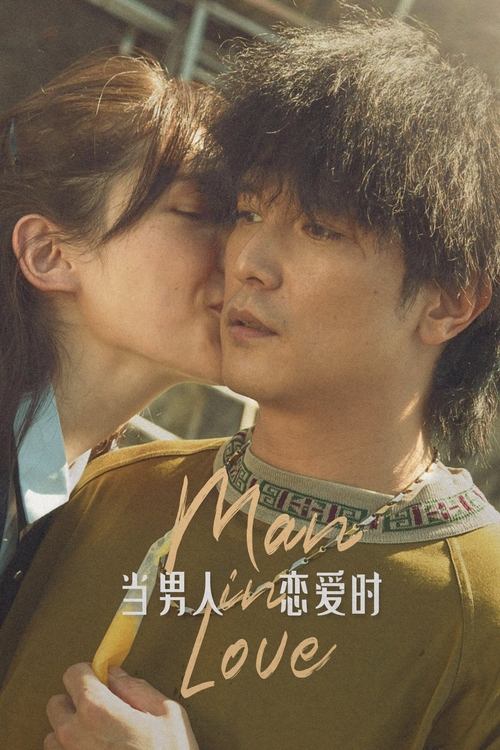
Man in Love
2021 · Yin Chen-hao
For when you want a big, unembarrassed romantic cry — the kind of love story that goes all in on feeling. Comfort food with a bruised heart.
What it's about
A small-time debt collector in working-class Taiwan is sent to squeeze money out of a young woman buried under her ailing father's medical bills — and falls for her instead. His offer: he'll cover her debts if she agrees to date him. What starts as an ugly bargain turns into a courtship between a swaggering, tender-hearted enforcer and a woman too exhausted to believe in anyone, with his violent world and her obligations pressing in from all sides.
The experience
It swings hard between rowdy gangster comedy and full-throttle tearjerker melodrama, and it commits completely to both. Expect to laugh at the hero's hopeless swagger for an hour and then get quietly demolished.
Performances
Roy Chiu is the whole show as the loan-shark suitor — ridiculous, preening, and then suddenly heartbreaking — opposite Ann Hsu's guarded, wearied warmth; the chemistry sells a premise that shouldn't work.
The craft
Director Yin Chen-hao came up through music videos, and it shows in the best way: a saturated, neon-and-fluorescent vision of working-class Taiwan, needle-drops that hit like choruses, and a confident tonal control that keeps the comedy and the melodrama from canceling each other out. A remake of a Korean film, it fully re-roots the story in Taiwanese street-level texture.
Why it matters
A runaway domestic box-office hit that became one of Taiwan's defining local successes of 2021, proving homegrown romantic melodrama could beat imports at their own game.
Snapshot
Man in Love (當男人戀愛時, Dāng Nánrén Liàn'ài Shí) is a Taiwanese romantic melodrama released in the spring of 2021, the feature directorial debut of Yin Chen-hao (殷振豪), who had previously built his reputation directing music videos and commercials. The film is an authorized remake of the 2014 South Korean melodrama of the same English title, Man in Love (남자가 사랑할 때), directed by Han Dong-wook, and it transposes that story's premise — a small-time debt collector who falls for one of his debtors, a young woman crushed by her sick father's medical bills — into a distinctly working-class Taiwanese idiom. The two leads are Roy Chiu (邱澤) as the loan-shark enforcer, and Ann Hsu / Hsu Wei-ning (許瑋甯) as the daughter he pursues. Against modest commercial expectations for a local romance, the film became one of the defining domestic box-office phenomena of its year in Taiwan and revived popular appetite for the bentu (本土, "native-soil") romantic melodrama. Its cultural footprint rests less on formal innovation than on its confident vernacular texture — Taiwanese Hokkien dialogue, a tâi-kheh (台客) streetwise masculinity, and an unabashed embrace of the tear-jerker's oldest machinery — and on a lead performance that critics and audiences treated as a genuine transformation.
Industry & production
Man in Love belongs to a wave of commercially minded Taiwanese genre filmmaking that sought, through the 2010s and into the 2020s, to win back a domestic audience long ceded to Hollywood and to Korean and mainland Chinese product. The project was structured around a proven foreign template: rather than originate a script, the producers acquired remake rights to a Korean hit, a strategy that had become common across East Asian markets because it de-risks development by starting from a story already validated at the box office. The Korean-to-Taiwanese transposition is the film's central production fact, and it shaped everything from the milieu (an unglamorous port-town, small-business, and gambling-den Taiwan) to the language choices.
Beyond that structural point, the granular production history — budget, financing partners, shooting schedule, and locations — is not something I can document precisely without risking invention, and I will not state figures I cannot stand behind. What is well established is the commercial outcome: the film was a major hit, widely reported at the time as among the highest-grossing domestic Taiwanese releases of 2021 and, by some accounts, of the preceding several years. I am confident about the scale of its success and its status as a word-of-mouth sensation; I am deliberately not quoting an exact gross, because the precise figure is the kind of detail that is easy to misremember, and the mandate here is accuracy over specificity.
Technology
Nothing about Man in Love suggests a film organized around technological novelty; it is a character melodrama shot with the conventional digital tools of contemporary mid-budget East Asian production, and its ambitions are dramatic and tonal rather than technical. It would have been captured and finished digitally, as essentially all commercial Taiwanese features of this period were, but I do not have verified details of the specific camera system, lenses, or post-production pipeline, and I will not manufacture them. The honest characterization is that the technology is invisible by design: the craft budget is spent on warmth, texture, and the legibility of faces, not on spectacle.
Technique
Cinematography
The visual approach serves intimacy and social texture rather than display. The film favors the cluttered, lived-in interiors of a debt collector's world — cramped offices, night markets, hospital corridors, modest apartments — and lights faces to carry the emotional weight. Because the drama turns on a gruff man's slow softening, the camera's job is to register micro-changes in a hardened face, and the coverage leans toward the classical romantic-melodrama grammar of shot/reverse-shot and warm, slightly nostalgic color. I am describing the film's evident visual strategy here; the identity of the cinematographer is not something I can attribute with confidence, and I decline to guess a name.
Editing
The editing follows the melodrama's contract with its audience: it builds patiently through a courtship that begins in coercion and curdles into genuine feeling, then accelerates emotional payoff in the later movements when illness and mortality enter the story. The remake structure gives the film a pre-tested rhythm — the beats of the Korean original are the load-bearing architecture — and the Taiwanese version's pacing is tuned to let comic, streetwise interludes breathe before the turn into tragedy. The specific editor is not verifiable to me, and I will not attribute the cut to a named individual.
Mise-en-scène / staging
This is where the remake most decisively becomes its own film. The staging is saturated with signifiers of working-class Taiwan: the loan-shark's economy of favors and threats, temple and street-level social life, betel-nut-and-scooter masculinity, the aesthetics of the tâi-kheh. Costume and setting mark the protagonist as a specific social type — flashy but cheap, tough but sentimental — and the production design uses the unglamorous to earn sincerity. The staging repeatedly frames the couple across a gulf of class and circumstance (creditor and debtor, enforcer and family in crisis) so that physical proximity registers as social transgression.
Sound
Sound and music are central to the film's popular appeal. The dialogue's frequent use of Taiwanese Hokkien alongside Mandarin is itself a sonic identity marker, coding authenticity and locality in a way Mandarin-only romance would not. The film is also remembered for its use of song — the melodrama tradition in which a theme number becomes inseparable from the picture's emotional brand — and its soundtrack circulated as part of the film's cultural moment. I do not want to over-specify composer credits or song attributions I cannot verify, so I note the prominence of the musical dimension without naming individuals.
Performance
Performance is the film's engine and its most celebrated element. Roy Chiu's turn as the debt collector was received as a career-redefining piece of acting — a movie-star charmer submerging himself in an unglamorous, dialect-speaking, physically and vocally coarsened working-class character, and finding pathos underneath the swagger. The performance was widely honored on the festival-award circuit in Taiwan; Chiu was recognized as Best Actor at the Taipei Film Awards for the role, and the part became the reference point for discussing his range. Ann Hsu, opposite him, anchors the film's plausibility: her character must move from wary resentment toward a man who first appears as a threat to genuine attachment, and the courtship only works if that arc reads as earned rather than coerced. I'll flag that I am confident about the critical elevation of Chiu's performance and the Taipei Film Award recognition, and less certain about the full slate of nominations across other ceremonies, which I won't enumerate speculatively.
Narrative & dramatic mode
The dramatic mode is full-throated melodrama — the genre of moral legibility, coincidence, illness, and the wringing of tears — operating in the specific subvariant of the redemptive-rogue romance. The narrative engine is a transactional premise that the film gradually converts into a moral one: what begins as a predatory arrangement (the creditor offering to relieve the debt in exchange for the daughter's company) is reframed as the awakening of a coarse man's capacity for love and sacrifice. This is a structure with obvious hazards — the coercive setup can read as troubling under a contemporary lens — and the film's dramaturgy is bent toward disarming that hazard by making the man the one who ultimately gives more than he takes, culminating in the melodrama's classic economy of self-sacrifice in the face of mortality. The mode is unironic and emotionally maximalist; it does not hedge its sentiment, and that commitment is precisely what its audience responded to.
Genre & cycle
Man in Love sits within the East Asian romantic-melodrama cycle and, more locally, within a recurring Taiwanese effort to build commercial hits out of bentu identity and unabashed feeling — a lineage whose popular landmark is the 2008 crossover success Cape No. 7 and which runs through subsequent locally flavored crowd-pleasers. The film also belongs to the pan-regional remake cycle, in which Korean melodramas and comedies are re-shot for Taiwanese, Chinese, and Southeast Asian markets. Within Roy Chiu's own filmography it connects to a run of well-received Taiwanese dramas that repositioned him from idol-drama actor toward serious leading man. As a genre object it is deliberately traditional: it revives the weepie at a moment when much prestige East Asian cinema had moved toward irony, art-film restraint, or thriller mechanics.
Authorship & method
The clearest authorial fact is that this is Yin Chen-hao's first feature, arriving out of a music-video and commercial background. That provenance is legible in the film's instinct for the encapsulated emotional image and its comfort with song-driven sequences; MV-trained directors tend to think in terms of feeling delivered in compressed, music-bound units, and the film's popular texture is consistent with that training. The method here is fundamentally adaptive rather than originating: Yin's authorship expresses itself in localization — the decision to root a Korean plot in a specifically Taiwanese class world and language — rather than in narrative invention. On the key craft collaborators (cinematographer, composer, editor, and the screenwriting team who handled the adaptation), I do not have verified attributions, and consistent with the standard of this dossier I decline to name individuals I cannot confirm. What can be said confidently is that the film's authorship is a shared achievement between a first-time director working in a popular register and a lead actor whose committed transformation carries the picture.
Movement / national cinema
The film is best understood not through the lens of the internationally canonized Taiwan New Cinema (Hou Hsiao-hsien, Edward Yang) or its second-wave art-film successors (Tsai Ming-liang, and later Ang Lee's global career), but through the other Taiwanese cinema: the popular, commercial, identity-affirming strand that surged after Cape No. 7 and that stakes its appeal on local language, local types, and shared emotional catharsis. Where the New Cinema built Taiwan's art-house prestige through austerity and long-take contemplation, Man in Love represents the populist counter-tradition that trades on warmth, humor, and bentu pride. Its heavy use of Taiwanese Hokkien is politically and culturally resonant in this context, aligning the film with a broader reassertion of local, non-Mandarin identity in Taiwanese popular culture.
Era / period
Released in 2021, the film arrived during the COVID-19 pandemic, a period when Taiwan's relative domestic containment left cinemas comparatively open even as global exhibition was crippled, and when local audiences were unusually receptive to homegrown product. This context is not incidental to its success: with the international pipeline disrupted, a warm, accessible, unmistakably local romance found an audience hungry for exactly that. The film thus stands as a marker of a specific pandemic-era moment in Taiwanese exhibition, when domestic cinema briefly enjoyed conditions favorable to a breakout hit.
Themes
The film's thematic core is the redemption of a socially marginal man through love and sacrifice — the idea that tenderness and moral seriousness can reside in someone the world reads as a lowlife. Around that spine cluster several linked concerns: debt as both literal economic bondage and metaphor for obligation and worth; class and the dignity (and indignity) of working-class Taiwanese life; filial duty, embodied in the daughter's care for her dying father and mirrored in the protagonist's own family relationships; and mortality as the melodrama's great equalizer and the pressure that converts sentiment into sacrifice. The transactional origin of the romance also foregrounds a theme of exchange — the film continually asks what is bought, what is given freely, and how love reorders an economy built on coercion. That the film asks its audience to root for a man introduced as a predator is its central thematic gamble, resolved through the melodramatic logic that true love is proven by what one relinquishes.
Reception, canon & influence
Critically and commercially, Man in Love was one of the Taiwanese success stories of its year: a sleeper that built through strong word of mouth into a genuine phenomenon, widely discussed as among the highest-grossing local films of the period. (I am confident of the magnitude of that success while deliberately not quoting a precise gross I cannot verify.) Roy Chiu's performance was the critical centerpiece and earned him Best Actor recognition at the Taipei Film Awards, cementing the role as a landmark in his career and a frequent example in discussions of a matinee idol reinventing himself as a serious actor.
Backward influence (what shaped it): The most direct antecedent is the 2014 Korean Man in Love, whose plot and emotional architecture it inherits wholesale; the redemptive-rogue melodrama tradition of East Asian cinema and television more broadly; and, within Taiwan, the Cape No. 7-era template of building commercial hits out of local language and bentu feeling. Chiu's own prior run of well-received Taiwanese dramas set up the audience's willingness to accept his transformation.
Forward influence (what it shaped): As a high-profile commercial success, the film reinforced the viability of the localized-remake strategy and of the unironic bentu melodrama as a path to the Taiwanese box office, encouraging the industry's continued investment in popular, identity-rooted genre filmmaking. For Roy Chiu specifically, it became a defining credit that reshaped how he was cast and discussed. Its longer-term canonical standing is still consolidating — it is remembered primarily as a beloved popular hit rather than an art-cinema landmark — and I would characterize claims about a deep, traceable stylistic legacy on subsequent filmmakers as premature; the honest verdict is that its influence to date is chiefly commercial and cultural, as proof that a sincerely local weepie could still command a mass Taiwanese audience.
Reception
A pandemic-era phenomenon at home — it held the #1 spot at the Taiwan box office for three straight weeks and became the biggest domestic hit of 2021 — then found a second, international life as a Netflix weepie that ambushed unsuspecting viewers abroad.
How Man in Love was received, from release to now →
How to watch Man in Love: what to notice on a first viewing
- Watch the small changes on his face as he softens. The camera favors close shot/reverse-shot coverage that lets you register micro-expressions on a hardened face, tracking a gruff man's slow change scene by scene. The romance is being tracked on his face before it ever shows up in what he says.
- Notice the night markets, temples, and scooters that fill every scene. The staging is saturated with signifiers of working-class Taiwan, betel-nut-and-scooter masculinity, the streetwise texture of a loan shark's world of favors and threats. The setting marks him as a specific social type before the plot ever has to explain who he is.
- Listen for the switches between Hokkien and Mandarin in conversation. The frequent use of Taiwanese Hokkien alongside Mandarin codes authenticity and place, marking who belongs to which world every time someone speaks. The dialect itself is doing the work of telling you exactly whose story this is.
- Watch how Roy Chiu coarsens his voice and physical manner. A movie-star charmer submerges himself in a dialect-speaking, physically rough character, finding pathos underneath the swagger rather than playing the swagger for its own sake. The transformation is the whole point, and it's visible in his body before it's visible in the plot.
The whole guide to watching Man in Love, with the keys for a rewatch →
Influences: the films it descends from and the films it influenced
- Man in Love (2014) — The direct source text: Yin inherits wholesale its plot engine — a lowlife debt-collector who falls for the daughter of a dying debtor — and its structural pivot from comic courtship into terminal-illness tragedy, which the Taiwanese version re-times beat-for-beat.
- Failan (2001) — Established the redemptive-rogue grammar the seed runs on: a low-tier gangster granted sudden emotional interiority through love for a woman he barely knows, his tenderness revealed retrospectively rather than performed, softening the tough-guy archetype into a melodrama lead.
- A Moment to Remember (2004) — Codified the Korean terminal-illness melodrama architecture — romance deliberately engineered toward a diagnosis-driven third act and punctuated by a recurring ballad motif — that the seed's redemptive-rogue plot bolts onto.
- Christmas in August (1998) — The restraint template for mortality melodrama: the dying protagonist who hides his illness to protect the beloved, with grief carried in held close-ups of quiet faces rather than dialogue — the source of the seed's face-lit intimacy over shot-reverse-shot courtship.
- My Sassy Girl (2001) — Set the East-Asian tonal blueprint of abrasive-comic courtship curdling into weepie, delivered through OST-driven montage — the ballad-bound emotional unit that an MV-trained director like Yin thinks in natively.
- Cape No. 7 (2008) — Founded the bentu commercial template the seed is built on: Hokkien-language working-class texture plus a theme song engineered to be the film's emotional payload, proving sincere localism could command a mass Taiwanese box office.
- Monga (2010) — Supplied the tai-keh working-class gangster milieu and, crucially, the idol-actor-roughened-into-serious-actor arc (Ethan Juan) that Roy Chiu's committed physical-vocal transformation directly follows.
- Marry My Dead Body (2023) — Extends the proven playbook the seed reinforced — take a commercial genre premise, root it hard in Hokkien working-class Taiwan, and ride local texture to a mass hit — confirming localization-to-blockbuster as a durable industry path.
- Till We Meet Again (2024) — Yin's own follow-up, carrying forward his localization-as-authorship method and MV-trained instinct for song-bound emotional units into the next popular-register melodrama, treating the seed as his stylistic home base.
- Always (2011) — A parallel redemptive-rogue melodrama — an ex-fighter's brute masculinity dissolved by devotion to a vulnerable woman — running the same 'hard man made tender, then made to grieve' emotional machine.
- More Than Blue (2018) — The closest commercial twin: another Taiwanese localization of a Korean terminal-illness weepie that became a box-office phenomenon on the strength of a theme song and a leading man's tearful transformation, validating the exact localized-remake strategy.
- Our Times (2015) — A bentu populist romance whose word-of-mouth phenomenon was fused to a hit theme song ('A Little Happiness'), sharing the seed's MV-logic of releasing accumulated feeling through a single song-bound montage.
- You Are the Apple of My Eye (2011) — A first-time director building a local phenomenon out of vernacular Taiwanese texture and compressed image-and-song set-pieces — the same debut-feature-from-a-non-narrative-craft-background instinct for the encapsulated emotional image.
- Night Market Hero (2011) — Extends the Hokkien working-class populist register — night-market and tai-keh milieu played straight and warm — as a deliberate box-office appeal to a mass identity-rooted audience rather than the arthouse.
- Little Big Women (2020) — A contemporaneous bentu family melodrama that pairs Hokkien working-class texture and a theme-song climax with a mortality-and-filial-duty core, drawing the same tears from the same populist register and Best-performance recognition.
- Zone Pro Site (2013) — Another commercially-minded bentu picture that mines specifically Taiwanese working-class ritual (the roadside banquet) for populist warmth, sharing the strategy of rooting genre in unironic local identity.
Similar films
- Our Times (2015) — influence & lineage
- My Sassy Girl (2001) — influence & lineage
- Dear Ex (2018) — shared sensibility
- Your Name Engraved Herein (2020) — shared sensibility
- How to Make Millions Before Grandma Dies (2024) — shared sensibility
- Taipei Story (1985) — shared sensibility
- Even If This Love Disappears Tonight (2025) — shared sensibility
- Falling in Love Like in Movies (2023) — shared sensibility