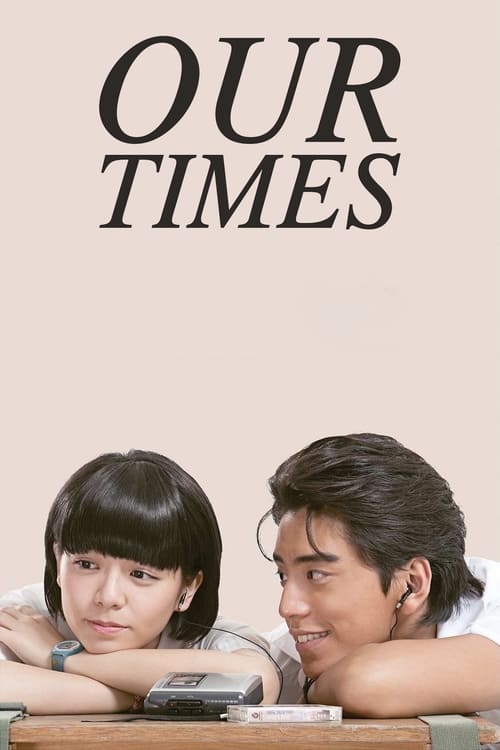
Our Times
2015 · Frankie Chen
For a cozy night in when you want to fall in love and maybe cry about your own high-school self. Pure comfort viewing — bring snacks, expect to text an old friend afterward.
What it's about
A worn-down Taipei office worker drifts back twenty years to her high-school self: plain, overlooked Truly Lin, hopelessly crushing on the most popular boy in school. She strikes a bargain with Hsu Tai-yu, the campus delinquent, who's pining for the school beauty — each will help the other break up the golden couple and win their dream date. It's a scheme built on 1990s Taiwan: pop idols, paper notes passed in class, and the slow discovery that the person helping you might matter more than the person you thought you wanted.
The experience
Warm, funny, and shamelessly nostalgic — it runs on the giddy embarrassment of first crushes and then, without warning, hits you square in the chest. Long for a teen romance, but it earns the runtime by letting the friendship-into-love turn breathe.
Performances
Lin Chen-hsin makes Truly's ordinariness the whole point — awkward, sincere, and easy to root for — and the chemistry of the mismatched pact carries the film.
The craft
Frankie Chen directs with a fan's love for period detail: 90s Taiwanese pop, school uniforms, roller rinks, the whole texture of a pre-smartphone adolescence. The framing device — a disillusioned adult remembering — gives the candy-colored flashbacks a gentle ache that plain nostalgia wouldn't have.
Why it matters
A massive commercial phenomenon across Chinese-language markets, it cemented the mid-2010s wave of Taiwanese nostalgic campus romances and proved the genre could be a box-office juggernaut, not just a niche.
Snapshot
Our Times (Chinese: 我的少女時代, Wǒ de Shàonǚ Shídài, literally "my girlhood era") is a Taiwanese nostalgic campus romance that became one of the defining commercial phenomena of mid-2010s Chinese-language cinema. Structured as a framed flashback, it opens on Truly Lin (Lin Chen-hsin), a browbeaten present-day office worker, before dissolving into her memories of high school in the mid-to-late 1990s. There the ordinary, unremarkable Truly strikes a pact with Hsu Tai-yu, the school's swaggering delinquent: she will help him win the campus beauty, Tao Min-min, while he helps her chase the perfect boy, Ouyang Fei-fan — and, inevitably, the scheme reroutes their affections toward each other. The film belongs squarely to the Taiwanese "youth/first-love" cycle that crested after Giddens Ko's You Are the Apple of My Eye (2011), but it distinguished itself by centering a female protagonist's point of view and by wrapping its coming-of-age story in a fantasy of adult reunion. It was the feature directorial debut of Frankie Chen (Chen Yu-shan) and became a sleeper blockbuster across Taiwan, Hong Kong, mainland China, and Southeast Asia.
Industry & production
Our Times was a mid-budget Taiwanese production released in 2015. It arrived in a period when Taiwanese commercial cinema had rediscovered the domestic and pan-Chinese market for local-language youth pictures — a lineage running from Cape No. 7 (2008) through You Are the Apple of My Eye (2011). Its commercial trajectory is the most historically significant fact about the production: after a modest opening it built through strong word-of-mouth into a runaway hit, becoming one of the highest-grossing Taiwanese films of its era and, unusually, an outsized success in mainland China and Hong Kong, where it substantially out-earned its home-market take. I want to be careful here: precise, verified box-office figures vary across sources and reporting standards, so rather than cite a specific number I can defend, I'll note only that it is consistently ranked among the top-grossing Taiwanese films of the 2010s and was a genuine cross-strait phenomenon. The film's soundtrack was a second commercial engine — the theme song "A Little Happiness" (小幸運), performed by Hebe Tien, became a ubiquitous hit in its own right and materially extended the film's cultural footprint.
Technology
Our Times is a conventionally produced digital feature of its moment; there is no evidence it pursued technological novelty, and its interest lies elsewhere. It was shot and finished digitally in the standard workflow of mid-2010s Taiwanese commercial production. Its most consequential "technology," in a cultural sense, is diegetic and period-specific: the film foregrounds the material media culture of the 1990s — handwritten chain letters, cassette tapes and Walkmans, pager/BB-call devices, arcade and pop-idol ephemera — as the texture through which memory is reconstructed. These objects are not merely dressing; they are the film's mnemonic apparatus, the tactile artifacts that trigger and organize the flashback structure. On the exhibition side, the film benefited from the fully digital distribution and social-media-driven marketing environment of 2015, which allowed its word-of-mouth surge to translate quickly into expanding screen counts across multiple territories.
Technique
Cinematography
The visual scheme is warm, high-key, and softly saturated — the house style of the nostalgic-youth cycle, in which the remembered past is bathed in a gently idealizing light. The camera favors the legible, emotionally direct framings of commercial romance: clean singles for the comic beats, over-the-shoulder coverage for the flirtation-by-scheming exchanges, and slightly heightened, storybook compositions for the fantasy register. The 1990s classroom-and-corridor world is shot to feel enveloping and burnished rather than documentary. I should flag candidly that I cannot reliably attribute the cinematography to a specific director of photography from memory without risking a false credit; readers should verify the DP credit against the film's titles or an authoritative database.
Editing
The film's most defining formal decision is structural: a frame narrative in which the adult present bookends and periodically interrupts the extended high-school flashback. The editing sustains a brisk romantic-comedy tempo inside the flashback — montage sequences compress the scheming, the growing intimacy, and the passage of the school year — while reserving slower, more sentimental cutting for the emotional turns and the climactic reunion. The reveal architecture is engineered around a late payoff, holding back the identity of the grown Tai-yu so that the return to the present lands as a wish-fulfillment surprise. This oscillation between comic acceleration and sentimental deceleration is the picture's characteristic rhythm.
Mise-en-scène / staging
Period reconstruction is central. The production design assembles a densely specific 1990s Taiwanese high-school milieu — uniforms, worn desks, disciplinary rituals, idol posters, snack-shop and arcade spaces — and stages the comedy within familiar institutional geographies (the classroom, the corridor, the staircase, the after-school street). Costume and hair do heavy characterological work: Truly's dowdy, permed, oversized-glasses styling marks her as the overlooked everygirl, and her later transformation is legible entirely through mise-en-scène. Tai-yu's delinquent iconography (uniform worn defiantly, physical swagger) and the "golden couple's" polished perfection are equally costume-coded. The staging consistently uses the school's spaces to choreograph proximity and longing.
Sound
Sound is arguably the film's secret weapon. The score and song program lean into 1990s Mandopop nostalgia and, crucially, weave the real-world stardom of Andy Lau into the fiction as a fannish object of Truly's devotion. The original theme, "A Little Happiness," functions as both emotional leitmotif and the film's most durable cultural export; its melody recurs to underscore the central relationship and the bittersweet retrospection. The sound design otherwise serves clarity and warmth — dialogue-forward, with music cues shaped to swell at the sentimental peaks in the manner of mainstream romance.
Performance
The performances are the film's engine, and its casting of relative newcomers in the teen roles proved star-making. Vivian Sung (Song Yun-hua) anchors the film as Truly with a broad, endearing comic register — physical, self-deprecating, unglamorous by design — that grounds the fantasy in likability. Darren Wang (Wang Ta-lu) plays Tai-yu with a bruised, charismatic bravado that the film gradually softens into tenderness; the role launched him as a youth-cinema lead. Dino Lee and Dewi Chien (also credited as Simona Wang) fill out the quartet as the idealized objects of desire who are humanized as the plot unwinds. The adult framing roles are played by established stars, and the film's final movement trades on the audience's recognition of a marquee actor as the grown Tai-yu — a casting coup that converts the reunion into an event.
Narrative & dramatic mode
The dramatic mode is romantic comedy in a memory-elegiac frame. Its structural spine is the classic "wrong object" romance: two people conspire in pursuit of other people and discover each other in the process — a device as old as screwball comedy, here filtered through the specifically Asian teen-idol idiom. The framing device converts the whole high-school story into an act of adult retrospection, which shifts the film's mode from simple comedy toward something closer to a memory-fantasy: the past is not merely recalled but redeemed, and the ending grants the wish that ordinary life denied. This gives Our Times a double affect — the pleasure of comic first love and the ache of lost time — that accounts for much of its emotional reach. The reunion climax is unapologetically wish-fulfilling, and the film knows it; the fantasy is the point.
Genre & cycle
Our Times is a textbook entry in the pan-Chinese "youth" (青春, qingchun) film cycle, and more specifically the first-love/campus-nostalgia strain that dominated Chinese-language commercial cinema in the first half of the 2010s. Its immediate generic sibling is You Are the Apple of My Eye (2011), and it participates in a broader mainland wave — films such as So Young (2013) and Tiny Times (2013) — trafficking in nostalgia for school days and the roads not taken. Within that cycle Our Times is notable for its gender inversion: where Apple of My Eye narrates first love from a young man's vantage, Our Times is organized around a young woman's desire, agency, and self-transformation, which broadened and arguably feminized the cycle's audience. It also amplifies the cycle's fairy-tale tendencies, foregrounding the Cinderella arc more than the melancholy-realist strain some of its peers preferred.
Authorship & method
Our Times is significant as a debut. Frankie Chen (Chen Yu-shan) directed from a background in advertising and commercial filmmaking, and that lineage is visible in the picture's polished, emotionally efficient, image-conscious craft — a sensibility tuned to legibility, warmth, and the well-timed swell. Her method here is one of tonal control: keeping broad comedy, teen fantasy, and sincere sentiment in balance without letting any register curdle into parody or mawkishness. On the key collaborators, I want to be scrupulous rather than confident-sounding: the most historically secure creative attribution beyond the director is the theme song, "A Little Happiness," performed by Hebe Tien, which became the film's signature and a hit in its own right. For the screenwriter, cinematographer, editor, and film composer, I do not have reliably verified names I can attach without risking a fabricated credit, and the English-language scholarly record on the film's below-the-line authorship is genuinely thin; those credits should be confirmed against the film's titles or an authoritative database before being cited.
Movement / national cinema
The film sits within contemporary Taiwanese commercial cinema's post-2008 revival — the wave that followed Cape No. 7 and demonstrated that locally rooted, Mandarin/Hokkien-inflected popular films could command large domestic and regional audiences after years in which Taiwan's international reputation rested on the austere art cinema of Hou Hsiao-hsien, Edward Yang, and Tsai Ming-liang. Our Times belongs to the populist rather than the auteurist tradition of Taiwanese film: its ambitions are affective and commercial, not formalist. Yet it also exemplifies how thoroughly the 2010s youth-nostalgia film had become a cross-strait and pan-Chinese product, made in Taiwan but consumed massively in Hong Kong and the mainland, where its 1990s iconography and Mandopop soundtrack read as broadly shared regional memory rather than narrowly Taiwanese.
Era / period
There are two temporal registers to distinguish. The film was made and released in 2015, at the peak of the Chinese-language youth-nostalgia cycle and within a fully digital, socially networked distribution economy. But its emotional subject is the 1990s — the decade of the characters' adolescence, evoked through Andy Lau fandom, cassette culture, chain letters, and the analog textures of a pre-internet school life. The gap between these two eras is the film's very engine: it addresses a 2015 adult audience old enough to feel the pull of that 1990s world, staging nostalgia as the shared structure of feeling of a whole regional generation entering middle adulthood. The film's success is inseparable from the demographic timing of that nostalgia.
Themes
The governing themes are first love and the redemption of the ordinary. Truly is defined precisely by her unremarkableness — plain, overlooked, unpopular — and the film's fantasy is that such a person is worthy of transformation and grand devotion; it is, structurally, a Cinderella story. Bound up with this is the theme of self-worth: Truly's arc moves from self-erasure toward the confidence to be seen. A second cluster concerns memory, regret, and the road not taken — the frame narrative literalizes the adult wish to revisit and repair the past, making nostalgia itself a theme rather than merely a mood. A third strand is the social hierarchy of adolescence — the tyranny of popularity, the rigid castes of the "golden couple" versus the invisible majority — which the plot exists to dismantle. Finally, the film treats fandom and pop culture (the Andy Lau devotion) as a genuine emotional resource, a way ordinary people rehearse desire and hope.
Reception, canon & influence
Critically, Our Times was received as an accomplished, deeply crowd-pleasing entry in a crowded cycle — praised for its central performances and emotional generosity, and noted (sometimes gently criticized) for leaning hard into formula and fairy-tale wish-fulfillment. Its more important reception story is popular: it became a word-of-mouth blockbuster whose success far exceeded expectations, particularly in Hong Kong and mainland China, and it turned Vivian Sung and Darren Wang into youth-cinema stars. The theme song "A Little Happiness" earned significant recognition and became a lasting karaoke and cover-culture standard; I recall it being honored at the awards level, but as I cannot verify the specific award and result with confidence, I'll leave that to be confirmed rather than assert it.
Looking backward, the film's clearest influence is You Are the Apple of My Eye (2011), which established the commercial template — the retrospective first-love structure, the mixture of comedy and melancholy, the pop-song emotional payload — that Our Times adopts and inverts by gender; behind both stands the broader 2010s pan-Chinese qingchun wave and, further back, the perennial "wrong object" romance of classical comedy and the Cinderella archetype.
Looking forward, Our Times helped consolidate and, arguably, mark a late peak of the campus-nostalgia cycle, proving the commercial durability of the female-centered first-love film and reinforcing the model in which a hit theme song and a nostalgic period setting drive a picture's reach. Its stars carried the youth-film momentum forward into subsequent careers, and its soundtrack outlived the film as a piece of pan-Chinese popular culture. Within the atlas of influence, Our Times is best understood not as a formal innovator but as a consummate synthesizer — the film that took the youth-nostalgia formula to its most polished, most broadly beloved, and most fairy-tale-complete expression.
Reception
A monster hit in 2015 — Taiwan's top-grossing local film that year, and huge across the Mandarin-speaking world — while critics shrugged at it as formula nostalgia; a decade on it's settled in as a beloved comfort-watch classic of the Taiwanese school-romance wave.
How Our Times was received, from release to now →
How to watch Our Times: what to notice on a first viewing
- Notice the film starts in the present before slipping into the past. An adult Truly Lin, worn down by office life, opens the film before it dissolves into an extended flashback to her 1990s high school. You are told upfront this is a story being remembered, not simply lived, before it even begins.
- Watch the classroom scenes glow in warm, high-key light. The remembered 1990s are shot soft and softly saturated, so the whole school world feels burnished rather than documented. The light itself tells you this past has been polished by twenty years of missing it.
- Notice Truly's oversized glasses and permed hair early on. Her dowdy styling marks her as the overlooked everygirl from her first scene, and every later change in her costume tracks a change in her confidence. You can read her whole arc off her wardrobe alone, without a line of dialogue.
- Listen for the same melody returning across the film. The theme song 'A Little Happiness' recurs throughout to underscore Truly and Tai-yu's relationship, tying the comic scenes to the bittersweet ones. One recurring melody is doing the work of reminding you this is all being looked back on.
- Notice the 1990s props: cassette tapes, pagers, chain letters. The film fills its high school world with specific analog objects, from Walkmans to idol posters, that date and texture every scene. These objects are what make the nostalgia feel earned instead of generic.
The whole guide to watching Our Times, with the keys for a rewatch →
Influences: the films it descends from and the films it influenced
- You Are the Apple of My Eye (2011) — Sets the exact commercial template Our Times inherits and gender-inverts — a present-day frame narrating a high-school first love, comedy sliding into melancholy, and a pop-ballad climax carrying the emotional payload.
- Cape No. 7 (2008) — Its post-2008 revival proved a Mandopop/local soundtrack could be a Taiwanese film's emotional and box-office engine — the music-as-commercial-motor model Our Times runs with 'A Little Happiness.'
- Secret (2007) — Builds a campus romance around a pop idol and a signature recurring song/piano motif as narrative spine — the star-plus-leitmotif construction Our Times echoes.
- Blue Gate Crossing (2002) — Establishes the Taiwanese idiom of uniformed-adolescent first love shot in tender, bright naturalism that Our Times polishes into warm high-key.
- A Brighter Summer Day (1991) — The benchmark for granular reconstruction of a vanished Taiwanese school-era material culture — classrooms, uniforms, analog music media — that Our Times miniaturizes for its 1990s period setting.
- She's All That (1999) — Codifies the costume-coded makeover device — a plain/tomboy girl restyled into the desired object through wardrobe and framing — that structures Truly's transformation arc.
- Sixteen Candles (1984) — Model of the everygirl-wins-the-dreamboy wish-fulfillment and the comic-vs-sentimental tonal control that Our Times' fairy-tale tempo depends on.
- Soul Mate (2016) — Extends the dual-timeline retrospective youth film with a structural late reveal that recontextualizes the central relationship — the reveal-payoff editing Our Times popularized.
- Take Me to the Moon (2017) — A direct Taiwanese follow-on that rebuilds a 1990s campus around a nostalgic pop soundtrack, extending Our Times' music-nostalgia-plus-period-reconstruction formula.
- Us and Them (2018) — Carries the frame-flashback first-love model forward with present/past color-coding and a pop-ballad-driven nostalgia payload in the Our Times mold.
- More Than Blue (2018) — A Taiwanese weepie engineered, like Our Times, on tonal control between comedy and melodrama with a signature theme song as the closing emotional payload.
- 18x2 Beyond Youthful Days (2024) — Cemented the revival's blockbuster structure of a present-day adult reunion cracking open a preserved teenage romance, and the pop-anthem-over-montage payoff 18x2 inherits.
- Sunny (2011) — Runs the same adult-present/teen-past dual timeline as a female-centered nostalgia machine, with period needle-drops and a marquee-cast reveal of the grown characters — Our Times' late-reveal payoff in parallel.
- Architecture 101 (2012) — A present-day frame brackets an unrequited college first love — the 'wrong object' realized too late — mirroring Our Times' retrospective reckoning structure.
- So Young (2013) — Inaugurates the mainland qingchun campus-nostalgia cycle Our Times consummates, pairing a retrospective school-to-adulthood structure with a hit-song emotional payload.
- Fleet of Time (2014) — Pan-Chinese campus nostalgia keyed to period pop and a first-love-lost frame, the cycle Our Times shares and outperforms.
- My Old Classmate (2014) — Deploys the retrospective everykid-loves-classmate structure spanning schooldays to adulthood, driven by nostalgic pop cues, in the same wave.
- Man in Love (2021) — A bentu populist romance whose word-of-mouth phenomenon was fused to a hit theme song ('A Little Happiness'), sharing the seed's MV-logic of releasing accumulated feeling through a single song-bound montage.
- Love Untangled (2025) — Runs the same mid/late-90s first-love nostalgia with retro needle-drops and an ordinary-girl heroine, a parallel regional entry in the same youth-romance cycle.
Similar films
- Us and Them (2018) — influence & lineage
- Sunny (2011) — influence & lineage
- A Brighter Summer Day (1991) — influence & lineage
- Your Name Engraved Herein (2020) — shared sensibility
- 18x2 Beyond Youthful Days (2024) — shared sensibility
- 20th Century Girl (2022) — shared sensibility
- Taipei Story (1985) — shared sensibility
- Flipped (2010) — shared sensibility