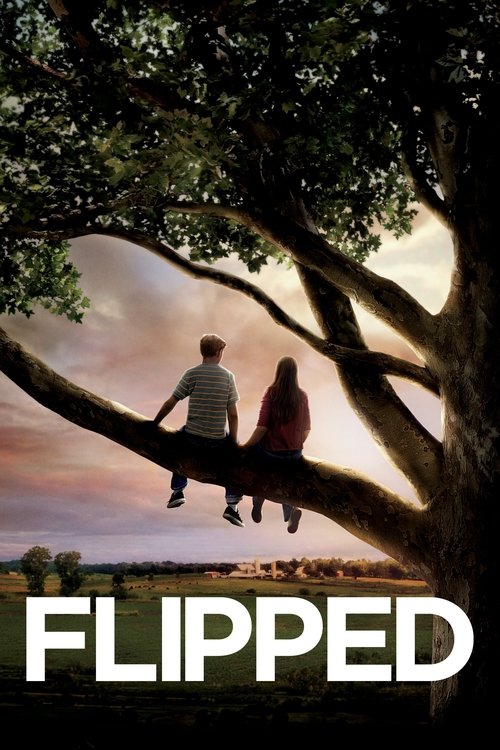
Flipped
2010 · Rob Reiner
For a cozy, wholesome night when you want something sweet that still has a brain — the kind of film to watch with family, or when you need to be reminded that first crushes were both ridiculous and enormous.
What it's about
In a sun-dappled late-1950s suburb, Juli Baker falls hard for her new neighbor Bryce Loski in the second grade — and spends the next six years certain he'll come around. He spends those same years dodging her. The film tells their story twice, alternating between her version and his, so every incident — a first meeting, a beloved tree, a basket of eggs — means something completely different depending on who's remembering it.
The experience
Gentle, warm, and quietly clever: the fun is watching the same moment flip its meaning when the other kid narrates it. It's nostalgic without being syrupy, and sneakily wise about how families shape what children think love is.
Performances
Madeline Carroll is the standout as Juli — open-hearted, stubborn, and completely believable as a kid whose feelings are bigger than everyone around her knows what to do with.
The craft
The dual-narration structure is the whole game: Rob Reiner replays scenes from both kids' points of view so the audience gets to be smarter than either of them. The period setting is lovingly done — bikes, front lawns, dinner tables — and the film trusts small objects, like a tree and a carton of eggs, to carry real emotional weight.
Why it matters
Overlooked in theaters but adopted by audiences afterward — it's become a word-of-mouth favorite and a go-to gateway film about young love, and a late-career return to sincerity for the director of beloved coming-of-age classics.
Snapshot
Flipped is Rob Reiner's adaptation of Wendelin Van Draanen's 2001 young-adult novel, a two-sided chronicle of a childhood infatuation traced from the second grade to the edge of adolescence. Its defining formal gesture is structural: the film narrates the same sequence of events twice, alternating between the interior monologues of Juli Baker (Madeline Carroll) and Bryce Loski (Callan McAuliffe), so that a single incident — a first meeting, a basket of eggs, a felled sycamore — accrues two incompatible meanings. Reiner and his co-writer Andrew Scheinman made one decisive change to the source: they relocated Van Draanen's contemporary suburb to the late 1950s and early 1960s, converting a present-tense middle-school romance into a nostalgic period piece keyed to Reiner's own boyhood. The result sits at the gentle, sincere end of Reiner's range, closer to Stand by Me than to his satires, and it arrived in 2010 to modest attention. It is best understood as a minor, deliberately old-fashioned work by a major popular filmmaker — a film about learning to see beneath the surface, told through a device that forces the audience to do exactly that.
Industry & production
Flipped was produced through Castle Rock Entertainment, the company Reiner co-founded in 1987 and the home of his most durable work, and released by Warner Bros. It is very much an inside-the-tent Reiner production: developed and directed by a founding partner, written with his longtime collaborator Scheinman, and staffed with technicians who had worked with him for decades. The picture came after a difficult creative stretch — the 2000s had been Reiner's least certain decade, marked by the poorly received Rumor Has It... (2005) and the commercially successful but critically middling The Bucket List (2007) — and it reads as a return to smaller, more personal material.
Commercially it was a disappointment. Warner Bros. gave Flipped a limited platform release in the late summer of 2010 rather than a wide push, and it did not find a theatrical audience; the film's afterlife has been largely on home video, cable, and streaming, where it developed a warmer reputation than its box-office performance suggested. Precise budget and gross figures are not something I can state reliably here, and I will not invent them; the salient fact is the shape of the release — quiet, limited, underperforming — rather than any specific number. The production itself was modest in scale, a contained suburban drama built around two young leads and a deep bench of experienced adult character actors.
Technology
Flipped is a conventional late-2000s studio production shot photochemically on 35mm film, a choice consistent with both its period setting and the traditionalism of its director and cinematographer. There is no significant technological novelty to claim, and it would be a mistake to manufacture one. The film's "technology" of interest is old and narrative rather than new and mechanical: the period reconstruction of a late-1950s American suburb — automobiles, appliances, television sets, the material texture of the Eisenhower-to-Kennedy years — assembled through production design, costume, and set dressing rather than digital effects. Visual effects are minimal and invisible by design, confined to the sort of unobtrusive clean-up and set extension standard for the era. The film belongs to a tradition of analog, actor-centered studio filmmaking that was, by 2010, beginning to feel deliberately unfashionable.
Technique
Cinematography
The photography is by Thomas Del Ruth, whose association with Reiner reaches back to Stand by Me (1986) and who brought to that earlier film the same golden, memory-burnished treatment of an American small town. In Flipped Del Ruth again lights the suburb as remembered rather than observed: warm, softly saturated, nostalgic without tipping fully into sepia. The camera is largely classical — clean coverage, unshowy compositions, an emphasis on faces and on the geography of the two houses facing each other across the street. The most important visual motif is the sycamore tree that Juli climbs, framed to convey elevation and expanded sight, the literal high vantage from which she "sees" more than Bryce does. The film's restraint is purposeful: because the storytelling relies on doubled narration, the images stay legible and stable so that meaning can shift through voice-over and context rather than through visual disorientation.
Editing
The editing is the film's most conceptually loaded department, because the entire structure depends on how the two points of view are cut against each other. Rather than braid the perspectives moment to moment, the film moves in blocks — presenting an episode through one character's account and then rewinding to replay it through the other's — so the cut is often a return to an already-seen scene now inflected differently. This demands careful matching of action and precise control of what the audience knows at each pass. The work is credited to editors associated with Reiner's team, including his longtime collaborator Robert Leighton, whose cutting shaped Stand by Me, The Princess Bride, and When Harry Met Sally...; I would not want to overstate the exact division of labor on this particular title beyond that lineage. The governing principle is clarity in service of a potentially confusing conceit.
Mise-en-scène / staging
Reiner stages the film around a simple, expressive spatial opposition: two family homes across a suburban street, and the traffic — social, emotional, literal — between them. The Loski house is orderly, affluent, and quietly corrupted by snobbery; the Baker house is shabbier, warmer, morally richer. Juli's chicken coop, the untended yard, and above all the sycamore become moral geography, exteriorizing the film's argument that surfaces mislead. Dinner tables function as key theatrical spaces — the film's turning points are often meals, where class attitudes and family character are exposed in conversation. The staging is proscenium-clear and actor-forward, trusting performance and blocking over visual flourish.
Sound
Music is by Marc Shaiman, one of Reiner's most consistent collaborators (When Harry Met Sally..., Misery, A Few Good Men, The American President), who supplies an orchestral score in a warm, melodic idiom suited to the film's sincerity. Equally important is the needle-drop soundtrack of late-1950s and early-1960s American pop, rock and roll, and doo-wop, which does much of the period-setting work and situates the film in the same nostalgic-jukebox tradition as Stand by Me and American Graffiti. The dominant sonic element, however, is the human voice: the twinned first-person narration is nearly continuous, and the film's sound design is organized to let those two interior voices sit clearly above score and source music.
Performance
The film rests on its two young leads. Madeline Carroll's Juli is the stronger, more fully dimensioned role — earnest, headstrong, morally clear-eyed — and Carroll carries the emotional weight, particularly in the scenes of the tree and of family conflict. Callan McAuliffe's Bryce is written as the more passive, conventional, and initially shallow figure, and the performance is calibrated to that diffidence. Around them Reiner deploys an unusually seasoned adult ensemble — Aidan Quinn and Penelope Ann Miller as Juli's parents, Anthony Edwards and Rebecca De Mornay as Bryce's, and John Mahoney as Bryce's grandfather Chet, whose recognition of Juli's worth becomes the film's moral hinge. The adult playing is naturalistic and grounded, providing ballast beneath the children's coming-of-age narration.
Narrative & dramatic mode
The film's dramatic mode is dual retrospective narration: two adolescents recounting a shared history in the past tense, each convinced of a different version of events. This is not the contradictory, epistemologically destabilizing testimony of Rashomon; the facts do not change, only their interior meaning. Where Bryce sees Juli's persistence as embarrassing pursuit, Juli experiences the same moments as devotion and disappointment. The structure is fundamentally about the gap between how we appear to others and how we experience ourselves, and it uses repetition as its central engine: the pleasure and the argument both come from seeing an event a second time from the inside of the other person. The dramatic arc is a slow inversion — a "flip" — in which Bryce gradually begins to value what he had dismissed just as Juli begins to withdraw her long-held admiration, the two trajectories crossing near the film's end.
Genre & cycle
Flipped sits at the intersection of the coming-of-age film and the period romance, with a strong dose of nostalgia cinema. It belongs to a recognizable American cycle — films that reconstruct a mid-century boyhood or girlhood as a landscape of first feelings — whose touchstones include American Graffiti (1973), A Christmas Story (1983), and, most directly, Reiner's own Stand by Me. Within that cycle it is unusual for centering a girl's moral and emotional development at least as much as a boy's, and for treating pre-adolescent romance with un-ironic sincerity. As adaptation, it participates in the durable stream of young-adult-novel-to-film properties, though it predates and stands apart from the darker, more high-concept YA adaptations that dominated the following years.
Authorship & method
Flipped is a characteristic late Reiner film in its warmth, its faith in ensemble acting, and its preference for sentiment held just short of sentimentality. Reiner's method has always been collaborative and continuity-driven, and here the continuity is striking: co-writer and producing partner Andrew Scheinman, cinematographer Thomas Del Ruth (Stand by Me), composer Marc Shaiman (multiple prior features), and editor Robert Leighton (Stand by Me, The Princess Bride) all belong to a company of collaborators Reiner had trusted for decades. The screenplay's central authorial decision — pushing the story back into the late 1950s — is the clearest mark of Reiner's hand, converting Van Draanen's contemporary material into something adjacent to his own memory-film sensibility. The source author, Wendelin Van Draanen, supplies the doubled-narration architecture, which her novel builds through alternating chapters; the film's fidelity to that device is the adaptation's most important structural loyalty.
Movement / national cinema
This is mainstream American studio filmmaking, unaffiliated with any avant-garde or self-conscious movement. Its national-cinema identity is doubly American: made within the Hollywood studio system, and about a mythologized American place and time — the postwar suburb — that functions as a recurring setting in the national imagination. If it belongs to any "movement," it is the loose tradition of Hollywood nostalgia films that reconstruct the Eisenhower-to-Kennedy years as an age of innocence, a tradition to which Reiner had already contributed and to which Flipped returns.
Era / period
Two time frames matter. The film was produced in 2010, at a moment when photochemical, actor-driven, mid-budget studio dramas were rapidly losing ground to franchise and effects filmmaking — a context that helps explain both its unfashionable sincerity and its commercial marginalization. Its diegetic period is the late 1950s into the early 1960s, an era the film evokes through cars, music, dress, and social manners. That setting is not incidental: the rigid class consciousness and propriety of the moment sharpen the story's conflict between the snobbish Loskis and the unpretentious Bakers, and the period's coded surfaces — the well-kept lawn, the respectable home — become the very "surfaces" the film asks us to see past.
Themes
The film's governing theme is stated almost aphoristically by Juli's father, a painter: that a whole can be greater than the sum of its parts — that a person, like a landscape, must be seen entire rather than piece by piece. From this flows everything else: the opposition of surface and substance, of appearance and integrity. Juli values what is real and grown (the tree, the eggs she raises, her father's paintings, her disabled uncle whom the Bakers care for) while Bryce's family prizes appearance and status. The dual-narration structure is itself a theme made into form — an argument that understanding requires occupying another point of view. Secondary themes include class and the moral difference between wealth and worth, the ethics of how we treat the vulnerable, and the ordinary miracle of a person's inner life becoming visible to someone who had refused to look.
Reception, canon & influence
Critical reception in 2010 was mixed to lukewarm and commercially the film was a non-event, released on a limited platform and largely bypassed in theaters. Reviewers tended to divide along a predictable line: admirers responded to its sincerity, its performances (Carroll's especially), and its craftsmanship, while skeptics found it slight, over-narrated, and cloying, and some questioned the decision to bathe a children's story in adult nostalgia. It won no major awards and entered no critical canon; it is a footnote rather than a landmark in Reiner's filmography.
The lines of influence run mostly backward. Flipped draws on Van Draanen's novel for its doubled structure, and on a deep tradition of American nostalgia and coming-of-age cinema — American Graffiti, A Christmas Story, and, unmistakably, Reiner's own Stand by Me, whose golden-memory suburb, period soundtrack, and retrospective narration it echoes down to the shared cinematographer. Forward influence is genuinely thin, and I will not overstate it: the film shaped no discernible cycle and launched no movement. Its most tangible legacy is a durable second life on home video and streaming and a modest, affectionate cult — particularly among viewers who encountered the novel — that regards it as an underseen, gentle-hearted small film. Its lasting interest for the study of cinema lies less in influence than in example: a clean, unusually sincere demonstration of how repetition and shifting point of view can turn a simple romance into an argument about the difficulty, and the reward, of seeing another person whole.
A Deleuzian reading
A boy carries a basket of eggs into his kitchen and drops them in the trash.
The full Deleuzian reading of Flipped →
Reception
A box-office flop in the US in 2010 — barely released, shrugged off by critics as too sweet — it then found a staggering second life in China, where it became one of the highest-rated films on Douban and even got a Chinese theatrical release in 2020 that out-grossed its original American run.
How Flipped was received, from release to now →
How to watch Flipped: what to notice on a first viewing
- Notice the same scene told twice, once per narrator. The film replays a single event, a first meeting, a basket of eggs, once from Juli's memory and again from Bryce's, changing nothing about the facts but everything about their meaning. Understanding here means occupying someone else's point of view, not gathering more evidence.
- Notice the warm, softly saturated light on the street. Thomas Del Ruth lights the suburb as remembered rather than observed, nostalgic and golden without tipping into full sepia. The look itself tells you this is a memory being replayed, not a scene being reported.
- Notice the two houses facing each other across the street. One yard is orderly and status-conscious, the other shabbier and warmer, and the sycamore tree Juli climbs becomes a literal high place from which she sees more. The geography of the street is quietly arguing that surfaces mislead.
- Listen for two different voices narrating the same events. Juli's and Bryce's interior voice-overs run nearly continuously, mixed to sit clearly above the score, so you are always hearing someone's private account of what just happened. You are never just watching the story. You are always inside someone's telling of it.
- Notice the basket of eggs at Bryce's back door. The same eggs, carried over by Juli as a gift, get treated completely differently depending on whose house you're standing in when you watch it happen. One small object holds two entirely different meanings depending only on who is looking at it.
The whole guide to watching Flipped, with the keys for a rewatch →
Influences: the films it descends from and the films it influenced
- Stand by Me (1986) — Reiner's own template for Flipped, sharing cinematographer Thomas Del Ruth and editor Robert Leighton and the same golden-hour retrospective voiceover framing a period-suburb boyhood.
- American Graffiti (1973) — Established the wall-to-wall late-'50s doo-wop/rock needle-drop as continuous non-diegetic scoring that Flipped borrows to date and emotionally underscore its Eisenhower-Kennedy suburb.
- A Christmas Story (1983) — Model for the wry adult narrator recounting his own childhood in near-continuous voiceover over a warmly reconstructed period neighborhood.
- Rashomon (1950) — The originating structure of replaying one event through competing first-person accounts, which Flipped domesticates into its scene-by-scene his/her retellings.
- He Said, She Said (1991) — Tells a single romance twice, once narrated by each partner, the direct romance-genre precedent for Flipped's dual-retrospective point-of-view doubling.
- Annie Hall (1977) — Its subtitled/split-screen replays exposing the gap between what characters say and privately feel prefigure Flipped's surface-versus-substance use of doubled POV.
- Meet Me in St. Louis (1944) — The ur-text of Technicolor golden-memory Americana whose idealized turn-of-century family suburb defines the nostalgic lighting and set palette Flipped reaches for.
- To Kill a Mockingbird (1962) — Supplies the child's-eye moral geography of a small town — houses, yards, and thresholds as ethical space — narrated from an adult's retrospective remove.
- The Sandlot (1993) — Extends the same device of an adult nostalgic voiceover glazing an early-'60s boyhood suburb in golden, mythologized light.
- Moonrise Kingdom (2012) — Renders a 1960s pre-adolescent romance as precise moral geography and period-scored tableau, extending Flipped's staging of young love within a mapped, nostalgic world.
- The Princess Bride (1987) — Product of the same Reiner collaborator company (editor Robert Leighton, producer-writer Andrew Scheinman) and its nested-narration architecture framing a story as retold memory.
- Now and Then (1995) — Frames a period small-town coming-of-age through adult retrospective narration, the female-POV counterpart to Flipped's nostalgic memory-film form.
- 500 Days of Summer (2009) — Reorders a romance into subjective, non-chronological replays driven by needle-drop scoring, a contemporary variant of Flipped's POV-doubled editing.
- Atonement (2007) — Reshows a pivotal scene from a second character's vantage to reveal misperception, the same rewind-and-recontextualize move Flipped uses to argue surface versus substance.
- Vantage Point (2008) — Builds an entire film from literally rewinding one event and replaying it across successive points of view, the editing gimmick Flipped organizes its romance around.
- The Tree of Life (2011) — Reconstructs a 1950s suburban childhood as impressionistic golden-memory imagery carried by near-continuous interior voiceover, the art-cinema pole of the same nostalgia-narration craft.
Similar films
- Moonrise Kingdom (2012) — influence & lineage
- (500) Days of Summer (2009) — influence & lineage
- The Princess Bride (1987) — influence & lineage
- Love, Rosie (2014) — shared sensibility
- Lady Bird (2017) — shared sensibility
- Little Amélie or the Character of Rain (2025) — shared sensibility
- 20th Century Girl (2022) — shared sensibility
- Twilight (2008) — shared sensibility