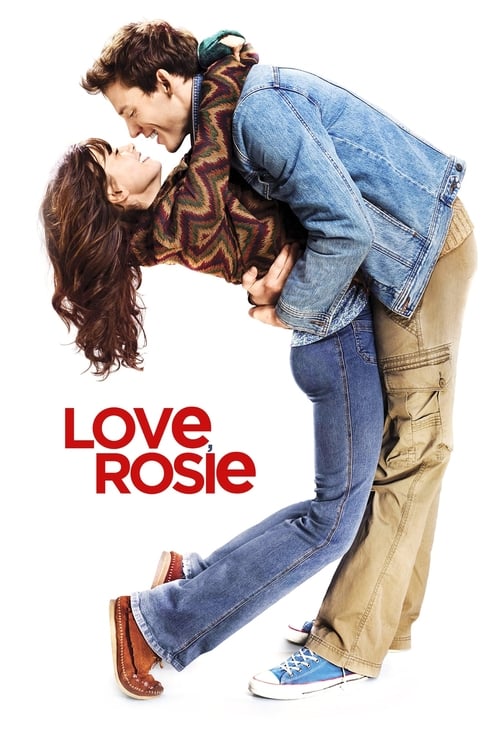
Love, Rosie
2014 · Christian Ditter
For a cozy night in when you want to fall in love and maybe yell at the screen a little — comfort viewing with just enough heartbreak to earn the ending. Ideal with wine, a blanket, or a best friend you have complicated feelings about.
What it's about
Rosie and Alex have been best friends since they were five, and everyone but them can see they belong together. One almost-kiss and an unplanned pregnancy send their lives spinning in opposite directions — she stays home in Dublin raising a daughter, he heads to America for medical school — and for over a decade they keep circling each other through wrong partners, bad timing, and letters that say everything except the one thing that matters.
The experience
Warm, bittersweet, and briskly paced, it plays the long ache of missed timing for both laughs and lumps in the throat. You spend most of it wanting to shake both of them, which is exactly the point.
Performances
Lily Collins carries the film with a scrappy, self-deprecating charm that keeps Rosie's string of setbacks from turning maudlin, and Sam Claflin gives Alex an easy warmth that makes twelve years of near-misses believable.
The craft
Adapted from Cecelia Ahern's novel of letters and emails, the script compresses a decade-plus of texts, voicemails, and botched confessions into a nimble back-and-forth structure that keeps the two leads connected even when an ocean apart. It's bright, glossy, and built for rewatching rather than the big screen.
Why it matters
A modest theatrical release that found its real life on streaming, it became a word-of-mouth staple of the 2010s romcom revival and a defining early role for Lily Collins.
Snapshot
Love, Rosie is a British-German co-production adapting Cecelia Ahern's 2004 epistolary novel Where Rainbows End (published in the United States as Love, Rosie and elsewhere as Rosie Dunne), directed by the German filmmaker Christian Ditter from a screenplay by Juliette Towhidi. It stars Lily Collins and Sam Claflin as Rosie Dunne and Alex Stewart, childhood best friends whose romance is deferred across roughly twelve years by an unsent letter, an unplanned pregnancy, an ocean, and a sequence of wrong partners.
The film belongs to a specific and recognizable formation: the mid-2010s British-inflected romantic comedy made for a primarily international and increasingly streaming-and-download audience, aimed at a young-adult readership already familiar with the source. Its production history — German money, Irish and English locations, a German director working in English, a cast assembled from the YA-adjacent star system — is characteristic of how European co-production financing kept the mid-budget romance alive after the Hollywood studios had largely abandoned it.
Critically it was received poorly in the Anglophone trade and broadsheet press, and warmly by audiences, particularly outside the UK and US. That gap is the most interesting single fact about the film, and it is the fact around which any serious account of its place in the atlas has to be built. Love, Rosie is a useful specimen precisely because it is not a good film by the standards its reviewers applied, and because those standards turned out to be poorly calibrated to what the film was doing and for whom.
Industry & production
The financing structure is the key to the film. Love, Rosie was produced principally through German companies — Constantin Film was the central force, with Ditter arriving from a German commercial-cinema background — in partnership with UK and Irish production entities, and it drew on the co-production and regional-incentive architecture that governs European filmmaking of this scale. Constantin, a Munich house with a long record of turning literary properties and genre material into reliable continental hits, is exactly the kind of company for which an internationally recognized romance novel with a built-in readership represents a low-variance proposition.
This matters because it explains the film's aesthetic and commercial logic. A Hollywood studio in 2014 was, with a few exceptions, no longer making the theatrical romantic comedy at all; the genre had migrated to television, to streaming platforms then in their infancy as originators, and to precisely this European co-production niche. The mid-budget romance did not die so much as change passport. Ditter's film was made for a budget that permitted location shooting in Dublin and in England, a modest period-spanning production design covering roughly a dozen years, and two leads on the cusp of wider recognition, but not for the kind of marketing spend that would have made it a global theatrical event.
The casting reflects a specific 2014 calculation. Lily Collins had come through Mirror Mirror (2012) and The Mortal Instruments: City of Bones (2013); Sam Claflin was mid-Hunger Games, having appeared as Finnick Odair in Catching Fire (2013), and had done Snow White and the Huntsman (2012) and the British romance The Riot Club the same year as Love, Rosie. Both were legible to the young-adult audience without being expensive. Neither was yet a name that could open a film alone. The supporting cast — Jaime Winstone, Tamsin Egerton, Suki Waterhouse, Christian Cooke, Jamie Beamish — is drawn largely from the British screen ecology.
Distribution was territory-by-territory rather than unified, which is standard for this financing model and consequential for reception: the film performed considerably better in continental Europe and in a number of international markets than in the UK or the US, where it received limited theatrical exposure and was substantially discovered later on home video and streaming. Specific box-office figures vary by source and territory and I will not assert them here; the directionally reliable claim is that the film's commercial life was international, long-tailed, and platform-driven rather than concentrated in an opening weekend.
Technology
Love, Rosie was made at the point where digital capture had become the unremarked default for productions of its budget, and the film shows no interest in making an argument about its own image technology. It is shot digitally, finished digitally, and graded toward a warm, slightly lifted, consistently pretty palette — the house style of the mid-2010s commercial romance, in which the digital intermediate is used to smooth rather than to differentiate.
The relevant technological fact is not the camera but the distribution stack. Love, Rosie is a film whose afterlife was made by video-on-demand and, later, subscription streaming. Its structure — episodic, propulsive, built from short scenes with clear emotional beats and frequent time jumps — is well suited to a viewing context of home screens, second viewings, and clip circulation. Sequences from the film, particularly the comic set piece involving a contraceptive mishap and the various near-miss confessions, circulated widely as excerpted video on social platforms in the years after release. That circulation is a genuine part of the film's reception history and not a footnote to it.
The period-spanning premise also required a modest technological discipline of a different kind: aging two actors from roughly eighteen to their early thirties without prosthetics or recasting, relying instead on hair, wardrobe, and performance. The film mostly declines to age its leads convincingly, which is a choice with consequences discussed below under Technique.
Technique
Cinematography
Christian Rein shot the film. The photography is competent, bright, and conventional: shallow-focus coverage of two attractive faces, warm practicals, golden-hour exteriors in Dublin and along the coast, and a general commitment to legibility over atmosphere. Handheld is used sparingly and mostly for emotional agitation. The camera's default position is close — the film is largely built from mediums and close-ups, with wides reserved for establishing the passage of time or the physical separation of the leads.
There is one consistent formal idea worth naming: the film repeatedly frames Rosie and Alex in the same shot but oriented away from each other, or in matching singles that refuse to become a two-shot. The visual grammar of the missed connection — two people composed as a couple by the frame and as strangers by the blocking — is the film's most reliable device, and it is deployed often enough to read as intentional rather than accidental.
Against that, the photography is indifferent to place. Dublin appears as pleasant generic Europe; the Boston sequences are functional. A film about geographic separation might have made more of the difference between the two worlds, and this one does not.
Editing
The editing carries the film's central structural burden. Twelve years must pass in under two hours, which means the picture is built on ellipsis: hard cuts across months and years, sometimes bridged by voiceover from letters and emails, sometimes by a match on action or an object. The cutting is brisk to the point of impatience, and the film's most common failure is that it moves past emotional consequences before they land — a breakup, a marriage, a death are each given roughly the same duration as a comic beat.
The film's best editorial passages are its montage sequences, where the compression is the point rather than a problem, and its worst are the transitions into and out of major life events, where the elision reads as evasion. Reviewers who complained that the film was "rushed" were describing a real structural property, though it is worth noting that the source novel is itself an epistolary sprint across two decades, and that some of the compression is inherited rather than imposed.
Mise-en-scène / staging
The production design tracks the period lightly. Mobile phones, laptops, and hairstyles do most of the temporal work; the film does not commit to the specificity of the mid-2000s in the way that, say, a period-conscious British film of the same era might. Interiors are warm, cluttered, and lived-in for Rosie, cooler and more provisional for Alex — a straightforward but effective spatial expression of the two characters' relationship to rootedness.
The staging of the recurring set pieces is the film's strongest craft dimension. The wedding-toast scene, the hotel-room misunderstanding, the airport and doorstep confrontations: these are blocked with an understanding of romantic-comedy geometry — who can see whom, who is about to enter, where the door is. Ditter came from commercials and from German mainstream comedy, and the craft of the extended comic set piece is visible.
Costume is used more intelligently than the film is generally credited for. Rosie's clothing across the decade tracks her constriction and eventual release; her wardrobe narrows as her circumstances do.
Sound
The score is by Ralf Wengenmayr, a longtime Ditter collaborator from German cinema, and it does what commercial romance scores do: it underlines, it swells, it resolves. More consequential is the needle-drop soundtrack, which is heavy, contemporary-pop-oriented, and used in the mid-2010s manner — songs deployed as emotional summary rather than as counterpoint. Lily Allen's "Little Things," Ed Sheeran material, and similar tracks anchor several sequences. The soundtrack circulated independently of the film and is a meaningful part of how the film reached its audience.
The sound design proper is unremarkable and unobtrusive. Letters and emails are read in voiceover, and the film's sonic signature is really the sound of two voices addressing each other across distance — the epistolary novel's device converted, somewhat literally, into audio.
Performance
The performances are the film's principal asset and the reason its audience reception diverged so sharply from its critical one. Lily Collins plays Rosie with a physical comic looseness that the material does not always deserve — she is willing to be graceless, panicked, and unflatteringly photographed in a way that romantic leads of this type frequently are not. Sam Claflin's Alex is warmer and less varnished than his contemporaneous franchise work, and the two have a genuine, legible chemistry that survives the script's mechanical obstacles.
The film asks both actors to play an age range they cannot fully sustain; neither reads convincingly as a thirty-something parent late in the film. The supporting performances are broader — Tamsin Egerton and Suki Waterhouse are given obstacle roles rather than characters, which is a structural weakness of the screenplay rather than an acting failure.
Narrative & dramatic mode
Love, Rosie runs on deferral. Its engine is the "wrong moment" — the confession that arrives a day late, the letter that is never opened, the phone call missed by seconds. This is the oldest machinery in the romance genre, and the film uses it without embarrassment and without variation. The dramatic mode is dramatic irony sustained across a decade: the audience knows from minute five what the characters will spend two hours failing to say.
The epistolary structure of Ahern's novel — which is told entirely in letters, emails, instant messages, and notes — is only partly retained. The film keeps voiceover correspondence as a bridging device but converts the bulk of the story into conventional dramatized scenes. This is a defensible adaptation choice and also a lossy one: the novel's formal interest lies precisely in what is not dramatized, in the gaps between documents, and the film fills those gaps in.
The tonal register shifts more than most romantic comedies of its type. Rosie's unplanned pregnancy at eighteen, her abandonment by Greg, her father's death, and her curtailed education are handled with more weight than the comic scaffolding around them can always bear. The film is genuinely two things — a broad comedy of embarrassment and a melodrama about a woman whose life is redirected by a single night — and its failure to reconcile them is the most substantive critical charge against it.
Genre & cycle
The film sits at the intersection of three cycles. First, the British romantic comedy in the Richard Curtis lineage — Four Weddings and a Funeral (1994), Notting Hill (1999), Love Actually (2003) — from which it inherits the ensemble warmth, the comic set piece, and the wedding-and-airport iconography, without the verbal density that made those films distinctive. Second, the friends-to-lovers deferral romance, whose modern template is When Harry Met Sally... (1989) and whose 2010s variants include One Day (2011), also a British-set adaptation of a bestselling novel structured around time jumps and a deferred romance, and Like Crazy (2011). Third, and most immediately, the commercial adaptation of a female-authored contemporary bestseller — the Ahern/Sophie Kinsella/Jojo Moyes publishing category that supplied the mid-2010s screen with P.S. I Love You (2007, also from Ahern), Confessions of a Shopaholic (2009), and Me Before You (2016).
One Day is the closest comparison and the most instructive one. Both adapt a hugely popular novel about two people over a decade; both were directed by non-British directors (Lone Scherfig, Danish, in that case); both were criticized for compression and for casting; both were far better liked by their readerships than by reviewers. The pairing suggests a structural problem with the form rather than a failure specific to either film: the decade-spanning novel-romance may simply resist two-hour cinematic adaptation, because the novel's power comes from accumulated duration and the film has to summarize it.
Authorship & method
Christian Ditter came to Love, Rosie from German commercial cinema, notably the Vorstadtkrokodile (The Crocodiles) children's films and Wickie auf großer Fahrt. He is a director of clean, efficient mainstream entertainment rather than a stylist, and Love, Rosie was his English-language debut. He would follow it with How to Be Single (2016) for Warner Bros. — a genuine Hollywood studio romantic comedy — and later work in streaming television. The trajectory is worth noting as a case study in how European commercial directors were recruited into the Anglophone system in this period: not on the strength of a distinctive voice but on the strength of demonstrated competence with genre and budget.
Juliette Towhidi wrote the screenplay. She had previously adapted Calendar Girls (2003) and would go on to Testament of Youth (2014, the same year) — a considerably more ambitious literary adaptation. Towhidi's task on Love, Rosie was the hardest in the production: converting an epistolary novel into dramatized scenes while preserving its emotional logic. The screenplay's weaknesses — the underwritten obstacle characters, the tonal collisions — are largely structural consequences of that conversion.
Christian Rein (cinematography) and Ralf Wengenmayr (music) both came from Ditter's German working circle, which is typical of co-production practice: the director imports his key department heads and the below-the-line crew is local. This produces a particular texture, a film shot in Ireland and England by a German crew for an international market, belonging fully to none of them.
Tobias Haas edited. Given how much of the film's identity is determined by its compression across twelve years, the editorial contribution is arguably more determinative here than the direction.
Movement / national cinema
Love, Rosie is not a national film in any straightforward sense, and this is its most interesting industrial characteristic. It is set in Ireland, shot in Ireland and England, adapted from an Irish novelist's book, financed largely from Germany, directed by a German, and made for an international market. It is a genuine example of what scholars of European cinema call the "Euro-pudding" — the co-production whose national identity is dissolved by its financing.
The term is usually pejorative and is often deserved. Here it produces a specific effect: the Dublin of Love, Rosie is a Dublin without much Irishness, a pleasant, legible, exportable city. Compare almost any Irish-financed film of the same period — Sing Street (2016), say, or the work of Lenny Abrahamson — and the difference is stark. Love, Rosie uses Ireland as a setting rather than as a subject.
That said, the film's relationship to British cinema is real. Its comic register, its supporting cast, its wedding-speech and pub scenes, and its general emotional decorum are all inherited from the Working Title romantic-comedy tradition. It is best understood as a continental production working in a British idiom about an Irish story for a global audience — which is, increasingly, what mid-budget European commercial cinema is.
Era / period
2014 is a specific and legible moment. The theatrical romantic comedy was in the final phase of its collapse as a Hollywood category; the young-adult adaptation was at its commercial peak and beginning its decline; and streaming was on the verge of transforming how films of this size found audiences. Love, Rosie arrives at the intersection of all three.
The film's dependence on a pre-existing readership — Ahern's novel had sold very widely and been translated into many languages — is the defining industrial fact of its era. In 2014, the mid-budget romance without intellectual property behind it was close to unfinanceable; with IP, it remained viable through European co-production and international pre-sales. Love, Rosie is what the romantic comedy had to become in order to keep being made.
The film is also period-specific in its texture: the mobile phone as instrument of romantic misfire, the email and text message as the modern letter, the low-cost flight as the mechanism of separation and reunion. Ahern's novel, published in 2004, was already alert to how digital correspondence had changed the epistolary form; the film updates this to the smartphone era, and much of its plotting depends on communications technology that is simultaneously constant and unreliable.
Themes
The unlived life. The film's serious subject is not whether Rosie and Alex will get together but what Rosie loses in the interval. Her hotel-management ambition, her Boston place, her twenties: these are surrendered to a pregnancy at eighteen, and the film is more honest about the cost than its comic packaging suggests. The best reading of Love, Rosie is as a film about class and constraint disguised as a film about romance — Rosie stays because she cannot afford to leave, and the romance plot is the sugar on that pill.
Friendship as a form of cowardice. The film understands that the "best friends" designation can be a mutual arrangement for avoiding risk. Both characters use the friendship as a reason not to speak, and the film's most acute moments recognize that the deferral is not fate but choice.
Correspondence and the incomplete message. Inherited directly from the novel: the letter unsent, the email unread, the message intercepted. The film's whole plot mechanism is the failure of communication technologies to deliver the one thing they exist to deliver.
Motherhood as interruption and as redirection. Rosie's daughter Katie is treated not as an obstacle to be resented but as the thing that reorganizes Rosie's life, and the film's refusal to frame single motherhood as tragedy is one of its quieter virtues.
Reception, canon & influence
Critical reception. The Anglophone critical response was substantially negative. The dominant complaints were consistent: that the film was excessively compressed, that its central obstacle was contrived and repetitive, that the leads were too glamorous and too young for the arc they were playing, and that it recycled Curtis-era romantic comedy conventions without their wit. Several British reviewers were particularly severe, treating the film as a debased copy of a native tradition. This was a fair description of the film's relationship to its models, if an incomplete account of what the film achieved.
Audience reception. Audience response diverged sharply and durably. The film scored far higher with general viewers than with critics on aggregation platforms, and its popularity was notably stronger in continental Europe, Latin America, and parts of Asia than in the UK and US. It became, over the following decade, a persistent streaming and social-media presence — a "comfort film" in the specific sense that term acquired in the 2010s: rewatched, quoted, excerpted, and defended.
The gap is analytically significant. The critical framework applied to the film was that of the auteur-inflected romantic comedy, in which originality and verbal invention are the measures. The audience framework was closer to that of genre fiction, in which reliable delivery of a known pleasure is the measure. By the second standard, Love, Rosie succeeds. Its long tail is the more accurate verdict on what it was built to do.
Influences on the film (backward). The primary source is Ahern's novel and its epistolary structure. Cinematically, the film draws on the Working Title/Curtis British romantic comedy for tone and set-piece construction, on When Harry Met Sally... for the friends-to-lovers architecture, and on One Day for the decade-spanning adaptation template. P.S. I Love You, the earlier Ahern adaptation, established that her novels could be converted into international commercial cinema and is the direct industrial precedent for this film's existence.
Legacy (forward). Love, Rosie's influence is industrial and platform-driven rather than aesthetic. It is a demonstration case for the streaming-era romance: a film that failed conventionally and succeeded structurally, whose value was realized over years of licensing rather than weeks of exhibition. The wave of Netflix original romantic comedies that began in 2018 — To All the Boys I've Loved Before, Set It Up, and their successors — inherited the audience that films like Love, Rosie had demonstrated existed and was being underserved theatrically. The causal chain here is a matter of interpretation rather than documented influence, and should be read as such.
Ditter's own trajectory is the clearest direct consequence: Love, Rosie led to How to Be Single, a studio picture, and thence to streaming television. For Lily Collins and Sam Claflin, the film functioned as a bridge between franchise work and more varied careers; Collins in particular would later anchor Emily in Paris, a project that trades in a comparable register of exportable, warmly photographed, critic-resistant romance for a global streaming audience.
The film has not entered any critical canon and is unlikely to. Its place in an atlas of influence is as a specimen of transition — the point at which the mid-budget romance stopped being a theatrical proposition and became a library asset, and the point at which the audience for that form became visible to the companies that would spend the following decade serving it.
Reception
Critics shrugged in 2014 — another glossy rom-com adaptation — but streaming gave it a second life, and it's since become a certified comfort-watch with a devoted Gen Z fanbase who found it years after release.
How Love, Rosie was received, from release to now →
How to watch Love, Rosie: what to notice on a first viewing
- Notice Rosie and Alex sharing a frame but not a look. The film keeps composing them in the same shot, oriented away from each other, or in matching singles that never quite become a real two-shot. The camera keeps pairing them visually while the story keeps them apart.
- Watch how abruptly the story jumps forward in time. Years pass in a single cut, sometimes bridged by a letter or an email read in voiceover, compressing over a decade into under two hours. The speed of the cutting is how the film covers twelve years without slowing down.
- Watch who can see whom in the wedding-toast scene. Ditter blocks these set pieces, the hotel room, the doorstep, the toast, around exactly who is about to walk in and who cannot see them coming. The comedy and the heartbreak both run on this careful arrangement of bodies and doorways.
- Track how Rosie's wardrobe changes across the years. Her clothing starts loose and colorful and steadily narrows as her circumstances do, while Alex's interiors stay cooler and more provisional throughout. You can track how much room Rosie has in her life just by what she is wearing.
- Listen for a pop song arriving right after a big moment. Contemporary pop tracks come in right where the film needs an emotional beat, standing in for the letters and messages the characters keep failing to send. The soundtrack is doing the summarizing work the script does not always slow down for.
The whole guide to watching Love, Rosie, with the keys for a rewatch →
Influences: the films it descends from and the films it influenced
- The Shop Around the Corner (1940) — The founding grammar of epistolary dramatic irony in romantic comedy — the correspondents' written selves carry the truth their face-to-face dialogue actively contradicts, and the camera stays with the character who doesn't yet know, which is exactly how Rosie's unsent/misdirected messages are staged.
- When Harry Met Sally... (1989) — Supplies the friends-to-lovers architecture as a chaptered structure: discrete meetings separated by title-marked year jumps, with the two protagonists deliberately kept in separate compositions or split-screen phone calls so that the eventual sustained two-shot reads as the film's payoff.
- Sleepless in Seattle (1993) — Perfects the refused two-shot as a feature-length engine — the leads are cut against each other in matched, geographically separate frames for nearly the whole runtime, with mediated messages (broadcast, letter) doing the work dialogue normally does.
- Four Weddings and a Funeral (1994) — The Working Title set-piece geometry Ditter copies wholesale: the formal social occasion (wedding, reception, speech) as a comic staging grid where blocking, seating and eyelines generate the jokes, with hard ellipses between events doing all the narrative connective tissue — plus formalwear as literal costume constriction on the performers.
- You've Got Mail (1998) — Establishes the modern epistolary voiceover cut: written text read aloud in VO laid over mundane parallel daily routine, so correspondence becomes montage scaffolding rather than a scene — the precise device carrying Rosie and Alex's transatlantic gap.
- Notting Hill (1999) — The Portobello Road walk codified the Curtis-era seasonal compression montage — one continuous pop needle-drop absorbing months of elapsed time and emotional state change — which Love, Rosie deploys repeatedly to leap years without dramatizing them.
- Bridget Jones's Diary (2001) — The template for diaristic first-person female VO over comic humiliation, and for casting a conventionally glamorous star and then staging her in deliberately unglamorous physical comedy — pratfalls, bad costume, public exposure — a bargain Love, Rosie makes with Lily Collins but only half-commits to.
- Love Actually (2003) — The cue-card confession scene made written text a substitute for spoken declaration in mainstream romance, and its pop-scored cross-cut finale is the model for Rosie's climactic assembly of separated characters under a single needle-drop.
- Juno (2007) — Provides the tonal-hybridity license for the teen-pregnancy first act: unplanned pregnancy played in a wry comic register with the emotional weight carried by curated indie-pop needle-drops rather than by score, and by a best-friend relationship the film refuses to name as romance.
- P.S. I Love You (2007) — The direct industrial and formal precedent — the first proof that Ahern's letter-driven construction could be converted into international commercial cinema, with a sequence of discovered written messages functioning as the film's scene-generating machine and its structural spine.
- One Day (2011) — The immediate adaptation template: a two-decade literary romance compressed into date-stamped annual samples, with aging conveyed by costume and hair rather than by performance or casting — including the same unconvincing age-range problem across the leads that critics leveled at Love, Rosie.
- How to Be Single (2016) — Ditter's direct authorial continuation — the same elliptical montage chaptering, needle-drop-as-transition rhythm and set-piece-per-act construction, now distributed across an ensemble rather than a pair, confirming that the compression grammar is his rather than the novel's.
- To All the Boys I've Loved Before (2018) — Inherits the letters-never-meant-to-be-sent mechanism as its entire plot engine, plus the pastel shallow-focus close-up grammar and the audience-knows-first dramatic irony — and monetizes the streaming romance audience Love, Rosie's long licensing tail had proved existed.
- Set It Up (2018) — A platform-native rebuild of the deferral structure: two leads kept in working proximity for the full runtime while the film systematically withholds the romantic two-shot, with comic set-pieces (the dinner, the arena) doing the geometric work weddings did in the Curtis model.
- The Last Letter from Your Lover (2021) — Takes the epistolary-adaptation form to its logical end — correspondence read in braided voiceover across two timelines, with the letters themselves cut as the transition device between decades, formalizing what Love, Rosie used only intermittently.
- What If (2013) — Runs the identical deferral engine in the same production cycle — the obstacle is never external but the pair's own refusal to speak, staged through interrupted confessions and blocking that repeatedly places a third party physically between them.
- Man Up (2015) — The contemporaneous British answer to the same Curtis inheritance: comic set-pieces built on geographic misunderstanding and public space, with the lead performer given genuinely unflattering physical comedy — the commitment Love, Rosie's casting hedges.
- Me Before You (2016) — The same Anglo-export pipeline built around Sam Claflin: British bestseller adaptation shot in warm golden-hour exteriors and heritage interiors, with costume used as explicit character signal, engineered for international audience appeal over domestic critical standing.
- People We Meet on Vacation (2026) — A decade-spanning friends-to-lovers whose engine is mistiming and dramatic irony — the audience aches over near-misses the characters can't see — matching the seed's friendship-versus-romance tension.
Similar films
- Me Before You (2016) — influence & lineage
- To All the Boys I've Loved Before (2018) — influence & lineage
- Bridget Jones's Diary (2001) — influence & lineage
- People We Meet on Vacation (2026) — shared sensibility
- The Fault in Our Stars (2014) — shared sensibility
- Finding Emily (2026) — shared sensibility
- We Live in Time (2024) — shared sensibility
- Little Women (2019) — shared sensibility