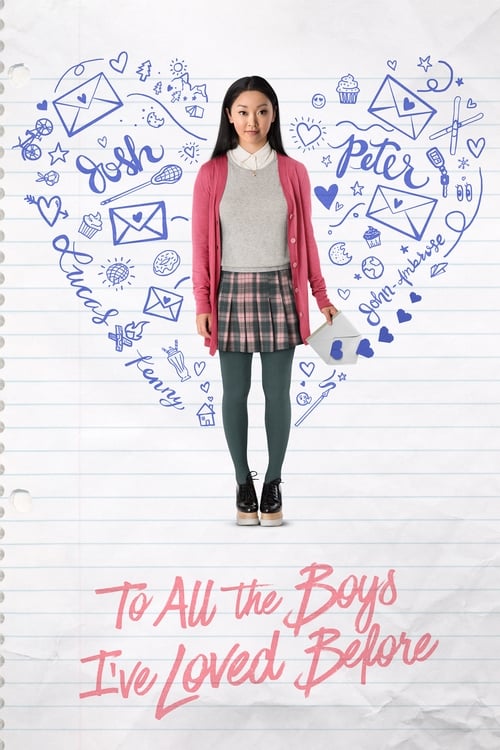
To All the Boys I've Loved Before
2018 · Susan Johnson
For a cozy night in when you want to fall in love with zero risk — sleepover viewing, comfort-food romance, the film you put on when you need the world to be kind for ninety minutes. All comfort, no challenge.
What it's about
Lara Jean Covey deals with crushes the safest way possible: she writes each boy a love letter she never sends and hides it in a hatbox. Then all five letters get mailed. To contain the fallout, she strikes a fake-dating deal with Peter Kavinsky, the school's affable golden boy — and the arrangement starts doing what fake-dating arrangements do. Around the romance sits a warm portrait of three sisters and a widowed dad holding a family together.
The experience
Pure lift — funny, swoony, and paced like a favorite song, with just enough ache underneath (a lost mother, a shy girl learning to be seen) to make the sweetness land. It's the kind of movie you finish smiling.
Performances
Lana Condor makes Lara Jean's interior life visible — every flustered pause reads — and Noah Centineo's easy, teasing warmth as Peter turned him into an overnight phenomenon; the chemistry between them is the whole engine.
The craft
Susan Johnson directs Sofia Alvarez's adaptation of Jenny Han's novel with a pastel, storybook prettiness — Lara Jean's daydream world rendered in candy colors and cozy interiors — and a script that keeps the tropes but sands off the meanness. It's small-scale filmmaking with unusually confident tone control.
Why it matters
The film that led Netflix's 2018 teen-romance wave, proved a rom-com with a Korean-American lead could be a mainstream phenomenon, and launched a trilogy plus a genuine internet-heartthrob moment. It helped revive the whole genre for a streaming generation.
Snapshot
To All the Boys I've Loved Before is a Netflix original teen romance adapted from Jenny Han's 2014 young-adult novel, directed by Susan Johnson from a screenplay by Sofia Alvarez. It follows Lara Jean Song Covey (Lana Condor), a introverted high-school junior who processes her crushes by writing secret, never-sent love letters — until all five are mailed out, throwing her into a fake-dating arrangement with popular jock Peter Kavinsky (Noah Centineo). Released to streaming in August 2018, the film became a defining cultural artifact of that summer's teen-romance surge, and its significance runs well beyond its modest scale: it placed a Korean-American girl at the center of a mainstream American romance, minted a bona fide internet heartthrob in Centineo, and helped establish Netflix as a maker (not just a licenser) of the sort of studio programmer Hollywood had largely abandoned. It anchored a trilogy and became a touchstone for the streaming-era rom-com revival.
Industry & production
The film sits at the intersection of two industrial shifts: the collapse of the mid-budget theatrical romantic comedy in the 2010s, and Netflix's aggressive move into original film production. It was produced by Awesomeness Films — the film arm of the youth-media company AwesomenessTV — together with Will and Jada Pinkett Smith's Overbrook Entertainment. Netflix acquired distribution rights (the project had been developed with theatrical distribution in mind before Netflix stepped in), a pathway that became characteristic of the era: films conceived as modest theatrical releases finding a larger, algorithmically surfaced audience on streaming.
The production's most consequential decision predated any camera. Author Jenny Han has spoken publicly and repeatedly about the years-long effort to get the book adapted with an Asian-American Lara Jean intact, describing interest from producers who wanted to alter the character's ethnicity — a demand Han refused. That the finished film keeps Lara Jean and her sisters as biracial Korean-American characters, with their late Korean mother woven through the family's texture, is the direct result of that insistence, and it is central to the film's place in history. It arrived within weeks of Crazy Rich Asians (2018), and the two together were widely read as a watershed moment for Asian-American representation in mainstream American film.
Budgetary and viewership figures require caution. As a Netflix original, the film had no theatrical box office, and Netflix did not release conventional gross or precise viewership data. The company did publicly characterize the film as one of its most-viewed and most-rewatched originals, and its cultural footprint — trending social-media conversation, a rapid greenlight for sequels — corroborates strong performance; but specific viewer counts in wide circulation should be treated as estimates rather than disclosed fact.
Technology
The film is a product of the streaming-first distribution paradigm as much as any camera technology. It was shot digitally and delivered to Netflix's original-content specifications, which in this period mandated 4K/UHD capture and finishing — a technical baseline that lent even a small teen romance a clean, high-resolution polish. The specific camera and lens package is the kind of detail best confirmed against the production's technical credits rather than asserted from memory; the visible image is consistent with contemporary digital cinema capture and a controlled, softly graded color pipeline.
More important than the acquisition format is the distribution technology and its feedback loop with social media. The film's release strategy — a single global streaming drop rather than a platform-by-platform theatrical rollout — allowed its audience to discover, watch, and re-watch it simultaneously, and to convert that experience instantly into online conversation. Noah Centineo's ascent to "internet boyfriend" status was a phenomenon native to Twitter and Instagram, inseparable from the film's streaming release model. In this sense the relevant "technology" is the platform itself: recommendation surfacing, binge availability, and the social feed as amplifier.
Technique
Cinematography
Cinematography is by Michael Fimognari, a notable choice given his background: he had built a reputation shooting horror and psychological genre work, much of it in collaboration with director Mike Flanagan (Oculus, Gerald's Game, and the Netflix series The Haunting of Hill House). In To All the Boys he applies that formal control to a warm, aspirational register. The palette leans pastel and candied — dusty pinks, creamy neutrals, soft blues — organized to externalize Lara Jean's romantic, interior imagination. Light is generally flattering and diffused, with backlit hair and gentle highlights giving key scenes a wish-fulfillment glow. The camera is composed and unfussy, favoring clean framing and shallow-focus close-ups that keep faces and small gestures legible; the film's most-quoted images (Peter's hand slipping into a back pocket, the hot-tub confession) are staged for iconic clarity rather than kinetic energy. Fimognari's investment in the material was such that he went on to direct both sequels — a rare cinematographer-to-director throughline within a single franchise.
Editing
The editing is smooth and rhythmically conventional in the best sense — a classical continuity approach that keeps the romantic-comedy machine running cleanly, letting reaction shots and comic beats land without stylistic intrusion. The letters' fantasy logic and Lara Jean's voice-over are integrated through orderly cutting rather than showy montage. The precise editorial credit is the sort of fact worth confirming against the finished titles; the technique on screen is one of unobtrusive assembly in service of performance and pacing.
Mise-en-scène / staging
Production design does substantial narrative work. The Covey household is a lived-in, cozy space coded with the family's history — Korean touchstones, the absent mother's presence, the three sisters' distinct textures — that grounds the film's fantasy in genuine domestic warmth. Lara Jean's bedroom, her wardrobe (thrifted, layered, deliberately individual), and recurring props like the treasured hatbox of letters and the scrunchie all function as character. Staging favors intimate two-shots that let physical proximity carry the slow-burn courtship; the choreography of not-quite-touching is the film's real subject, and blocking is arranged to make longing spatially visible.
Sound
The soundscape is pop-forward, using a curated contemporary and throwback song bed to score the emotional beats — Lauv's "I Like Me Better" is among the tracks most closely associated with the film's mood. Needle drops carry much of the romantic register, in keeping with the modern teen-romance idiom. The specific score composer is a credit best verified against the titles rather than asserted here; functionally, the music supervision and song choices do more to define the film's sonic identity than any orchestral underscore, cushioning the drama in a warm, radio-adjacent glow.
Performance
Performance is the film's engine. Lana Condor plays Lara Jean with a mixture of guardedness and open-hearted sincerity, calibrating shyness so it reads as rich interiority rather than passivity; her voice-over and her reaction shots do a great deal of the storytelling. Noah Centineo's Peter Kavinsky is disarmingly relaxed — a charm built on ease, teasing warmth, and unexpected emotional availability, which is precisely what turned the character into a cultural object. The chemistry between the two leads is the film's non-negotiable asset, and it holds. Around them, the ensemble — Janel Parrish and Anna Cathcart as Lara Jean's sisters Margot and Kitty, John Corbett as the gentle single father, Israel Broussard as the childhood-friend complication Josh — supplies a credible family and social world that keeps the romance emotionally anchored.
Narrative & dramatic mode
The film operates in the comic-romantic mode, structured around a classic contrivance (the mailed letters) that forces a fake-dating pact — a device with deep roots in the genre, from screwball pretense to the contemporary "contract romance." Its dramatic engine is dramatic irony and slow-burn: the audience recognizes the real feeling growing beneath the arrangement long before the characters admit it. First-person voice-over gives us privileged access to Lara Jean's inner life, positioning the film squarely within the confessional YA tradition. The stakes are deliberately intimate — self-protection versus vulnerability, the risk of actually wanting something — and the arc is one of emotional coming-of-age: Lara Jean's growth is learning to stop hiding inside imagined love and to hazard the real, unscripted kind. Notably, the film ends on connection but withholds tidy closure, leaving a thread (the recurring video, the lingering doubt) that sets up serialization.
Genre & cycle
To All the Boys belongs to the teen romantic comedy, and more precisely to its 2010s streaming revival. It arrived in the summer of 2018 alongside Netflix's The Kissing Booth and Sierra Burgess Is a Loser, a cluster that signaled the platform's discovery of a durable, underserved audience for the genre. The film consciously converses with the John Hughes–inflected teen-movie canon of the 1980s and the studio rom-com boom of the 1990s–2000s — genres Hollywood had effectively vacated theatrically by the mid-2010s. It updates that lineage with contemporary specifics: a woman-of-color protagonist, a social-media-native sensibility, and a self-aware relationship to genre convention. Its commercial and critical success is widely credited with catalyzing the streaming rom-com cycle that followed.
Authorship & method
The film is a case study in adaptation-driven authorship layered over directorial craft. The originating vision belongs to novelist Jenny Han, whose insistence on an Asian-American lead shaped the project's identity and who remained a public steward of the material. Screenwriter Sofia Alvarez performed the adaptation, condensing Han's novel into a tight romantic arc while preserving its confessional voice and family warmth (Alvarez would continue with the franchise's second installment). Director Susan Johnson, working on her second narrative feature, brought a light, empathetic touch attuned to performance and emotional legibility; her direction prioritizes warmth and star chemistry over stylistic assertion. Michael Fimognari (cinematographer) supplied the film's polished, pastel visual identity and became so central to the franchise that he directed both sequels. The music-supervision-forward song score and the editing are the collaborative contributions whose specific individual credits are best confirmed against the film's titles; the record on those names is thinner in general circulation than the above principals. The through-line of the authorship is fidelity to a beloved source combined with a producer's-eye instinct for casting chemistry — the single most decisive creative act of the production.
Movement / national cinema
The film is an American production (shot in the Vancouver, British Columbia area, a common stand-in for the Pacific Northwest setting), and it does not belong to any formal aesthetic movement. Its more meaningful affiliation is with a representational current in late-2010s American popular cinema: the mainstream push toward Asian-American visibility, of which it and Crazy Rich Asians became the twin 2018 emblems. It is best understood not as art-cinema authorship but as commercial genre filmmaking inflected by a deliberate, and historically significant, choice about whose face gets to headline a wish-fulfillment romance.
Era / period
It is a quintessential artifact of the streaming-transition moment, roughly 2017–2020, when Netflix moved decisively into original film production and the theatrical mid-budget romantic comedy went nearly extinct. The film both reflects and helped define that period: it is contemporary in setting, saturated with the aesthetics and communication habits of late-2010s teen life, and its reception played out on the social platforms that characterized the era. It also marks a specific inflection point in representation history, arriving at the crest of the 2018 conversation about Asian-American presence in Hollywood.
Themes
The film's central theme is vulnerability versus self-protection — the emotional cost and necessity of letting oneself actually want and be seen. The letters are its governing metaphor: love kept safe by never being sent, feeling preserved precisely by being withheld. Around this it develops motifs of family and grief (a motherless household held together by sisterly devotion and a tender father), the negotiation of identity and belonging (a biracial protagonist quietly at home in her Korean heritage without the film treating that as a problem to be solved), and the contrast between imagined romance and the messier reality. Fantasy and reality, performance and authenticity — the "fake" relationship that becomes real — run throughout, giving a light genre exercise a genuine emotional spine.
Reception, canon & influence
Critically, the film was received far more warmly than its genre and streaming pedigree might have predicted, praised for the charm and chemistry of its leads, its emotional sincerity, and the significance of its casting; it is frequently cited as one of the better teen romances of its decade and a high-water mark for the streaming rom-com. Precise aggregate scores and viewership figures should be checked against the record rather than asserted, but the qualitative consensus — strong reviews, outsized cultural reach — is not in dispute.
Its influences (backward) are the teen-movie tradition of John Hughes and its 1990s–2000s studio rom-com descendants, filtered through the confessional first-person mode of contemporary young-adult fiction; the fake-dating premise draws on a romance convention older than cinema.
Its legacy (forward) is substantial for so modest a film. It spawned a completed trilogy — P.S. I Still Love You (2020) and Always and Forever (2021), both directed by Fimognari — and, more broadly, it helped prove out Netflix's teen-romance strategy, encouraging a wave of streaming YA adaptations and original romances. It made Noah Centineo a star and gave Lana Condor a defining lead role. Within representation history it stands, alongside Crazy Rich Asians, as a marker of the 2018 shift toward Asian-American leads in mainstream American entertainment — a small romance that carried a genuinely large cultural weight.
A Deleuzian reading
A hand slides into a back pocket.
The full Deleuzian reading of To All the Boys I've Loved Before →
Reception
An instant phenomenon on Netflix in the summer of 2018, it was credited (alongside Set It Up and Crazy Rich Asians) with single-handedly resuscitating the rom-com — and while its two sequels drew a shrug, the original's standing as the best of the Netflix teen-romance boom has only solidified.
How To All the Boys I've Loved Before was received, from release to now →
How to watch To All the Boys I've Loved Before: what to notice on a first viewing
- Watch Peter's hand slide into Lara Jean's back pocket. Johnson holds the gesture long enough to settle into a picture, and Fimognari shoots it in clean framing and soft backlight rather than chasing it with movement. The reading calls this an index of equivocity: one gesture that is both a performance for onlookers and a boy touching a girl he likes.
- Notice the pastel pinks, creams, and soft blues everywhere. Fimognari and Johnson keep light diffused and flattering, backlighting hair and tinting rooms in the same honeyed palette rather than reserving color for dream sequences. The palette carries her imagination into every frame instead of setting it apart in a separate dream sequence.
- Watch how close two people stand without quite touching. Johnson blocks Lara Jean and Peter in intimate two-shots where the small remaining distance is always visible and measured. The blocking makes longing something you can see in inches, not something the dialogue has to explain.
- Listen for the voice-over narrating what Lara Jean feels. Her spoken thoughts run under scenes where her face is already doing something different, a gap between what she says and what you can see. You become the third party who knows more about her feelings than she admits to herself.
- Watch for Korean objects and touches in the Covey house. The family home carries traces of the absent mother throughout its furniture and rituals, without a single scene dedicated to explaining the loss. Grief lives in the props instead of in a speech, shaping every scene while never being staged directly.
The whole guide to watching To All the Boys I've Loved Before, with the keys for a rewatch →
Influences: the films it descends from and the films it influenced
- Sixteen Candles (1984) — Establishes the reaction-shot grammar of the longing teen girl watching her crush across a crowded room — the sympathetic-POV close-up register Johnson leans on for emotional legibility (while TATBILB pointedly overwrites its Long Duk Dong caricature with an actual Asian-American lead).
- Pretty in Pink (1986) — Codifies the needle-drop pop score cued to precise emotional beats rather than diegetic realism, the song-supervision-forward approach TATBILB's soundtrack inherits.
- Can't Buy Me Love (1987) — The literal fake-dating contract — paying someone to pose as your partner and the feelings that leak through the arrangement — is the plot engine TATBILB revives as Lara Jean and Peter's written relationship terms.
- Say Anything... (1989) — Models the needle drop as an unironic romantic climax (the boombox / 'In Your Eyes'), prioritizing sincerity over cool detachment — the earnest tonal permission TATBILB operates in.
- Clueless (1995) — First-person female-teen voiceover narration that structures the film's dramatic irony (the narrator misreads her own heart before we do) — the confessional device TATBILB adapts from Han's prose.
- The Virgin Suicides (1999) — The gauzy, soft-diffused pastel palette photographing teenage girlhood as memory — the visual template Michael Fimognari draws on for the film's honeyed, romanticized light.
- 10 Things I Hate About You (1999) — Pairs a transactional-courtship premise (a boy paid to date the reluctant girl) with banter-driven, chemistry-forward two-handers — the casting-chemistry-over-style calculus TATBILB treats as its decisive creative act.
- Easy A (2010) — Runs a to-camera confessional narrator over a fake-relationship rumor engine while openly invoking the Hughes canon — the self-aware YA voice-and-premise combination TATBILB refines into sincerity.
- Before I Fall (2017) — DP Michael Fimognari carried the soft, warm, handheld-intimate YA visual grammar straight from Before I Fall into this streaming romance — and went on to direct its sequels — a literal collaborator through-line.
- Love, Rosie (2014) — Inherits the letters-never-meant-to-be-sent mechanism as its entire plot engine, plus the pastel shallow-focus close-up grammar and the audience-knows-first dramatic irony — and monetizes the streaming romance audience Love, Rosie's long licensing tail had proved existed.
- The Half of It (2020) — Extends the confessional-letters mechanism explicitly into Cyrano, again on Netflix and again with an Asian-American lead — inheriting TATBILB's proof that a letter-driven interior voice can carry a streaming romance.
- P.S. I Still Love You (2020) — The direct sequel in which the original's cinematographer takes the director's chair, extending the same pastel visual identity — authorship literally passing from the camera to the direction.
- The Summer I Turned Pretty (2022) — Jenny Han's next adaptation carrying the identical confessional-YA voice and vulnerability-vs-self-protection love-triangle template into serialized streaming form.
- XO, Kitty (2023) — A direct spin-off of the trilogy's world, transposing the same family-warmth-plus-first-love formula and Han stewardship into a Netflix series.
- Anyone But You (2023) — Revives the fake-dating contrivance and chemistry-first casting for a theatrical, adult-skewing rom-com in the commercial slipstream TATBILB reopened for the genre.
- Crazy Rich Asians (2018) — The parallel 2018 mainstream-studio milestone built on an all-Asian/Asian-American lead cast, sharing TATBILB's representation-as-craft-decision — casting identity as the film's foundational authorial choice.
- Set It Up (2018) — Part of the same-year Netflix rom-com revival, engineering romance from a contrived fake-setup scheme and foregrounding lead chemistry over directorial signature.
- The Kissing Booth (2018) — The other 2018 Netflix teen romance that co-proved the streaming-YA strategy, sharing the pastel-bright palette and streaming-original distribution model TATBILB helped validate.
- Sierra Burgess Is a Loser (2018) — A same-wave Netflix teen romance running a Cyrano/catfish deception plot — the mistaken-correspondence device adjacent to TATBILB's escaped-love-letters premise.
- All the Bright Places (2020) — The Netflix YA-novel-adaptation romance machine Bright Places was built for — available-light digital naturalism and star-forward casting engineered for a reader-fanbase streaming audience.
- Finding Emily (2026) — Misdirected private correspondence as the inciting accident, and the post-2018 house look Finding Emily adopts wholesale: high-key, saturated, symmetrically centered medium two-shots with the background thrown well off.
Similar films
- 20th Century Girl (2022) — shared sensibility
- Love Untangled (2025) — shared sensibility
- Girls Like Girls (2026) — shared sensibility
- Even If This Love Disappears Tonight (2025) — shared sensibility
- Voicemails for Isabelle (2026) — shared sensibility
- Your Name Engraved Herein (2020) — shared sensibility
- Falling in Love Like in Movies (2023) — shared sensibility
- People We Meet on Vacation (2026) — shared sensibility
All the films related to To All the Boys I've Loved Before →