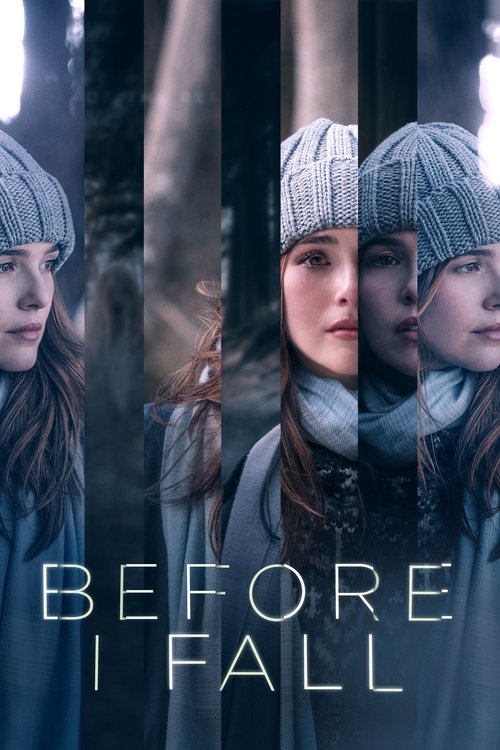
Before I Fall
2017 · Ry Russo-Young
For when you want a good cry with something to chew on afterward — a rainy-afternoon film about second chances that's gentle on the surface and heavier underneath.
What it's about
Samantha Kingston is a popular high-school senior with the boyfriend, the friend group, and the easy cruelty that comes with sitting on top. After one fateful night ends in a car accident, she wakes up to find herself reliving the same February day again and again. With each repetition she starts seeing her world — her friends, her family, the girl her clique torments — differently, and starts asking what a single day is actually for.
The experience
Moodier and more melancholy than its teen-movie packaging suggests — the repetitions shift from disorienting to quietly devastating as the film turns into a meditation on kindness and consequence. It sneaks up on you emotionally.
Performances
Zoey Deutch carries the whole structure, playing subtly different versions of the same girl across the same day — her gradual softening is what makes the film work.
The craft
Ry Russo-Young shoots the repeated day with an indie drama's restraint rather than a fantasy film's gimmickry, using small variations in staging and tone to mark how Sam is changing inside a world that isn't. The wintry Pacific Northwest light gives the whole thing a hushed, overcast beauty that suits its subject.
Why it matters
A cult favorite of the YA adaptation wave, it stands out for taking the time-loop device — usually played for comedy — dead seriously, and helped launch Zoey Deutch as a lead.
Snapshot
Before I Fall is a young-adult drama with a fantastical premise: a popular high-school senior dies in a car accident and is condemned to relive the same February day repeatedly until she reckons with her own cruelty and its consequences. Adapted from Lauren Oliver's 2010 debut novel — a substantial bestseller in the YA market — the film was directed by American independent filmmaker Ry Russo-Young from a screenplay by Maria Maggenti, and it stars Zoey Deutch as Samantha Kingston. It premiered at the Sundance Film Festival in January 2017 and received a modest U.S. theatrical release through Open Road Films that March. The film sits at an unusual crossroads: it takes the time-loop structure most associated with high-concept comedy and fantasy and repurposes it as a vehicle for moral education, empathy, and adolescent grief. Its significance lies less in commercial impact — which was limited — than in its position within the mid-2010s wave of literary YA adaptations and in Russo-Young's translation of an indie-auteur sensibility into studio-adjacent teen filmmaking.
Industry & production
The film is a product of the mid-2010s YA-adaptation cycle that followed the commercial success of The Hunger Games, The Fault in Our Stars, and the Divergent films. It was produced with the involvement of Awesomeness Films — the feature arm of AwesomenessTV, a company built around teen and young-adult audiences and their social-media consumption habits — alongside other production partners, with Open Road Films handling U.S. distribution. That configuration is telling: the picture was conceived for a demographically targeted audience rather than as a broad four-quadrant release, and its marketing leaned on the built-in readership of Oliver's novel and on Deutch's rising profile.
Commercially, the film returned modestly. It opened to soft box-office numbers and did not become the crossover hit that the strongest YA adaptations achieved; I won't cite precise gross figures here, as the reliable public record should be consulted directly rather than approximated. Its production scale was comparatively small for a studio-distributed release — an economical, location-driven shoot rather than an effects-heavy tentpole. This budget discipline is consistent with the film's origins: a director from the American independent scene working within a genre framework, and a story whose "fantasy" element requires performance and editing rather than expensive visual effects.
Technology
Before I Fall was shot digitally, consistent with the standard practice for a production of its scale and period; the visual approach favors naturalistic, available-feeling light over stylized artifice. The specific camera and lens package are not details I can attest to from the established record without risk of error, so I flag that as thin. What matters technologically is what the film chooses not to do: the repeating-day conceit is realized almost entirely through in-camera staging, production design continuity, and editorial rhythm rather than through digital effects or overt visual signposting. The one recurring stylistic marker — the way each new iteration of the day is introduced — is handled as a controlled reset rather than a spectacle. The film thus belongs to the strain of fantasy cinema that keeps its supernatural mechanism deliberately unexplained and low-tech, locating the "impossible" element in structure rather than in imagery.
Technique
Cinematography
The cinematography, by Michael Fimognari, is central to the film's identity. Fimognari — who would go on to become a defining visual voice for the streaming-era YA romance, shooting and later directing entries in Netflix's To All the Boys series — brings a soft, intimate, Pacific Northwest palette to the material. The film exploits its regional setting: overcast skies, misty coniferous forests, and a cool, desaturated register that lends the repeating day a melancholy, dreamlike quality rather than a bright teen-comedy gloss. Handheld and close proximity to the actors keep the emotional register subjective, anchoring us inside Samantha's shifting perception. As the loop progresses and her understanding deepens, the imagery is calibrated to move from the glossy surface of popularity toward something more searching and elegiac. The forest and roadway that bracket the fatal night recur as visual motifs, gaining weight with each return.
Editing
Editing is the film's defining formal problem, because the time-loop structure lives or dies on repetition management. The picture must show the same day enough times to establish pattern and ritual, while varying each pass sufficiently to sustain momentum and mark Samantha's growth. The cutting therefore functions as the primary storytelling engine: recurring beats (the alarm, the drive to school, the party) are re-presented with escalating compression or pointed variation, so the audience reads change against a fixed template. This is the mechanism that lets the film compress narrative information — later loops can elide what earlier loops established. I can't reliably attribute the credited editor from memory, so I leave that specific naming to the verified record rather than guess.
Mise-en-scène / staging
The production design and staging do quiet, essential work. Because the same spaces recur — Samantha's bedroom, the high-school corridors, the party house, the fatal stretch of road — the film relies on precise continuity so that variations register as meaningful rather than accidental. The social geography of the high school is staged hierarchically: the clique of four girls occupies the film's center of gravity, and their coordinated styling, cars, and body language visually encode status and belonging. The staging of the bullied classmate, Juliet Sykes, is pointedly marginal early on and grows in centrality as Samantha's attention — and the film's — turns toward her. The costuming and set dressing also serve the calendar conceit: the day is a Valentine's-adjacent occasion (in the source material, "Cupid Day"), and the roses/valentines motif becomes a recurring social currency that the staging tracks obsessively.
Sound
The score is by Adam Taylor, a composer known for atmospheric, mood-forward work (his television scoring, including The Handmaid's Tale, exemplifies that register). Here the music leans toward ambient, emotionally interior textures that reinforce the film's contemplative rather than propulsive mode. As is standard for the YA idiom, the film also deploys curated contemporary and indie-pop needle-drops to locate the characters generationally and to color the party and driving sequences. Sound design supports the loop mechanic subtly — the morning alarm and the recurring ambient cues of the day function as auditory anchors that tell the audience, without dialogue, that we have reset.
Performance
Zoey Deutch carries the film almost entirely, appearing in nearly every scene and required to modulate Samantha across a wide arc — from complacent, casually unkind popular girl to bewildered prisoner of the loop to someone arriving at painful self-knowledge. The role demands that she replay the same beats with incremental internal difference, and the performance's success is inseparable from the editing's. The supporting ensemble — including Halston Sage as the domineering best friend Lindsay, Logan Miller as the earnest Kent, and Elena Kampouris as the isolated Juliet — provides the fixed social constellation against which Samantha changes. Kampouris's Juliet functions as the film's moral fulcrum, and the performances of the clique are calibrated to make their casual cruelty feel ordinary rather than cartoonish, which is essential to the film's argument.
Narrative & dramatic mode
The film's dramatic mode is the moral-fantasy parable executed through a time-loop structure. Its lineage runs directly to the "repeating day as ethical curriculum" tradition, and the picture is candid about using recurrence as a mechanism of transformation: each iteration is a draft of a life, and Samantha's task is to revise it. Crucially, the film resists the wish-fulfillment resolution that the genre often permits. Rather than escaping the loop by simply becoming nicer or by winning a romance, the narrative moves toward sacrifice and acceptance — an ending oriented around mortality and moral reckoning rather than restoration. This gives the film a somber, elegiac tone unusual for the teen market, closer to a meditation on death and empathy than to a comedy of self-improvement. The mode is subjective throughout; we are locked to Samantha's perspective and knowledge, and the audience learns the rules of the world exactly as she does.
Genre & cycle
Before I Fall belongs to two overlapping cycles. First, the YA literary adaptation cycle of the 2010s, with its conventions of first-person female interiority, high-school social stratification, and emotionally heightened stakes. Second, the time-loop fantasy tradition, whose canonical reference point is the perpetual comparison every such film invites. Notably, 2017 was a banner year for the teen time loop: Before I Fall arrived the same year as Blumhouse's Happy Death Day, which fused the loop with slasher horror, and shortly before the streaming era's more comedic and philosophical takes on the device proliferated. Within that clustering, Before I Fall is the earnest, dramatic entry — the one that treats the loop as grief-work and ethics rather than as comedy or genre pastiche. It thus occupies a specific niche: the "sincere" time-loop film aimed at a young female readership.
Authorship & method
The film's most interesting authorial dimension is Ry Russo-Young's presence behind the camera. Russo-Young emerged from the American independent scene of the late 2000s and early 2010s, with features such as You Won't Miss Me (2009) and Nobody Walks (2012), the latter co-written with Lena Dunham — placing her adjacent to the mumblecore-inflected indie world of naturalistic, character-driven, low-budget filmmaking. Before I Fall represents her move into genre and into a more industrial, IP-driven mode, and the film bears the marks of that background in its performance-forward intimacy and its restraint with the fantastical. Russo-Young's own biography — she was raised by two mothers and later directed the personal documentary Nuclear Family (2021) about her family and a landmark custody dispute — informs a body of work preoccupied with identity, belonging, and the making of a self, themes legible in Before I Fall's concern with who Samantha chooses to become.
The screenplay is by Maria Maggenti, herself a writer-director with roots in independent and queer cinema (notably The Incredibly True Adventure of Two Girls in Love, 1995). Two filmmakers with indie and identity-conscious pedigrees adapting a mainstream YA property is a meaningful authorial signature. Cinematographer Michael Fimognari and composer Adam Taylor round out the key creative collaborators; Fimognari's involvement in particular connects the film to the visual grammar that would define the subsequent streaming YA romance. The credited editor and additional department heads I leave to the verified record rather than assert from memory.
Movement / national cinema
The film is an American production, shot on location in the Pacific Northwest region (British Columbia standing in for an unnamed American town), and it belongs to no formal movement. Its most useful contextual placement is as a crossover artifact between two American traditions: the independent, character-driven cinema from which its director and writer emerged, and the commercial, franchise-minded YA studio product of its distributor and producers. That hybridity — indie sensibility housed in a genre-IP frame — is its defining "movement" identity.
Era / period
Before I Fall is very much a film of the mid-to-late 2010s. It reflects the tail end of the YA-adaptation boom, when studios were mining the bestseller lists that had produced The Hunger Games and The Fault in Our Stars but when audience appetite for such adaptations was beginning to cool. It also reflects the period's growing attention to bullying, teen mental health, and empathy as explicit thematic subjects in youth-oriented media — the same cultural moment that produced intense debate around works like 13 Reasons Why. Technologically and industrially, it belongs to the digital-shoot, mid-budget, demographically targeted release model that was already being squeezed by the shift toward streaming, where much of this kind of teen-oriented storytelling would soon migrate.
Themes
The film's central themes are mortality, empathy, and moral responsibility. The loop dramatizes the idea that a life is defined by the accumulation of small choices — particularly choices about how one treats others. Bullying and the social violence of adolescent hierarchies are foregrounded: Samantha's complicity in the group's cruelty toward Juliet is the wound the narrative circles back to obsessively, and her redemption is figured as recognizing the humanity of those she had rendered invisible. Grief and the fear of death run beneath the surface, and the film's refusal of an easy escape gives its ending a genuinely tragic cast, reframing self-sacrifice as the only authentic form of growth. Secondary themes include the performance of popularity, the difference between being liked and being good, and the way a single day can contain an entire ethical life.
Reception, canon & influence
Critical reception was mixed-to-moderate. Reviewers frequently praised Zoey Deutch's committed lead performance and the film's sincerity and visual atmosphere, while some found the premise overfamiliar and the execution earnest to a fault; the recurring critical move was to measure it against the long shadow of prior time-loop films. It was not a breakout at the box office and did not enter the broader cultural canon in the way the biggest YA adaptations did.
Looking backward, the film's influences are clear and openly worn: the time-loop moral fable that the genre's canonical entries established, and the confessional, first-person YA literary tradition embodied by Oliver's source novel. Its emotional and thematic DNA also connects to the empathy-and-consequence strain of youth fiction contemporary with it.
Looking forward, its legacy is more diffuse than decisive. It stands as an early-2017 marker in a sudden proliferation of teen time-loop stories, and it helped consolidate a "sincere, dramatic" register for the device distinct from comedic or horror treatments — a register that later streaming projects would develop further. Perhaps its most concrete forward influence is through its collaborators: cinematographer Michael Fimognari carried a visual sensibility from this film into the enormously popular streaming YA romances that followed, and director Ry Russo-Young continued toward more personal work. For a modestly received adaptation, Before I Fall has retained a durable minor following, particularly among readers of the novel and viewers drawn to its unusual willingness to let a teen fantasy end in sacrifice rather than rescue.
A Deleuzian reading
The same gray morning through the same window.
The full Deleuzian reading of Before I Fall →
Reception
Shrugged off in March 2017 as 'YA Groundhog Day' and buried at the box office, it's since been reappraised as the sincere forerunner of the time-loop boom — arriving before Happy Death Day, Russian Doll and Palm Springs made the device fashionable again.
How Before I Fall was received, from release to now →
How to watch Before I Fall: what to notice on a first viewing
- Watch the same gray, misty light morning after morning. Fimognari shoots overcast skies and foggy coniferous forests in a cool, desaturated register, so the repeating day feels melancholy and dreamlike rather than like a bright teen comedy. The color of the world tells you this loop is not going to be fun.
- Watch how Samantha's group fills the hallway frame. In the first passes through the day the four friends are staged at the center of every frame, with other students pushed to the edges. Position in the image tells you who the school treats as important.
- Notice which parts of the morning get skipped over. The alarm, the drive, the corridor get replayed each time, but later passes compress or vary these beats, trusting you to fill in what earlier loops already established. You read Samantha's change by measuring it against a version of the day you already carry in your head.
- Listen for the alarm marking the exact start of a reset. The same morning sounds return at the top of each loop, telling you without any dialogue that the day has started over again. The sound design does the work of announcing a reset that the story never explains out loud.
- Watch the four girls move and dress in sync. Their coordinated outfits, cars, and synchronized walk down the hallway visually encode status and belonging without a line of dialogue explaining the hierarchy. You can read the social order of the school directly off how these four move together.
The whole guide to watching Before I Fall, with the keys for a rewatch →
Influences: the films it descends from and the films it influenced
- Groundhog Day (1993) — Established the repetition-management edit grammar where each loop shows only the deltas — new choices made, tedious repeats elided or fast-forwarded — turning one repeated day into a moral-education arc, the exact structural template Before I Fall inherits.
- Run Lola Run (1998) — Fused a propulsive needle-drop/score-forward soundtrack to iterated runs in which tiny variations cascade to different fates, modeling the music-driven momentum Before I Fall uses to keep repeated days kinetic rather than static.
- The Virgin Suicides (1999) — Pairs a mood-forward score with a hazy suburban dream palette and elegiac subjective POV around doomed teen girls — the atmospheric mortality-of-youth template that Before I Fall's Pacific-Northwest palette and score-forward mood descend from.
- The Lovely Bones (2009) — Structures itself on a girl's first-person narration facing and past her own death, using subjective interiority as the organizing device Before I Fall inherits from the confessional YA-literary tradition.
- Nobody Walks (2012) — Russo-Young's mumblecore-adjacent, handheld, performance-forward naturalism is the intimate character-driven method she imported into Before I Fall's restraint with the fantastical and its Deutch-carried closeness.
- The Incredibly True Adventure of Two Girls in Love (1995) — Screenwriter Maggenti's indie/queer, identity-conscious coming-of-self voice — the who-do-I-choose-to-become throughline — is the authorial DNA she brought to the Before I Fall script.
- The Map of Tiny Perfect Things (2021) — Extends the sincere YA time loop into romance while keeping the moral-fantasy-parable frame in which escape requires an act of empathy and letting-go rather than a puzzle solution.
- Palm Springs (2020) — Develops the loop-as-emotional-crucible in the sincere-dramatic register Before I Fall helped consolidate, where the exit is a change of self rather than a mechanism to be cracked.
- Russian Doll (2019) — Advances the sincere-dramatic streaming time loop in which the way out is a psychological and mortality reckoning, extending the non-comedic, non-horror register Before I Fall marked out for the device.
- To All the Boys I've Loved Before (2018) — DP Michael Fimognari carried the soft, warm, handheld-intimate YA visual grammar straight from Before I Fall into this streaming romance — and went on to direct its sequels — a literal collaborator through-line.
- The Sun Is Also a Star (2019) — Russo-Young's follow-up YA-literary adaptation continues her compressed single-day structure, performance-forward intimacy, and identity/belonging preoccupation legible in Before I Fall.
- Edge of Tomorrow (2014) — Solved loop-tedium with die-and-reset supercuts that compress dozens of repeats into montage, a repetition-management device Before I Fall echoes in the accelerated, elliptical editing of its later loops.
- Happy Death Day (2017) — A same-year teen-girl time loop running the identical Groundhog structure through slasher mechanics, bracketing the 2017 teen-time-loop cluster by splitting its comedic-horror register from Before I Fall's sincere-dramatic one.
- The Fault in Our Stars (2014) — Set the studio template for the sincere YA-literary mortality adaptation — first-person voice, indie-pop needle-drop soundtrack, earnest register — the exact commercial mode Before I Fall operates within.
- If I Stay (2014) — Builds a YA adaptation on a teen girl suspended between life and death, driving it through subjective POV and a mortality-sacrifice choice — a near-identical thematic-structural engine to Before I Fall's.
- The Perks of Being a Wallflower (2012) — An author-adapts-own-novel YA film built on confessional first-person voice, empathy and bullying/trauma, and a curated needle-drop soundtrack deployed as emotional architecture.
Similar films
- The Perks of Being a Wallflower (2012) — influence & lineage
- To All the Boys I've Loved Before (2018) — influence & lineage
- Palm Springs (2020) — influence & lineage
- Girls Like Girls (2026) — shared sensibility
- Lady Bird (2017) — shared sensibility
- 20th Century Girl (2022) — shared sensibility
- Even If This Love Disappears Tonight (2025) — shared sensibility
- All the Bright Places (2020) — shared sensibility