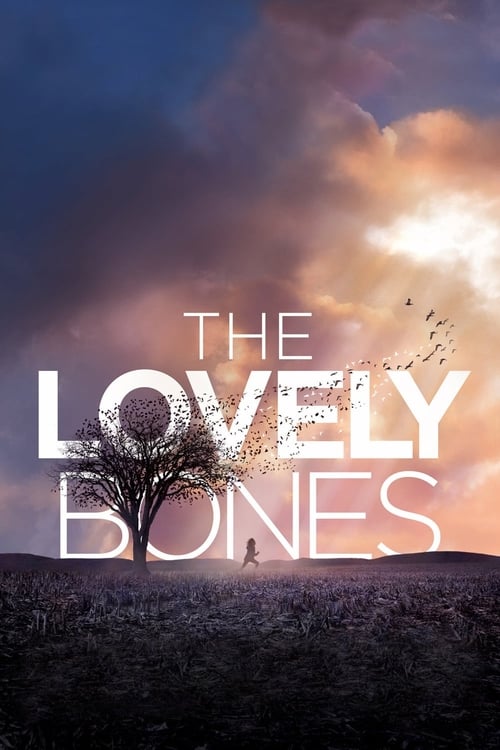
The Lovely Bones
2009 · Peter Jackson
For when you want to feel something big and are braced for genuinely dark subject matter — not a casual pick, but one for a night when you're ready to sit with loss.
What it's about
In 1970s suburban Pennsylvania, fourteen-year-old Susie Salmon is murdered by a neighbor — and narrates what follows from a shimmering, dreamlike afterlife. From her in-between place she watches her shattered family try to hold together, watches her killer move carefully through his ordinary life, and is torn between wanting justice and wanting the people she loves to be able to heal.
The experience
A strange, swooning mix of tones — wrenching family grief, skin-crawling suspense whenever the killer is on screen, and gusts of lush visual fantasy in between. It's emotionally heavy and deliberately uneven, beautiful one minute and deeply unsettling the next.
Performances
A young Saoirse Ronan is luminous — her open, expressive face makes Susie's narration ache — and Stanley Tucci is chillingly unrecognizable as the mild-mannered neighbor, a performance of quiet, meticulous menace.
The craft
Peter Jackson pours his full Wellington effects apparatus into rendering a personal heaven of morphing landscapes and saturated color, set against the drab, precise period detail of the 1970s suburb below. The collision of digital dreamscape and intimate grief drama is audacious filmmaking whether or not you think the two halves fuse.
Why it matters
A famously divisive entry in Jackson's career — his intimate turn after the blockbuster years — it endures as a case study in the risks of visualizing the unimaginable, and as an early showcase for Ronan and Tucci.
Horror · Serial-killer thriller · Suspense & terror. A murdered girl watches her grieving family and her killer from a lush dream-world. Grief alternates with creeping suspense.
Snapshot
The Lovely Bones is Peter Jackson's adaptation of Alice Sebold's 2002 bestselling novel, a story narrated from the afterlife by a murdered fourteen-year-old girl. It arrived as Jackson's first directorial feature after the culmination of his blockbuster era — the Lord of the Rings trilogy (2001–2003) and King Kong (2005) — and it represented a deliberate turn toward more intimate, emotionally driven material, though executed with the full weight of his Wellington-based effects and craft apparatus. The film occupies an unstable generic space: a domestic grief drama and procedural crime story fused with a lavish, digitally rendered vision of a personal heaven. That fusion is the film's central ambition and, for most critics, its central problem. Anchored by a luminous performance from a young Saoirse Ronan as Susie Salmon and a chilling, Oscar-nominated turn from Stanley Tucci as her killer, the film is best understood as a major auteur's high-risk experiment in reconciling the metaphysical with the melodramatic — an experiment the critical consensus judged only partly successful.
Industry & production
The project moved through Jackson's own infrastructure. It was produced by his WingNut Films alongside Steven Spielberg's DreamWorks, with financing and distribution involving Paramount and the UK's Film4 — a co-production structure typical of a mid-budget prestige adaptation with international reach. Jackson had optioned Sebold's novel early; the film's development coincided with his post-King Kong period and with the well-publicized contractual dispute between Jackson and New Line over The Hobbit, which shaped the timing of what he directed next.
Casting drew notable attention. Ryan Gosling was originally cast as the father, Jack Salmon, and reportedly prepared for the role, but Jackson and Gosling parted ways shortly before production over differing conceptions of the character; Mark Wahlberg was cast in his place. Saoirse Ronan, who had earned an Academy Award nomination for Atonement (2007), was cast as Susie; Rachel Weisz played the mother, Susan Sarandon the grandmother, and Stanley Tucci — cast against his customary warmth — the neighbor and murderer George Harvey. The ensemble also included Michael Imperioli, Rose McIver as sister Lindsey, and Susan Sarandon's comic register providing tonal counterpoint.
Principal photography took place largely in New Zealand, with location work in Pennsylvania to establish the 1973 suburban setting of Norristown. The production leaned heavily on Jackson's Weta Digital and Weta Workshop to build the film's "in-between" — the liminal afterlife from which Susie observes the living. The budget was substantial for a drama (broadly reported in the high tens of millions), and the film's commercial performance was modest relative to that outlay; precise figures vary by source, so I will not assign a specific gross. It opened in limited release in December 2009 to qualify for awards, expanding in January 2010.
Technology
Technologically, The Lovely Bones is a study in applying blockbuster-scale visual-effects capacity to non-blockbuster ends. Weta Digital, fresh from King Kong and on the cusp of Avatar-era pipeline maturity, constructed Susie's afterlife as a fully digital, constantly metamorphosing environment — fields, ships in bottles made vast, gazebos, frozen lakes, and skies that shift with her emotional state. Rather than the creature and battle work that had defined Jackson's recent output, the technology here was mobilized for landscape and mood: painterly, surrealist tableaux built to externalize a dead girl's psychology.
This is a case where the tooling and the intended feeling sit in tension. The same photoreal-capable pipeline that grounded Middle-earth's creatures produced an afterlife that many viewers found glossy and literal — a "heaven" so richly rendered that it foreclosed the ambiguity the material arguably needed. The film thus stands as an instructive artifact in the late-2000s conversation about whether more computational realism always serves a story. The digital environments are undeniably accomplished as craft; whether they serve the emotional argument is exactly what critics contested.
Technique
Cinematography
Andrew Lesnie, Jackson's regular cinematographer since The Lord of the Rings, shot the film, and his work draws a sharp visual line between the two worlds. The living world of 1970s Pennsylvania is rendered in warm, period-inflected naturalism — grainy autumn light, wood-paneled interiors, the muted palette of suburban domesticity. The in-between is by contrast supersaturated and luminous, its colors pushed toward the hallucinatory. Lesnie's camera in the earthly scenes is patient and observational, attentive to faces and the textures of a household coming apart; in the afterlife it becomes untethered and roaming. The film's most discussed sequence — the extended cross-cutting around Harvey's underground hideout and Susie's final moments — relies on suspense staging and framing that consciously evoke the thriller tradition, marking one of the picture's most controlled passages.
Editing
Jabez Olssen edited the film, and its structure is fundamentally a problem of editorial rhythm: the narrative must braid three registers — the grief-stricken family, the murder investigation, and Susie's afterlife observation — without any one collapsing the others. The cross-cutting is at its strongest in the pre-murder sequence, which sustains dread through parallel action, and in the later intrusion of Susie's sister into Harvey's house, a genuinely tense set piece. Elsewhere the intercutting between the elegiac afterlife and the earthbound drama is where reviewers most often located the film's tonal whiplash: the movement from suspense to reverie to melodrama does not always modulate cleanly, and the editing bears much of that strain.
Mise-en-scène / staging
The period reconstruction of early-1970s suburbia is meticulous — costume, production design, and set dressing establish a specific, lived-in America. Harvey's house is staged as a study in ordinary menace: the dollhouse-builder's tidy, controlled interiors become an index of his pathology. The film repeatedly uses miniature and enclosure imagery — dollhouses, the ship in the bottle, the sinkhole — as staging motifs that link the killer's craft, Susie's memory, and the idea of lives held in small containers. In the afterlife, mise-en-scène is deliberately unstable, objects and landscapes reconfiguring to Susie's inner state, which is the film's boldest formal gambit and its most divisive.
Sound
Brian Eno composed the score — a striking choice, given that Jackson's signature films had been scored by Howard Shore. Eno's contribution favors ambient, textural, tonal washes over conventional thematic underscoring, and the music is one of the film's more consistently praised elements, lending the afterlife passages an oceanic, drifting quality. The sound design contrasts the hushed, enveloping acoustics of the in-between with the sharper, more grounded sound of the living world. In a film often criticized for over-literalizing the metaphysical, Eno's score is frequently cited as the element that most successfully suggests the ineffable without illustrating it.
Performance
The performances are widely regarded as the film's surest achievement. Saoirse Ronan carries the picture as narrator and presence, conveying a mixture of childlike wonder, longing, and dawning moral seriousness that holds the fantastical conceit together. Stanley Tucci's George Harvey is the film's most acclaimed performance — a portrait of predatory ordinariness, fastidious and mild, that earned him an Academy Award nomination for Best Supporting Actor. Susan Sarandon supplies comic relief as the boozy, careless Grandma Lynn, a tonal register some found jarring against the grief. Mark Wahlberg and Rachel Weisz, as parents pulled apart by loss, register unevenly in reviews, with Wahlberg's casting in particular a recurring point of debate given the role's late recasting.
Narrative & dramatic mode
The film's defining formal feature is its narrating dead. Susie speaks from beyond death, and the entire story is filtered through her posthumous point of view — an unusual dramatic mode that combines first-person elegy, family melodrama, and crime thriller. This produces a built-in tension: the afterlife frame reassures the audience that Susie persists, which drains conventional suspense from the murder, while the family and procedural strands generate suspense of a more traditional kind. The film oscillates between wanting to console and wanting to unsettle. Sebold's novel managed this through interiority and prose; the film must externalize it, and the dramatic mode strains when consolation (the luminous heaven) and horror (the murder) are placed in direct visual juxtaposition. The screenplay also notably softens the novel's most explicit content, eliding the rape that precedes the murder — a decision that reshapes the story's moral weight and became a focus of critical discussion about tone and audience.
Genre & cycle
The Lovely Bones resists clean genre placement. It belongs partly to the cycle of literary-adaptation prestige dramas of the 2000s built around traumatic events and non-linear or unconventional narration — a lineage that includes Jackson's collaborators' own Atonement connection through Ronan. It also draws on the afterlife-fantasy tradition (films imagining personalized heavens and the persistence of consciousness) and on the suburban-serial-killer thriller. The film's difficulty is that these cycles carry incompatible expectations — the fantasy cycle promises transcendence, the thriller promises dread and justice — and the picture commits fully to neither. It is best situated as a hybrid that helped mark the limits of pairing large-scale fantasy filmmaking with grounded domestic tragedy.
Authorship & method
The film is a product of Jackson's established authorial unit. The screenplay was written by Jackson with his longtime collaborators Fran Walsh and Philippa Boyens — the same trio behind the Lord of the Rings and King Kong scripts — and the adaptation reflects their characteristic emphasis on emotional grandeur and mythic scale, here applied to intimate material. Andrew Lesnie's cinematography and Weta's effects continue Jackson's method of building worlds wholesale in Wellington. The most significant authorial departures are the hiring of Brian Eno rather than Howard Shore for the score, and the choice to render the afterlife as an elaborate visual spectacle rather than to gesture at it obliquely. Jackson's method — maximalist, world-building, technically exhaustive — is precisely what many reviewers argued the material resisted: a story of grief and absence given a surplus of presence. The film is thus a revealing test of an auteur applying a signature approach to a subject that may have called for restraint.
Movement / national cinema
As with all of Jackson's mature work, the film is deeply tied to the New Zealand production ecosystem he built — Weta Digital, Weta Workshop, and Wellington's post-production infrastructure — even as its story is set in and partly shot in the United States. It belongs to the phenomenon of a New Zealand filmmaker and craft base servicing globalized Hollywood-scale productions, a defining feature of 2000s transnational cinema. There is no meaningful national-cinema "movement" claim to make for the film's content, which is thoroughly American in setting; its significance to national cinema lies in demonstrating the reach and versatility of the New Zealand effects and craft industry beyond fantasy spectacle.
Era / period
The film sits at a hinge point in late-2000s Hollywood: the tail end of the CGI-fantasy boom that Jackson himself had helped drive, and just before the Avatar-catalyzed shift in effects and 3-D. Its 1973 setting places it within a wave of period pieces mining the recent American past, and its release amid the 2009–2010 awards season positioned it as a prestige contender that ultimately drew far more debate than acclaim. It also reflects a moment when major fantasy directors were being trusted with, and testing themselves against, non-genre material.
Themes
The film's central themes are grief and its long arc, the persistence of love and identity beyond death, and the tension between vengeance and healing — the last made explicit in the story's framing of Susie caught between wanting her killer punished and wanting her family to survive their loss. It examines the fracturing and slow repair of a family under catastrophic loss, the danger hidden within suburban ordinariness (embodied in Harvey), and the difficulty of letting go. The imagery of enclosure and miniature — dollhouses, bottled ships, the sinkhole that swallows evidence — threads a meditation on containment, memory, and what remains hidden versus what is finally released. The elision of the story's sexual violence complicates its treatment of trauma, shifting the emphasis from horror toward consolation.
Reception, canon & influence
Critical reception was mixed to negative. Reviewers broadly praised Saoirse Ronan and, especially, Stanley Tucci — whose performance earned the film's most significant awards recognition, a Best Supporting Actor nomination at the Academy Awards — and Brian Eno's score drew admiration. The dominant criticism concerned tone: the collision of a horrifying crime with a candy-colored digital heaven struck many as misjudged, and the CGI afterlife was frequently singled out as overwrought, draining the story of tension and ambiguity. The decision to soften the novel's darker material was likewise contested. The film became a notable case of a major director's reach exceeding the material's tolerance, and it is often cited as the least successful of Jackson's post-Rings efforts.
Backward, the film's influences are legible: Sebold's novel above all, the afterlife-fantasy and personalized-heaven tradition, the American suburban-thriller mode, and Jackson's own world-building instincts carried over from Middle-earth and Skull Island. Forward, its direct legacy is thin — it did not spawn imitators — but it holds a specific place in two ongoing conversations: the durability of Saoirse Ronan, who moved on to become one of her generation's most acclaimed actors, and the recurring critical case study of whether photoreal digital spectacle can serve interior, elegiac storytelling. The honest assessment of the record is that the film's most lasting influence is cautionary and discursive rather than stylistic — a widely referenced example of ambition and craft outrunning tonal control.
A Deleuzian reading
A ship in a bottle, grown to the size of a barn, sailing through tall grass.
The full Deleuzian reading of The Lovely Bones →
Reception
Savaged on release in 2009 as the big misfire between Jackson's King Kong and The Hobbit — critics found the CGI afterlife kitschy and the tone wobbly — and it hasn't been rescued since; it remains a 'fascinating failure' rather than a rehabilitated classic.
How The Lovely Bones was received, from release to now →
How to watch The Lovely Bones: what to notice on a first viewing
- Watch the color jump from autumn browns to supersaturated light. Lesnie shoots 1973 Pennsylvania in grainy naturalism, wood paneling and muted suburban tones. The in-between is pushed until the color stops belonging to any object in it. Color is how the film tells you which world you are in, and in the bright one it carries the feeling directly.
- Watch the camera hold still on earth and roam in the in-between. In the Pennsylvania scenes Lesnie is patient and observational, staying on faces in wood-paneled rooms. In the afterlife the camera comes untethered and drifts with nothing to anchor it. The two registers are built into how the camera behaves, not only into what it photographs.
- Watch how little Susie does while the landscape rearranges itself. She mostly stands. Fields reorganize, gazebos appear, lakes freeze, and skies change color because she has changed. Everything she is barred from doing gets done by the terrain. A character who cannot act has her motion handed over to the world around her.
- Look at the dollhouses and the ship in the bottle. The film keeps returning to small enclosed things. Harvey builds dollhouses. Susie's father builds ships in bottles. One motif links the man's craft and the girl's memory. Track where each object turns up.
- Watch how mild and tidy Tucci keeps the neighbor Harvey. Tucci is cast against his usual warmth and plays fastidiousness rather than menace. He is polite, helpful, precise with his hands, and he never raises his voice. The danger is assembled out of ordinary manners, so you have to read behavior instead of waiting for a signal.
The whole guide to watching The Lovely Bones, with the keys for a rewatch →
Influences: the films it descends from and the films it influenced
- Heavenly Creatures (1994) — Jackson's own template for braiding a subjective, effects-built fantasy world against a real adolescent murder — the imagined register rendered as literal spectacle intercut with mounting dread, the direct precursor to the in-between heaven.
- King Kong (2005) — Established the Wellington Weta pipeline of building an entire immersive environment wholesale in photoreal CGI — the maximalist world-building instinct Jackson then turned onto Susie's afterlife.
- What Dreams May Come (1998) — The bespoke, painterly, saturated digital heaven personalized to the dead protagonist's inner life — the exact 'render the afterlife as elaborate visual spectacle' choice reviewers flagged in The Lovely Bones.
- A Matter of Life and Death (1946) — Structured on parallel cross-cutting between a stylized otherworld and the living earth, with the two planes rendered in deliberately contrasting visual registers — the formal spine of the heaven/earth intercutting.
- Sunset Boulevard (1950) — The posthumous first-person narrator organizing the entire film — a dead protagonist recounting the events of their own death, the device Jackson gives to Susie Salmon.
- American Beauty (1999) — A dead suburban narrator delivering retrospective, elegiac voiceover over a candy-lit domestic world, pairing the posthumous-narration device with tonal shifts between menace and reverie.
- Psycho (1960) — The methodical, unremarkable predator whose ordinariness is the horror — Tucci's mannered, house-proud killer descends from Bates, as does the suspense framing that withholds and reveals around his rituals.
- Peeping Tom (1960) — Suspense built by aligning the camera with a killer's private, ritualized methodology, making the audience complicit in his preparation — the framing logic of Harvey's underground room and lured-victim sequence.
- Ghost (1990) — The dead protagonist suspended near the living, watching and straining to intervene in the aftermath of their murder but unable to act — the affective engine of Susie's limbo.
- Pan's Labyrinth (2006) — A child braids an escapist, effects-realized fantasy world against unbearable real-world violence, with the two registers cross-cut so the fantasy carries the trauma — the braided-registers structure Jackson attempts with heaven.
- Hereafter (2010) — Extends the late-2000s attempt to render the afterlife and cross-realm contact for an adult grief drama, opting for muted, near-abstract visualization precisely as a corrective to overwrought digital heaven.
- The Tree of Life (2011) — Deploys high-end photoreal digital imagery toward an elegiac, interior treatment of a child's death and a final afterlife-reunion tableau — the same photoreal-CGI-for-grief experiment, executed with restraint and impressionism.
- A Monster Calls (2016) — A child's grief rendered through an effects-built fantasy braided with realist trauma, deliberately managing the tonal whiplash between digital wonder and loss that critics said Jackson mishandled.
- Brooklyn (2015) — Carries forward the durability of Ronan's luminous, interior close-up register and warm first-person narration — the through-line of the actor The Lovely Bones helped establish as her generation's elegiac lead.
- Remarkably Bright Creatures (2026) — A precedent for the decisive craft task here: converting a novel's structurally impossible first-person narrator into a workable cinematic narrating voice and gaze.
- Before I Fall (2017) — Structures itself on a girl's first-person narration facing and past her own death, using subjective interiority as the organizing device Before I Fall inherits from the confessional YA-literary tradition.
- Atonement (2007) — Saoirse Ronan as the watching child whose act of perception structures a narrative of irreversible harm — the performer and the observer-narrator function Jackson recruits her for two years later.
- Enter the Void (2009) — A contemporaneous experiment in a subjective post-death POV drifting above the living, using digital abstraction to visualize the dead consciousness's untethered vantage — the same year, the opposite tonal wager.
- Prisoners (2013) — The American suburban child-abduction thriller built on withholding suspense framing around an ordinary neighborhood predator — extends the crime-thriller half of the hybrid without the fantasy register.
- The Virgin Suicides (2000) — A dead girl's retrospective voiceover gazes back on the suburb that contained and destroyed her, romanticizing adolescence from beyond an irreversible loss.
Similar films
- Heavenly Creatures (1994) — influence & lineage
- King Kong (2005) — influence & lineage
- The Tree of Life (2011) — influence & lineage
- Atonement (2007) — influence & lineage
- Antichrist (2009) — shared sensibility
- The Ritual (2017) — shared sensibility
- Midsommar (2019) — shared sensibility
- Bones and All (2022) — shared sensibility