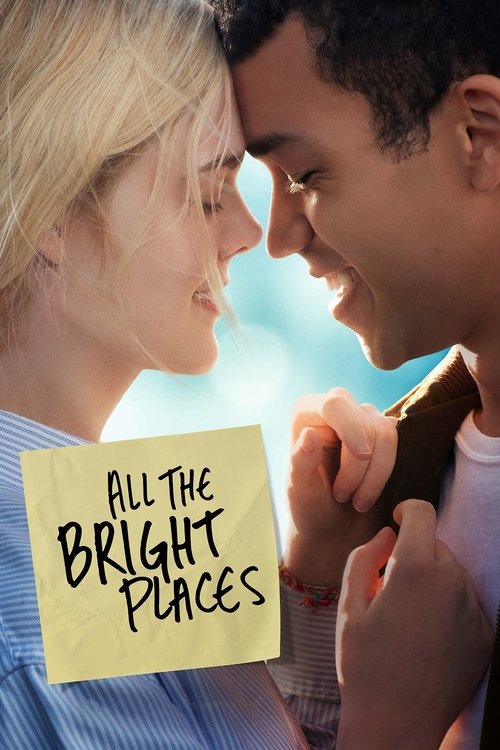
All the Bright Places
2020 · Brett Haley
For when you need a good cry — a gentle-looking teen romance that goes to honest, heavy places about grief and mental illness. Not a light comfort watch, despite the cozy packaging.
What it's about
Two Indiana teenagers meet at the worst moments of their lives: Violet is frozen by grief after losing her sister in a car accident, and Finch is a magnetic, unpredictable classmate quietly fighting his own mind. A class project — wander the state and document its overlooked wonders — throws them together, and roadside oddities become the backdrop to a tender, precarious first love.
The experience
Soft-spoken and aching, with a warm road-trip glow laid over real darkness — it's a romance that keeps reminding you love can steady a person but can't cure them. Expect to be charmed first and quietly gutted later.
Performances
Elle Fanning and Justice Smith carry the whole film on chemistry and vulnerability — Fanning making grief look like paralysis, Smith giving Finch a charm that flickers unnervingly between light and trouble.
The craft
Brett Haley shoots small-town Indiana with an unhurried, golden-hour intimacy that lets long conversations breathe, adapting a beloved young-adult novel without sanding off its most difficult subject matter. The wandering structure — landmark by landmark — gives the romance a scrapbook tenderness.
Why it matters
Part of the wave of young-adult novel adaptations that streaming brought straight to teenage audiences, it became a touchstone for viewers who wanted a love story that takes mental health seriously.
Snapshot
All the Bright Places is a Netflix original teen romance-drama adapted from Jennifer Niven's best-selling 2015 young-adult novel of the same name. Directed by the American independent filmmaker Brett Haley, it follows two Indiana high-schoolers — Violet Markey (Elle Fanning), immobilized by grief after her older sister's death in a car accident, and Theodore Finch (Justice Smith), a charismatic, volatile classmate living with an untreated mood disorder — whose accidental meeting on a bridge parapet grows into a fragile, redemptive first love. Framed by a class assignment to "wander" and document the overlooked wonders of their home state, the film uses the road-trip and love-story templates to approach heavier subject matter: suicidal ideation, mental illness, and the limits of love as a cure. Released into Netflix's streaming ecosystem on 28 February 2020, weeks before the pandemic reshaped theatrical exhibition, it belongs to the platform-driven YA-adaptation wave of the late 2010s while carrying the muted, character-first sensibility of Haley's earlier indie work. Fanning served as a producer as well as star, and her long attachment to the material — she had been developing it for years before cameras rolled — is the film's central authorial fact.
Industry & production
The project's defining trait is its protracted, star-driven development. Niven's novel was a commercial success on publication, and screen rights were pursued early; Elle Fanning attached herself to the Violet role while still a teenager and remained the constant through a development period that outlasted several directors and configurations. That through-line matters: by the time the film was made, its lead was also a producer with a personal stake in seeing the material realized, which shaped the adaptation's fidelity to the novel's emotional priorities over any wholesale reinvention.
Haley came aboard as director relatively late in that history, bringing the aesthetic economy he had honed on micro-budget features. The screenplay is credited to Niven herself, working with Liz Hannah — the writer best known for co-scripting Steven Spielberg's The Post (2017) — a pairing that yokes the author's proprietary knowledge of her characters to a screenwriter experienced in structuring adult dramatic material. The film was produced for and distributed by Netflix, positioning it inside the company's aggressive late-2010s strategy of acquiring and commissioning teen-oriented romances (To All the Boys I've Loved Before, The Kissing Booth, Sierra Burgess Is a Loser) as reliable engagement drivers. As a streaming original, it bypassed theatrical release entirely; conventional box-office figures therefore do not exist, and Netflix's characteristic non-disclosure of viewership means the record of its commercial performance is genuinely thin — a limit worth stating plainly rather than papering over.
Technology
Technologically the film is unremarkable by design, which is itself the point of a Haley production. It was shot digitally, as is near-universal for a contemporary mid-budget feature, and finished for streaming delivery in high dynamic range for Netflix's platform specifications. There is no signature technological gambit — no large-format capture event, no visual-effects showcase, no formal experiment with frame rate or aspect ratio. The Indiana landscapes — bluffs, roadside oddities, the "wonders" the assignment sends the couple to find — are captured with naturalistic digital cinematography rather than manufactured through post-production. The relevant technological context is instead distributional: the film is a native artifact of algorithmic streaming, made to be watched on domestic screens and surfaced by recommendation systems, and its intimate scale and dialogue-forward construction are legible partly as adaptations to that viewing environment.
Technique
Cinematography
The cinematography favors available-light naturalism and unhurried compositions over stylization, consistent with Haley's house style; his features are photographed by a small regular circle of collaborators, and the look here extends that lineage of soft, character-centered shooting. The camera tends to hold on faces and two-shots, letting the Indiana exteriors register as lived-in rather than picturesque. The "wandering" premise licenses a travelogue strand — bridges, rivers, roadside monuments — but the film resists turning these into postcard inserts, keeping them anchored to the characters' subjectivity. Where the material risks prettifying despair, the photography leans toward restraint.
Editing
The cutting is conventional continuity editing in service of performance and emotional beat, the norm for the genre. The film's structural challenge is tonal: it must braid the buoyancy of a burgeoning romance and a whimsical class project against a downward gravitational pull, and the editing manages that modulation through pacing rather than flashy transitions. The withholding of certain information about Finch's interior state until late is an editorial as much as a screenwriting decision, structuring audience knowledge to arrive at its turn. Specific editorial credits are not something I can verify with confidence here, and I won't invent an attribution.
Mise-en-scène / staging
Production design renders a recognizable, non-glamorized Midwestern adolescence — high-school corridors, family kitchens, a bedroom that doubles as refuge. The bridge where Violet and Finch first meet is the film's key recurring space, a literal threshold between falling and being pulled back that the staging returns to as a motif. Domestic interiors are staged to communicate absence: the shape of Violet's grief is written into her family home and her late sister's room. Haley's blocking keeps actors physically close in intimate scenes, trusting proximity and gesture over expository camera moves.
Sound
The soundscape is built around a contemporary needle-drop songscape typical of the YA-romance cycle, layered over an original score. Music does significant emotional labor, cueing the romance's lift and underscoring its darker undertow. Haley's films have consistently used the composer Keegan DeWitt, whose gentle, melodically direct scoring shaped I'll See You in My Dreams, The Hero, and Hearts Beat Loud; that collaboration continues here, with a score that stays understated and warm rather than manipulative. Sound design otherwise favors quiet naturalism — the ambient hum of small-town Indiana — reserving fuller orchestration for the film's emotional peaks.
Performance
Performance is where the film concentrates its ambition. Elle Fanning plays Violet's grief inwardly, in withdrawal and gradual thaw, avoiding the theatrics that the "recovering from tragedy" arc invites. Justice Smith's Finch carries the heavier load: he must render charm and generosity that are genuine and simultaneously read as symptoms, so that the character's warmth and his illness are inseparable rather than sequential. Smith modulates between the role's exuberance and its troughs without signposting the diagnosis, which is essential to the film's refusal to reduce Finch to a case study. The supporting ensemble — including Alexandra Shipp, Luke Wilson, Kelli O'Hara, Keegan-Michael Key, Lamar Johnson, and Virginia Gardner — is deployed sparingly around the central pair, keeping the two leads' interplay as the film's engine.
Narrative & dramatic mode
The film operates in the intimate realist mode of the character-driven relationship drama, borrowing the scaffolding of two genres — the teen romance and the quest/road narrative — while inverting their usual payoffs. The "wander Indiana" assignment supplies episodic forward motion and a pretext for the couple to fall in love in motion, a familiar romantic-comedy geometry. But the dramatic mode is fundamentally tragic rather than comic: the narrative is organized around a withheld truth about Finch's condition and a reversal in which the caregiver becomes the one in danger. This is a deliberate subversion of the "manic pixie" rescue plot, in which a troubled boy exists to reanimate a grieving girl; here the film insists that his vitality is not a resource to heal her but a symptom that love cannot fix. The dual-protagonist structure — Violet's arc toward re-engagement crossing Finch's toward crisis — creates a dramatic irony in which the couple's rising happiness and the story's true stakes diverge, and the mode shifts from romance to grief drama as that gap closes.
Genre & cycle
All the Bright Places sits squarely within two overlapping cycles. The first is the 2010s YA literary-adaptation boom, whose commercial template was set by The Fault in Our Stars (2014) and its lineage of first-love stories shadowed by illness or mortality — a subgenre sometimes called the "sick-lit" or terminal-romance film. The second is Netflix's platform-era teen-romance slate, which industrialized the form for streaming. Within these cycles the film distinguishes itself by relocating mortality from physical illness to mental illness and suicide, aligning it with a smaller cluster of youth-facing works — 13 Reasons Why being the most conspicuous and controversial contemporary — that grapple, with varying success and considerable public debate, with adolescent depression and suicide on screen. Its whimsical-quest surface links it to the road-trip romance, but its willingness to end in loss aligns it more with the melodrama of grief than with the genre's usual affirmations.
Authorship & method
Brett Haley is an independent director associated with small, humane, dialogue-forward character studies — I'll See You in My Dreams (2015), The Hero (2017), and Hearts Beat Loud (2018) — often about people negotiating loss, aging, or transition with unusual gentleness. His method favors performance, restraint, and emotional legibility over stylistic assertion, and he tends to work with a recurring company of collaborators; the composer Keegan DeWitt is his most consistent creative partner across features, supplying the warm, unforced scoring that recurs here. All the Bright Places represents Haley's move onto a larger platform and into YA-adaptation territory, and the interesting authorial tension is between his indie tact and the genre's more sentimental defaults — a tension that mostly resolves toward understatement.
The screenplay's authorship is genuinely dual in a productive way: Jennifer Niven, adapting her own novel, guards the characters' interiority and the book's readership expectations, while Liz Hannah brings the craft of an established dramatic screenwriter. And Elle Fanning's authorship-by-stewardship cannot be overstated — her years-long attachment and producer role make this, in a real sense, an actor-driven project as much as a director's. That configuration explains the film's fidelity to the source's emotional contract and its resistance to sanding down the difficult ending.
Movement / national cinema
The film belongs to no organized movement; it is a product of American mainstream independent filmmaking absorbed into a streaming studio. Its most meaningful "national cinema" dimension is regional and internal — its deliberate rooting in Indiana. The "wonders of Indiana" premise is a modest act of regional cinema, valorizing an unfashionable, flyover Midwest against the coastal defaults of American youth media, and treating the state's roadside ordinariness as worthy of attention. This places it in a loose American tradition of Midwestern-set coming-of-age films that find meaning in the overlooked. Beyond that regional specificity, it is a globally distributed Netflix product designed for simultaneous international streaming rather than a work in dialogue with any auteurist or national film tradition.
Era / period
The film is thoroughly of its late-2010s / 2020 moment. It arrives at the crest of the streaming-original teen romance and at a cultural juncture of rising, more openly discussed adolescent mental-health concern — a period in which media depictions of teen suicide were under intense scrutiny, largely in the wake of debate over 13 Reasons Why. That context conditioned how such a film had to be made: with care around depiction, and often accompanied by mental-health resources and crisis-line signposting, a now-standard practice for youth content touching suicide. Its 28 February 2020 release also gives it an accidental historical position on the eve of the COVID-19 disruption, landing just before streaming became, for a captive housebound audience, the dominant mode of film consumption.
Themes
The film's governing themes are grief, mental illness, and the ethics of love as care. Violet's arc dramatizes survivor's guilt and the slow, non-linear work of re-entering life after loss; Finch's dramatizes living with an untreated mood disorder in a family and community poorly equipped to see it. Crucially, the film thematizes the difference between rescue and companionship: it stages, and then refuses, the fantasy that a loving partner can cure another's illness, insisting instead that love can accompany but not substitute for treatment. Related motifs — wandering, thresholds, the search for beauty in overlooked places — carry a double charge, expressing both the romance's wonder and Finch's restless attempt to outrun his own mind. The "bright places" of the title name the film's central ambivalence: the moments of light that make life worth staying for, and the tragedy when they prove insufficient.
Reception, canon & influence
Critical reception was mixed and, in keeping with the film's streaming release and modest profile, comparatively muted; it did not become a major awards or discourse event. Reviewers tended to praise the two central performances — Fanning's restraint and Smith's difficult, layered turn in particular — while a recurring critical reservation concerned the film's handling of its heavy subject matter, with some faulting a softening or aestheticizing of mental illness and suicide relative to the responsibility such depiction carries. I want to be careful not to overstate a consensus the record does not clearly support: precise aggregate scores and viewership data are not something I can cite reliably here.
Looking backward, the film's influences are legible: Niven's own novel as primary source; the Fault in Our Stars terminal-romance template as commercial precedent; and Haley's prior indie features as the source of its tonal restraint and its DeWitt-scored warmth. Looking forward, its influence is best understood as incremental rather than foundational. It is one node in the ongoing normalization of mental-health narratives within mainstream youth media and within Netflix's teen-romance machine, contributing to a body of work that has made adolescent depression and suicide speakable — if still contested — subjects on popular screens. Its most durable legacy may lie less in cinema than in the reader-to-viewer pipeline of Niven's novel and in the model it offers of a star (Fanning) shepherding personally meaningful YA material through a decade of development into a streaming release.
A Deleuzian reading
Two teenagers on the parapet of a bridge over an Indiana river, at the wrong height, talking.
The full Deleuzian reading of All the Bright Places →
Reception
Landed on Netflix in early 2020 to mixed reviews — critics were wary of its handling of heavy subject matter even as book fans showed up for it — and it hasn't really been reappraised since, settling in as a designated cry-movie rather than a rediscovered gem.
How All the Bright Places was received, from release to now →
How to watch All the Bright Places: what to notice on a first viewing
- Notice how the roadside wonders match the kitchen's light. Haley shoots bluffs and river bridges at the same exposure as domestic interiors, refusing postcard inserts. The wonders never get more polish than the ordinary rooms around them. Any place becomes worth seeing once you actually look, which is the film's whole idea of wonder.
- Watch the bridge where Violet and Finch first meet. The parapet where they meet is the one space the film returns to again and again. One recurring place anchors the relationship, so watching it return shows how they change.
- Listen for the songs fading into DeWitt's quiet score. The soundtrack runs a contemporary needle-drop songscape over Keegan DeWitt's original score, saving fuller orchestration for the film's emotional peaks and staying understated elsewhere. The music does the emotional work so the images and performances don't have to oversell it.
- Watch how long the camera holds on Violet's face doing nothing. Haley lets scenes stay scenes instead of turning them into plot moves, so Violet often just looks and listens rather than acts. Violet's stillness is not passivity. It is what grief does to a person before she can act again.
- Notice how fast Finch swings from playful to intense. Justice Smith moves through exuberance and quieter stretches, and the film gives you no tidy label for either. His moods read as one whole person, not a puzzle to decode.
The whole guide to watching All the Bright Places, with the keys for a rewatch →
Influences: the films it descends from and the films it influenced
- The Fault in Our Stars (2014) — Set the reader-to-viewer YA terminal-romance template Bright Places follows — a faithful adaptation that preserves the novel's first-person interiority and refuses to soften the difficult ending to protect the built-in fanbase's emotional contract.
- I'll See You in My Dreams (2015) — Haley's own dialogue-forward, performance-first restraint and his first sustained partnership with composer Keegan DeWitt, whose warm unforced scoring recurs directly in Bright Places.
- Hearts Beat Loud (2018) — Establishes Haley's needle-drop/songscape as emotional engine plus DeWitt scoring, carried into Bright Places' two-hander built on gentle character legibility over stylistic assertion.
- The Hero (2017) — Models Haley's actor-driven method, where a star's stewardship shapes the project and mortality is treated with understatement rather than melodramatic scoring.
- The Perks of Being a Wallflower (2012) — The novelist-directs-own-adaptation configuration guarding interiority, plus the tunnel/threshold-crossing motif and needle-drop songscape used to make teen mental illness and suicide speakable — the exact bridge-threshold and dual-authorship debt.
- Garden State (2004) — The indie-pop needle-drop songscape scoring emotional beats, and the manic-pixie muse archetype whose fantasy Bright Places' anti-MPDG design deliberately reacts against.
- Elizabethtown (2005) — The Manic Pixie Dream Girl template (coined for Dunst's Claire) that Bright Places inverts by giving Finch his own suicidal interiority instead of making him a healing device for the heroine.
- Harold and Maude (1971) — Youth-suicide romance rendered with tonal gentleness and a single-artist song-cycle (Cat Stevens) as connective tissue — the precedent for playing death-obsessed material warm rather than grim.
- Eternal Sunshine of the Spotless Mind (2004) — Reworks the depressive-man/vivid-woman dyad so the seemingly quirky partner carries her own damage, undercutting the muse fantasy that the anti-manic-pixie construction depends on.
- Silver Linings Playbook (2012) — Structures romance as mutual mental-illness recovery, treating diagnosis as characterization for both leads — the dual-protagonist-with-illness architecture Bright Places adopts.
- It's Kind of a Funny Story (2010) — Teen psychiatric crisis softened into charm and romance — the aestheticizing-of-illness tendency Bright Places is critically faulted for inheriting via Finch's illness-as-charm.
- Five Feet Apart (2019) — Near-contemporaneous sick-lit terminal-romance running the same reader-to-viewer pipeline and honoring the difficult-ending contract rather than granting a rescue.
- All Together Now (2020) — Haley's immediate next Netflix film, extending his actor-driven restraint and DeWitt-scored warmth into streaming teen drama about trauma and grief.
- The Sky Is Everywhere (2022) — Later streaming-era YA grief adaptation that pushes the score-forward, music-cue-driven emotional design of the sick-lit lineage into heightened sensory stylization.
- To All the Boys I've Loved Before (2018) — The Netflix YA-novel-adaptation romance machine Bright Places was built for — available-light digital naturalism and star-forward casting engineered for a reader-fanbase streaming audience.
- Chemical Hearts (2020) — Same-year streaming (Amazon) YA grief-romance built on a damaged love interest whose trauma backstory is withheld and revealed late — the same withheld-information editing strategy.
- Words on Bathroom Walls (2020) — Same-year YA adaptation dramatizing serious mental illness (schizophrenia) through subjective first-person interiority, extending the normalization of clinical adolescent illness on popular screens.
Similar films
- The Fault in Our Stars (2014) — influence & lineage
- The Perks of Being a Wallflower (2012) — influence & lineage
- Five Feet Apart (2019) — influence & lineage
- To All the Boys I've Loved Before (2018) — influence & lineage
- People We Meet on Vacation (2026) — shared sensibility
- Short Term 12 (2013) — shared sensibility
- My First Summer (2020) — shared sensibility
- Girls Like Girls (2026) — shared sensibility