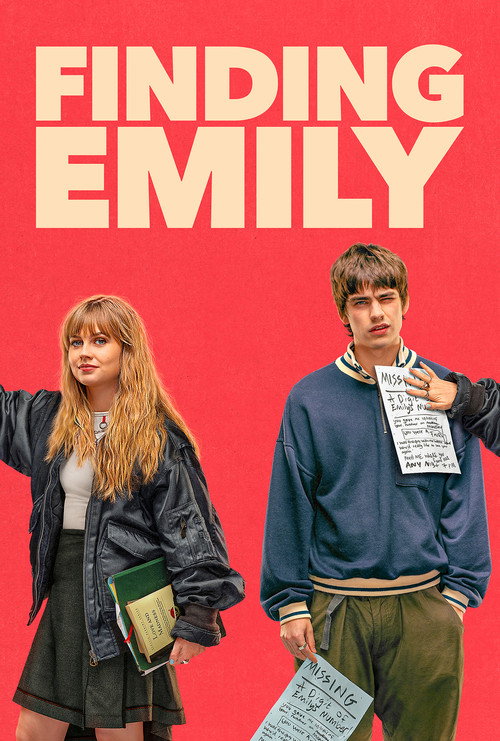
Finding Emily
2026 · Alicia MacDonald
For a cozy night in when you want to fall in love a little — easy, charming comfort viewing for a date, a group hang, or a solo evening that needs cheering up.
What it's about
A lovesick campus musician gets handed the wrong phone number for the girl of his dreams, so he recruits a sharp, ambitious psychology student to help him find her. Their search snowballs into a campus-wide frenzy — flyers, theories, spectacle — while the real story quietly becomes the two people running the search. It's a romantic comedy about chasing an idea of someone while the actual someone is standing next to you.
The experience
Light on its feet and warm-hearted, with the fizzy momentum of a caper — the fun is watching a small crush balloon into a public event while the banter between the two leads does the real work. It's funny without being mean, and sweeter than it first lets on.
The craft
The script runs on one of romantic comedy's most reliable engines — the quest for an idealized stranger — and gets its energy from pairing a dreamer with a pragmatist and letting their worldviews collide. The campus setting gives the search room to escalate from private longing into public spectacle.
Why it matters
A fresh entry in the college romantic comedy, carrying one of the genre's oldest and most beloved story shapes to a new generation.
Snapshot
A lovesick musician receives the wrong phone number for the woman he has fallen for, recruits a pragmatic psychology student to help him track her down, and sets off a campus-wide search that curdles into spectacle while the two searchers become the film's real romance. That is the shape of Finding Emily as its distributor's synopsis describes it, and it is the shape of one of the most durable machines in the history of romantic comedy: the quest for an idealized stranger that delivers, instead, the person standing beside the quester.
A caveat belongs at the top rather than buried. Finding Emily is a very recent release, and the scholarly and trade record for it — production history, department credits, festival and critical response, commercial performance — is not established in the sources available for this dossier. Nothing below should be read as a verified account of what the film's crew did. Where this dossier is specific, it is specific about the traditions, technologies and formal conventions the film is working inside, all of which are documented; where it concerns Finding Emily itself, it reasons from the premise, the credited director and genre, and says so. No credits, quotations, figures or attributions have been supplied that are not in the record.
Industry & production
The romantic comedy arrives in 2026 having completed a full cycle of collapse and rehabilitation. The theatrical romcom, a reliable mid-budget studio product through the 1990s and early 2000s, was effectively evacuated from cinemas in the 2010s as studios consolidated around franchise tentpoles; the form survived by migrating to streaming, where Netflix in particular rebuilt it as a volume business from roughly 2018 onward (Set It Up, To All the Boys I've Loved Before, Always Be My Maybe). The theatrical return came later and more narrowly — Anyone But You (2023) was the proof-of-concept that audiences would still pay for the form in a cinema, and prestige variants such as Celine Song's Materialists (2025) demonstrated that the genre could carry authorial ambition again.
Finding Emily sits inside that recovered market. Its premise is characteristic of the recovered romcom's economics: a contained contemporary setting (a campus), a cast built around two leads and an ensemble of peers, no period reconstruction, no effects burden. This is a budget profile that works either as a modest theatrical release or as a platform acquisition, and the two paths have converged since the 2020s, when windowing shortened and the distinction between a theatrical romcom and a streaming one became a question of marketing spend rather than production method. The film's specific financing, production companies and distribution path are not documented here.
One structural fact about the period is worth stating because it conditions everything else: post-2023, following the WGA and SAG-AFTRA work stoppages and the subsequent contraction in commissioning, mid-budget comedy became a genre where directors with television and short-form track records were the likeliest hires. The romcom has historically been a director's entry point rather than a destination — Nora Ephron, Amy Heckerling, Nancy Meyers, Alice Wu and Olivia Wilde all entered or re-entered features through comedies of courtship — and that pattern is the sensible frame for a film like this one.
Technology
The relevant technology here is of two kinds, and only one of them is a camera.
The production toolkit for a 2026 comedy of this scale is well documented as a class: large-format digital acquisition (the ARRI Alexa 35 and Sony Venice 2 generation of sensors), spherical or anamorphic-emulating glass chosen for skin rendition and pleasing out-of-focus fields, LED fixtures that permit fast relighting of dialogue coverage, an ACES-managed color pipeline, and delivery in HDR and Dolby Atmos alongside an SDR broadcast master. Comedy has been the slowest genre to adopt technically exhibitionist tools, for a good reason: the form's demands are for clean, fast, matchable coverage of faces in conversation, which is an argument for efficiency rather than novelty. Which of these tools Finding Emily used is not on record.
The second technology is diegetic, and it is the film's actual engine. A plot that turns on a wrong phone number is making a specific claim about communication infrastructure — that a ten-digit string can still be the sole fragile bridge between two people. That premise was native to the party-line and switchboard era (Pillow Talk, 1959; Bells Are Ringing, 1960), where the telephone was genuinely a site of misrouting and assumed identity. In a smartphone era of contact syncing, reverse lookup, social search and institutional directories, the same premise requires engineering: the modern romcom must actively construct disconnection. Contemporary variants solve this by making the barrier social rather than technical — the searcher can find a person but not the person, or knows a name that is too common, or cannot approach without the approach itself becoming public. The campus is a shrewd setting for exactly this reason: it is a closed population, large enough to hide someone and small enough that a search becomes visible to everyone in it.
Technique
Cinematography
Romantic comedy has one of the most stable photographic grammars in narrative cinema, and it is stable because it is functional. The conventions: high-key, low-contrast lighting that keeps both faces legible in a two-shot; warm practical-heavy interiors; a shallow depth of field that isolates the couple from a busy world without eliminating it; and a preference for the medium two-shot over aggressive singles, because the genre's subject is the space between two people and cutting them apart forfeits it. Lubitsch understood this in 1940 and Ephron rediscovered it in the 1990s. A campus film gains a second register from its setting — the pastoral quad, the seasonal turn, the lecture hall as amphitheatre — which supplies wide compositions where the crowd can be photographed as a crowd, a necessity for any plot involving a public frenzy. Finding Emily's actual photographic strategy is not documented.
Editing
Comic editing is a timing discipline before it is a structural one. The romcom's characteristic figures are the shot/reverse exchange cut a beat early to accelerate verbal sparring, the held reaction that lets an audience arrive at a joke before the character does, and the montage of accumulating failure that compresses a search into a rhythm. A hunt narrative invites the second of these heavily: the sequence of wrong Emilys, each a self-contained gag with a fixed structure and escalating variation, is the search plot's natural set piece, and its lineage runs from the screwball chase through The Sure Thing (1985) to the viral-escalation comedies of the 2010s.
Mise-en-scène / staging
The campus comedy's spatial logic is enclosure: dorm room, dining hall, quad, library, lecture theatre, party. Each is a social pressure chamber with its own rules of who may speak to whom, which is why the setting has served everything from Animal House (1978) to Legally Blonde (2001) to Pitch Perfect (2012). A search story exploits the enclosure directly — the same spaces must be re-entered as the search widens, so that staging carries the escalation. The "campus-wide frenzy" the synopsis promises is, in staging terms, the moment the private two-hander is forced into public space, the structure Easy A (2010) built an entire film around.
Sound
The protagonist is a musician, which makes diegetic performance available as the film's emotional index — the technique John Carney systematized across Once (2007), Begin Again (2013) and Sing Street (2016), where a song performed inside the story does work that scoring cannot, because the character has chosen to say it. A musician-protagonist romcom typically operates a three-layer soundtrack: original diegetic songs attached to the hero, licensed needle-drops to date and place the world, and a light score that mostly stays out of the way. The mix strategy of the campus scenes matters too; a frenzy sequence is a sound design problem as much as a staging one. Finding Emily's composer, music supervision and songs are not recorded here.
Performance
The genre offers two performance registers and the choice between them is the film's most consequential casting decision. One is the inherited screwball register — verbal velocity, overlapping attack, performed competence — which suits a "driven psychology student" whose characterization is built on control. The other is the post-mumblecore naturalism the 2010s romcom absorbed, with hesitation, self-interruption and comic deflation, which suits a lovesick musician whose defining trait is being slightly behind events. Pairing the two registers across the central couple is a standard and effective strategy: the friction between styles is the incompatibility the plot must resolve.
Narrative & dramatic mode
Structurally, Finding Emily is a Cyrano: a protagonist pursues a beloved through an intermediary, and the intermediary turns out to be the film's true romantic partner. Rostand's 1897 play remains the genre's most reproduced armature, adapted directly (Roxanne, 1987; Cyrano, 2021) and appropriated constantly — The Sure Thing (1985), Some Kind of Wonderful (1987), Hitch (2005), and, on a campus in a form very close to this one, Alice Wu's The Half of It (2020).
The mode is comedy of errors operating on dramatic irony: the audience recognizes the real couple long before the characters do, and the pleasure is the gap. Everything then depends on how the object of the search is handled. Emily is a MacGuffin in the strict sense — the sought thing whose content is irrelevant to the machine — and the genre's recurring failure is to treat her as only that, discarding a person to reward a protagonist. The better versions of the plot (The Sure Thing again, and Sleepless in Seattle's treatment of Walter) grant the displaced figure a dignity that costs the ending something. The second structure at work is Pygmalion-adjacent: a student of psychology who approaches courtship as a research problem belongs to the lineage of She's All That (1999) and How to Lose a Guy in 10 Days (2003), where instrumentalizing love is the sin the narrative exists to punish and then forgive.
Genre & cycle
The film belongs to three overlapping cycles. First, the post-2018 romantic comedy revival described above, which restored the form's commercial viability and broadened its authorship. Second, the campus comedy, historically a male-coded raucous genre that has been substantially rewritten since Legally Blonde, Pitch Perfect, Booksmart (2019) and Bottoms (2023) toward female protagonists, ensemble friendship and escalation-to-absurdity plotting. Third, the search-for-a-stranger romance — Sleepless in Seattle (1993), Serendipity (2001), The Lake House (2006) — in which the lovers are separated by an information barrier rather than a social one, and the barrier's collapse is the climax.
Authorship & method
The public record on Alicia MacDonald available for this dossier is thin, and the honest position is to say so rather than to construct a filmography. Her key collaborators on Finding Emily — cinematographer, editor, composer, screenwriter — are likewise not documented in the sources at hand, and it would be a fabrication to name them.
What can be said is methodological rather than biographical. Direction in this genre is overwhelmingly performance direction: the form's successes are chemistry-dependent in a way that no shot design can rescue, and the craft consists of casting, rehearsal, and knowing which take to protect. The genre also rewards a specific kind of tonal management, because the plot device at its center — a public search for a private person — can read as charming or as harassment depending entirely on calibration. Contemporary romcoms have become notably more careful here than their 1980s predecessors, whose grand-gesture climaxes have aged into ambivalence. How Finding Emily handles that problem is the question a full authorship account would need to answer, and it cannot be answered from the record available.
Movement / national cinema
The film's production nationality is not established here, which limits what can responsibly be claimed. The relevant national traditions are two. The British romantic comedy, as consolidated by Working Title from Four Weddings and a Funeral (1994) through Notting Hill (1999) and Love Actually (2003), favors ensemble embarrassment, self-deprecating heroes and a tolerance for farce that American versions tend to smooth away. The American tradition runs from Lubitsch and Sturges through Ephron and Meyers and into the streaming revival, and is more invested in career-versus-love as a thematic axis — which the synopsis's "ambitions" explicitly invokes.
Era / period
2026 is a specific moment for this material. The post-strike industry has fewer mid-budget slots and more competition for them. Generative AI has become an anxiety inside production rather than a speculation about it, with consequences for how audiences read authenticity — which raises the stakes of a diegetic songwriting protagonist, a figure whose value in the story is that a human wrote the song. And the campus itself is contested ground in a way it was not in 2012: a film setting a mass public search among students is working in an environment where audiences bring assumptions about surveillance, virality and consent to the premise before the film states its own position. The romcom has always been a genre that registers the courtship norms of its moment more precisely than it registers anything else; that is the lens a later historian will bring to this one.
Reception, canon & influence
No critical consensus, awards record or commercial figures for Finding Emily are established in the record available, and inventing them would defeat the purpose of this dossier. Its reception history remains to be written.
The influences on the film are legible, and they are the ones traced above: Lubitsch's The Shop Around the Corner (1940) as the origin point for lovers who know each other in one register and not another; the telephone comedies of the late 1950s that made misrouted connection romantic; Rostand's proxy-wooer structure by way of its American teen adaptations; The Sure Thing and Some Kind of Wonderful for the quest that ends beside the quester; Ephron for the long-distance search and its tonal register; Carney for the musician whose songs carry the argument; Easy A and the 2010s–2020s campus comedies for the escalating public frenzy; and The Half of It for the recent demonstration that a Cyrano set among students can be both funny and serious about what the displaced party loses.
What it shapes forward is unknowable at this distance, and any claim otherwise would be speculation dressed as scholarship. The honest forward-looking statement is a conditional one: if the theatrical and platform romcom continues its recovery, the films that will matter historically are the ones that found a way to make twenty-first-century communication technology generate genuine separation rather than merely pretending it does not exist. That is the specific formal problem Finding Emily's premise takes on, and it is the ground on which the film's eventual place in the cycle should be assessed.
A Deleuzian reading
Ten digits get dialed, and a stranger answers.
The full Deleuzian reading of Finding Emily →
Reception
Too new for a reappraisal arc, but it's already had a mini one: a modest limited US theatrical release in August 2026, then it blew up on streaming weeks later as the year's best-reviewed rom-com.
How Finding Emily was received, from release to now →
Influences: the films it descends from and the films it influenced
- The Shop Around the Corner (1940) — The origin of the dual-register construction Finding Emily runs on — two people tender in one channel and barbed face-to-face — and of the comic engine that gives the secret to the audience and one party only, so every shared two-shot plays twice.
- Pillow Talk (1959) — The party-line gag that turns a shared telephone circuit into the romantic obstacle, plus the split-screen that holds both lovers in one composition while insisting they are nowhere near each other — the 1959 formal answer to constructed disconnection.
- Bells Are Ringing (1960) — A courtship conducted entirely through a misrouted voice service, with the operator adopting a false name when she finally meets the man in person — the two-register meeting scene, in which the beloved is present and unrecognized, staged as sustained comic suspense.
- The Sure Thing (1985) — Reiner makes the distant ideal a pure MacGuffin and locates the actual romance in the sparring beside the quester; his scenes cut out on the insult rather than the reply, the early-exit rhythm Finding Emily uses for its verbal duels.
- Desperately Seeking Susan (1985) — Builds the search-for-a-stranger apparatus out of text fragments — a personal-ads column read as evidence, then a physical tail through the city — establishing the hunt conducted on circumstantial detail rather than a name.
- Some Kind of Wonderful (1987) — Hughes's structure in which the friend recruited to rehearse the hero's courtship is the person he should have wanted; the rehearsal-date scene, where instruction and seduction share identical blocking, is the beat the Pygmalion strand keeps restaging.
- Roxanne (1987) — The staging template for the three-body Cyrano scene — the real wooer hidden in darkness feeding lines to a surrogate lit in the window — and the translation of Rostand's verse duel into improvised comic riffing as the character's proof of worth.
- Sleepless in Seattle (1993) — Ephron keeps her leads physically apart for nearly the entire runtime, cross-cutting two cities so the audience accrues an intimacy the characters have not yet earned — the structural precedent for a romance whose antagonist is distance itself.
- You've Got Mail (1998) — Resets the Lubitsch premise onto a live communication technology and makes the asymmetry deliberate: one party learns the truth and withholds it, converting the back half into sustained dramatic irony played out in flat high-key medium two-shots.
- 10 Things I Hate About You (1999) — The school as a closed economy in which a courtship is commissioned and paid for, and a climax that forces the private text — the poem — into compulsory public performance: the private-to-public exposure beat in its campus form.
- She's All That (1999) — The wager that makes a makeover transactional, fixing instrumentalized love as a debt the third act must settle, along with the reveal grammar the genre still quotes — the descent held in shallow focus, the rack that isolates the transformed party from the room.
- Once (2007) — Carney's method of letting complete songs play in-scene as the argument the characters cannot have in dialogue, performance covered long, handheld and in available light so the music is diegetic labor rather than score commentary.
- Set It Up (2018) — The revival's engineered-courtship comedy, structured as a run of sabotage-and-setup attempts that fail in escalating registers, with the schemers' two-shot chemistry carrying the film that the manufactured romance cannot.
- To All the Boys I've Loved Before (2018) — Misdirected private correspondence as the inciting accident, and the post-2018 house look Finding Emily adopts wholesale: high-key, saturated, symmetrically centered medium two-shots with the background thrown well off.
- Love, Simon (2018) — Stages the hunt for an anonymous correspondent as a casting exercise, cutting to imagined inserts of each candidate speaking the writer's words, then makes the forced publication of that correspondence the film's exposure crisis.
- Sierra Burgess Is a Loser (2018) — The nearest precedent for the premise itself — a wrong-number text opening a romance conducted under a borrowed identity, the Cyrano triangle run by phone in split-attention scenes — and the film that exposed how badly the device reads when the tonal calibration slips.
- The Half of It (2020) — Wu's proof that a student Cyrano can take the ghostwriter's loss seriously: text exchanges cross-cut and performed as present-tense conversation, and a close that resolves on the displaced party's choice rather than on a couple.
Similar films
- To All the Boys I've Loved Before (2018) — influence & lineage
- 10 Things I Hate About You (1999) — influence & lineage · often watched together
- Love, Rosie (2014) — shared sensibility
- Rye Lane (2023) — shared sensibility
- Girls Like Girls (2026) — shared sensibility
- People We Meet on Vacation (2026) — shared sensibility
- Voicemails for Isabelle (2026) — shared sensibility
- My First Summer (2020) — shared sensibility