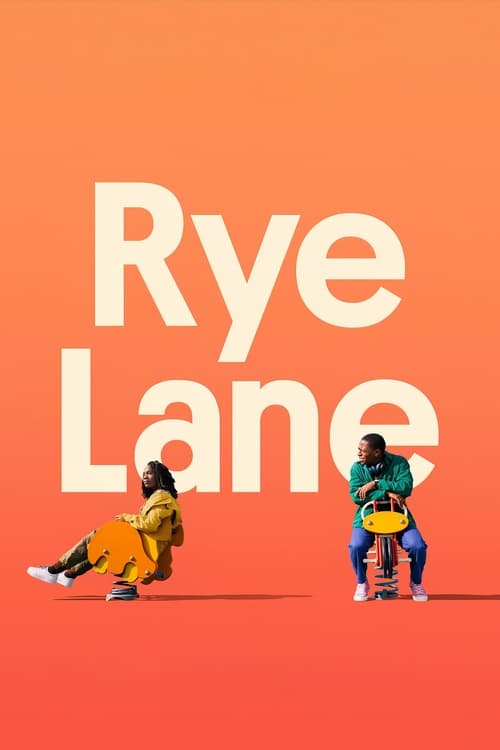
Rye Lane
2023 · Raine Allen-Miller
For a night when you want to fall in love a little — a warm, low-stakes charmer that's pure comfort with actual wit. Perfect for a date, a duvet, or restoring your faith in people after your own bad break-up.
What it's about
Two twenty-somethings, both freshly wrecked by bad break-ups, collide at an art exhibition and end up spending one long, eventful day wandering South London together. She's brash and up for anything; he's an accountant still crying in public over his ex. Between Peckham's markets, chicken shops, and a karaoke stage, they hatch small schemes against their nightmare exes and slowly let their guards down.
The experience
Fast, funny, and openly romantic — eighty-odd minutes of quick-witted banter that keeps sneaking up on you with real tenderness. It moves at a jog and leaves you grinning.
Performances
David Jonsson and Vivian Oparah have the prickly, quicksilver chemistry the whole genre depends on — she all forward motion, he all wounded reserve, both landing jokes and hurt in the same breath.
The craft
Raine Allen-Miller shoots Peckham and Brixton through fisheye lenses and candy colors, turning postcodes usually filmed in gray realism into a heightened storybook. It's a debut with a music-video eye and a real sense of place — bright, loud, and worth watching on the best screen you have just for the color alone.
Why it matters
An instant-classic British rom-com debut that gave South London the swooning cinematic treatment it rarely gets, and announced Allen-Miller as a director to watch.
Raine Allen-Miller's debut compresses the walking-and-talking romance — Linklater's Vienna, Wong's Hong Kong — into one saturated day in Peckham and Brixton, and in doing so gives South London the swooning cinematic treatment its markets and chicken shops rarely receive. Two twentysomethings, both freshly wrecked by breakups, meet awkwardly and proceed to talk, wander, scheme, and slowly disarm each other across eighty-two brisk minutes. Allen-Miller, arriving from music videos and advertising, shoots much of it through a fisheye lens that bends the streets into a heightened, candy-colored storybook — a bold refusal of the gray social-realist palette that has long been British cinema's default for these postcodes. David Jonsson and Vivian Oparah carry it with the kind of prickly, quick-witted chemistry the genre lives or dies on; their conversations feel improvised even when precision-tooled. Premiering at Sundance in 2023, the film announced both a director and a proposition: that the Black British romcom could be as formally playful as anything on the festival circuit. Watch for the karaoke scene — a small aria of embarrassment transmuted into grace.
A Deleuzian reading
A face fills the screen and the street curves away behind it.
The full Deleuzian reading of Rye Lane →
Reception
A Sundance 2023 breakout that critics adored on sight, but Searchlight sent it straight to Hulu in the US — so its afterlife has been pure word-of-mouth, growing from 'buried streaming gem' into the default proof that the rom-com never died.
How Rye Lane was received, from release to now →
Influences: the films it descends from and the films it influenced
- Before Sunrise (1995) — Establishes the two-strangers-walking-and-talking template where a burgeoning romance unfolds almost entirely through continuous ambulatory conversation across a city, the film's structure dictated by the pair's roaming rather than plot.
- Before Sunset (2004) — Compresses the walk-and-talk romance into a single unbroken afternoon in near-real-time, using long tracking takes that follow the couple through actual streets — the compressed single-day timeframe Rye Lane adopts wholesale.
- Chungking Express (1994) — Model for the handheld, saturated-neon urban romance of chance encounters, where fast-food stalls and cramped city corners are shot in candy-bright color as heightened emotional spaces.
- Fallen Angels (1995) — Pioneers the extreme wide-angle/fisheye lens pressed close to faces in cramped interiors, warping intimate two-shots into expressionist distortion — the exact optical signature Allen-Miller borrows.
- Do the Right Thing (1989) — Sets one sun-baked, hyper-saturated Black neighborhood over a single day and lets the locale function as a character, with stylized wide-angle framing rejecting documentary naturalism.
- She's Gotta Have It (1986) — Template for the stylized Black romantic comedy built on direct-to-camera address, playful formal breaks, and specificity of a real neighborhood milieu.
- Amélie (2001) — Source for the hyper-saturated storybook palette and whimsical fantasy inserts that turn a real city into a magical-realist playground, romance rendered as visual delight rather than kitchen-sink observation.
- Punch-Drunk Love (2002) — Demonstrates bold color-block production design and heightened, near-surreal saturation deployed to make an anxious romance feel emotionally amplified beyond realism.
- In the Mood for Love (2000) — Lush, sumptuously saturated color grading and expressive framing of longing between two people in confined urban spaces — the WKW palette Rye Lane cites in its color.
- 500 Days of Summer (2009) — Shares the fragmented, formally playful indie-romcom vocabulary — including a musical/karaoke set-piece and stylized breaks from realism — to chart heartbreak and recovery.
- Attack the Block (2011) — Stylizes a South London estate through genre and kinetic energy rather than social-realist grimness, treating Black British youth locales with pop vibrancy — the same anti-social-realism turn.
- The Last Black Man in San Francisco (2019) — Lyrical, saturated, formally heightened portrait of Black urban belonging where the city is shot as dreamlike terrain, refusing the drab realism usually assigned to such stories.
- If Beale Street Could Talk (2018) — Applies sumptuous saturated color and tender, held close-ups to a Black romance, insisting on visual beauty and lyricism as the register for love rather than austerity.
- Been So Long (2018) — Neon-saturated Black British musical romance unfolding across a single London night, using song set-pieces and stylized color to lift a local milieu out of social realism.
- Weekend (2011) — Builds a compressed single-encounter British two-hander romance on prickly, improvised-feeling chemistry and long conversational takes, the naturalistic dialogue counterpart to Rye Lane's structure.
- Sylvie's Love (2020) — Reclaims the glossy, richly colored classical romance idiom for Black leads, prioritizing stylized warmth and craft-polish over the social-issue framing usually imposed on Black stories.
- Red, White & Royal Blue (2023) — The saturated, stylized 2020s rom-com-revival aesthetic (wide-lens color-pop staging over a single-day courtship), a parallel argument that the glossy studio rom-com's craft was worth reviving for a new audience.
Similar films
- Weekend (2011) — influence & lineage
- Red, White & Royal Blue (2023) — same viewing thread
- People We Meet on Vacation (2026) — same viewing thread
- Finding Emily (2026) — shared sensibility
- Love, Rosie (2014) — shared sensibility
- We Live in Time (2024) — shared sensibility
- Even If This Love Disappears Tonight (2025) — shared sensibility
- Fallen Leaves (2023) — shared sensibility
All the films related to Rye Lane →
Watch it with: curated runs of related films
- The Rom-Com Grows Up — Watch these when you want the modern love story in every register — the giddy fantasy, the one-perfect-day meet-cute, the raunchy hustle, and the version that finally does the math on romance.