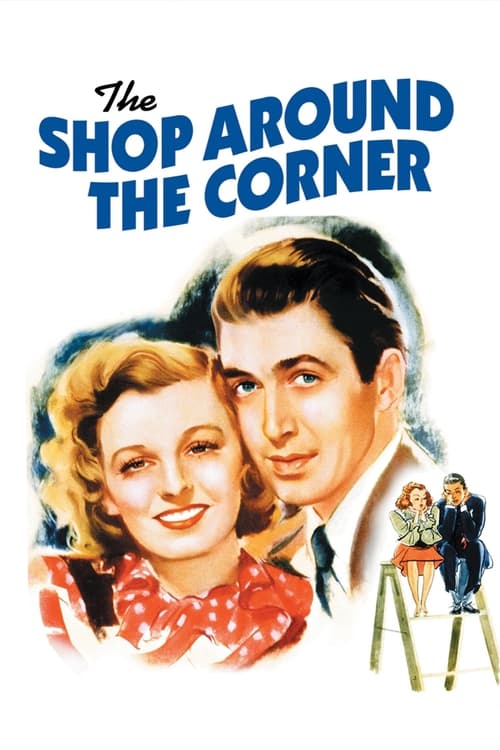
The Shop Around the Corner
1940 · Ernst Lubitsch
For a cozy night in when you want to fall in love — pure comfort, ideal for winter evenings and anyone who believes the right person might be hiding in plain sight.
What it's about
In a Budapest gift shop, head clerk Alfred Kralik and new hire Klara Novak bicker across the sales counter and can barely stand each other. What neither knows is that they're already in love — as anonymous pen pals, pouring their best selves into letters to a stranger. Around them, the little shop hums with its own dramas: a proprietor with troubles at home, wages and dismissals, and the small dignities of people who work retail for a living.
The experience
Tender, funny, and quietly melancholy — a romance that takes its time and takes its working people seriously. It's the rare comedy where the warmth feels earned rather than dispensed, and it leaves you glowing.
Performances
James Stewart is at his most gently prickly, and Margaret Sullavan matches him barb for barb while letting you see the loneliness underneath; Frank Morgan gives the shop's proprietor a surprising, affecting depth.
The craft
Lubitsch confines nearly the whole film to one storefront and its back rooms, and out of that modesty builds a perfect machine of misunderstandings, glances, and things left unsaid. Samson Raphaelson's script is a marvel of economy — every joke doubles as characterization, every kindness lands.
Why it matters
Frequently cited among the greatest romantic comedies ever made, its anonymous-correspondence premise has been remade and borrowed for decades, and it remains the model for romances built on wit rather than spectacle.
Snapshot
The Shop Around the Corner is Ernst Lubitsch's chamber romance about two clerks in a Budapest gift shop who despise each other across the sales counter while unknowingly conducting a tender love affair by anonymous letter. Adapted by Samson Raphaelson from Miklós László's Hungarian play Parfumerie (Illatszertár), it stars James Stewart as head clerk Alfred Kralik and Margaret Sullavan as Klara Novak, with Frank Morgan as the shop's proprietor, Hugo Matuschek. Made at MGM and released in January 1940, it is Lubitsch's most intimate feature—almost entirely confined to a single storefront and its back rooms—and one that trades the gilded cosmopolitanism of his earlier comedies for the anxieties of ordinary employment: wages, dismissal, loneliness, and the small dignities of shop work. Frequently cited as the director's own favorite among his pictures, it has become a touchstone of the romantic comedy and the source-text for a lineage running through the musical She Loves Me to Nora Ephron's You've Got Mail.
Industry & production
The film was produced by Lubitsch himself at Metro-Goldwyn-Mayer, where he had recently delivered the studio the hit Ninotchka (1939). It was a deliberately modest undertaking by MGM's lavish standards—a single principal set, a compact cast, and a short shooting schedule of roughly four weeks. This economy was strategic as much as circumstantial: Lubitsch wanted the picture small and unshowy. He shot it quickly and largely in sequence-friendly conditions on the studio's soundstages, using MGM's standing craft resources (art direction under Cedric Gibbons, costumes, and the studio's polished camera department) to build a wholly artificial "Budapest" that never required location work.
The timing situates the film precisely within a busy, transitional year for its makers. Stewart and Sullavan reunited later in 1940 for The Mortal Storm, an anti-Nazi drama, so the same principals moved from the warmth of Matuschek and Company to a story of Germany's descent within months. Lubitsch, a German-Jewish émigré, was himself turning toward the gathering war; his next major work, To Be or Not to Be (1942), would confront Nazism directly. The Shop Around the Corner's vision of a peaceable Central European commercial street thus carries, in retrospect, an unspoken poignancy, though the film itself is set in an apolitical present and makes no reference to the war.
Technology
Technically the film is a product of mature late-1930s studio practice rather than innovation. It was photographed in black-and-white on 35mm in the standard Academy ratio, with optical sound recording and the closed, controlled acoustics of a soundstage. There are no conspicuous technical flourishes—no elaborate crane work, process photography, or optical effects called upon to sell the illusion. That restraint is the point: Lubitsch and his collaborators used the reliable, mature toolkit of the classical Hollywood studio to achieve invisibility, subordinating every technical resource to the intimacy of performance and the legibility of a confined space.
Technique
Cinematography
The photography is by William H. Daniels, a leading MGM cinematographer best known as Greta Garbo's favored cameraman. His work here is unobtrusive and warm, favoring soft, even illumination and clean medium shots that keep the ensemble legible within the shop. The camera tends to observe rather than editorialize, holding on faces and letting reactions play. Daniels lights the store as a snug, inviting interior—particularly in the Christmas-season finale—so that the physical environment reads as a kind of second home for its employees, which is central to the film's emotional logic.
Editing
Cut by Gene Ruggiero, the film is edited in the classical continuity style, prioritizing clarity and comic timing over rhythmic display. The construction is essentially theatrical, built from entrances and exits, arrivals at the shop door, and conversations that turn on precise beats. Lubitsch's celebrated timing is realized as much in the cutting as in the staging: the film knows exactly when to hold a shot for a reaction and when to move on, and it repeatedly withholds and then delivers information to the audience—who know the letter-writers' identities long before the characters do—so that editing becomes an instrument of dramatic irony.
Mise-en-scène / staging
This is the film's richest dimension. The single set—Matuschek and Company, a leather-goods and gift shop with its selling floor, back office, and stockroom—functions as a complete social world, and Lubitsch stages the entire drama within its geography. The recurring motif of the shop door, the counter as a barrier between antagonists, the storeroom as a place for private confidences: these spatial relationships carry meaning. The famous "Lubitsch touch"—his gift for implying through objects, gestures, and offscreen action what a lesser director would state outright—operates continually here. A musical cigarette box that Matuschek insists on stocking becomes a running gag and a test of loyalty; a doorway, a letter, a bouquet of carnations do narrative work that dialogue never has to spell out. Lubitsch keeps the ensemble in constant, believable circulation so that the shop feels genuinely populated and worked-in.
Sound
The score is by Werner R. Heymann, a frequent Lubitsch collaborator (Ninotchka; later To Be or Not to Be). The music is used with characteristic economy, coloring the seasonal and romantic passages without swamping the comedy, and the diegetic gimmick of the music-playing cigarette box weaves sound into the plot itself. The soundtrack otherwise foregrounds dialogue—Raphaelson's exact, character-revealing exchanges—treating speech as the film's primary music.
Performance
The performances are the film's core achievement. James Stewart plays Kralik with a slightly starchy, wounded decency—less the drawling everyman of his populist Capra roles than a proud, insecure employee whose self-regard is easily bruised. Margaret Sullavan gives Klara a brittle sharpness that softens into vulnerability; her distinctive husky voice and quicksilver shifts between hauteur and longing anchor the romance. The two had already been paired in earlier films and their offscreen friendship reads as onscreen intimacy even in antagonism. Around them, Lubitsch fields one of the era's finest character ensembles: Frank Morgan as the proud, betrayed Matuschek, bringing unexpected pathos to a comic actor's register; Felix Bressart as the meek Pirovitch, who vanishes whenever the boss demands an "honest opinion"; Joseph Schildkraut as the oily, treacherous Vadas; and William Tracy as the brash errand boy Pepi. The film gives each of them a distinct comic and emotional life.
Narrative & dramatic mode
The screenplay interlaces two modes. The primary plot is a romance of mistaken identity in the classical, almost Shakespearean sense: two people in love with an idealized correspondent they cannot recognize in the flesh-and-blood colleague they clash with daily. Because the audience is told the truth early, the film runs on sustained dramatic irony, wringing comedy and ache from every near-miss. Running beneath it is a darker, more melancholy strand—Matuschek's discovery of his wife's infidelity, his mistaken suspicion and firing of the loyal Kralik, and his despair, which brings the story startlingly close to tragedy before it is pulled back. This willingness to let sorrow and even a brush with death sit inside a Christmas comedy gives the film its unusual gravity. The tone is bittersweet realism dressed as light comedy: its subject is work, money, loneliness, and the fear of being unlovable, resolved by a final act of tender revelation on Christmas Eve.
Genre & cycle
The Shop Around the Corner belongs to the sophisticated romantic comedy that flourished in Hollywood in the 1930s, but it stands somewhat apart from the screwball cycle then at its height. Where screwball favored the wealthy, the manic, and the anarchic, Lubitsch's film is quiet, wage-bound, and emotionally grave—closer to a workplace ensemble comedy of manners. It also participates in the enduring tradition of the "letter" or mistaken-identity romance, and it helped consolidate a durable romantic-comedy premise: antagonists who are secretly ideal partners. Its Christmas setting places it within the loose company of holiday films, though it long predates the marketing of "Christmas movies" as a category.
Authorship & method
The film is a signal example of the "Lubitsch touch"—the director's elegant indirection, his faith in suggestion over statement, and his humane attention to the dignity and folly of ordinary people. Lubitsch reportedly regarded it as among his finest and truest work, valuing above all the authenticity of its atmosphere and characters; that judgment is widely reported in the biographical literature (notably Scott Eyman's account) and is consistent with the film's evident care. Central to that achievement is his long partnership with screenwriter Samson Raphaelson, who had scripted Trouble in Paradise, The Smiling Lieutenant, and other Lubitsch pictures; Raphaelson's dialogue supplies the film's precise, character-driven wit and its emotional exactness. The key collaborators—cinematographer William H. Daniels, composer Werner R. Heymann, editor Gene Ruggiero, and art director Cedric Gibbons—all served the same aim of unobtrusive warmth. The result is one of the purest demonstrations of Lubitsch's method: comedy built from behavior and objects rather than jokes, and feeling conveyed through restraint.
Movement / national cinema
The film is a product of the classical Hollywood studio system at its zenith, but it is inseparable from the European emigration that enriched that system. Lubitsch brought a Continental, specifically German and Viennese, comic sensibility—the operetta's lightness, the Central European café world's manners—to an American studio, and here he applies it to an imagined Budapest peopled by Hungarian names and Old World courtesies (played, tellingly, by American actors making no attempt at accents). It is thus a characteristically transatlantic artifact: an American studio film that dreams a Mitteleuropa of the mind, filtered through an émigré's affectionate memory of the world he had left.
Era / period
Released at the very start of 1940, the film sits at the hinge between the Depression decade and the Second World War. Its preoccupations—job security, the fear of dismissal, the meaning of steady employment, the substitute family of the workplace—are legible as inheritances of the 1930s, when a salaried position at a respectable shop was no small thing. At the same time, its warm portrait of a functioning European commercial life reads across the coming catastrophe that its makers could already sense. It is a period piece twice over: contemporary to its moment, yet nostalgically evoking a genteel Old World order.
Themes
The film's governing themes are the gap between the idealized and the actual beloved; the persistence of pride and insecurity as obstacles to love; and the substitute kinship of the workplace, where colleagues form a fragile family unit presided over by a paternal, fallible boss. It is unusually attentive to class and money—raises, commissions, the terror of unemployment—grounding its romance in material reality. Loneliness is its deep note: the anonymous correspondence exists because both lovers are isolated, and Matuschek's near-suicide dramatizes solitude as a genuine threat. Against these it sets the redemptive possibility of connection—by letter, across a counter, at Christmas—arguing quietly that people are often lovelier in their private, written selves than in the armored performances they give at work.
Reception, canon & influence
The Shop Around the Corner was well received on release as a graceful, expertly made romantic comedy, though it did not arrive as an obvious blockbuster in the manner of Ninotchka; precise contemporary box-office figures are not something I can responsibly quote here. Its critical standing has risen steadily over the decades, and it is now widely regarded as one of the greatest of American romantic comedies and among Lubitsch's supreme achievements, admired by later critics and filmmakers for its emotional truth and its mastery of tone.
Looking backward, the film draws on Miklós László's stage play Parfumerie for its structure and Budapest milieu, on the Continental operetta and comedy-of-manners traditions that shaped Lubitsch's whole career, and on the classical device of mistaken identity. Looking forward, its influence is unusually direct and traceable. MGM promptly reworked it as the Judy Garland musical In the Good Old Summertime (1949); it became the basis for the acclaimed Broadway musical She Loves Me (1963), by Jerry Bock, Sheldon Harnick, and Joe Masteroff; and Nora Ephron and Delia Ephron transposed its premise to email and a New York bookstore in You've Got Mail (1998), explicitly honoring the original. Beyond these adaptations, its central conceit—sparring co-workers who are secretly each other's ideal—has become a foundational template of the romantic comedy, and its blend of comic warmth with genuine melancholy remains a model that later filmmakers, from admirers of Lubitsch to contemporary directors, continue to cite.
A Deleuzian reading
The first thing Lubitsch shows you is a door somebody else has the key to.
The full Deleuzian reading of The Shop Around the Corner →
Reception
A modest, well-liked release in 1940 that got somewhat lost amid Stewart's blockbuster run, it has since climbed to 'greatest romantic comedy ever made' status — a Criterion-canonised, critic-beloved jewel of the Lubitsch touch.
How The Shop Around the Corner was received, from release to now →
How to watch The Shop Around the Corner: what to notice on a first viewing
- Notice which room in the shop a conversation happens in. The shop has a selling floor, a back office, and a stockroom. Each one changes what can be said: performance on the floor, confession in the stockroom, verdicts in the office. The room a person stands in decides how much truth they can risk telling.
- Watch the cigarette box that plays music when opened. Matuschek insists on stocking it though Kralik says it will not sell. The small novelty keeps resurfacing until it becomes an argument, a test of loyalty, and a firing. One unsellable item ends up carrying an argument, a test of loyalty, and a man's job.
- Watch Margaret Sullavan's face while she needles Kralik at the counter. Sullavan tips from hauteur into longing by small degrees, often while she is still talking about something else entirely. Every line she throws at Kralik works as both a workplace complaint and a flirtation, and nothing decides which.
- Listen for how rarely music plays under the dialogue. Heymann's score colors only the seasonal and romantic passages. Elsewhere Lubitsch lets Raphaelson's exact, character-revealing dialogue carry the scene alone. Speech becomes the film's real music, so every exchange is written to reward close listening.
- Notice how long the camera holds a face after a line lands. Daniels and Lubitsch let a reaction play out instead of cutting away, trusting a held face to finish the joke or the ache. The pause is where the comedy turns tender, since the actor's face is allowed to do the work.
The whole guide to watching The Shop Around the Corner, with the keys for a rewatch →
Influences: the films it descends from and the films it influenced
- Trouble in Paradise (1932) — Establishes the Lubitsch–Raphaelson method of building comedy from behavior and props rather than gags, the same object-driven wit (here a handbag and a garter) that Shop channels into wallets, cigarette cases, and a music box.
- The Smiling Lieutenant (1931) — Raphaelson's early script for Lubitsch codifies the Central-European operetta-and-manners register and the sympathetic triangle Shop later strips of music and plays as pure character comedy.
- One Hour with You (1932) — Refines Lubitsch's elegant indirection—feeling conveyed by what characters withhold and by cutaways to closed doors—the suggestion-over-statement grammar Shop uses for Kralik and Klara's concealed courtship.
- Design for Living (1933) — A Continental comedy of manners staged largely within a confined domestic set, prefiguring Shop's discipline of restricting the drama almost entirely to Matuschek's store interior.
- Grand Hotel (1932) — MGM's template for interweaving a full ensemble's private lives inside one institutional single set, the staging logic Shop miniaturizes from a Berlin hotel to a Budapest shop floor.
- To Be or Not to Be (1942) — Deploys the same tight theatrical-troupe ensemble as a surrogate family under threat, with Werner Heymann's scoring and Lubitsch's blend of warmth and dread that Shop practices on a smaller domestic scale.
- The More the Merrier (1943) — Confines a sparring-then-yielding romance to a single cramped apartment, extending Shop's principle that a fixed set intensifies the choreography of proximity and misread signals.
- In the Good Old Summertime (1949) — MGM's direct musical remake keeps the pen-pals-who-are-bickering-coworkers structure and the dramatic-irony engine intact, merely adding Judy Garland's songs to the same script skeleton.
- The Shop Around the Corner→She Loves Me lineage: The Apartment (1960) — Wilder, who kept a 'How would Lubitsch do it?' sign on his wall, transplants Shop's workplace-family melancholy and comedy-from-restraint into a corporate office, using a single institutional set as the arena for love and humiliation.
- You've Got Mail (1998) — An acknowledged transposition that preserves the exact mechanism—correspondents in love while their in-person selves feud—updating László's letters to email and the shop to a bookstore.
- When Harry Met Sally... (1989) — Builds its whole architecture on Shop's foundational conceit that antagonistic sparring partners are secretly each other's ideal, sustaining the comic delay through dramatic irony the audience holds before the characters do.
- Amélie (2001) — Advances Shop's technique of routing emotion through circulated objects and hidden messages, letting props and secret notes carry the courtship in place of direct declaration.
- The Grand Budapest Hotel (2014) — Anderson openly cites Lubitsch and Zweig, reviving the Mitteleuropa comedy-of-manners milieu and the surrogate-workplace-family staged within one ornate institution, with comedy generated by decorum, ritual, and objects.
- The French Dispatch of the Liberty, Kansas Evening Sun (2021) — The 'Lubitsch touch' of Continental ensemble comedy confined to a single institution feeds Anderson's deadpan-presentational handling of an office full of eccentric staff.
- The Lunchbox (2013) — Supplies the core structural engine: two strangers fall in love through anonymous written notes without knowing who is on the other end, the device The Lunchbox transposes into misdelivered tiffin letters.
- Crossing Delancey (1988) — Romance conducted entirely across a commercial counter inside a closed workplace ecology, with the comedy generated by one party's information advantage — the structural blueprint for the pickle stand and Sam's courtship-by-merchandise.
- Voicemails for Isabelle (2026) — Establishes the epistolary dramatic-irony engine the film runs on — the audience is given knowledge of the correspondents' true identities that the characters lack, so every in-person scene plays double, and Raphaelson's technique of cutting a written confidence directly against the writer's contradictory behavior in the room is exactly the seed's voicemail/face-to-face counterpoint.
- Ninotchka (1939) — Made a year earlier at MGM with the same émigré's tonal control, it pairs comic timing with sudden emotional exposure the way Shop lets melancholy surface beneath the banter.
- Cluny Brown (1946) — Lubitsch's late comedy sustains the object-as-emotion device (plumbing tools standing in for desire) that Shop pioneers with its recurring parcels and the cigarette-box music box.
- Portrait of a workplace: His Girl Friday (1940) — Released the same year, it turns a workplace into a pressure-cooker of romantic antagonism between colleagues, a parallel deployment of the coworkers-as-destined-couple template Shop crystallized.
Similar films
- To Be or Not to Be (1942) — influence & lineage
- Trouble in Paradise (1932) — influence & lineage
- The Grand Budapest Hotel (2014) — influence & lineage
- The More the Merrier (1943) — influence & lineage
- It's a Wonderful Life (1946) — same viewing thread
- The Apartment (1960) — same viewing thread
- Casablanca (1943) — shared sensibility
- Rear Window (1954) — shared sensibility
All the films related to The Shop Around the Corner →
Watch it with: curated runs of related films
- Grace in the Dead of Winter — A run of cold-season films where a lonely or cynical soul, snowbound and nearly out of hope, stumbles into connection — watch them across one dark week.