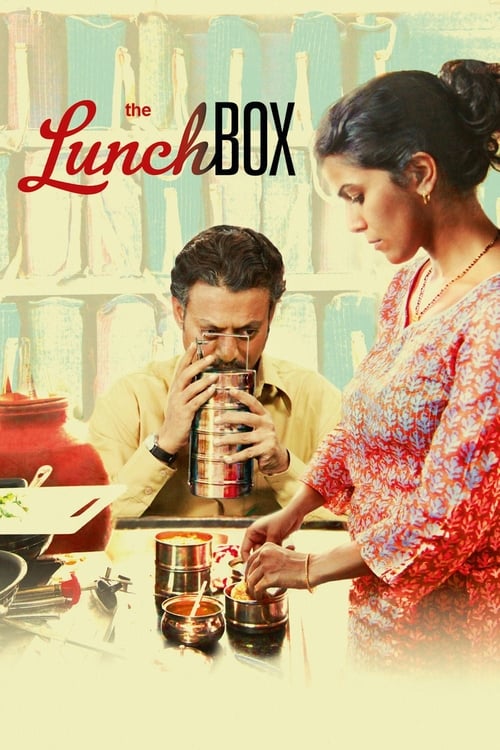
The Lunchbox
2013 · Ritesh Batra
For a gentle, grown-up evening when you want to feel a real ache of connection — romance for people who find meet-cutes false and letters true. Comfort viewing with a melancholy center.
What it's about
Mumbai's dabbawallas famously almost never misdeliver a lunchbox — but one day they do, and Ila, a young housewife cooking to win back her distracted husband, finds her tiffin reaching Saajan Fernandes instead, a widowed accountant grinding toward a joyless retirement. She slips a note into the next box; he answers; and two lonely strangers build a cautious, confessional intimacy out of food and paper, one delivery at a time. The question hanging over every note is whether the fantasy can survive contact with reality.
The experience
Quiet, wry, and quietly devastating — a slow-burn romance where nobody touches and everything is felt. You lean in for two hours; the food alone will make you hungry, and the loneliness will make you want to call someone.
Performances
Irrfan Khan gives a masterclass in stillness as Saajan — a man thawing almost imperceptibly — opposite Nimrat Kaur's hopeful, wounded Ila; Nawazuddin Siddiqui brings unexpected warmth as Saajan's eager trainee.
The craft
Ritesh Batra's debut trusts absence: the two leads barely share the frame, so the romance lives in voiceover letters, close-ups of cooking, and the documentary texture of Mumbai's trains and tiffin-carriers. The city's real dabbawalla network isn't backdrop but co-author of the story.
Why it matters
One of the most internationally successful Indian films of its decade, it proved a small, spectacle-free Mumbai story could travel worldwide and announced both Batra and a new export lane for intimate Indian indies.
Snapshot
The Lunchbox is a chamber romance built almost entirely on absence: two lonely people in Mumbai fall into an epistolary intimacy after the city's near-infallible lunchbox couriers, the dabbawallas, make one of their statistically rare mistakes. Ila (Nimrat Kaur), a young housewife trying to win back a distracted husband through cooking, finds her hot tiffin delivered instead to Saajan Fernandes (Irrfan Khan), a widowed government accountant on the threshold of a joyless retirement. When she realizes the food is reaching a stranger, she slips a note into the next box, and a correspondence begins — cautious, then confessional, then dangerous to the fantasy each has built. It was the debut feature of Ritesh Batra and became one of the most internationally visible Indian films of its decade, less through spectacle than through a rigorously controlled tenderness. Its cultural footnote — the film's failure to secure India's official Academy Award submission despite strong festival momentum — became part of its story, crystallizing a debate about what kind of Indian cinema deserves to represent the country abroad.
Industry & production
The film sits at the seam between Indian independent cinema and the international art-house co-production circuit. It emerged from Batra's earlier interest in the dabbawalla system, which he had approached first as documentary material before the fictional premise took over. The production was a genuinely multinational assembly: Indian producers including Guneet Monga's Sikhya Entertainment and DAR Motion Pictures worked alongside European partners (French and German companies) and other international financiers, with India's National Film Development Corporation among the backers — a configuration typical of the "world cinema" financing model in which a modestly budgeted, culturally specific story is de-risked across several territories. For the Indian release, established figures from the Hindi industry — notably Anurag Kashyap and Karan Johar — lent presenting/promotional weight, helping a small film reach domestic audiences that art films often cannot.
Its launch platform was Cannes: the film premiered in International Critics' Week in 2013 and won that section's audience-facing Grand Rail d'Or, a result that generated the buzz on which its subsequent global distribution was built. Sony Pictures Classics handled North American release, and the film performed unusually well for a subtitled Indian drama in Western markets. The single loudest industrial episode, however, was negative: the Film Federation of India passed over The Lunchbox in favor of another title as the country's Best Foreign Language Film Oscar entry, prompting public dismay from critics and some industry figures who read the choice as a rebuke to precisely the kind of crossover film Indian cinema was often accused of failing to produce. That controversy is well documented; the internal reasoning of the selection committee is less so, and should be treated as contested rather than settled.
Technology
The Lunchbox is not a technologically ambitious film in the sense of format or effects, and that restraint is itself a choice. It was shot digitally by American cinematographer Michael Simmonds; I would not want to assert a specific camera model or capture format without the production record in front of me, and the point is in any case secondary — the film's aesthetic is defined by lens choice, available and practical light, and location shooting rather than by any headline technology. What is worth naming is the film's relationship to a real logistical technology: the dabbawalla network itself, a century-old, low-tech distribution system famous for an error rate so low it has been the subject of management-school admiration. The plot literally depends on this system's mythology of near-perfection, and the film gently interrogates it — the "mistake" is both statistically improbable and, the film implies, perhaps not a mistake at all in some larger design. In that sense the film's animating technology is analog human infrastructure, not digital cinema.
Technique
Cinematography
Simmonds shoots Mumbai as a city of interiors and thresholds. The visual grammar is built on confinement: Ila's kitchen and balcony, Saajan's office of endless ledgers and his silent apartment, the packed local trains. Framing repeatedly isolates figures within doorways, windows, and the geometry of the tiffin itself, so that the film's spaces echo the characters' enclosure. The palette leans warm and slightly desaturated, favoring the ambient greens, browns, and fluorescent whites of a working Mumbai rather than postcard color. Crucially, the two leads share almost no frames until very late; the cinematography must therefore carry a romance between people who are never composed together, which it does through parallel visual rhymes — matching gestures, food, light — that bind them across cuts.
Editing
John F. Lyons edited, and the film's structure is fundamentally an editorial achievement, because the central relationship exists only in the montage. The rhythm alternates between Ila's and Saajan's separate days, with the lunchbox and its notes acting as the hinge between them. Voice-over readings of the letters bridge the two worlds, and the cutting learns to hold on silence, on the small business of eating, cooking, and commuting, rather than rushing. The pacing is deliberately unhurried; the film trusts the accumulation of routine, and its restraint at the climax — refusing a conventional payoff — is as much an editing decision as a script one.
Mise-en-scène / staging
Food is the film's central mise-en-scène element and its primary language. The preparation, packing, transit, and consumption of meals structure nearly every scene, and the tiffin's stacked compartments become a recurring visual motif of separated-yet-connected lives. Ila's flat is staged vertically around an unseen upstairs "Auntie," a disembodied voice who dispenses recipes and life-wisdom — a staging choice that keeps a key relationship entirely offscreen, consistent with the film's fascination with presence-through-absence. Saajan's environment is staged as ossified routine — the ledgers, the balcony cigarette, the commuter train — into which the trainee Shaikh (Nawazuddin Siddiqui) intrudes as disruptive warmth.
Sound
The film's sound design foregrounds the texture of the city: train announcements, kitchen sounds, the clatter of the dabbawallas' transit, the murmur of crowds. Dialogue is sparse relative to ambient sound, and the letters are delivered in intimate voice-over that pulls the audience into a private register against the public noise. On music, the film draws on pre-existing composition — Max Richter's work is prominently associated with the film — used sparingly to underline emotional turns rather than to saturate scenes. I would flag the precise original-score credit as something I cannot confirm from memory with confidence; the dominant and most-cited musical presence is the borrowed contemporary-classical material and the city's own soundscape.
Performance
Performance is where the film's control pays off. Irrfan Khan gives one of his signature studies in interior weather — a man whose feeling registers in the smallest recalibrations of posture and gaze, his loneliness worn as habit rather than announced. Nimrat Kaur, in a breakout role, plays Ila with a delicacy that keeps her from being merely a victim of neglect; her hope and her nerve are legible even when she is alone in a kitchen. Nawazuddin Siddiqui, as the eager orphaned trainee Shaikh, supplies the film's comedy and its counter-argument about human warmth, and the interplay between his forced sociability and Khan's withdrawal is one of the picture's great pleasures. The ensemble underplays uniformly; nothing is pitched for the back row.
Narrative & dramatic mode
The dramatic mode is the epistolary romance, updated to a contemporary megacity and stripped of its usual sentimental machinery. The narrative runs on two parallel tracks joined by the exchanged notes, and its tension is not "will they meet?" so much as "should the fantasy survive contact with reality?" The film is structured around missed connection as a principle rather than an obstacle — its most quoted line concerns wrong trains sometimes taking you to the right station, a formulation that reframes error as possibility. The ending is famously withheld: the film declines to confirm whether the two ever meet, ending on movement and possibility rather than resolution. This open, elliptical mode aligns the film with an international art-cinema sensibility more than with the closure-driven storytelling of mainstream Hindi film.
Genre & cycle
Nominally a drama-romance, The Lunchbox belongs to a specific cycle of the "everyday Mumbai" film — modest in scale, attentive to ordinary working lives, and skeptical of song-and-dance spectacle. It participates in a broader early-2010s wave of Indian films that sought festival and crossover audiences with realist, character-driven material. Within the international romance genre it is a distinctly restrained entry, closer to the tradition of the unconsummated encounter than to the courtship comedy, and it deliberately withholds the genre's contractual union.
Authorship & method
Ritesh Batra directs and wrote the screenplay, and the film reads as an authored debut: its patience, its use of food and letters, and its refusal of closure are consistent authorial signatures that he carried forward. His method here grew out of research into the dabbawalla system and out of development through international screenwriting labs, a route that shaped the film's clean, translatable structure. Among collaborators, cinematographer Michael Simmonds established the confined, warm-but-unglamorous look; editor John F. Lyons built the parallel architecture on which the entire romance depends; and the borrowed contemporary-classical music (Max Richter prominently) set the emotional register. The performances of Khan, Kaur, and Siddiqui should be counted as co-authorial contributions given how much of the film lives in faces and restraint. Batra subsequently moved into English-language and international production — adapting The Sense of an Ending and directing Our Souls at Night — before returning to India for Photograph, a trajectory that confirms the crossover instincts already visible here.
Movement / national cinema
The film is best located within a lineage of Indian "middle cinema" — the humane, realist, urban storytelling associated historically with directors like Hrishikesh Mukherjee and Basu Chatterjee, who chronicled the small dramas of ordinary Mumbai and Delhi lives without the maximalism of commercial Bollywood. Simultaneously it belongs to the 2010s Indian independent scene clustered around producers and figures who cultivated a festival-facing alternative to the mainstream. Its co-production financing places it equally within the transnational world-cinema economy. It is emphatically not a "Bollywood" film in the popular Western sense — no musical numbers, no melodramatic scale — and its international reception partly rested on that distinction, for better and worse.
Era / period
Set in contemporary Mumbai, the film is a document of the early-2010s city: the commuter trains, the persistence of the dabbawalla economy amid modernization, the aspirational middle class, and the quiet erosions of urban family life. It is also suffused with a sense of period nostalgia internal to its characters — Saajan's grief locates him in a past Mumbai, and the film's melancholy is partly about a city and a way of living receding. In the arc of Indian cinema, it arrives at a moment when independent and crossover films were briefly finding both domestic footholds and global distribution, making it something of a high-water mark for that ambition.
Themes
The governing themes are loneliness and urban isolation — the paradox of solitude within a hyper-connected, overcrowded city — and the human hunger for recognition. Food operates throughout as the language of care, substituting for the words neglected spouses cannot say. Communication itself is thematized: the handwritten note as a slower, more truthful medium than daily speech; the fantasy that intimacy can be built and preserved precisely by keeping the other person unseen. The film weighs fantasy against reality, asking whether an imagined connection should ever be tested. Class, religion (a Hindu housewife and a Christian widower), age, and the marginality of figures like the orphaned Shaikh all inform its social texture. Running under everything is the motif of the "wrong train" — chance, error, and misdelivery reimagined as the mechanisms of grace.
Reception, canon & influence
Critically, The Lunchbox was widely and warmly received internationally, praised for its restraint, its performances (Irrfan Khan's especially), and its emotional intelligence; it became one of the most successful Indian art films in Western markets of its period. Its Cannes Critics' Week audience award anchored that reception. Domestically it performed strongly for its category, and the Oscar-submission controversy paradoxically raised its profile by making it a symbol of a road not taken by the Indian film establishment.
Looking backward, the film's influences are the epistolary and missed-connection romances of world cinema — the tradition running through works like Brief Encounter and the letters-across-distance stories of the Shop Around the Corner / 84 Charing Cross Road lineage — filtered through the humane realism of Indian middle cinema (Mukherjee, Chatterjee) and a broadly Iranian/international art-house ethic of understatement. Looking forward, its legacy is threefold: it helped demonstrate a viable international market for restrained Indian independent drama; it materially advanced careers, cementing Nawazuddin Siddiqui and launching Nimrat Kaur while adding to Irrfan Khan's growing global stature; and it opened an international directing path for Ritesh Batra. It is now frequently cited as a touchstone example of 2010s Indian crossover cinema — proof, for its admirers, that a small film about a lunchbox could travel further than the spectacles that were sent in its place.
Reception
A Cannes Critics' Week darling in 2013 that became one of the biggest international crossover hits Indian indie cinema has ever had — and its stature has only grown since Irrfan Khan's death in 2020, when it became the film everyone told newcomers to start with.
How The Lunchbox was received, from release to now →
How to watch The Lunchbox: what to notice on a first viewing
- Track every step the lunchbox takes, packed to eaten. Batra shows the tiffin cooked, sealed, carried by hand and train, and opened again, its stacked compartments holding separate lives close but apart. The ritual repeats all through the film. Food becomes the language these two use instead of speech, care sent through the city rather than said out loud.
- Notice Ila and Saajan never share a frame together. Simmonds keeps the two leads in separate rooms, doorways, and trains, cutting between matching gestures, food, and light instead of composing them side by side. The romance is built entirely by the editing rhythm, not by two bodies occupying the same space.
- Listen for the letters read aloud in voice-over. Against train announcements, kitchen clatter, and crowd noise, the notes arrive as a private, intimate register that cuts through the public soundscape of Mumbai. The voice-over marks the letters as the one place these two people are actually heard.
- Watch for the voice from Ila's unseen upstairs Auntie. Ila's flat is staged vertically around a neighbor who is heard constantly, dispensing recipes and advice, but is never once shown on screen. A relationship that matters can exist entirely through presence without a body, which is exactly how the central romance works too.
- Watch Saajan's posture at his office ledgers. Irrfan Khan plays loneliness as habit, not announcement, small recalibrations in how he sits, cigarettes on the balcony, before trainee Shaikh's forced warmth starts to shift him. You read a life of withdrawal off his body language long before anything is explained in words.
The whole guide to watching The Lunchbox, with the keys for a rewatch →
Influences: the films it descends from and the films it influenced
- The Shop Around the Corner (1940) — Supplies the core structural engine: two strangers fall in love through anonymous written notes without knowing who is on the other end, the device The Lunchbox transposes into misdelivered tiffin letters.
- Brief Encounter (1945) — Model for the restrained, never-consummated middle-class romance narrated in hushed first-person voiceover laid over drab everyday settings, and for the emotionally withheld non-resolution.
- The Apartment (1960) — Pioneers the lonely office drone adrift in an impersonal metropolis whose tenderness is expressed through small domestic acts (cooking, workplace kindness) rather than declaration — the urban-loneliness register Batra inherits.
- 84 Charing Cross Road (1987) — Sustains an entire two-decade romance out of exchanged letters between two people who never once share a frame, proving the correspondence-as-relationship structure can carry a feature without the couple meeting.
- Rajnigandha (1974) — Founding text of Indian 'middle cinema' realism — unstarry Bombay middle-class protagonists, ambient street texture, low-key emotional stakes — the exact tradition The Lunchbox revives and exports.
- Anand (1971) — Establishes the humane middle-cinema register between Bollywood song-spectacle and austere art film, where feeling is carried by understated performance and faces, as Irrfan Khan's is here.
- Tampopo (1985) — Codifies food-as-language cinema, treating the preparation and sharing of a meal as the erotic and emotional channel through which characters communicate what they cannot say aloud.
- Eat Drink Man Woman (1994) — Films cooking with fetishistic tactility as the vehicle for unspoken longing and familial love, the food-as-language grammar The Lunchbox routes through Ila's daily tiffin.
- Through the Olive Trees (1994) — Embodies the Iranian art-house ethic of understatement and the courage to withhold the ending, resolving a courtship on an ambiguous, unreadable long-shot rather than closure.
- In the Mood for Love (2000) — Builds a never-consummated romance out of presence-through-absence, cramped confined framing, repeated visual rhymes, and a single borrowed classical cue used as recurring emotional refrain — all techniques The Lunchbox echoes.
- Lost in Translation (2003) — Two lonely strangers form a fragile, restrained bond inside an alienating megacity built from ambient sound, with an ending deliberately withheld from the audience.
- Udaan (2010) — The mid-budget, restrained-naturalist, festival-facing Indian independent whose viability Udaan helped legitimize — quiet observational tempo and drained realism over commercial spectacle.
- Masaan (2015) — Extends the 2010s Indian crossover template The Lunchbox made bankable — interwoven parallel storylines, understated performance, Cannes-facing restraint — replacing spectacle with quiet realism.
- Is Love Enough? Sir (2018) — Directly reprises the template: a class-divided, restrained Mumbai romance between a domestic worker and her employer in which cooking and domestic labor become the language of affection.
- Photograph (2019) — Batra's own return to Mumbai reasserts his authorial signatures — cross-class quiet courtship, unhurried pacing, interior restraint, and presence-through-absence — first assembled in The Lunchbox.
- The Sense of an Ending (2017) — Carries Batra's withheld-information and memory-through-restraint method into English-language literary adaptation, confirming the crossover instincts already visible in the seed film.
- You've Got Mail (1998) — Sibling node on the Shop Around the Corner line, updating the anonymous-correspondents device to modern written messages between two people unaware they already know each other.
- Her (2013) — Contemporary companion piece on mediated, disembodied intimacy and urban loneliness, shot in the same warm-but-desaturated palette, staging love that lives in voice and text rather than shared physical space.
- Arrival (2016) — Needle-drops the very same Max Richter cue, 'On the Nature of Daylight,' as its emotional signature, sharing The Lunchbox's practice of borrowing contemporary-classical music to set the register.
- Ship of Theseus (2012) — Parallel proof-of-concept for the early-2010s Indian indie: naturalistic, restrained-sound urban realism made independently and validated on the international festival circuit, demonstrating the same demonstration effect.
Similar films
- Masaan (2015) — influence & lineage
- Eat Drink Man Woman (1994) — influence & lineage
- Bajrangi Bhaijaan (2015) — shared sensibility
- Lost Ladies (2024) — shared sensibility
- Dilwale Dulhania Le Jayenge (1995) — shared sensibility
- Jab We Met (2007) — shared sensibility
- Like Stars on Earth (2007) — shared sensibility
- Homebound (2025) — shared sensibility